


1. Background
Human resources regulation is an important issue for policy makers. In the health systems, the policy makers are able to control the supply of health professionals by changing the admission of students in medical universities but in other sectors there are no controls in supply of skilled labor force and it is set by supply and demand equilibrium. However, there are some regulations in the labor supply, but the human resource policy makers do not have enough power to control the whole sector (1, 2). In Iran’s health system, the ministry of health is the administrator of both health and medical education; therefore, the health policymakers are able to control both supply and demand side for health professionals.
The number of physicians in labor market depends on the number of graduated medical students (3). While money is spent for these students to make them skillful, after graduation a large percent of them does not enter the health system and goes to other sectors or becomes inactive. All of these may lead to physician shortage (4). In a health education system like Iran, the government is also responsible for paying the cost of training for medical students. It is also important to find how many of these students leave the health system and go to other sectors.
Another important issue in physician labor supply is the equilibrium between male and female labor supply. The proportion of female physicians has increased in developed countries in the last decades (2). This means that not only the gap between male and female physician supply becomes smaller, but also this change leads to new consequences too. For example, some evidence from Canada and Australia showed that female physicians are less like to work in rural areas and they also want to retire earlier compared to male physicians (5, 6). Other studies show that female physicians work less than male ones (7).
The age of starting work and the age of retirement are other important issues in physician labor market. Because of the nature of professional works, finding work for graduated medical students are more difficult than other ones. Therefore, the age of entering physicians into the labor market is higher than other sectors. Unlike other sectors, physicians retire themselves later and some of them work until disability or death. Studies showed that instead of retirement, physicians decrease their work time at elderly (1, 7).
2. Objectives
This study aimed to determine the factors, which affected physician labor supply in Iran. We focused on the presence and absence of medical graduated students in the labor market. We investigated the changes in labor supply among different age groups and the differences in male and female physician labor supply. In addition, an unemployment rate among physicians was calculated.
3. Patients and Methods
We did not use any sampling method in this study. We used the available data of the Iranian statistical center. In this study, Iran’s population and census data in 2011were used (8). All of the people with Medical Degree (MD) were separated. At least 756 data were available. The data were blinded and each person had an identification number. The researchers did not access to persons' name; so, there were no ethical considerations. Because of using all available data (2% of population and census data for all of the population of Iran), no sample size calculations were used. These data were presented by Iran Statistical Center using the clustered sampling with the Statistical Analysis System (SAS) software.
To estimate the factors that affect physician labor supply, the articles that had been done in this field were considered (3, 5). With studying the literature, we found the most important factors that affect physician labor supply. At the end, in consideration with the availability of data, we used the model below (Equation 1):
Equation 1.

Where Lfp is physician labor supply. 0: when the graduated student do not go to work; 1: when the graduated student goes to work; β1: constant term of the model; edu is whether the person is going to university or not. If the person continued to higher levels of education, the value of this variable would be 1, otherwise 0; urb is living in urban regions. If the person lived in urban regions, the value of this variable would be 1, otherwise 0; age: is the age of the person, starting from 24 years old, there were not any physician graduated student under 24 years old; mar: is the marriage status of the physician: 0: when the person has not been married, 1: the person is married, 2: the person is divorced or widowed (5, 9); β2 to β5 are the coefficients of each variable.
We used logistic regression for estimating the model. The likelihood ratio and goodness of fit test were also calculated in this study. Stata software was used to estimate the model and descriptive statistics.
Based on the definition, the unemployment rate had also been calculated in this study. This rate was divided by gender too (10). To estimate the effects of aging on labor force supply, concentration curves were used. Three curves were used for this propose. The categorical variable in these curves was the people’s age and the outcome variable (the variable which is examined) was labor supply, which is a dummy one. As declared in Kakwani et al. we could use a dummy variable as the outcome variable (11).
4. Results
4.1. The Results of Descriptive Statistics
Table 1 shows the results of the type of the work which each physician was doing. The frequency of each work and its proportion from all working physicians were also shown. The stared variables contain ones which related to the education of the physician. As noted in the Table 1, from 466 working physicians, 295 ones (63%) had works which were related to their study. The category of the work was based on International Standard Classification of Occupations (ISCO 2007) and was categorized into 10 subgroups. From 756 physicians, 466 ones were working; therefore, the labor force participation rate of physicians was 61.6% in Iran. Table 2 shows the results of labor force participation by gender. As shown in the Table 2, the male physician labor supply is 72.3% while the female physician labor supply is 50.5%. It means that, male physicians are more in the labor market than female ones. To show the effects of ageing on labor supply graphically we used a concentration curve. Age was the categorical variable and presence or absence in labor market was the outcome variable. It is important to know that due to the high proportion of young physicians, the median of the data was at the age of 32 and in the last quintile the range of ages was wide from 42 to 95 years old. As shown in the Figure 1, in the ageing quintiles of 0 to 0.8, the labor force participation rate is lower than the 45 degree line. However, in the last quintile the labor supply line goes up the 45 degree line. It means that at the last quintile (physicians more than 45 years old) the labor supply is more than others.
The unemployment rate of medical graduate students was also calculated in this study. By definition, unemployment occurs when a person who is actively seeking for work is unable to find work. In the population and census survey, people are asked if they are seeking for work. From 756 data, 59 ones were seeking for work; therefore, unemployment rate for physicians in Iran was 7.8% and is lower than the overall unemployment rate (12.3% - based on the Iranian statistical center data, spring 2011) (12, 13). In the Table 2, the results are divided by gender too. The unemployment rate for male physicians is 7.29% while it is 8.3% for female physicians; however, the differences were not significant. Table 3 shows the share of physician work force in each sector. As shown in the Table 3, the public sector has the biggest share of the physicians (59%).
4.2. The Results of the Physician Labor Supply Model
In the binary logistic models, the estimator uses a maximum likelihood technique to estimate the effects of explanatory variables on dependent variables. In the maximum likelihood (ML) approach, the interpretation of the effects of each variable on another is not the same as the least square technique. In ML approach, we are dealing with the proportions in determination of the effect of each variable on another (14). Table 4 shows the results of logistic regression. As shown in the Table 4, age has a significant positive relationship with physician labor supply (OR above one). To avoid using categorical age data and to see the changes of age effects on labor supply, we used the square of age as another variable, which showed that the effect of age in the labor supply had a diminishing rate. Being male has a positive effect on labor supply. The marriage status was categorized into 3 subgroups: 0) Not married yet 1) Married 2) Divorced or widowed. As shown in the Table 4, the odds ratio of “married” is significant and more than one and means that a married physician goes to work 1.496 times more than an unmarried physician. For divorced and widowed person, despite having a positive effect (more than one odds ratio), the null hypothesis of the coefficient was zero that could not be rejected in 5%; therefore, there was no relationship between being divorced or widowed and the proportion of going to work. Another variable we used in the model was education. It was used for the person who continues to educate at the higher level of medical science in the universities, like specialty, PhD. As shown in the Table 4, the odds ratio of the variable was under one. This relationship was significant too. There was no significant relationship between living in urban regions and the proportion of going to work. Similar to divorced variable, the null hypothesis of being 0 could not be rejected for urbanization.
The Pseudo R2 for the model was 0.1985. Also, the χ2 statistics of a likelihood ratio (LR) test was 0.000 with the LR statistics of 228.38. The null hypothesis of this test indicates that all of the coefficients in the whole model are 0. The null hypothesis was rejected in the model; therefore, it can be concluded that at least one of the variables was not 0.
Table 1. Descriptive Statistics, Physicians and Type of the Work Done, Based on ISCO 2007 a
| Work | No. (%) |
|---|---|
| Armed force physicians b | 21 (4.5) |
| Medical doctors b | 159 (34.1) |
| Health associate professors b | 115 (24.6) |
| Other professors | 26 (5.5) |
| Managers | 51 (10.9) |
| Clerical support workers | 14 (3) |
| Skilled agricultural, forestry, fishery workers | 17 (3.6) |
| Craft and related trades workers | 13 (2.8) |
| Plant, machine operators, assemblers | 11 (2.3) |
| Service and sales workers | 30 (6.4) |
| Elementary occupations | 9 (1.9) |
| Total | 466 (100) |
a Abbreviations: ISCO, international standard classification of occupations.
b Work related to medical education.
Table 2. Descriptive Statistics, Physician Participation Rate and Unemployment Rate by Gender in Iran a
| Variabels | Male | Female | Total | t | P Value |
|---|---|---|---|---|---|
| Participation rate | -6.3328 | 0.000 | |||
| Working | 278 (72.3) | 188 (50.5) | 466 (61.6) | ||
| Not working | 106 ( 27.6) | 184 (49.4) | 290 (38.3) | ||
| Total | 384 (100) | 372 (100) | 756 (100) | ||
| Unemployment rate | 0.5355 | 0.5801 | |||
| Seeking work | 28 (7.29 ) | 31 (8.3) | 59 (7.8 ) | ||
| Not seeking work | 356 (92.7) | 341 (91.6) | 697 (92.1) | ||
| Total | 384 (100) | 372 (100) | 756 (100) |
a Data are presented as No. (%).
Table 3. Public-Private Share of the Physicians in Iran
| Variables | No. (%) |
|---|---|
| Public sector | 263 (59.7) |
| Private sector | 103 (23.3) |
| Independent and others | 76 (17.2) |
| Variables | OR | Coefficient | SE | P Value | OR Confidence Interval (95%) | |
|---|---|---|---|---|---|---|
| Lower Limit | Upper Limit | |||||
| Age | 1.3644 | 0.3107 | 0.0549 | 0.000 | 1.225043 | 1.51971 |
| Age 2 | 0.99615 | -0.0038 | 0.0006 | 0.000 | 0.9948 | 0.997457 |
| Male | 2.7448 | 1.009 | 0.1741 | 0.000 | 1.95125 | 3.86115 |
| Married | 1.4963 | 0.4030 | 0.1899 | 0.034 | 1.03117 | 2.17134 |
| Divorce | 1.1000 | 0.0953 | 0.5959 | 0.873 | 0.34212 | 3.53724 |
| Education | 0.2772 | -1.2827 | 0.1894 | 0.000 | 0.19128 | 0.40194 |
| Urban | 0.65684 | -0.4203 | 0.3533 | 0.234 | 0.3286 | 1.3128 |
| Constant | -5.2474 | 1.0403 | 0.000 | |||
a Abbreviations: SE, standard error.
bPseudo R2 = 0.1354
c Likelihood Ratio = 136.21
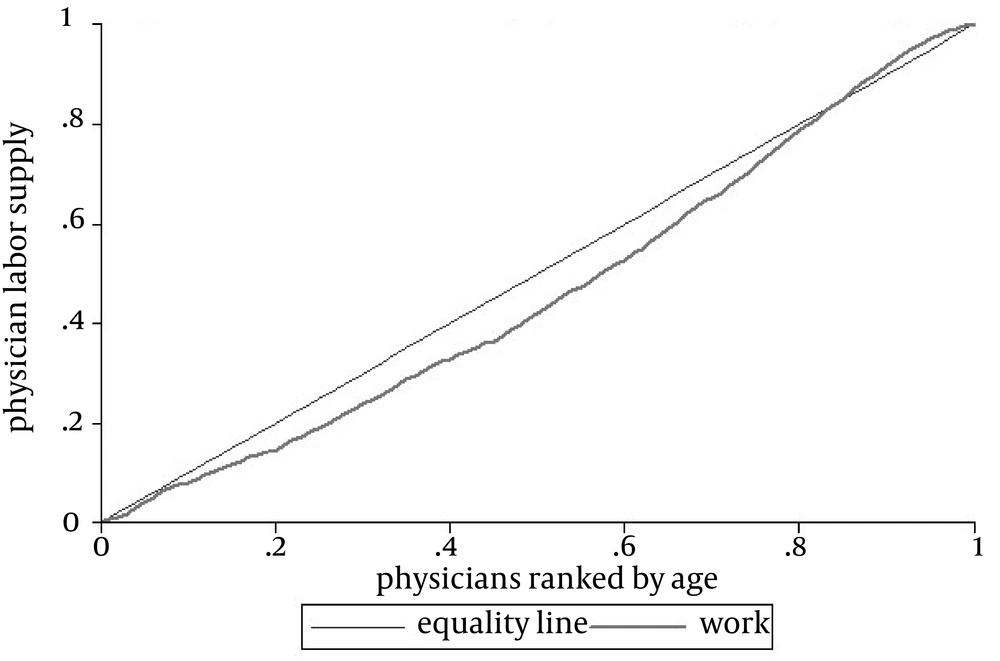
Figure 1.
Concentration Curve of Physician Labor Supply Ranked by Age
5. Discussion
The physician labor force participation rate was calculated 61.6% in Iran. It is higher than the overall labor participation rate in this country (49%). It was predictable, because in professional jobs which needs high levels of education, the labor participation is higher than simpler ones (15). Educating in medical science needs lots of time and it is 7 years in Iran. The educated student, after this long time of studying does not like to lose the labor market and enter to it. Medical training is costly and after this costly investment if the person not to decide to work, it is not cost effective for both government and the person (16, 17). The 61.6% labor participation rate shows that still a lot of the physicians against the costly investment of their time and money, do not work. Form physicians entered the labor market, 63% have jobs associated with their works and 39% have not. Williams et al. in their study found that job stress and stratification may result in changing the job in physicians (18). Job changes impose high costs to governments especially in Iran, where the medical education is free. Similar results were expressed by Pathman et al. in a study done in 2002 (19).
In this study, a physician unemployment rate was defined as the number of people with physician certificate which seeking work to all of people with physician certificate. As said later, the unemployment rate of physicians is lower than the overall unemployment in Iran. Similar to Iran, a survey in the United States showed that medical doctors had one of the lowest unemployment rates in job groups in 2011 (20). Similar findings was published in United Kingdom in 2013 too (21). In some countries there are shortages in the medical doctors too. The low unemployment and shortage of physicians are justified by the difficulties of entrance to medical schools and the low capacity of medical schools (4, 22). It is important to note that there are major differences between labor force participation and unemployment rate and they are not contradictory to each other. Labor force participation is a supply side indicator, while unemployment rate is a demand side one. Unemployment rate shows the power of economy to absorb labor force (23). The share of a public sector from physician labor force is more than others. An important issue in physician labor supply is the transfer of physicians from a public to private sector. Yuji in Japan found that more physicians decided to transfer to a private sector in recent years (3). In addition, for maximizing the income, physicians desire to work at both a public and private sector (24).
In the regression model, ageing has a positive relationship with physician labor supply. This means that by increasing the age, the percentage of working will increase. This relationship has a diminishing rate because of retirement. The entrance age of physicians in labor market is higher than other jobs. This is because the long period of education. Also, the retirement age of physicians is higher than other jobs. The high income of physicians gives them enough attitudes to continue working. In addition, their work is not so physical that need high level of physical ability. Therefore, in old ages, physicians can continue their works. Similar results were found by Johannessen et al. in a study done in Norway in 2012. They found a positive relationship between increasing age and labor supply with a diminishing rate. The dependent variable of their study was hours of work (5). Sex also had relationship with labor supply of physicians. If the physician was male, the percentage of working was increased. Similar to our study, Johannsson et al. found that the hours of work in female physicians are lower than male ones. These difference is contributed to the child boring and maternity leaves of women (5). In addition, evidence showed that in a country like Iran female physicians prefer stay at home to work in deprived regions (25) similar to Vujicic findings in Philippines in 2011 (9). In this study, being married had a positive relationship with the proportion of working. Using macroeconomics panel estimator of a Generalized Method of Movements (GMM), Baltagi et al. found that the relationship between marriage and labor supply is positive but not significant (26). Wang et al. in a study done in Canada found the hours of work will decrease by marriage for both male and female physicians (6), as well as Johannessen study (5). Attendance to university for higher degrees of medical sciences had a negative relationship with labor supply. Obviously, labor and attendance to college are displaced to each other (27, 28). This study had limitations. Income was an important variable, which affects the labor participation. Data of income were not available. In addition, this was a cross-sectional study and we could not investigate the trend.
The results of this study showed that the unemployment in physicians was lower than other sectors. Moreover, a participation rate of female physicians was less than male ones. We found that there was inequality in labor supply between male and females. Government must use strategies to improve gender inequality in physician labor supply. These results are important for policy makers and can alert them about what happens to physicians and give evidences about changing their decisions everywhere it is needed. There is a large gap in the science about the physician behaviors, especially in Iran. For future studies, inequalities in physician’s income and gender inequality in physician distribution are suggested.


