


1. Administrative Events
The 1st national seminar on Media and Health opened on Thursday 7 August 2014 at Velayat Convention Center, Shiraz University of Medical Sciences, Shiraz, Iran. The Seminar was organized and hosted by Health Policy Research Center (HPRC) in cooperation with Shiraz University of Medical Sciences, United Nations International Children's Emergency Fund (UNICEF) and the Islamic Educational, Scientific and Cultural Organization (ISESCO) offices in Iran. The meeting was held around the world Day of reporters and attended by more than 150 authorities, researchers, representatives and specialists from universities, and also reporters from news agencies and centers related to Media and Health domains from nearly all parts of Iran. This gathering, for the first time in Iran, created a great opportunity for Media and Health experts to discuss and exchange their knowledge, experiences and recommendations about a wide range of disciplines around five themes of Health literacy, self-care, demand - organization, orientation of communities about their rights and social responsibilities and supervision by people. Ten members of the administrative committee arranged the activities of the meeting according to a pre-planned schedule.
2. Scientific Events
Ayatollah Khamenei, supreme leader of Iran, in the 11th article of his recommended health policies, emphasized on increasing knowledge , taking responsibility and empowerment of community to provide, maintain and promote health by means of capacities of cultural and educational organizations and also media under supervision of the ministry of health, treatment and medical training. He also highlighted the importance of increasing the knowledge of people regarding their rights and social responsibilities in the article 1-2 of this communique.
Twenty lecturers (two from UNICEF and ISESCO, 14 from universities and four from media) were invited for speeches. One-hundred ten abstracts were sent to seminar secretariat, out of which 55 were accepted for presentations as posters and seven as oral lectures. The meeting was divided in two parts of morning and afternoon sessions (Figures 1-2). Themes of the seminar were: Health literacy, self-care, demand-organization, orientation of communities about their rights - social responsibilities and supervision by people that were discussed by lecturers through following subheadings.
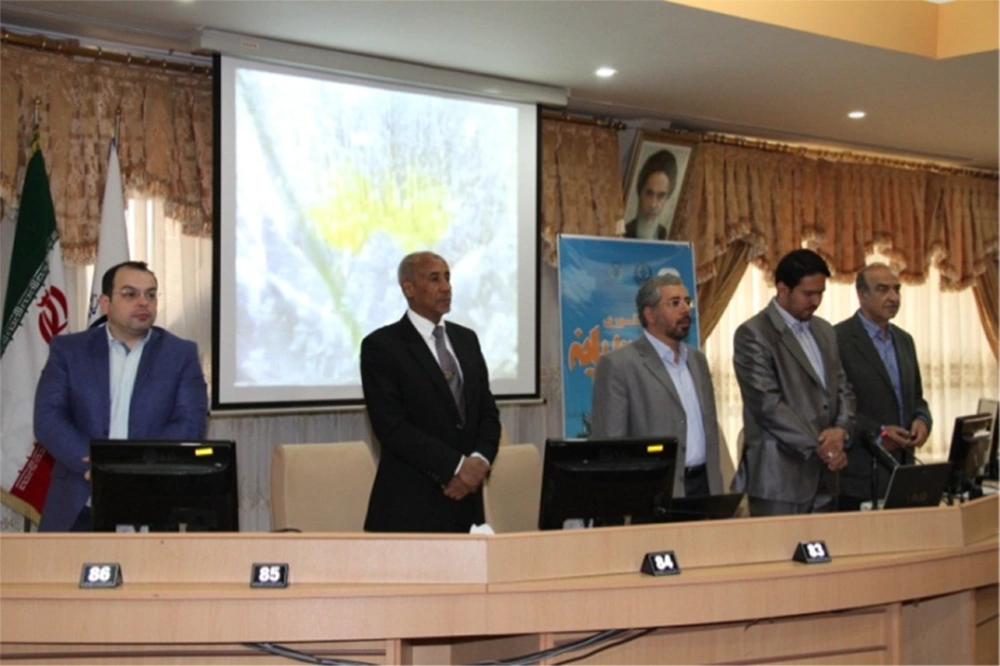
Figure 1.
From right to left: Dr A.Sadri (General director of the ISESCO in Iran), Mr Omodvari (Guest and reader of Koran from Shiraz University of Medical Sciences), Professor Lankarani (president of the seminar), Dr Mohamed Elmunir Safieldin (UNICEF Representative in Iran), Mr. Yarparvar (Guest and translator from UNICEF office in Iran)
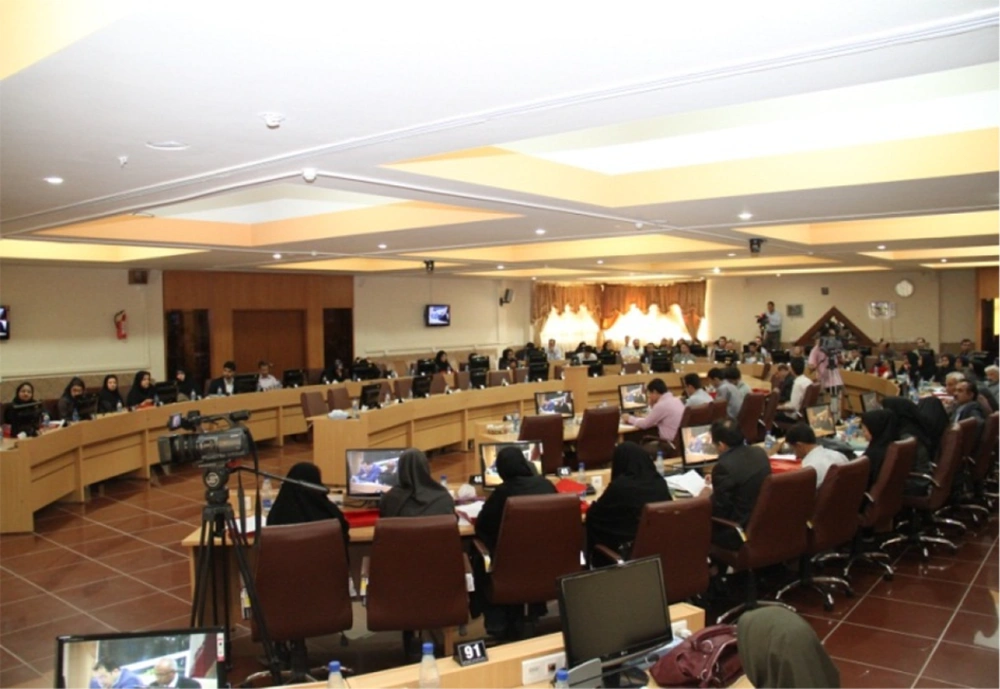
Figure 2.
Iran’s National Seminar of Health and Media hosted by Health Policy Research Center (HPRC) at Velayat convention center, Shiraz University of Medical Sciences, 7th August, 2014.
3. Complexities in the Health and Media
Professor Lankarani, Head of Health policy research center and president of Media and Health Seminar was the 1st lecturer of the opening ceremony. At first, he reviewed the themes and gave a report about this seminar for audiences. Professor Lankarani’s main discussion was on complexities in health and media. He declared that media not only have the role of transferring information, but also their importance and influence on changing the attitude of community towards having a healthy life style is more remarkable. Dr Lankarani believed that media and health are in interaction to each other and media should not be regarded as public relations of organizations. He emphasized that media have a dual role; in reflection of progresses and positive points and also in showing shortages and weaknesses through advocacy of changing of behaviors, promotion of policies and feeling of ownership in health promotion programs. Another aspect that was stressed by the president of the seminar was recent analysis about media limitations on transferring health news. Different and sometimes contradictory messages that are broadcasted by media may result in permanent mis-information or wrong attitudes of community. Production of new news, tendency toward being different from other media, financial and even political objectives may be involved in this crisis. In summary, (healthy) media has two main responsibilities: one in health promotion and the other to combat induced demands by advertisers of harmful products. These aspects of health and media complexities should be taken into account more precisely by authorities, researchers, policy-makers, managers and actives in media and health domains (1-3).
4. Role of Media, Information Communication Technology and Art in the Health of the Communities
The 2nd lecturer of the opening ceremony was Dr Mohamed Elmunir Safieldin, UNICEF Representative in Iran, whose speech was about Media and Health. He addressed the importance of media and health as two important topics and discussions in our daily life; at home, at schools, in academic circles, and in public policy. Dr Safieldin remarked that prevention of communicable and non-communicable diseases requires correct and easy to digest information by people of different age groups through accessible, user friendly and stimulating methods. He also announced that information communication technology (ICT) made media a powerful tool in transforming individuals and communities. Dr Safieldin highlighted the need for an effective partnership between media and health to ensure the highest standards of health well-being for every individual and community. However, to achieve these targets, purposeful engagement between media and health and avoiding the promotion of harmful products or behaviors that can affect people’s health (such as the promotion of tobacco, alcohol, junk food, and environmentally harmful products) through conscious dialogues between media and health decision-makers are necessary. UNICEF Representative in Iran believes that Media and Health stakeholders should clarify their shared visions and objectives by means of forward-feeding and feedback model via receiving feedbacks from customers and putting this feedback forward to the health parts. Dr Safieldin recommended incorporation of lessons-learned in future engagements and one-line validation” that will allow the public to judge the extent to which health related information they are taking from the non-professional sources of their choice are validated or not.
Dr Moosavi Khatat, PhD candidate of Iran University of Social Welfare and Rehabilitation Sciences, was another lecturer. His lecture was about WEB 2.0, a new technology in health communications. He reasoned that social networks and web 2 based technologies are not a mode, but are evoked from new communities. He believed that technology should be regarded as a tool and not a strategy.
Dr Shadnoosh, president of Semnan University of Medical Sciences, outlined the role of art and media in health promotion by culture-building, education, communication and social mobilization. He presented a brief report about two experiences in art and cultural festival on health in Semnan province.
5. Health-Media Literacy and Health Management Cycle
Dr Abbas Sadri, Director General of the Islamic Educational, Scientific and Cultural Organization (ISESCO) office in Tehran, Iran, presented his speech at the opening ceremony about the crucial role of Media in health management cycle and on achieving preventive health care goals. He believed that through transaction and creating links between people, Media and authorities and establishing effective and efficient communication by media and management of media literate people could have access to health information. Dr Sadri’s suggestions were: developing a university graduate discipline in some universities to train Health Media literacy specialist (as chief medical correspondent), to develop health dialog among people (with supporting the Media) and to consider the role of Media in preventing non-communicable diseases (as operational strategies in Health department).
6. Health and Life Style and Role of Women
Dr Homayoon, faculty member of Emam Sadegh University, talked about health and life style. His speech items were about social participation in civilization and science, religious democracy, conflicts between population versus expert training policies, profits mission and relationship between body, soul and healthy mind. Public knowledge has an influence on culture and life style and the role of family and especially women on health was also explained by Dr Homayoon.
7. Media and Its Role on Health Promotion Interventions
Dr Rakhshani, faculty member of Shahid Beheshti University of medical sciences, had a presentation on media and its role on health promotion interventions. She believed that media has an educative, advocational, promotional and complementary role in health behaviors. She also explained about the influence of media on four levels of audience-based health promotion activities, including: individual, network, organization and social levels. She stated that the effect of media on individual and social levels are more remarkable compared to other levels and this effect on health behaviors is magnified when combined with other interventions.
8. Media and People’s Rights and Social responsibilities
Role of Media in increasing the knowledge of people about their rights and social responsibilities was discussed by Dr Zafarghandi, psychologist and faculty member of School of Behavioral Sciences and Mental Health. He emphasized the importance of pulpits and schools as strong media to change ideas and values of general and special audiences. He also explained about the impacts of media on mental health and de-stigmatization.
9. Media and Health of School-Age Children
Dr Kavari from Iran University of Social Welfare and Rehabilitation Sciences, talked about role of media in improvement of health literacy of school-age children. He addressed the implications of Health literacy on health promotion, health protection, disease prevention and screening, care and maintenance, access to care and navigation of systems. The effects of low health literacy denoted by him include: poor health outcome, under-utilization of prevention services, over-utilization of emergency services, unnecessary healthcare expenditures, limited treatment effectiveness and needless patient suffering. “Improving the health literacy of school-going children will empower them to: make the right decisions in their adult years, reduce their chances of contracting diseases and reduce the need for hospitalization,” stated Dr Kavari. He also reported the experience of Singapore in increasing health literacy in schools. In Singapore, 85% of 10 to 14 year old children use computer and their computer usage are mainly for communication (78%) and for getting information (67%). Penetration rate of mobile in this country is 106.8%. He concluded that traditional and new media can be used both directly and subtly to influence school children's behavior and cognitive thinking on health issues and in this important stage in their lives, when their identities are being shaped, they are still receptive to learning healthy lifestyle practices. Dr Kavari believes that Media and new communication technologies can be used to complement the existing health education strategies in schools while repeated reinforcement of health messages through different channels can increase the rate of recall and awareness among school-going children. Through this way they are more likely to put into practice what they have learnt.
10. Good Experiences, Challenges and Suggestions about Media and Health in Iran
Dr Papi, head of health education department and faculty member of Isfahan university of medical sciences, stressed on quality analysis of health literacy and media literacy for presentation of a model on ”media and health” in Iran. He addressed a three dimensional model that consists of text, audience and production. The result will be that audiences have active and dynamic roles, not a passive role in approach to media. “Iran’s Islamic parliament research center warned against non-satisfactory media-literacy in Iran and remarked media literacy as a new approach” Dr Papi reported this and suggested establishing a framework (with object of critical-thinking) by policy makers, producing media and health literature in Iran, translating western texts to achieve a comparative study and including concept of media and health literacy in the curriculum of universities, using cinema to transfer concepts to people, revision of supervision-roles on media and education of health literacy to people through television programs.
Dr Saheb, head of social and family group of Iran Health TV network, was the next presenter whose speech was on the role of media in health promotion and solving current challenges. He put an emphasis on education, facilitative and ad vocative role of media towards health. Good experiences of media in Iran in promotion of polio eradication, elimination of measles and congenital rubella, social mobilization and people advocacy in Bam or Rood bar earthquake was exemplified by this lecturer. He explained that media‘s attempts should be towards revising and promoting laws and preparing administrative needs. Encouraging policymakers to be responsive and people to follow their rights were another role of media in health promotion. Dr Saheb believed that these impacts are mainly neglected in our country and production of Health programs by media may have a dual impact; therefore it needs evidence-based designing, pilot study, monitoring and evaluation. He said that lack of monitoring and evaluation in health fields of media, lack of quality and quantity of community-based evidences, insufficient social research centers or their lack of coordination with health program producers, inappropriate attitude of health managers and policymakers regarding media and insufficient knowledge of health managers about processes of production of effective programs are among the main challenges in health related media in our country.
Afshin Shaeri (Head of Fars news agency health group) as the last lecturer of the morning session, talked about challenges of Iran’s health system, such as problems in insurance system and resource management. He emphasized the role of media in transferring information (especially in disasters), promoting self-care and improving the population’s health literacy, supervision on managers, creating happiness in community, sensitization of managers toward social and economic factors and health-based advertisement. Problems such as insufficient scientific resources for education in the field of media and health, lack of educated reporters in health fields and their job, income and stress problems , limited access to information , weak data and inappropriate atmosphere of criticism are laso exist in this field. His recommendations were: producing valid academic resources in health-media fields, establishing of health-media research centers and associations, publishing seasonal journal of health-media, continuing medical education of related stakeholders and establishing health-reporting major at universities.
11. Social Media and Complementary Role of Media on the Health
Dr Kaveh, Associate professor of department of health education and promotion of Shiraz University of Medical Sciences, talked about health and media literacy. He reported that 85 percent of people in the world have internet access and the rate of growth for mobile users is 530+ Million (5% every year). Moreover, the number of social media users around the globe has reached 18% in 2013 and nearly 25 percent of people in the world now use social media. He also reported that Africa (with 129%) and Asia (76%) show the largest percentage in internet use. Dr Kaveh explained that social networking has become the most popular online activity, with Facebook claiming more than 500 million users and Twitter claiming 105 million users globally and studies show that many parents do not see their children’s media habits as a cause for concern. He stressed that among families with children aged 8 years and under, it has been a five-fold increase in ownership of tablet devices such as iPods; from 8% of all families in 2011 to 40% in 2013 and the percentage of children with access to some type of “smart” mobile device at home (e.g. smartphone, tablet) has jumped from half (52%) to three-quarters (75%) of all children in just two years. According to Dr Kaveh presentation, in September 2009, Iran had the most prevalent internet users among middle-east countries and in 2012, 53.3% of population used internet. He believed that Media is an important tool for socialization, quick transport of information, seeking people participation and provoking people enlightenment on local, national and world problems and pro-social effects. However, the challenges that have remained include: insufficient use of valid sources by media for the producing academic information, advertising of harmful behaviors or risky behaviors (such as sex, drugs, aggression), lack of precision, deficiency or conflicts in produced messages and bad presentation or negative modeling by media. Dr Kaveh marked that media literacy cannot change long-term behavior in the absence of other program elements.
Dr Sadati Kalateh, faculty member of health policy research center, gave a presentation about Public Health and Social Media; Opportunities and Challenges. He denoted that social media is a communicator platform based on the web in which many social actors can relate and communicate with each other. He believed that social media permit access for physicians to new information, enhance their professional networking efforts to express their view on health care related topics, share general, clinical or practical information and empower them to educate their patients and their community on a large scale. On the other hand the use of social media technology is an emerging trend for patients who are seeking health information. Dr Sadati stated that, social media opportunities are: feasible access to health knowledge and information, access to broad, rich, and update information, feasible relationship between providers, information exchange at a low cost and producing databases for policy-making. He also declared challenges of social media such as: reliability, social media ownership, limitation in face to face interaction, private domain, issue of patient privacy and possible abuses, potential media monopolies and inequalities in the use of social media.
12. Media and Self-Care Toward Non-Communicable Diseases
Davoud Poorsehat, head of social group of IRNA news agency, presented his lecture about media’s impact on self-care. He announced that 80% of people declare that their main source of health information is media. He said that self-care is divided into physical, psychological, social and intellectual types, and access to them needs special strategies and cooperation among different types of media.
Dr Rezazadeh, head of public relations at shiraz university of medical sciences, presented his lecture about self-care. He concluded that self-care programs achievement are: Increasing the quality of life and life satisfaction, decreasing patients’ needs to be visited (by physicians) , their admission to hospitals , their time of stay in the hospitals, decreasing drug use , decreasing absence of physicians at work place and reduction of chronic diseases cost. He suggested performing studies about self-care, training of experts in this field, organization of advocacy groups and providing qualified counseling groups in this regard.
Dr Moradi, faculty member of Ghom university of traditional medicine, stated the increasing trend of non-communicable diseases such as cardiovascular diseases, cancers, diabetes, obesity, osteoporosis, mental health, infertility and anemia. He delineated changes in life styles, non-effective educations and negative impact of industries as the main factors in these states.
13. Media-Induced Harmful Demands and Contradictory Messages
“Critical thinking and emergent media induced harms” discussed Dr Baharmnejad, clinical psychologist at Kerman University of medical sciences. He stated that media may have various and even contradictory impacts on community mental health. Media can present an effective model for reducing social crimes and promoting healthy life styles. On the other hand media may impose damages to the communities. Therefore, by providing education to audiences in the field of media literacy and critical thinking, they can protect themselves against harmful effects of media.
Mrs Akbari, MS of epidemiology in HPRC, presented some evidences about deleterious effects of media on suicidal attempts in some populations. She indicated that the way suicide is reported in the media can have a lot of effects on the people’s attempts to commit suicide.
The last speech was done by Dr Honarvar, Scientific Secretary of Media and Health Conference and Faculty member of Health Policy Research Center. He presented a review study about the role of media in changing health behavior. He stressed on mutual interaction between media and audiences, that may be positive (with shorter duration of impact) or negative (with longer duration of impact). He presented many examples about positive effects of media (in combination with community components) on health behaviors such as mediated health campaigns in the U.S and other countries like Uganda, Thailand, India, Nepal, Brazil and Hunduras about seat belt, oral health, smoking, alcohol, substance use, heart diseases, sexual behaviors, dietary habits, children diseases (infant diarrhea) and communicable diseases (AIDS, SARS, leprosy). Dr Honarvar, concluded that there is a very modest evidence that interventions incorporating online social networks such as facebook may be effective; however, this field of research is in its infancy. He stated that contradictory messages (such as paradoxical nutrition recommendations) result in backlash and the people’s belief that nutrition scientists keep changing their minds. Therefore, Health journalism is in serious trouble, if the intent is to provide factual information that people can use. Dr Honarvar also emphasized the importance of evaluation of cost effectiveness of health media activities through doing valid studies. According to this lecturer, empowerment of researchers, policy makers and health related media to Knowledge translation concepts and skills (for transferring health findings and messages in an effective and proper way to each other and to the people) will certainly strengthen the positive impacts of media on health literacy and healthy behavior of people (4). Therefore, Knowledge translation incorporation with communication strategies should be regarded in academic and administrative fields of media and health.
14. Social Events
Some participants of the seminar, who were mainly from news agencies attended in a recreational tour that was arranged by HPRC in the day prior to conference day. They visited Sheh-E-Cheragh the holly religious shrine, Eram garden and vakil Bazar. All reporters who attended the conference arranged on-site interviews with the president of conference (Figure 3) and other lecturers.
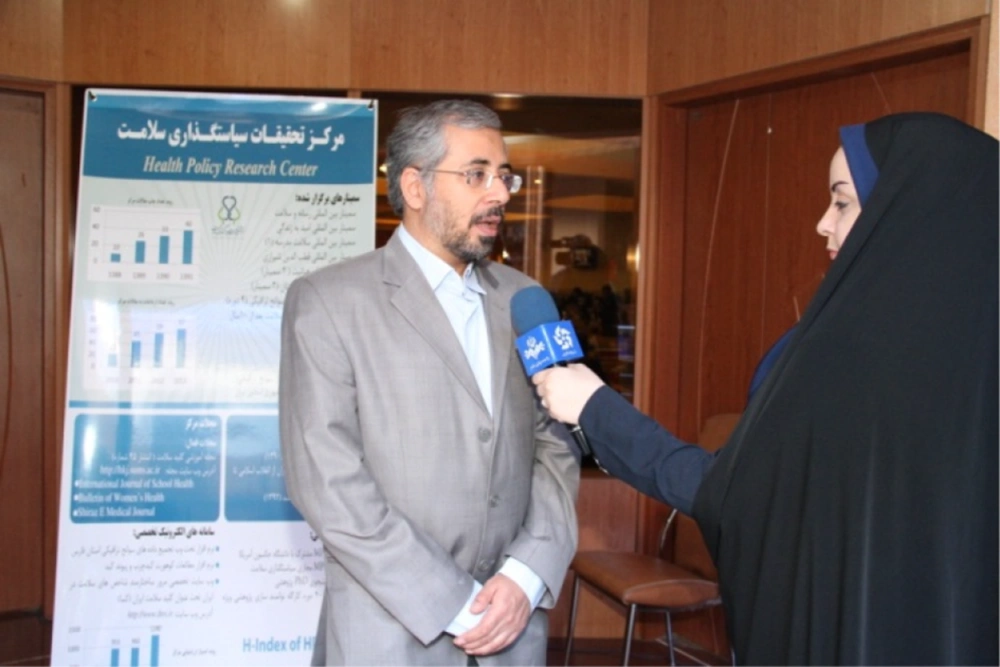
Figure 3.
Interview with Professor Lankarani, president of seminar, in the verge of Media-Health seminar


