


1. Background
1.1. Thalassemia Control Program in Iran
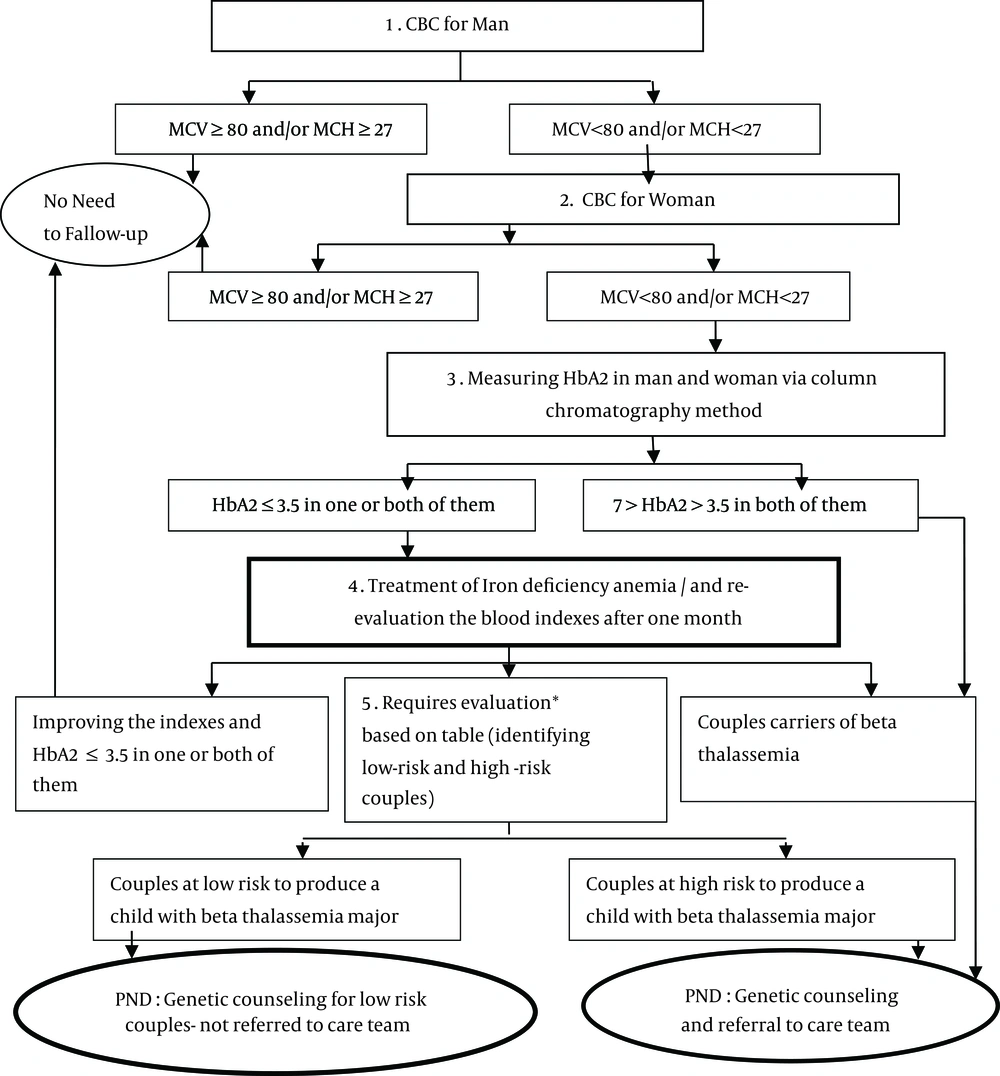
Guideline for the Laboratory Testing and Diagnosis of Thalassemia Carriers. * The blood indexes and further investigations, e g, Hb and Hct changes and Hb F; Adapted from: chronic disease program in Iran: thalassemia control program (19).
2. Objectives
3. Methods
3.1. Trial Design
3.2. Study Setting
3.3. Subjects
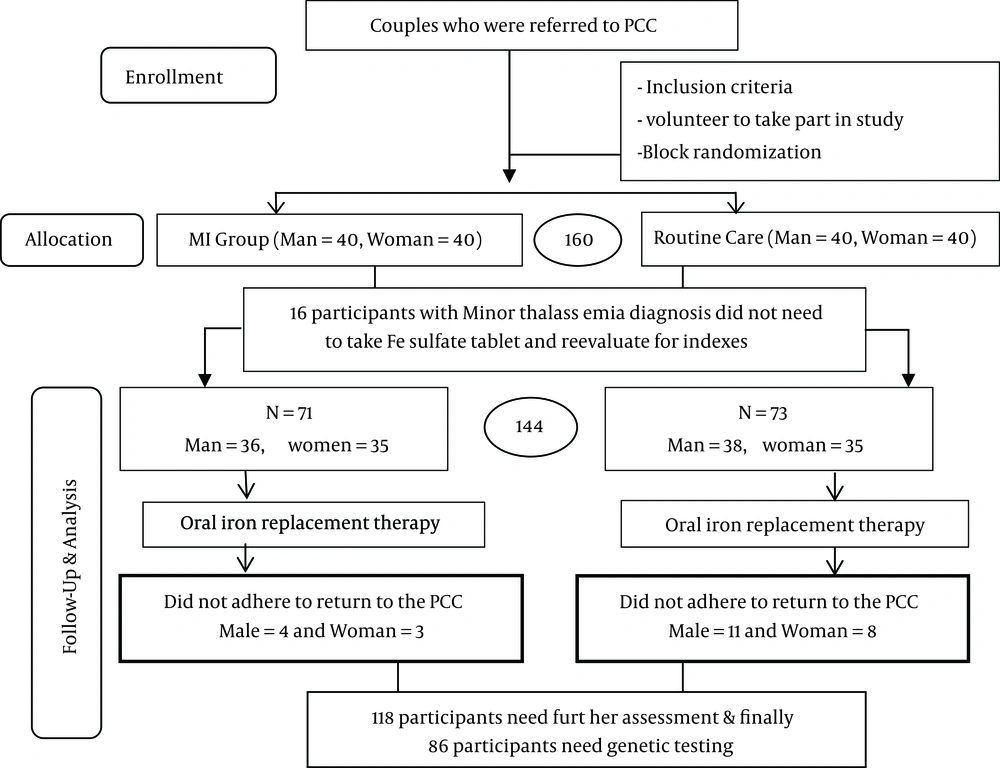
Flow Diagram of Study Participants
3.4. Sample Size
3.5. Randomization and Blinding
3.6. Interventions
3.6.1. Motivational Interviewing
| Sessions | Educational Concept |
|---|---|
| First | Orientation: Introduction, group norms and process; raising awareness regarding β-thalassemia; freedom practice; identifying the influence of having a baby with thalassemia on different aspects of life; change stages and practice on behavioral change; evaluation of commitment and confidence |
| Second | Feelings and pros and cons of behavioral change: Practice identifying and naming feelings; recognition of the effects of having a baby with thalassemia on family, work and social life and the feelings induced by them; assessment of short-term advantages and disadvantages of failure to comply with thalassemia screening program and early genetic counseling |
| Third | Values, perspective and conclusion: Assessment of short-term advantages and disadvantages of failure to comply with thalassemia screening program and early genetic counseling; definition of values; practice recognizing and prioritizing top life values; discussing how having a baby with thalassemia due to lack of successful screening can affect life values; determining barriers to thalassemia screening and the role of self-confidence in such situations; maintaining the perspective and completing the thalassemia screening program |
3.6.2. Routine Care
3.7. Outcomes
3.8. Statistics
3.9. Ethics
4. Results
| Male | P Value | Female | P Value | |||
|---|---|---|---|---|---|---|
| MI | Routine Care | MI | Routine Care | |||
| Health insurance coverage | 1 | 0.7 | ||||
| Yes | 31 (77.5) | 31 (77.5) | 33 (82.5) | 31 (77.5) | ||
| No | 9 (22.5) | 9 (22.5) | 7 (17.5) | 9 (22.5) | ||
| Ethnicity | 1 | 0.8 | ||||
| Baloch | 26 (65) | 27 (67.5) | 26 (65) | 28 (70) | ||
| Fars | 14 (35) | 13 (32.5) | 14 (35) | 12 (30) | ||
| Place of residence | 0.5 | 1 | ||||
| Town | 35 (87.5) | 32 (80) | 34 (85) | 34 | ||
| Village | 5 (12.5) | 8 (20) | 6 (15) | 6 | ||
| Education | 0.1 | 0.5 | ||||
| Primary to secondary school | 24 (60) | 19 (47.5) | 21 (52.5) | 25 (62.5) | ||
| High school diploma | 6 (15) | 13 (32.5) | 8 (20) | 8 (20) | ||
| University graduated | 10 (25) | 8 (20) | 11 (27.5) | 7 (17.5) | ||
| Occupation | 0.4 | 0.43b | ||||
| Laborer | 11 (27.5) | 7 (17.5) | - | - | ||
| State employee Self | 4 (10) | 6 (15) | 4 (16) | 1 (2.5) | ||
| Employed | 18 (45) | 23 (57.5) | 2 (5) | 2 (5) | ||
| Others | 7 (17.5) | 4 (10) | 34 (85) | 37 (92.5) | ||
| Family relationship | 0.2 | 0.2 | ||||
| Cousin | 16 (40) | 13 (32.5) | 16 (40) | 13 (32.5) | ||
| Common ancestor | 12 (30) | 19 (47.5) | 12 (30) | 19 (47.5) | ||
| No family relationship | 12 (30) | 8 (20) | 12 (30) | 8 (20) | ||
| Family history of marriage between thalassemia carriers | 0.5 | 0.5 | ||||
| Yes | 7 (17.5) | 4 (10) | 8 (20) | 4 (10) | ||
| No | 33 (82.5) | 36 (90) | 32 (80) | 36 (90) | ||
| Family history of members with β-thalassemia majorb | ||||||
| Yes | 1 (2.5) | 1 (2.5) | 1 | 4 (10) | 1 (2.5) | 0.3 |
| No | 39 (97.5) | 39 (97.5) | 36 (90) | 39 (97.5) | ||
Abbreviation: MI, motivational interviewing.
aValues are expressed as No. (%).
bBecause four cells were expected count less than five and it was not possible to integrate cells, the Monte Carlo test was used.
4.1. Compliance
| Routine Care | MI | P Value | RR (95% CI) | PF | |
|---|---|---|---|---|---|
| Refer to the PCC to re-evaluate the indexes after one month | 0.017 | 0.38% (0.17 - 0.84) | 0.62 | ||
| Yes | 54 (73.97) | 64 (90.14) | |||
| No | 19 (26.03) | 7 (9.86) | |||
| Total | 73 (100) | 71 (100) | |||
| Refer to the PND center for genetic testing after 5 monthsb | 0.05 | 0.83% (0.71 - 0.98) | 0.17 | ||
| Yes | 2 (5.26) | 10 (20.83) | |||
| No | 36 (94.74) | 38 (79.17) | |||
| Total | 38 (100) | 48 (100) |
Abbreviations: PCC, premarital counseling center; PND, prenatal diagnosis; MI, motivational interviewing.
aValues are expressed as No. (%).
bBased on the blood indexes and further investigations, couples were categorized into: no need to fallow up (14 in the routine care and 16 in the MI group), other haemoglobinopathies (two in the routine care group), and inconclusive (38 in the routine care and 48 in the MI group). Couples in the third group were referred to the PND center for genetic testing.


