




1. Background
Acinetobacter baumannii are coccobacillus gram-negative, oxidase negative, strictly aerobic, non-motile, and non-fermentative bacteria that are widely spread in soil and water and also in hospital environments and survives in these environments for a long time and is readily transmitted among patients (1). Due to the significant clinical activity of this bacteria and its ability to acquire antibiotic resistance, it is considered as one of the threatening microorganisms towards antimicrobial drugs (2). The major problem in the treatment of A. baumannii is its ability to acquire resistance to major antibiotic classes (3). Acinetobacter baumannii infections, include nosocomial infections, bacteremia, urinary tract infection, and secondary meningitis, while it has an important role in hospital pneumonia, especially pneumonia in upper respiratory tract hospitalized patients at intensive care units around the world. Acinetobacter baumannii is one of the most common isolates causing sepsis in patients with immune deficiency and is associated with increased risk of mortality (4). It is the most common species from blood, sputum, skin, urine, and pleural fluid isolates (5). Therapeutic problems caused by these bacteria and the possibility of transfer between living and non-living objects and also long-lasting nature in hospital environments has caused enhancement in the appearance of the bacteria in hospital environments and its increasing infection. Therefore, mortality in patients with A. baumannii infections is estimated to be about 75%. Hospital infections are currently a major problem around the world (6). The major problem in the treatment of infections caused by A. baumannii is the ability of these bacteria to acquire antibiotic resistance towards a large class of antibiotics. The emergence and spread of drug-resistant A. baumannii capable of transferring genetic elements of different antibiotic resistance has created a major threat in hospitals (7). One of the therapeutic agents effective against A. baumannii is polymyxin group antibiotics, including Polymyxin B and Colistin (Polymyxin E). Colistin is a cationic polypeptide composed of a circular decapeptide. These antibiotics show antimicrobial activity by two mechanisms, including initial connection and permeability of the outer membrane followed by re-establishment of the cytoplasmic membrane. Colistin has the wide antimicrobial spectrum of many gram-negative bacteria and is often considered as one of the last effective antibiotics against multi-resistant A. baumannii isolates. However, in the recent years, clinical isolates resistant to Colistin have also been reported (8, 9). Therefore, with regards to the importance of antibiotic resistance rate in clinical isolates of A. baumannii, the information on its statistics worldwide could help health planners in order to prevent the spread of antibiotic resistance and adopt appropriate strategies.
2. Methods
This systematic review and meta-analysis study was conducted to assess the prevalence rate of resistance to Polymyxins in clinical isolates of A. baumannii during years 2002 to 2016 in Iran and around the World. To collect the required data from published papers in national and international journals research in different databases was performed, including PubMed, Google Scholar, Scopus, SID, Magiran, and IranMedex. Keywords to search articles included prevalence of resistance, polymyxins, and Acinetobacter baumannii with all combinations possible. After reading the abstract of the articles, related articles were separated.
2.1. Study Selection Criteria and Data Extraction
The major inclusion criteria was that the study had to address “prevalence of resistance to the Polymyxin and Colistin in clinical isolates of Acinetobacter baumannii“ and the exclusion criteria of the study was lack of referrence to the prevalence of resistance to antibiotics in clinical isolates of A. baumannii, unrelated studies, and low-quality articles. To begin with, a researcher collected all the articles related to antibiotic resistance and after finishing the search, a list of article abstracts was prepared. At this stage, 156 articles, which mentioned “prevalence of resistance to antibiotics” and “Acinetobacter baumannii and ‘polymyxin and colistin’ in their titles were entered in the initial list. Then, 46 articles were excluded because of repetition, 34 articles due to differences in the type of criteria used, 23 articles due to low quality, and 11 articles due to the unavailability of the full text. Finally, 43 appropriate articles in order to enter the stage of meta-analysis were selected (Figure 1). Then, for the final evaluation, a checklist of data was prepared. Accordingly, the selected 43 articles were studied. The following information was needed for the study, investigator's name, age, location, the number of samples, and the prevalence of resistance. The underlying data for this study were to interpret the chart insert.
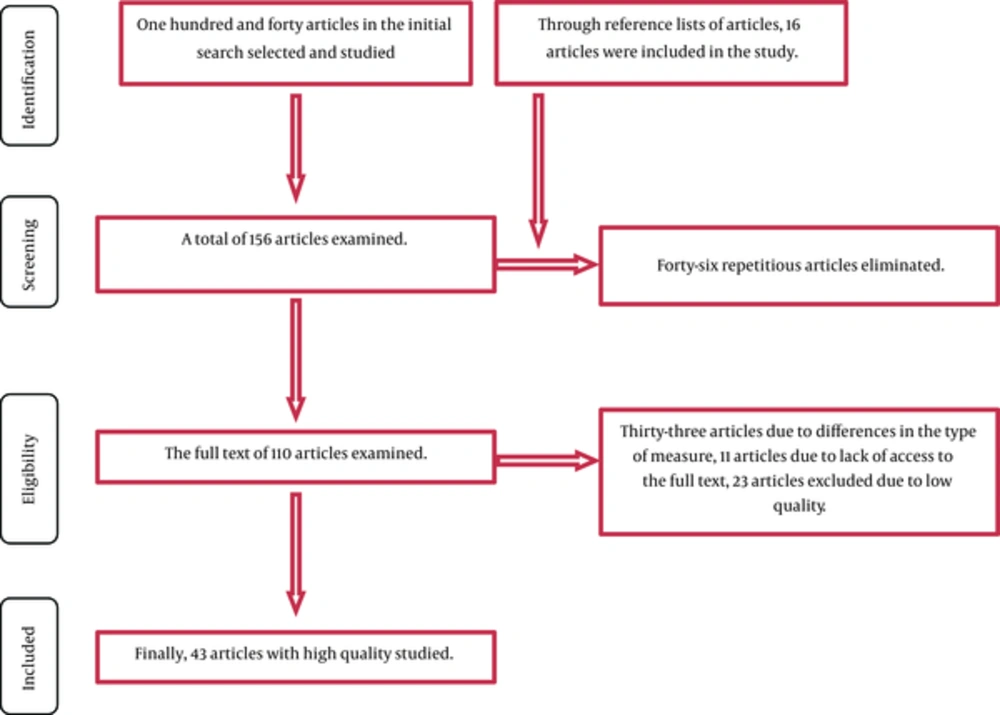
Figure 1.
The Stages Entered Into the Systematic Review and Meta-Analysis
2.2. Statistical Analysis
At first in this section, all the prevalence rates of antibiotic resistance were recorded, then to calculate the variance of each study, the binomial distribution formula was used. To combine the prevalence rate of different studies, average weight was used. Each study was weighted inversely proportional to its variance. Due to the large differences in the prevalence rates in various studies (heterogeneity of studies), significant heterogeneity index (I2) of the random-effects model was used.
3. Results
In the present study to conduct a meta-analysis and systematic review, 43 reports were selected and related articles conducted between 2002 and 2016 were studied. Extracted data are shown in Table 1. Total specimen volume of the 43 articles was 5360 samples. Drug-resistance of A. baumannii towards polymyxins was reported as 5%, according to estimates of 11 papers (Tables 2 - 4 and Figures 2 and 3).
Table 1.General Information and Data Entered in the Meta-Analysis Studies
| First Author | Study Location | Publication Year | The number of Samples | Study Type | The Sensitivity and Resistance Rate of Acinetobacter baumannii to Polymyxins, % | |||
|---|---|---|---|---|---|---|---|---|
| Polymyxin | Colistin | |||||||
| Sensitivity, % | Resistance, % | Sensitivity, % | Resistance, % | |||||
| Kooti (10) | Iran | 2015 | 200 | Case study | 100 | 0 | 100 | 0 |
| Quale (11) | New York | 2003 | 433 | Case study | 94.5 | 5.5 | ||
| Kwan (12) | Korea | 2007 | 214 | Cohort | 18 | 30.6 | ||
| Lolans (13) | India | 2006 | 94 | Case study | 100 | 0 | ||
| Gur (14) | Turkey | 2008 | 321 | Cohort | 99.3 | 0.7 | ||
| Bpharm (15) | Syria | 2012 | 260 | Cohort | 93.1 | |||
| Elabd (16) | Saudi Arabia | 2014 | 108 | Case study | 4.6 | 0 | ||
| Mohamed (17) | Egypt | 2014 | 40 | Case study | 95 | 5 | ||
| Carretto (18) | Italy | 2011 | 277 | Case study | 100 | 0 | ||
| Livermore (19) | London | 2010 | 166 | Cohort | 99.4 | |||
| Mirzaii (20) | Iran | 2015 | 100 | Case study | 97 | 3 | ||
| Anguti (21) | Iran | 2015 | 61 | Cross sectional | 89 | |||
| Scheetz (22) | USA | 2007 | 93 | Cohort | 100 | |||
| Song (23) | Korea | 2007 | 43 | Cohort | 100 | 0 | ||
| Lim (24) | Singapore | 2010 | 31 | Case study | 100 | 0 | ||
| Alaii (25) | Iran | 2014 | 85 | Cross sectional | 71 | 16 | ||
| Sadeqifard (26) | Iran | 2007 | 66 | Case study | 84.8 | 100 | 0 | |
| Nazari Monazam (27) | Iran | 2014 | 100 | Cross sectional | 97 | 3 | ||
| Noormohamad (28) | Iran | 2014 | 100 | Cross-sectional | 7 | 24 | ||
| Yosefiyan (29) | Iran | 2015 | 96 | Case study | 53.1 | |||
| Bratu (30) | USA | 2005 | 96 | Cohort | 91 | 9 | ||
| Dizbay (31) | Turkey | 2008 | 66 | Cross sectional | 100 | 0 | ||
| Yau (32) | Africa | 2009 | 30 | Cohort | 96.7 | 3.3 | ||
| Vila-Farres (33) | 2011 | 14 | Case study | 0.5 | 25.6 | |||
| Japooninejad. (34) | Iran | 2014 | 56 | Cross-sectional | 4 | |||
| Mirnejad (35) | Iran | 2014 | 400 | Cross sectional | 97 | 3 | ||
| McGowan (36) | USA | 2006 | 433 | Case study | 94.5 | 5.5 | ||
| Ahmadi (37) | Iran | 2014 | 43 | Case study | 60.5 | 39.5 | ||
| Shahcheraghi (38) | Iran | 2009 | 95 | cross-sectional | 4.2 | |||
| Ardebili (39) | Iran | 2012 | 65 | Case study | 0 | |||
| Mohammadi (40) | Iran | 2014 | 97 | Case study | 98.9 | 1 | ||
| Dinh Van (41) | USA | 2014 | 63 | Case study | 100 | 0 | ||
| Aliakbarzade (42) | Iran | 2013 | 103 | Case study | 84 | 16 | 77 | 19 |
| Hernandes-Torres (43) | Spain | 2012 | 77 | Case study | 100 | 0 | ||
| Sadeghifard (26) | Iran | 2006 | 66 | Case study | 84.8 | 0 | 100 | 0 |
| Talebi-Taher (44) | Iran | 2012 | 35 | Cross sectional | 21 | 40 | ||
| Nasrolahei (45) | Iran | 2014 | 100 | 88.7 | ||||
| Bayram (46) | Turkey | 2013 | 377 | 100 | 0 | |||
| Morkel (47) | Africa | 2014 | 17 | Retrospective | 71 | 29 | ||
| Kumar (48) | India | 2014 | 65 | Retrospective | 100 | 0 | ||
Table 2.The Resistance of Acinetobacter baumannii Against Polymyxins in Terms of the Number Entered in the Study Meta-Analysis
| Antibiotic | Study Number | Prevalence | Confidence Interval 95% (CI%95) | Heterogeneity IndexI2, % | P Value | |
|---|---|---|---|---|---|---|
| Polymyxin | Resistance | 11 | 5 | 0.03 - 0.07 | 85.8 | 0.000 |
| Sensitivity | 13 | 96 | 0.95 - 0.98 | 86.9 | 0.000 | |
| Colistin | Resistance | 21 | 4 | 0.03 - 0.5 | 93.8 | 0.000 |
| Sensitivity | 22 | 80 | 0.77 - 0.83 | 99.9 | 0.000 |
Table 3.Acinetobacter Baumannii Resistance to Polymyxins in Terms of Study Site Entered in the Meta-Analysis
| Antibiotic | Continent | Prevalence | Confidence Interval 95% (CI%95) | Heterogeneity IndexI2, % | P Value | |
|---|---|---|---|---|---|---|
| Polymyxin | America | Resistance | 6 | 0.03 - 0.09 | 20.6 | 0.262 |
| Sensitivity | 96 | 0.91 - 1.00 | 89.1 | 0.000 | ||
| Asia | Resistance | 5 | 0.02 - 0.08 | 87.8 | 0.000 | |
| Sensitivity | 97 | 0.95 - 0.99 | 84.4 | 0.000 | ||
| Europe | Resistance | 5 | 0.03 - 0.08 | 0.0 | 0.000 | |
| Sensitivity | 94 | 0.92 - 0.97 | 0.0 | 0.000 | ||
| Colistin | Africa | Resistance | 3 | 0.03 - 0.10 | 0.0 | - |
| Sensitivity | 86 | 0.61 - 1.11 | 80.1 | 0.025 | ||
| Asia | Resistance | 6 | 0.04 - 07 | 94.9 | 0.000 | |
| Sensitivity | 73 | 069 - 0.77 | 95.1 | 0.000 | ||
| Europe | Resistance | 1 | -0.01 - 0.02 | 68.2 | 0.024 | |
| Sensitivity | 100 | 0.99 - 1.00 | 0.0 | 0.422 |
Table 4.Acinetobacter baumannii Resistance to Polymyxins in Iran and Other Countries
| Antibiotic | Location | Prevalence | Confidence Interval 95% (CI%95) | Heterogeneity IndexI2 (%) | P Value | |
|---|---|---|---|---|---|---|
| Polymyxin | Iran | Resistance | 3 | 0.00 - 0.05 | 72.2 | 0.001 |
| Sensitivity | 95 | 0.92 - 0.98 | 88.2 | 0.00 | ||
| Other countries | Resistance | 9 | 0.05 - 0.13 | 86.2 | 0.000 | |
| Sensitivity | 97 | 0.97 - 0.99 | 86.9 | 0.000 | ||
| Colistin | Iran | Resistance | 14 | 0.07 - 0.21 | 95.0 | 0.000 |
| Sensitivity | 72 | 0.56 - 0.88 | 99.4 | 0.000 | ||
| Other countries | Resistance | 1 | 0.00 - 0.02 | 91.0 | 0.000 | |
| Sensitivity | 83 | 0.80 - 0.87 | 99.7 | 0.000 |
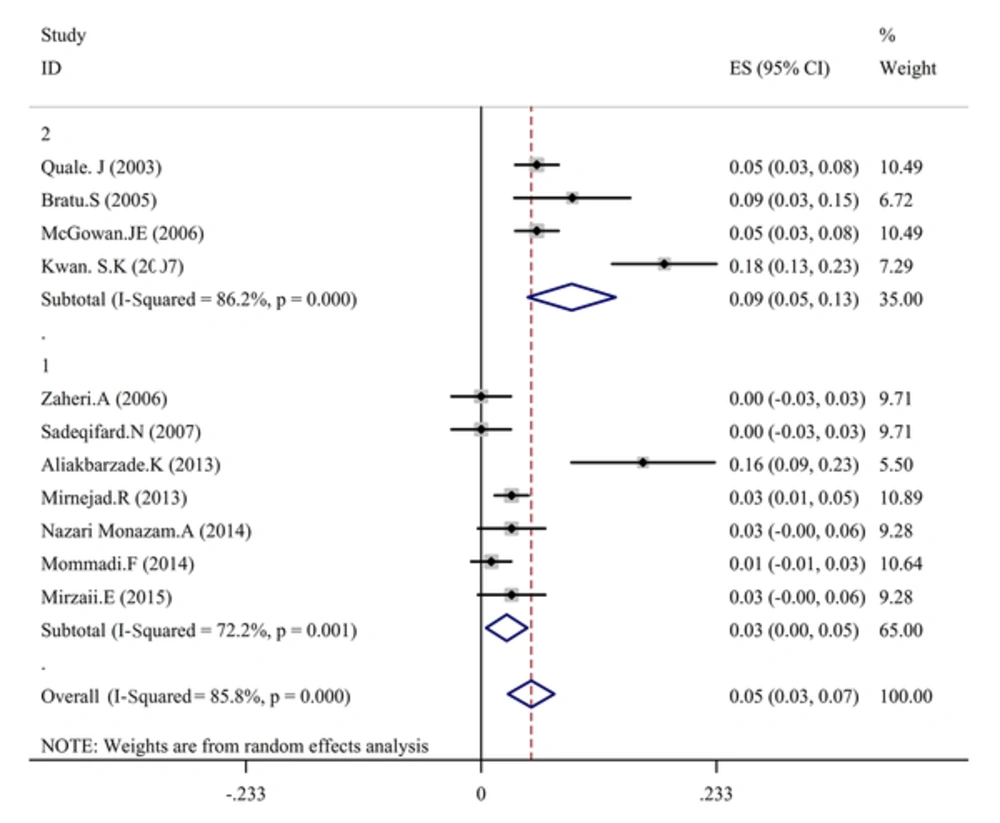
Figure 2.
The midpoint of each segment is the estimation of prevalence rate and line length is a confidence interval of 15% per study and diamond mark shows prevalence rate for all studies (code 1: Iran, code 2: Other countries).
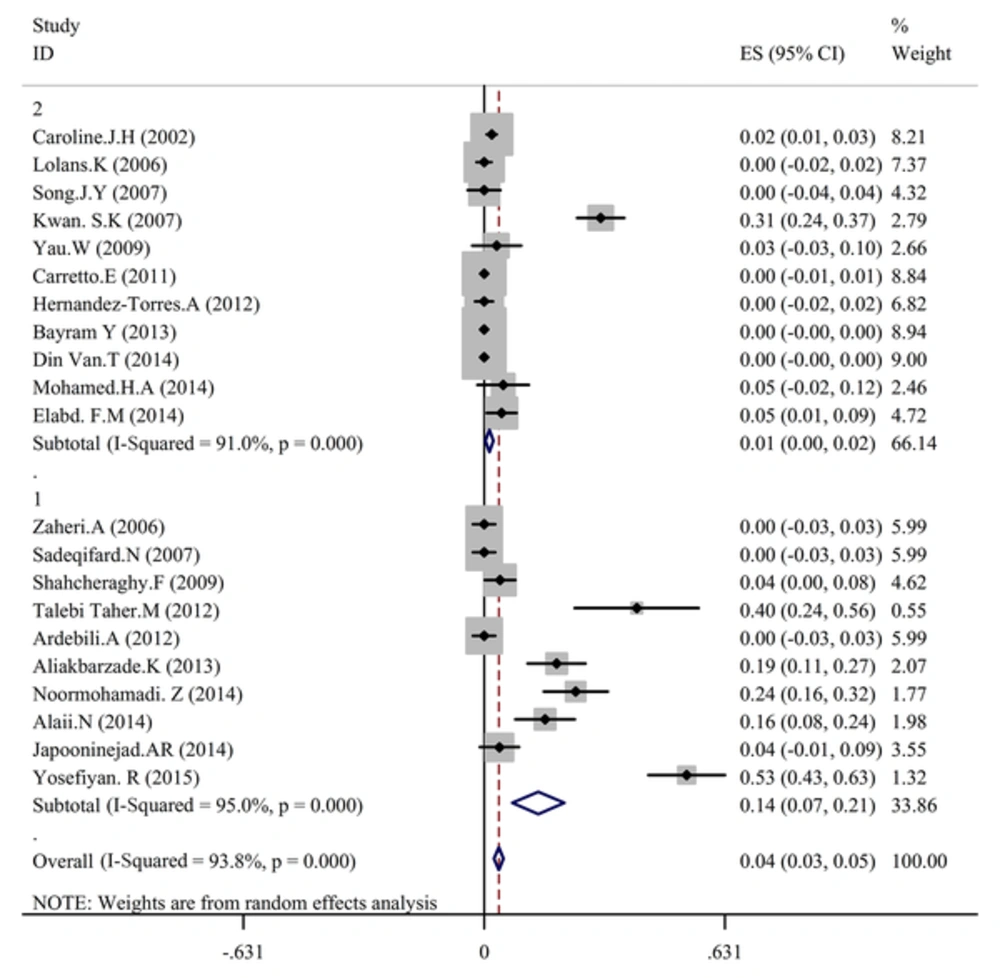
Figure 3.
The midpoint of each segment is the estimation of prevalence rate and line length is a confidence interval of 15% per study and the diamond mark shows the prevalence rate for all studies (code 1: Iran, code 2: Other countries).
4. Discussion and Conclusions
According to results of this study, the prevalence of A. baumannii isolates resistant to polymyxins is increasing. According to previous studies, the spread of antibiotic-resistant A. baumannii isolates and associated therapeutic problems have been approved in Iran and the World. In this study, the resistance rate towards colistin was 4% and for polymyxin, this was 5%. In the study of Ardabili et al. the pattern of resistance in A. baumannii isolates from patients in Motahari Tehran Hospital Burn Unit was towards 17 antibiotics determined by disk diffusion agar (DDA), while the drug resistance rate towards Colistin was zero percent (39). Moreover, in other studies, this resistance has been reported as zero percent (13, 18, 26, 41, 43). In the studies of Shahcheraghi et al. studies (38), Yau et al. (32), Elebd et al. (16) and Al-Agamy et al. (17), this amount was less than 5%. While in other studies, resistance has been unusually high, such as Youssefian et al. (29) 53.1%, Vila-Farres et al. (33) 25.6%, Talebi-Taher et al. (44) (40%), Ahmadi et al. (37) 39.5%. There has been large differences in the resistance rate of the organism towards Colistin. The study of Goudarzi et al. was done by the DDA method, and showed antibiotic resistance rate of A. baumannii in 243 samples to 19 antibiotics; all the samples were susceptible to colistin and tigecycline, so these two antibiotics were suggested for the treatment of A. baumannii (49).
In another study, 108 isolates of A. baumannii were isolated from 2 hospitals in Tehran. Resistance isolates to colistin were determined by DDA; 1.8% of the isolates were resistant to colistin (50). Polymyxin resistance to A. baumannii obtained in this study are almost consistent with the resistance obtained in other studies, including Moammadi et al. 1% (40), Ardebili et al. 3% (39), McGowan and Carlet 5.5% (36), Bratu et al. 9% (30), Nazari Monazam et al. 3% (27), Mirzaii 3% (20), and Quale et al. 5.5% (11). While in other studies, such as Aliakbarzadeh et al. (16%) (42) and Ko et al. (18%) (12) higher resistance rates were reported. Dispute in the findings with the results of this study could be attributed to differences in methods (51-54). The DDA method is a common method for determining susceptibility to antibiotics used, yet evaluation of susceptibility to antibiotics has shown DDA diverse methods compared to methods based on minimum inhibitory concentration (MIC), which have a higher error rate. On the other hand, the geographical differences in the area of sample isolation are also effective in the pattern of antibiotic resistant isolates; depending on the type of treatment strategy used, the resistance pattern changes. However, it should be noted that the results of epidemiological studies on antibiotic resistance of bacteria are not always predictable. Since Polymyxin is used as the last line of these bacteria, increasing resistance to these antibiotics is a dangerous alarm for health systems. Thus, the application of new therapeutic regimens, more sensitive diagnostic methods, and control of hospital infections seems essential.



