


1. Background
During the recent years, in the context of economic, social, cultural, and political development, various dimensions of population dynamics have been subjected to massive changes in Iran and throughout the world. Population and its various dimensions, including growth rate, age structure, fertility, mortality, and migration, have a high impact on the whole environment. Therefore, it is no wonder that demographic policy has globally become one of the pivotal and most basic areas of public policy over the past few decades. Although many of these changes have occurred align with globalization and as a consequence of development trends, after the first transition of the population, Iranian community faces its own emerging issues of population (1).
Global policy experiences indicate that according to demographic transition theory, the window period requires appropriate policies as it is a critical and effective time for policy making. Transforming demographic opportunity to demographic blessing requires efficient policies, proper planning, and strong implementation; otherwise, it may create problems for the country. For Iran, in the middle of the population transition spectrum of the world, there is a chance to take the experiences of pioneer countries into account, considering the native policy requirements and features (2).
In the face of changes and emerging issues, relying on routine planning methods cannot meet the requirements of public policy makers in countries. The uncertainties and the emergence of discontinuous events make it very difficult to predict the future and plan for it. Obviously, the demographic policy is a basic area of public policy. Population policy, in terms of the subject and its impact on other domains, is closely linked with futures studies. Comprehensive management in this field will not be achieved without “foresight” as the most important tool for planning and managing strategic change (3).
Considering the problems of past demographic policy and its consequences on the population, this study was designed to introduce a foresight model to improve policymaking in this field.
1.1. Choosing a Foresight Mixed Method Model; A New Approach
Obviously, it is necessary to obtain a clear logic for selection of methods while designing a research in all fields of science. Considering multiple possibilities of choices, the optimal mixture of methods that is appropriate to the subject and research context and methodology is still a controversial challenge (4). There are two more prominent approaches:
First, approaches that choose methods based on internal attribute: The nature of the method (qualitative, quantitative, and qualitative-quantitative) and its capabilities (the ability to compile and process data from various sources, such as experts, evidence, interaction, and creativity) (5) were considered.
Second, approaches that select methods based on a type of external attribute: This selection is due to the infrastructure components and the conditions that influence the process of foresight. A future research requires a subject and it is necessary to adapt the methods, accordingly.
2. Objectives
In future studies, there are discussions about the process, design, challenges, categories, and styles of foresight. In this study, the researchers tried to consider the main approaches.
3. Methods
This study was a mixed quantitative-qualitative research with practical and developmental orientation, originated in the interdisciplinary field of future studies. The aim was to apply foresight methods into population policy, addressing the challenges of the previous public policy trend. The list of challenges used in the study (Table 1) was derived from a previous study; named: “population policy challenges in Iran; a qualitative content analysis of interviews with key experts” (the same authors of this article).
Table 1.The Main Challenges of the Past Demographic Policy
| N | Indicators | Category | Nature |
|---|---|---|---|
| 1 | Attracting experts’ participation | Process | WHO |
| 2 | paying attention to the tacit knowledge of experts and managers | Process | WHO |
| 3 | Collective intelligence by a method | Process | WHO |
| 4 | Reducing divergence in the literature of experts and managers | Process | WHO |
| 5 | Stakeholders identification | Process | WHO |
| 6 | Not satisfying with pure elitism | Process | WHO |
| 7 | Considering the activism of human beings | Process | WHO |
| 8 | Institutionalization and organization | Structure | WHERE |
| 9 | concentration and convergence of the centers and decision-making authorities | Structure | WHERE |
| 10 | paying attention to the topic’s specialty | Process | WHAT |
| 11 | paying attention to the interdisciplinary nature | Process | WHAT |
| 12 | paying attention to the complexity | Process | WHAT |
| 13 | Considering timing and proper timeline | Process | WHAT |
| 14 | paying attention to native values and norms | Process | WHAT |
| 15 | paying attention to the past, present, and future (being historic) | Process | WHAT |
| 16 | Comprehensive view and avoidance of partial consideration | Process | WHAT |
| 17 | Open and flexible vision | Process | WHAT |
| 18 | Considering the dynamism and dynamics of policymaking? | Process | WHAT |
| 19 | Go over linear and simple approaches | Quality | HOW |
| 20 | Adopt an active approach rather than passive | Quality | HOW |
| 21 | Attention to the futures | Quality | HOW |
| 22 | Regarding the requirements of policy learning and policy transfer | Quality | HOW |
| 23 | Transparency, clarity, and resolution of ambiguity | Quality | HOW |
| 24 | Paying attention to the broad principles and spirit of macro policies and understanding the conceptual model of policymaking | Quality | HOW |
| 25 | Avoid the technocracy and engineering approach | Quality | HOW |
| 26 | systematic, timely and effective continuous evaluation and feedback | Quality | HOW |
| 27 | Avoiding politicization and preferring specialized considerations to political | Politics | HOW |
| 28 | Prioritization based on evidence rather than subjectivity | Quality | HOW |
| 29 | Promoting creativity and innovation | Quality | HOW |
| 30 | Considering critical thinking | Quality | HOW |
| 31 | Overcoming the fear and resistance of managers and administrators to change | Politics | HOW |
| 32 | Resilience and robustness to changes (governments and…) | Politics | HOW |
| 33 | Policy intelligence | Quality | HOW |
| 34 | In terms of external environment changes | Quality | HOW |
| 35 | Attention to group work in policy making and not being individualized | Quality | HOW |
| 36 | Theoretical support and paradigm fit | Quality | HOW |
| 37 | Promotion of social capital and national determination | Politics | HOW |
Based on the challenge list; extracted from the literature and expert’s views, a questionnaire was designed. The first question was about the priority of every policy indicators, followed by 2 phase questions on the appropriate methods to improve it. The questions were organized in a web-based questionnaire (Google form). In order to avoid the method selection cliché by the responders, this 2-phase approach was formulated after comparing different types of categorization models and based on the Magruk’s categorization model (Table 2). This category involves all of the futures known methods (6).
Table 2.Magruk Future Methods Classification
| Methods | Description |
|---|---|
| Consultative | Voting, polling, survey, interviews, expert panels, essays, conferences, workshops, citizen panels, brainstorming |
| Creative | Wild cards, weak signals, mindmap, lateral thinking, futures wheel, role play, business wargaming, synectics, speculative writing, visualization, metaphors, assumption reversal |
| Prescriptive | Relevance trees, morphological analysis, rich pictures, divergence mapping, Coates and Jarratt, future mapping, backcasting, SRI matrix, science fiction analysis, incasting, genius forecasting, futures biographies, TRIZ, future history, alternative history |
| Multicriterial | Key technologies, source data analysis, migration analysis, shift-share analysis, DEA, factor analysis, correspondence analysis, cluster analysis, sensitivity analysis, AHP, input-output analysis, prioritization, smart, prime, MCDM radar scientometrics, webometrics, patent analysis, bibliometrics, technological substitution, S-Curve anal technology mapping, analogies |
| Radar | Scientometrics, webometrics, patent analysis, bibliometrics, technological substitution, S-curve anal technology mapping, analogies |
| Simulation | Probability trees, trend extrapolation, long wave analysis, indicators, stochastic forecast, classification trees, modeling and simulation, system dynamics, agent modeling |
| Diagnostic | Object simulation, force field analysis, word diamond, SWOT, STEEPVL, institutional analysis, DEGEST, trial and error, requirement analysis, theory of constraint, issue management, ANKOT |
| Analytical | SOFI, stakeholder analysis, cross-impact analysis, trend impact analysis, structural analysis, megatrend analysis, critical influence analysis, technology barometer, cost-benefit analysis, technology scouting, technology watch, sustainability analysis, environmental scanning, content analysis, FMEA, risk analysis, benchmarking |
| Survey | Web research, desk research, technology assessment, social network analysis, literature review, retrospective analysis, macrohistory, back-view mirror anal |
| Strategic | Technology roadmapping, technology positioning, Delphi, scenarios, social impact assessment, RPM, technological scanning, multiple perspectives |
Literature study showed that several categories have been used so far. Glenn and Gordon introduced their classification in 2004 based on exploratory and normative, quantitative and qualitative, and published it in the Millennium book (3). Miles and Keenan model was based on 13 methods and four categories: Identification of the subject, exploration approaches, creative approach, and prioritization (6). A different kind of category was provided in the EUFORIA project:
(1) Based on the virtual environment, (2) based on the real environment, (3) soft (qualitative), (4) hard (quantitative), (5) based on expert judgment, (6) analytical, (7) bottom-up, and (8) top-down (7).
Furthermore, UNIDO also has presented a category including 40 methods and the following three categories: forecast, management, and creativity (8). In 2006, Aaltonen and Irene Sanders, offered a new typology with 29 methods and four categories: math, social, engineering and system (3). Saritas classified 32 methods in five groups, based on which key phases of foresight were attributed: understanding, synthesis and model, analysis and selection, and transformation (7). Popper’s typology is also well-known as the assignment to various stages of foresight: pre-foresight, recruitment, generation, action, and renewal (5). Fifteen categories of Porter used a combined way to classify the methods (9) and Voros defined two great categories (evolutionary and revolutionary) (10).
Among all of the above categorizations, Magruk typology was chosen for the current study due to four main reasons (11, 12).
1- It covered all the methods of futures studies (100 methods).
2- There was no interference and overlap in the categories and the logic of the conditional structure of the questionnaire.
3- The category that has been rarely used in the country and therefore may partly prevent responders from the stereotypes of the method.
4- It is almost comprehensive of all pre-existing typologies.
Reliability and validity of the questionnaire: In this study, the five-point Likert spectrum was employed for the questionnaire. The Cronbach’s alpha coefficient for the research questionnaire was 0.844, which is larger than 0.7 and it could be concluded that the entire questionnaire is reliable. Using “Lowsheh” questions test, 20 experts were asked to determine whether the test questions measure the index and cover the entire content of the test. They were asked to classify each of the questions based on the three-point Likert scale (essential, useful but unnecessary, and unnecessary). According to the Standard table, questions with a numeric value of less than 42 were below the proportion of validity and should be eliminated. The content of all questions was higher than the minimum and finally, the validity of the questionnaire was confirmed.
4. Results
The questionnaire was created online and was shared in some future studies social networks and the link was sent to the experts by Email. It was reminded approximately three to four times to responders until 24 complete questionnaires were gathered. It was filled by the futurists and the output was entered in the SPSS software for analysis.
Of the 24 futurists, who completed the questionnaire; five were female and the rest were male. In terms of education, only Ph.D. graduates or Ph.D. students in futures studies were included in the study.
Indicators were prioritized according to their importance in the Table 3.
Table 3.Importance of the Policy Improvement Indicators
| Policy Improvement Indicators | Importance | |
|---|---|---|
| 1 | Methodological use of collective wisdom | 69 |
| 2 | paying attention to the tacit knowledge of experts and managers | 68 |
| 3 | Identifying affecting and affected stakeholders | 68 |
| 4 | Attracting experts’ participation | 67 |
| 5 | Not satisfying with mere elitism | 64 |
| 6 | Concentration and convergence of the centers and decision-making authorities | 64 |
| 7 | Reducing divergence in the literature of experts and managers | 59 |
| 8 | Considering the activism of human beings | 58 |
| 9 | Paying attention to the complexity | 54 |
| 10 | Paying attention to the interdisciplinary nature | 53 |
| 11 | Comprehensive view and avoidance of partial consideration | 53 |
| 12 | Attention to the futures | 53 |
| 13 | Institutionalization and organization | 52 |
| 14 | Considering timing and proper timeline | 52 |
| 15 | paying attention to native values and norms | 50 |
| 16 | paying attention to the past, present, and future (being historic) | 50 |
| 17 | Considering the dynamism and dynamics of policymaking | 50 |
| 18 | systematic, timely and effective continuous evaluation and feedback | 47 |
| 19 | Promotion of social capital and National determination | 47 |
| 20 | Open and Flexible vision | 44 |
| 21 | Go over linear and simple approaches | 44 |
| 22 | Regarding the requirements of policy learning and policy transfer | 44 |
| 23 | In terms of external environment changes | 44 |
| 24 | Adopt an active approach rather than passive | 43 |
| 25 | Considering critical thinking | 43 |
| 26 | Attention to group work in policy making and not being individualized | 43 |
| 27 | paying attention to the topic’s specialty | 42 |
| 28 | Resilience and robustness to changes (governments and…) | 42 |
| 29 | Avoiding politicization and preferring specialized considerations to political | 41 |
| 30 | Prioritization based on evidence rather than subjectivity | 40 |
| 31 | Promoting creativity and innovation | 39 |
| 32 | Overcoming the fear and resistance of managers and administrators to change | 39 |
| 33 | Transparency, clarity, and resolution of ambiguity | 38 |
| 34 | Policy intelligence | 38 |
| 35 | Avoid the technocracy and engineering approach | 34 |
| 36 | Theoretical support and paradigm fit | 34 |
| 37 | Paying attention to the broad principles and spirit of macro policies and understanding the conceptual model of policymaking | 29 |
In the next step, the priority of the ten categories of the method was selected for each improving indicator (Table 4). The results revealed that Strategic and Consultative group of methods were the most favorite among the experts to solve the policy problems.
Table 4.Priority of the Ten Categories of the Methods
| Category | Score |
|---|---|
| Consultative | 90 |
| Creative | 44 |
| Prescriptive | 43 |
| Multicriterial | 44 |
| Radar | 5 |
| Simulation | 41 |
| Diagnostic | 29 |
| Analytical | 55 |
| Survey | 24 |
| Strategic | 98 |
In the next step, responders were asked to specify appropriate methods for improving policy indicators inside the selected group of methods. The priority of the attractiveness of selected methods is indicated in the Table 5.
Table 5.The Results of the Attractiveness-Capability Priority
| In Terms of Capability, the Following Method Was Also Obtained: Methods | Attractiveness-Capability |
|---|---|
| Causal layered analysis | 2250 |
| Scenarios | 1596 |
| Expert panels | 1560 |
| Interviews | 1232 |
| Citizen panels | 1120 |
| Brainstorming | 1044 |
| Workshops | 828 |
| System dynamics | 672 |
| Conferences | 589 |
| Factor analysis | 576 |
| Polling | 550 |
| Delphi | 550 |
| AHP | 486 |
| Survey | 450 |
| Environmental scanning | 432 |
| Stakeholder analysis | 420 |
| Modeling and Simulation | 418 |
| Structural analysis | 414 |
| Wild cards | 399 |
Finally, four methods were the most commonly selected: casual layered analysis (CLA) with 2250 points, scenario with 1596 points, expert panels with 1560 points, and Interviews with 1232 points. Two of them were strategic (98 points) and two others were in the consultative group (90 points), which were the most widely chosen method in the categorization. After these four methods, the other selected methods were as follows: citizens panel with 1120 points, brainstorm with 1044 points, workshop with 828 points, the system dynamic with 672 points, conference with 589 points, Factors analysis with 576 points and voting with 550 points.
At the beginning of the questionnaire and regardless to the challenges list, responders were asked to suggest methods to improve the population policy. The frequent responses were: scenario (20%), trend impact analysis (17.5%), Delphi (12.5%), casual layered analysis (10%), visioning (5%), trend extrapolation (5%), simulation (5%), and experts panel (2.5).
4.1. Limitations and Challenges
One of the challenges was the difficulty and time-consuming completion of the questionnaire, due to the inclusion of 100 methods in ten categories. To eliminate this problem, some of the methods could be removed from the questionnaire. The limited number of graduates of future studies, lack of think tanks, dispersion of future scholars with diverse backgrounds and systematic discipline, limited opportunities for postgraduate studies and practicing futuristic methods also may contribute to the cause.
5. Discussion
Global experiences indicated the creation of interdisciplinary dialogue between futurists and policymakers and the demographic contributes to the scientific growth and improvement of the three areas and achievement of a consensual ideal. Meanwhile, the author’s expectations must be realistic. Designing a policy that is completely in line with the goals may remain a challenge for decades. Future approach can be helpful, yet it cannot completely eliminate uncertainties. In conjunction with other analysis tools, it is possible to produce flexible and resilience policies. The futuristic approach will create a structure to realize uncertainties, and meanwhile, alternative perspectives on policy challenges. This expanded horizon will allow accurate measurement of the policy and may reduce the risk of unintended consequences. Future studies can be used throughout the entire cycle of policymaking.
Meantime, a main concern of future studies has always been the choice of methods. An appropriate combination of methods will lead to the optimal function of foresight in solving the main problems of policymaking. Otherwise, it can impose new limitations and problems on this interdisciplinary arena.
Overall, 2000 study of the world’s futures researches showed that futurists in each area are somehow clichéd in selection and application of methods (9). In this sense, most students often use their own ancestors chosen methods. This stereotype is also seen in other areas of knowledge, yet it could be fatal for the innovative nature of future studies. Therefore, the researchers are going to bypass the clichés according to new prioritization logic.
The main challenges of the population policy were introduced to future toolbox through a questionnaire, which was responded by futurists. Four methods were selected in this study as components of population policymaking improvement model: scenario, CLA, experts panel, and interview. A three-dimensional model was suggested by the scope and capacity of each selected method. The panel is suggested as the framework for implementing the model. Expert meeting in three steps is recommended to improve population policy with foresight approach. The first step with a forward-looking approach is adopted by the scenario method, in the second step, the deepening approach is applied by the CLA method and the third step with a practical approach will make a framework towards scenario planning.
It is observed in the figure that selected methods have also covered all four fundamental dimensions of popper’s future diamond (Figure 1). Also considering foresight steps, they are all represented in this model. After implementing this rough model, it is preferred to be assessed concerning fulfillment of its main goal, which was supposed to improve population policy. According to Magruk category, this study cleared that the main challenges of population policy and their solutions were aggregated in two of ten categories (of Magruk), including consultative and strategic methods; this result may be applied to most of the public policy issues in the country, which is researchable through further studies.
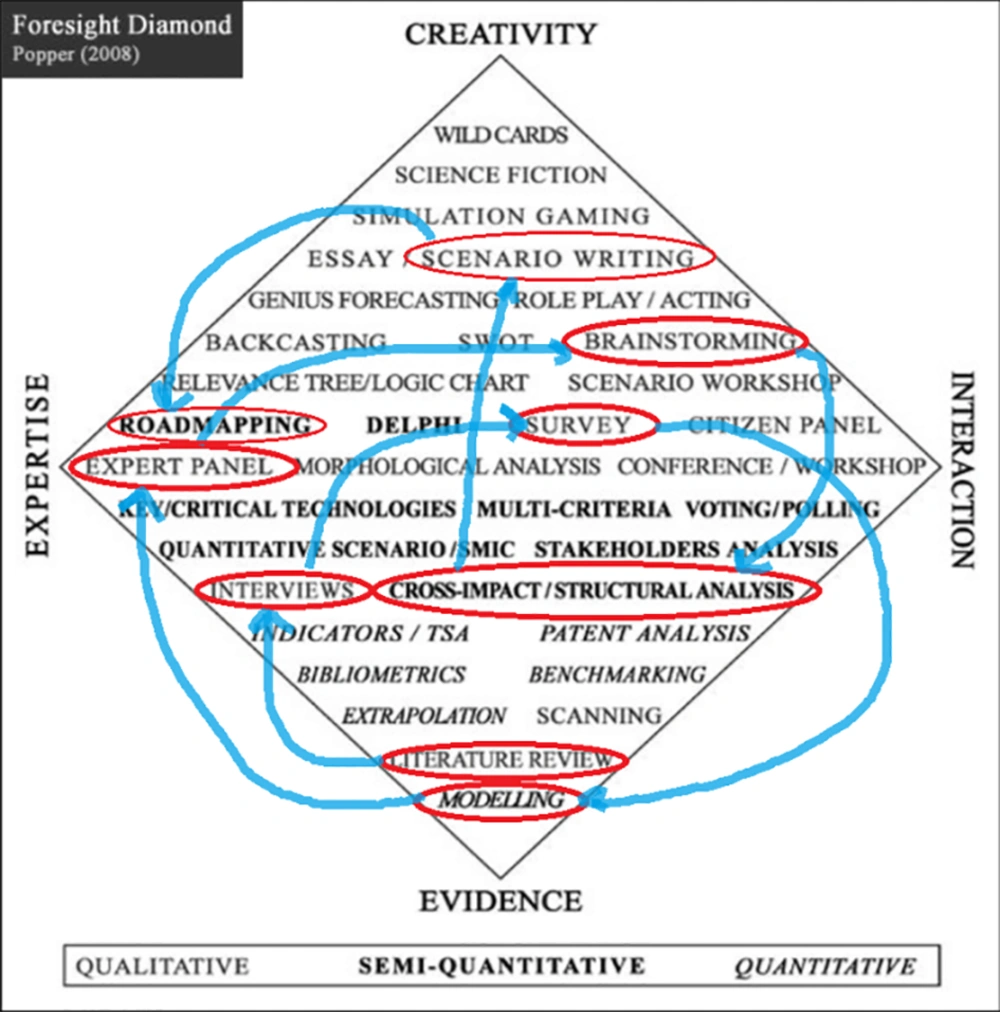
Figure 1.
Placing selected methods in popper foresight diamond
The path and logic used in this research to select the model of population foresight, considering constraints and challenges, can be generalized to other public policy areas and can be a scientific and methodological basis for applied interdisciplinary studies (Figure 2).
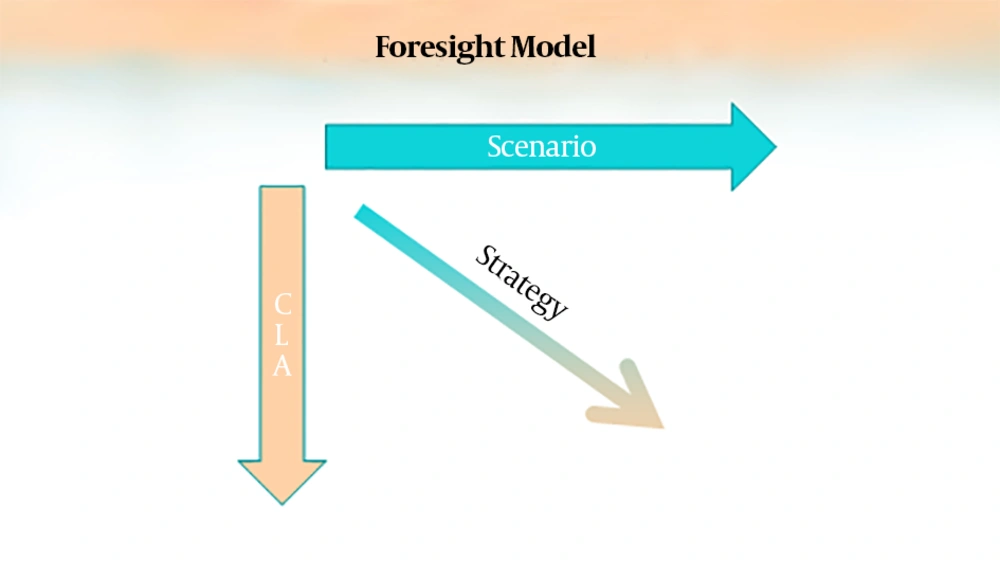
Figure 2.
3-D foresight model (depth, futures and practice)

