


1. Background
Substantial evidence now indicates that human exposure to artificial sources of light, especially short wavelength blue light at night can be associated with alterations in sleep, alertness, circadian physiology, and adverse health effects, such as insomnia and sleep problems, psychiatric disorders, obesity, diabetes, increased growth of bacteria, and different cancers (1-4). In many countries conventional incandescent light bulbs have been replaced by energy efficient compact fluorescent light bulbs (CFL) and light emitting diodes (LED), which relatively deliver higher levels of blue light. Light emitting diodes are also used in devices, such as televisions, computers, smart phones, and tablets. The light emitted by most LEDs appear white yet their peak emission lies in the blue range (400 to 490 nm) (5). The adverse health effects of chronic exposure to “blue-rich” LED light compared to other light sources, which emit less blue light is well documented (6). The high intensities of blue light emitted from the screens of smartphones, tablets, and laptops look white to the human naked eye. It has been shown that both blue light and electromagnetic fields (EMFs) generated by digital screens can disturb the circadian rhythm of the users of smartphones, who use this device at night (7). Moreover, applications developed for color-shifting that make the smartphone’s screen look “warmer” at night and using special eye glasses or filters which block blue light (e.g. amber filters) are widely believed to be able to reduce the detrimental biological effects of exposure to blue light (8, 9). Although mitigation of the blue light seems to be easy, reducing the effects of radiofrequency electromagnetic fields (RF-EMF) is more complicated and needs further research (10, 11).
Some studies show the light emitted by computer screens can alter circadian physiology, alertness, and cognitive performance (12).
2. Objectives
The aim of the current study was to assess whether exposure to blue light emitted from the screens of common smartphones in an environment with dim light at night alters human reaction time.
3. Methods
3.1. Ethical Considerations
This study was approved by the Medical Ethics committee of Shiraz University of Medical Sciences (Permit No. IR.SUMS. REC.1395.108). Written informed consent was obtained from all students.
3.2. Participants
This study was conducted on 267 apparently healthy students. Participants were randomly divided into two groups of control (N = 126 students) and intervention (N = 141 students). The socio-demographic characteristics of the participants are reported in Table 1.
Table 1.Demographic and Occupational Characteristics of the Sample (N = 157)
| Intervention Group | Controls | |||
|---|---|---|---|---|
| Frequency (%) | Mean ± SD | Frequency (%) | Mean ± SD | |
| Age, y | 141 (52.8) | 20.91 ± 5.49 | 126 (47.2) | 20.98 ± 4.66 |
| Sex | ||||
| Male | 86 (60.99) | 66 (52.38) | ||
| Female | 55 (39.01) | 60 (47.62) | ||
| Major | ||||
| Medicine | 89 (63.12) | 71 (56.34) | ||
| Dentistry | 52 (36.88) | 55 (43.66) | ||
| History of smartphone use, y | 7.37 (2.08) | 7.58 (2.50) | ||
| Smartphone’s screens use per day, h | 8.02 (2.30) | 7.81 (2.43) | ||
3.3. Pre-Intervention/Intervention Set-up
All participants, who had declared they usually sleep at 24:00 were asked to go to bed at 23:00. Participants in the intervention group were asked to use their smartphones from 23:00 to 24:00 (watching a natural life documentary movie for 60 minutes), while the control group only stayed in bed under the same low lighting condition (Figure 1). The researchers' previous study showed that the life documentary movie used in this study lacked exciting scenes. Before the experiment and 60 minutes after using smartphone, reaction time was recorded in the intervention group. In the control group, reaction time was recorded both at 23:00 and 24:00. To ensure the uniformity, participants, who used smartphones with the same size of display, were included in this study.
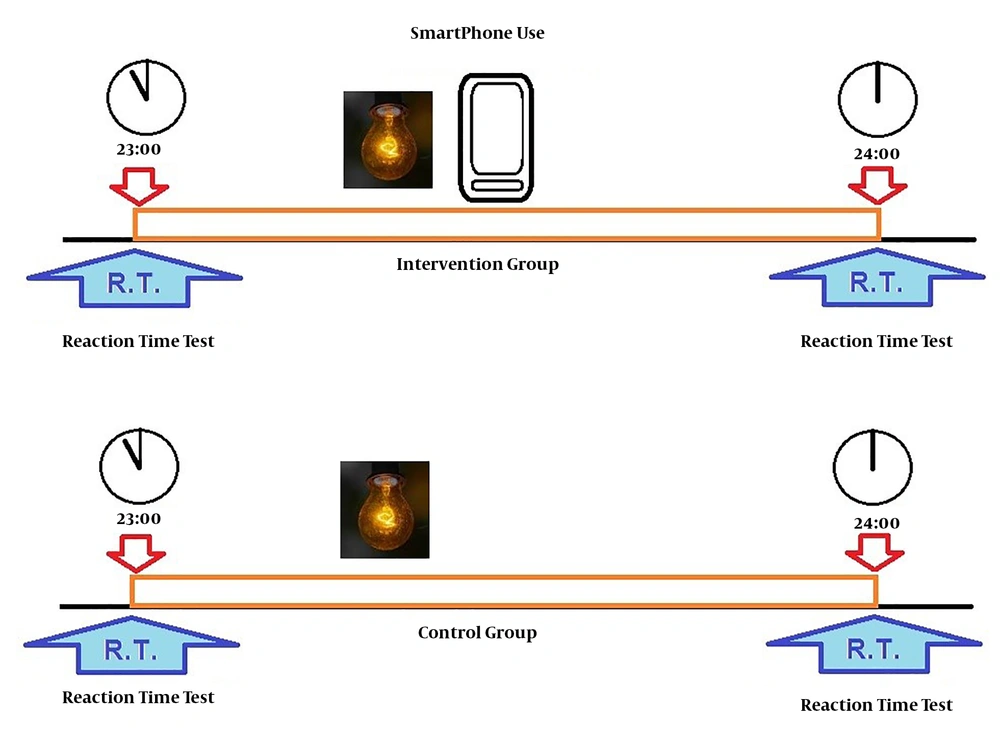
Figure 1.
graphic presentation of the protocol used in this study
3.4. Reaction Time Test
A modified simple blind computer-assisted-visual reaction time test, which was previously developed (13, 14), was used in this study. In summary, the participants were asked to respond as fast as possible by a single right click on a laptop mouse when a red square on the display was replaced by a green one.
3.5. Statistical Analysis
Student’s t-test was used to compare the means of VRT between the two groups, before the experiment and after 60 minutes of smartphone use (it was after 60 minutes of staying in bed for the control group). P values of less than 0.05 were considered statistically significant.
4. Results
The mean ± SD age of the participants was 20.94 ± 5.06 years. One hundred and fifty-two (56.9%) of the participants were male and 115 (43.1%) were female. One hundred and sixty (60%) of the participants were medical students and 107 (40%) were dentistry students. As indicated in Table 2, the mean reaction times in the intervention and the control groups before the experiment (23:00) were 412.64 ± 105.59 and 423.13 ± 120.31 msec, respectively. This difference was not statistically significant (P = 0.449). However, there was a statistically significant difference between the mean reaction times in the intervention (441.66 ± 125.78 msec) and the control groups (406.19 ± 92.60 msec) after 60 minutes (at 24:00) (P = 0.01).
Table 2.Mean Reaction Times in the Intervention and the Control Groups Before (23:00) and After the Experiment (24:00)
Abbreviation: NS, not significant.
aValues are expressed as mean ± SD.
As shown in the table, the reaction time in the intervention group significantly increased from 412.64 ± 105.60 at 23:00 to 441.66 ± 125.78 msec at 24:00 (P = 0.037) while in the control group there was no statistically significant difference between the mean reaction times at 23:00 (423.13 ± 120.31 msec) and 24:00 (406.19 ± 92.60 msec) (P = 0.211).
5. Discussion
To the best of the author’s knowledge, this is the first study, which showed that exposure to blue light emitted from common smartphones increases the visual reaction time. This effect can possibly result in a delay in human responses to different hazards. The current findings reveal that the effects of exposure to different parts of non-ionizing electromagnetic radiations (radiofrequency versus visible light) are contradictory. Mortazavi et al. previously showed that the visual reaction time of university students was significantly affected by a short-term exposure (10 min) to RF-EMFs emitted by a common mobile phone (13). Their experiment revealed that short term exposure to RF-EMFs could significantly decrease the reaction time in students (the mean ± SD reaction time after real exposure and sham exposure were 286.78 ± 31.35 msec and 295.86 ± 32.17 msec, respectively). Furthermore, Mortazavi et al. showed that occupational exposure to microwave radiation can also decrease the reaction time in radar workers (14). Based on these findings, exposure to RF-EMF scan decrease the reaction time while the findings of the current study showed that exposure to blue-rich visible light, in contrast with RF-EMFs, could lead to a longer response time to different hazards, which in turn can increase the probability of errors and accidents.
The current findings are generally in line with the results obtained in a study performed by Cajochen et al., who showed that the spectral pattern of the light generated by the screens of computers can affect the circadian rhythms, alertness, and the levels of cognitive performance (12).
However, another study that aimed at investigating the effects of exposure to a 30-minute pulse of blue light versus placebo (using amber light) significantly showed better long-delay verbal recall compared to individuals, who received amber light exposure (15). Given this consideration, Alkozei et al. discussed the potential applications of blue light for optimizing memory performance in healthy individuals. They also stated that further studies can answer the question of whether exposure to blue light can enhance the performance in patients with memory deficits. The difference between the findings of this study and those obtained in the current study comes from the exposure time (morning in the study performed by Alkozei et al. versus late night in our experiment) (15).
A more recent study on the effect of blue-enriched white light on reaction time does not support the current findings. Motamedzadeh et al. showed that during the sustained attention task, exposure decreased both omission errors and reaction time. This difference may come from confounding factors, which were ignored in the study of Motamedzadeh et al. (16).
5.1. Study Limitations
This study had some limitations. For example, the number of students participated in this study was relatively small. Moreover, the intervention group participated in a mentally and visually demanding task while the control group was resting.
5.2. Conclusions
To the best of the author’s knowledge, this is the first study, which showed that exposure to blue-rich visible light emitted from widely used smartphones increases visual reaction time, which would eventually result in a delay in human responses to different hazards. These findings indicate that people, such as night shift or on call workers, who need to react to stresses should avoid using their smartphones in a dim light at night.

