The present study showed that the aqueous and hydroalcoholic extracts of Salvia mirzayanii and the aqueous extract of Salvia macrosiphon had antidepressant-like activity in the forced swimming test.
FST is the most valuable model that is used for assessment of antidepressant activity in rodents (
26,
27). Although all antidepressant drugs reduce immobility as an index of their antidepressant activity in the FST, different drugs with different mechanism of action produce two distinct behavioral patterns including climbing and swimming. It has been shown that climbing is increased by drugs acting at noradrenergic system such as imipramine; and swimming is sensitive to increased serotoninergic transmission by drugs like fluoxetine (
25,
28).
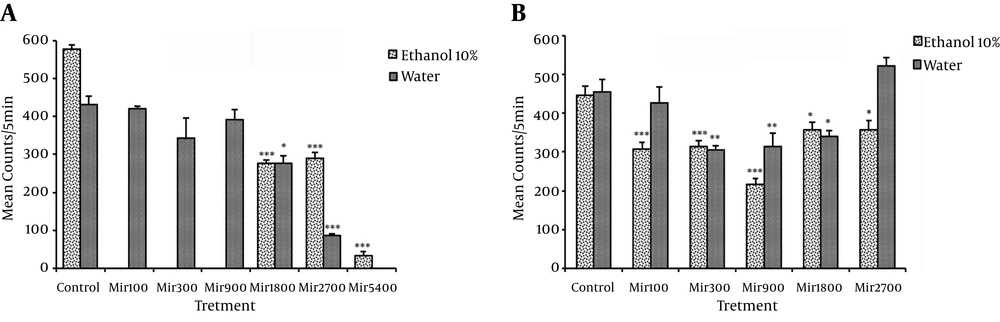
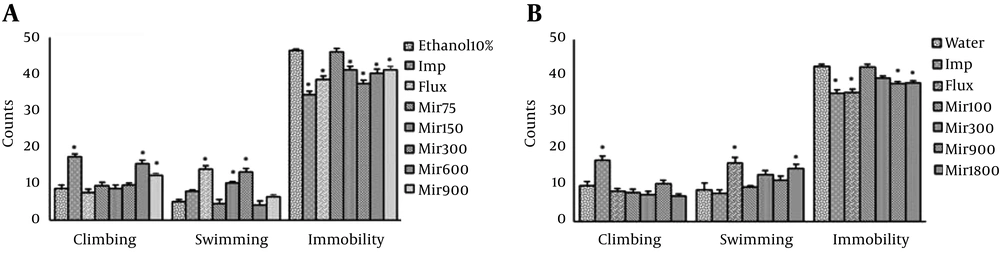
In the present study, reduced immobility was observed by both the hydroalcoholic and aqueous extracts of S. mirzayanii, which suggests that this plant has an antidepressant-like activity. The reduced immobility and antidepressant-like activity of S. mirzayanii are not related to the stimulatory effects of the extracts on motor activity, since the extracts did not increase locomotor activities.
The increased climbing behavior at higher doses of the hydroalcoholic extract of S. mirzayanii resembles to that of imipramine; while increased swimming behavior at lower doses of the hydroalcoholic extract is similar to what is seen by fluoxetine. These findings suggest that the hydroalcoholic extract contains compounds that act at both noradrenergic and serotonergic systems. However, the aqueous extract of S. mirzayanii increased swimming only at its highest studied dose (i.e. 1800 mg/kg) with no effects on climbing behavior. This suggests that the phytoconstituents of the aqueous extract act through serotonergic system similar to that of fluoxetine.
Comparing the findings of the hydroalcoholic and aqueous extracts of S. mirzayanii, it was observed that the antidepressant activity of the hydroalcoholic extract started at lower doses (150 mg/kg) than that of the aqueous extract (900 mg/kg). In addition, the lower dose of the hydroalcoholic extract was more effective in increasing swimming behavior than that seen with the high dose of the aqueous extract. Therefore, it can be implied that compounds responsible for antidepressant-like activity of S. mirzayanii are more soluble in ethanol than in water; and further studies for determining and isolating the constituent (s) with antidepressant activity should focus on the hydroalcoholic extract of S. mirzayanii.
The phytoconstituent is responsible for the antidepressant-like activity of
S. mirzayanii and the mechanism by which it acts is currently unclear. However, in this study, phytochemical screening revealed that the extracts of
S. mirzayanii like many other species of salvia genus contain tannins and flavonoids (
29,
30). The current finding is also in agreement with a previous report indicating that the methanolic extract of
S. mirzayanii contained flavonoids including rutin and luteolin (
31). In addition, phenolic compounds such as rosmarinic acid and catechin were found in methanolic extract of
S. mirzayanii (
31). Noteworthy, the antidepressant-like activity has been demonstrated for rosmarinic acid (
32), luteolin (
33), rutin (
34,
35) and catechin (
36). Moreover, previous studies have shown that tannins and flavonoids can possess antidepressant effects (
37,
38). In this regard, it is notable that the antidepressant activity of
S. elegans has been attributed to a flavon, named isosakuranetin-5-O-rutinoside (
39). Therefore, it is possible that these phytochemicals present in
S. mirzayanii have contributed to the antidepressant effects of
S. mirzayanii. Certainly, further investigations are required to clarify the key component of
S. mirzayanii accountable for its antidepressant action. The mechanisms by which the extracts of
S. mirzayanii exert antidepressant activity have to be elucidated in future studies as well. However, the patterns of behaviors showed by
S. mirzayanii are suggestive of its action on both noradrenergic and serotonergic systems. In agreement with this notion, it has been suggested that rutin and catechin, phytochemicals present in the extracts of
S. mirzayanii, produce their antidepressant activities possibly by increasing serotonin and norepinephrine availabilities in the synaptic cleft (
34). In addition, rosmarinic acid, present in the extracts of
S. mirzayanii, has been shown to act as an antidepressant through down regulation of mitogen-activated protein kinase phosphatase-1 and upregulation of brain-derived neurotrophic factor (
32). Rosmarinic acid has also modulated dopamine and corticosterone synthesis (
32). Furthermore, the antidepressant-like activity of luteolin, another phytochemical of
S. mirzayanii, has been partly related to the suppression of endoplasmic reticulum stress (
33). Any of these mechanisms may be contributed to the antidepressant effects of
S. mirzayanii extracts. Nevertheless, further studies should address its precise mechanism of action.
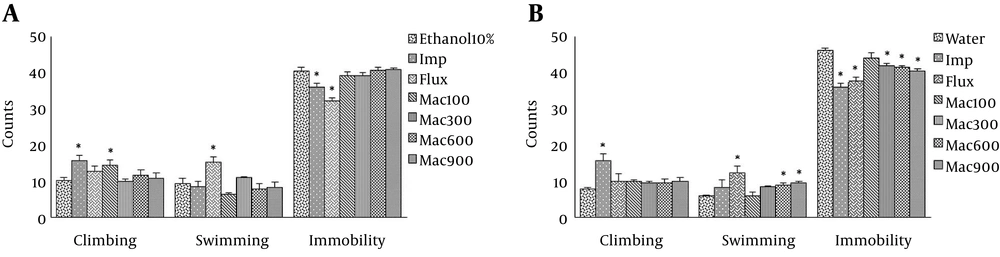
In the current study, the aqueous, but not the hydroalcoholic, extract of S. macrosiphon showed antidepressant-like activity as indicated by decreasing immobility in the FST. The antidepressant action of the aqueous extract of S. macrosiphon could not be due to an enhancement effect on locomotor activity, since the extract decreased spontaneous motor activity.
Comparing the aqueous and hydroalcoholic extracts of
S. macrosiphon, it can be suggested that the aqueous extract is the effective fraction of
S. macrosiphon in regards to antidepressant activity. The phytoconstituent(s) responsible for the antidepressant effect has to be identified and isolated in further studies. However, the phytochemical tests in the present study identified tannins in the aqueous extract of
S. macrosiphon. Tannins are water-soluble compounds of the polyphenolic group. Tannins have exerted antidepressant action in previous studies (
38,
40), and might be responsible for antidepressant effects of the aqueous extract of
S. macrosiphon. There is no other previous report regarding the phytochemicals present in the aqueous extract of
S. macrosiphon to be justified for its antidepressant activity. Certainly, future phytochemical studies are warranted for detection and isolation of antidepressant active ingredients of the aqueous extract of
S. macrosiphon. In addition, the mechanism by which the extract exerts its antidepressant effect is currently unknown. However, since the extract increased swimming, but not climbing, behavior, it can be proposed that the
S. macrosiphon extract mainly acts through serotonergic system. This is in agreement with previous reports regarding the involvement of serotonergic brain systems on antidepressant-like effect of other
Salvia species extracts i.e.
S. elegans and
S. verticillata (
15,
39,
41,
42). In addition, salvinorin A, a major active compound of
S. divinorum extract, has also exhibited antidepressant-like effect by reduced immobility and enhanced swimming behaviors in the FST (
17), which is suggestive of serotonergic involvement similar to the
S. macrosiphon extract. Surely, future studies should clarify this notion.
Comparing the two endemic Iranian Salvia species, the findings of this study indicated that the hydroalcoholic extract of S. mirzayanii is more effective than the hydroalcoholic extract of S. macrosiphon; while the aqueous of S. macrosiphon was more potent than the aqueous extract of S. mirzayanii in antidepressant-like activity. This might be due to quantitatively and/or qualitatively different phytoconstituents of these species.
The findings of this study are in agreement with previously reported antidepressant-like activity for other species of salvia genus. Previous reports are mainly used as methanolic, but not aqueous, extract of salvia genus. Thus, studies on rodent model and a single case report have indicated that
S. divinorum had antidepressant effect (
17,
43,
44). In addition, the antidepressive effects have been reported for the hydroalcoholic extracts of
S. elegans (125 - 2000 mg/kg) and
S. verticillata (250 - 2000 mg/kg) and the ethanolic extract of
S. lachnostachys Benth leaves (100 mg/kg) (
15,
41,
42,
45). Furthermore, essential oil of
S. sclarea, another
Salvia species, had antidepressant-like effect by modulation of dopamine activities in rats (
16). The range of antidepressant doses and patterns of behaviors observed in FST for other species of salvia are close to those of two endemic Iranian
Salvia species used in the current study. This suggests that possibly similar compounds are responsible for antidepressant properties of
Salvia species.
5.1. Conclusions
The results of this study indicated that both S. mirzayanii and S. macrosiphon had antidepressant effects. In addition, the hydroalcoholic extract of S. mirzayanii and the aqueous extract of S. microsiphon were more efficacious fractions of these plants; therefore, further studies to isolate the phytoconstituents responsible for antidepressant activity of S. mirzayanii and S. macrosiphon should focus on these fractions. The findings of this study support the use of these plants to treat depression as suggested in traditional medicine.