


1. Background
Domestic violence toward women remains an important challenge of mental health. World Health Organization (WHO) defines it as any action against the women that causes physical, psychological or sexual damage, or is against her freedom (1). The majority of what we know and data about different aspects of this problem comes from developed countries (2), where advanced health care monitoring and social systems are available. In the US, every year 2 million women experience physical violence, resulting in 73000 hospitalizations and 1500 deaths (3). However, the limited but valuable reports about other parts of the world indicate the extent of this problem across nations and cultures. Domestic violence is a serious health problem in Iran too with differences of prevalence and type in different regions of the country (4). The prevalence of intimate partner violence has been reported to be 63.4%, 28.0%, and 17.5% for emotional, physical, and sexual types of violence (4). Higher rates have been reported from special populations such as working women (5).
The violence against women by intimate partners is related to several problems in familial and social relationships (6) and might also affect other descendants and their behavior (7). Although any information about intimate partner violence within the family is useful for health services, this information is not easily provided in several communities not only because of stigma (8) but also because of insufficient assessment tools. Results of a systematic review in published articles from Iran in this regard show that very few articles have used a standard questionnaire for data acquisition (9). This will increase the likelihood of missing accurate data.
Several questionnaires have been validated for diagnostic evaluation and screening domestic violence, but very few are available in Persian. Sherin et al. developed HITS screening tool for domestic violence (Hurt, Insult, Threaten and Scream) that is a brief self-report tool, being used in different populations for both genders (10, 11). This tool might provide a sense of privacy for giving information about the stigmatized topic of domestic violence without asking for details. Another advantage is that HITS is very time saving and includes four questions using Likert’s scale. It identifies victims of violence in 91 % of clinical and 96% of the general population (10, 12).
2. Objectives
This study aimed to prepare the Persian version of HITS and report its psychometric properties in Iranian women.
3. Methods
This study was performed in two different sites and populations from August to December 2017. Tabriz University of Medical Sciences and Kermanshah University of Medical Sciences are located in two separate provinces with dissimilar populace. The former university is located in a province, which the majority of the population has Azeri ethnic background and the latter is located in a Kurdish and Fars ethnicity region. Therefore, we could reach a study sample with three major ethnicities of the Iranian population. The study protocol was approved by the Ethics Committee of Tabriz University of Medical Sciences and all participants gave written consent prior to participating in the study.
3.1. HITS Screening Tool
The four screening questions of HITS are as follows: “Over the last 12 months, how often did your partner: 1) physically hurt you, 2) insult you or talk down to you, 3) threaten you with physical harm, and 4) scream or curse at you?”. Responders are supposed to answer to each of these questions that appear on separate lines of a table, with a 5-point frequency format: never, rarely, sometimes, fairly often, and frequently. Therefore, score values could range from a minimum of 4 to a maximum of 20.
The HITS was translated into Farsi and (i.e. face validity). Content validity ratio (CVR) and content validity index (CVI) were estimated and items with low validity were revised finalized by a panel of experts in terms of clarity and relevance of the words. The tool was then back-translated into English and approved by the producer (10). The Persian version of HITS was designed in a table similar to the English version and printed on a paper with no demographic data of the participant.
3.2. Data Collection
In the next step of the study, married individuals and/or their spouses who attended university psychiatry clinics or family practice offices, for any reason, were enrolled in this study. All of the patients who attended the clinic in the first and third days of a week were enrolled for consecutive eight weeks. The inclusion criteria were the ability to read, willingness to participate in the study by filling a written informed consent, and age over 18. Those with an impaired memory, or in the acute phase of psychotic or affective disorders (mania, hypomania, and moderate to severe depressive episodes) were excluded. The first phase of this step was to compare the results of the Persian version of HITS with the results of a structured psychiatric interview.
After obtaining written informed consent, the participants were asked to answer the Persian version of HITS. The participants were told that they could decline to participate for any reason without an explanation. In case of agreement, a non-contributing researcher obtained their answered HITS paper sheet for further analysis. Then a psychiatric interview based on the Structured Clinical Interview for DSM-IV in Farsi language (13) was performed by skilled psychiatrists to diagnose a probable psychiatric condition as well as any kind of domestic violence toward the participant. Finally, 269 married women were fully evaluated by both Persian version of HITS screening tool and the psychiatric interview. Then the results were compared to reveal the validity of this version of HITS. The participants were invited to the clinics after four weeks and were asked to answer the HITS questions again. About 75% showed up (200 participants) and results were used to estimate the reliability of the Persian HITS.
3.3. Statistical Analysis
Data were analyzed with STATA version 12. Based on a study within the target population reporting a 15% rate on domestic violence (14), the sample size was calculated to be at least 195 subjects.
Face validity was confirmed based on expert opinions. Content validity was estimated by Content validity ratio (CVR) and content validity index (CVI). Experts were asked to rate the questionnaire in terms of the necessity of item, appropriateness, and clarity on a Likert scale and then CVR was calculated. Moreover, CVI was estimated with a modified kappa statistic. In this regard, a CVI of 0.80 or higher is considered “acceptable”.
Sensitivity, specificity, false positive, false negative rates (for testing validity) and Weighted Kappa coefficient (for testing reliability) were calculated. The reliability coefficient of 0.70 or higher is considered “acceptable”.
The receiver-operating characteristic (ROC) curve analysis was conducted to assess the overall accuracy of the HITS, using the psychiatric interview as the reference. The area under the ROC curve (AUC), which ranges from 0.5 (random performance) to 1.0 (perfect performance), is evaluated. The best cut-off value for the Persian version of HITS was estimated.
4. Results
In the first step of the study (preparing Farsi HITS), a panel of experts, including three psychiatrists, one psychologist, and one language expert translated the HITS tool, and concluded on its face validity. Ten psychiatrists and psychologists rated the new questionnaire as described within the methods and CVI and modified kappa were calculated to be 1 for questions 1, 3, and 4. For question number 2, CVI and kappa were 0.96. The tool was back-translated into English and approved by the producer.
Of the total sample, 44.6% were Azeri Turkic, 36.4% had Kurdish ethnic background and 19.0% were Fars. The mean age ± standard deviation (SD) of the participant women was 34.96 ± 9.83 years ranging from 18 to 64. The number of their children ranged from one to seven, with a mean ± SD of 2.41 ± 1.34. The highest educational degree was high school graduation in 57.2%, and the remaining had different levels of university education. The majority of the participants were housewives (78.9%), 13.5% were employed, and the remaining 7.6% were self-employed.
Answers of the participants to HITS in the first visit are described in Table 1. Only 97 (36.1%) participants reported they have never been victimized by any kind of violence listed in HITS. Table 2 shows the results reported by psychiatrists. Based on reports of the psychiatric interview, 58 women (21.5%) were victimized by domestic violence.
Table 1.Answers of Iranian Women (N = 269) to the Persian Version of HITS in the First Visit
| How Often Does Your Partner… | Never, No. (%) | Rarely, No. (%) | Sometimes, No. (%) | Fairly Often, No. (%) | Frequently, No. (%) |
|---|---|---|---|---|---|
| Physically hurt you? | 206 (76.6) | 22 (8.2) | 26 (9.7) | 7 (2.6) | 8 (3.0) |
| Insult or talk down to you? | 132 (49.1) | 53 (19.7) | 47 (17.5) | 26 (9.7) | 11 (4.1) |
| Threaten you with harm? | 202 (75.1) | 23 (8.6) | 21 (7.8) | 11 (4.1) | 12 (4.5) |
| Scream or curse at you? | 133 (49.4) | 49 (18.2) | 44 (16.4) | 22 (8.2) | 21 (7.8) |
Table 2.Results of the Psychiatric Interview of Iranian Women (N = 269)
| Victimized by | Not Victimized, No. (%) | Victimized No. (%) |
|---|---|---|
| Physical hurt | 256 (95.2) | 13 (4.8) |
| Insult or talk down | 223 (82.9) | 46 (17.1) |
| Threaten with harm | 238 (88.5) | 31 (11.5) |
| Scream or curse | 223 (82.9) | 46 (17.1) |
Based on the results of ROC curve analysis, the best cut-off point of the Persian version of HITS for diagnosing domestic violence was 9. Taking this cut-off point, 199 records were true negative, 5 were false negative, 12 were false positive, and 53 were true positive. Thus cut-off 9 had a sensitivity of 0.914, specificity of 0.943, positive predictive value (PPV) of 0.815, and negative predictive value (NPV) of 0.975. Figure 1 shows the described ROC curve with the AUC to be 0.974, LR + 16.068, LR – 0.091 and J-point was calculated to be 0.857.
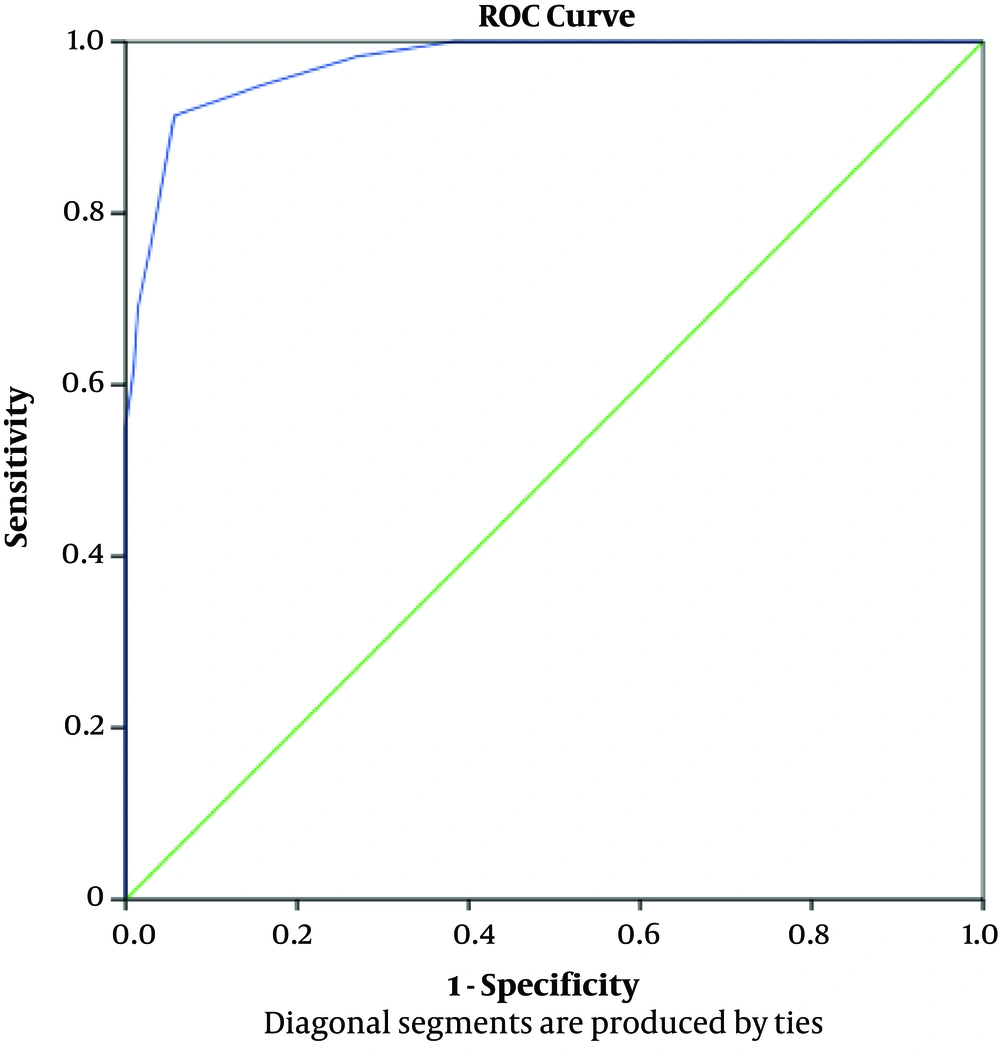
Figure 1.
The receiver operating characteristic (ROC) curve of the Persian HITS based on the results of this study. At cut-off score 9, the Persian HITS demonstrates the accuracy in predicting group membership with a sensitivity of 91.4% and specificity of 94.3%. The area under curve (AUC) of the ROC curve is 0.974.
For testing the reliability, 200 participants showed up and answered the Persian HITS for the second time. The results are described in Table 3. These results were compared with the results given by the same participants in the first round (Table 4).
Table 3.Answers of Iranian Women (N = 200) to the Persian Version of HITS for the Second Time
| How Often Does Your Partner… | Never, No. (%) | Rarely, No. (%) | Sometimes, No. (%) | Fairly Often, No. (%) | Frequently, No. (%) |
|---|---|---|---|---|---|
| Physically hurt you? | 172 (86.0) | 14 (7.0) | 11 (5.5) | 1 (0.5) | 2 (1.0) |
| Insult or talk down to you? | 103 (51.5) | 48 (24.0) | 31 (15.5) | 15 (7.5) | 3 (1.5) |
| Threaten you with harm? | 158 (79.0) | 21 (10.5) | 12 (6.0) | 7 (3.5) | 2 (1.0) |
| Scream or curse at you? | 101 (50.5) | 49 (24.5) | 32 (16.0) | 12 (6.0) | 6 (3.0) |
Table 4.Measurement of Agreement and Kappa Coefficient for Answers Given to the Persian HITS in the First and Second Visit
| Measure of Agreement (Predictive), % | Measure of Agreement (Measured), % | Kappa Coefficient | |
|---|---|---|---|
| Physically hurt you | 89.69 | 99.75 | 0.975 (P = 0.001) |
| Insult or talk down to you | 73.92 | 98.25 | 0.932 (P = 0.001) |
| Threaten you with harm | 85.04 | 99.00 | 0.933 (P = 0.001) |
| Scream or curse at you | 72.84 | 97.88 | 0.921 (P = 0.001) |
As described in Table 4, Cronbach’s alpha coefficients for testing the consistency of answers to the first question was 0.994, for the second was 0.984, for the third question was 0.977, and for the fourth question was 0.981. Therefore, all questions of the Persian HITS had acceptable reliability.
5. Discussion
This study evaluated the validity and reliability of the Persian version of HITS to estimate the best cut-off for diagnosing domestic violence in Iranian women and revealed that Persian HITS has acceptable reliability.
Despite the debate about the efficiency of screening people for domestic violence (15, 16), the fact that few female patients are screened for domestic violence (16, 17) seems to be universal. Implementation of a screening program in the healthcare system in Iran and its possible positive impact or harm should be addressed when sufficient data get available in this community. We believe that standard tools such as HITS might facilitate these types of studies in Iran.
Domestic violence against women has complex relationships with cultural factors. Domestic violence can be ignored or excused for ‘cultural reasons’, prevented from help and stigmatized, or make the victim more visible because of cultural beliefs (18, 19). Iran is a multi-cultural country, with ethnicity and cultural differences within its populace. Despite limited but valuable reports from different parts of Iran (20, 21), there is no large-scale report on domestic violence in a population. The lack of a standard screening tool might add to the barriers of research about domestic violence that was the main concern of this study. In addition, selecting different geographical regions with noticeable ethnical differences provided access to different cultures within Iran that is an important issue in the research about domestic violence.
The best cut-off score of the original HITS is 10.5 to achieve a sensitivity of 91% and a specificity of 96%. The best cut-off in our study was lower, implying that the Iranian population might overlook the abuse. The HITS, which is originally English has been translated into other languages too. The cut-off value for Spanish version of HITS is 5.5, with a sensitivity of 100% and a specificity of 86% (12). The sensitivity and specificity were calculated based on the results of Woman Abuse Screening Tool (WAST). The higher sensitivity of the Spanish version might be explained by the method that we used, and compared results of the Persian HITS with results of a psychiatric interview where the skilled psychiatrist could use several types of techniques to obtain more valid answers. Interestingly, this brief self-report (Farsi version) has a high specificity with cut-off 9.
It is appropriate to discuss here that HITS does not include questions about sexual abuse. This limitation might be an advantage by decreasing the stigma of giving an answer to the whole tool. Nevertheless, Chan et al. “extended” HITS by adding a question about sexual abuse, and reported the best cut-off 8.5 for this translated and five-question tool with a sensitivity of 98.2% and a specificity of 94.8% [47]. The HITS has been successfully used in the male population too. Shakil et al. reported that cut-off 11 has a sensitivity and specificity of 88% and 97% (11). Hence, Persian HITS is a valid, reliable, and practical tool for the assessment of violence in families similar to other versions.
This study had some limitations. This was not a population-based study; however, the sample was recruited to university clinics as well as family practice offices and comprised both clinical and non-clinical participants. As victimized women usually have lower access to health services, the sample had a low chance of including them and this might influence the results. The sample missed illiterate women and non-responders as well that might be addressed in further studies.
5.1. Conclusions
The Persian version of HITS is now available as a valid tool for screening domestic violence in Iranian women with acceptable validity and reliability.

