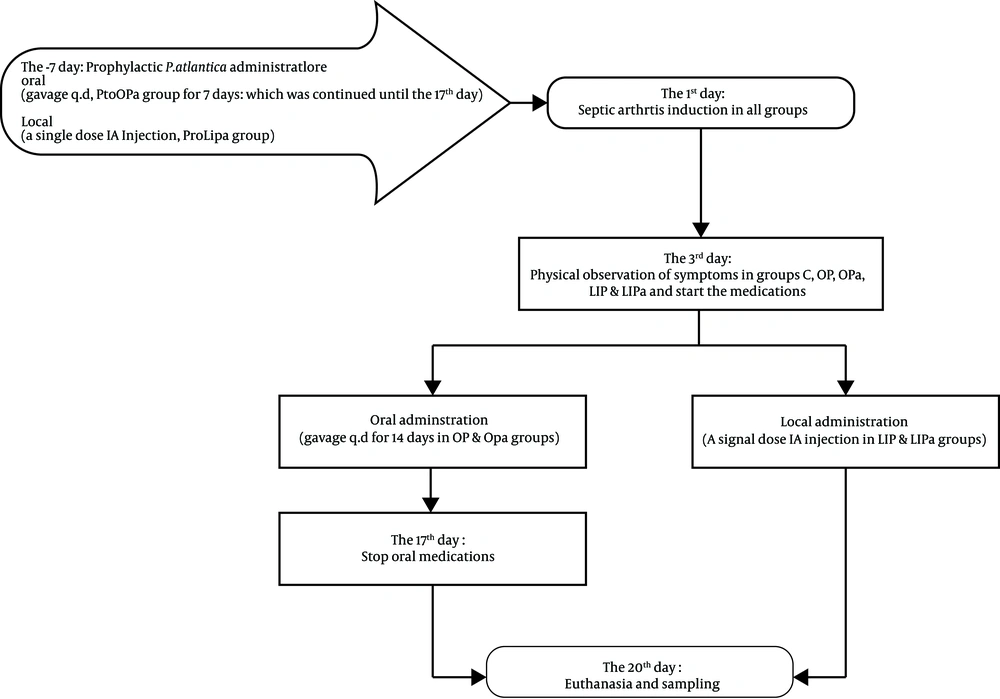
In this study, synovitis appeared just three days after the IA injection of
S. aureus. Evaluating clinical and paraclinical effects of
P. atlantica on
S. aureus septic arthritis showed that joint inflammation symptoms were present so obviously in the control group to the end of the study revealing two cases of mortality, but no mortality was recorded in the experimental rats. The final physical examination revealed that P.O.
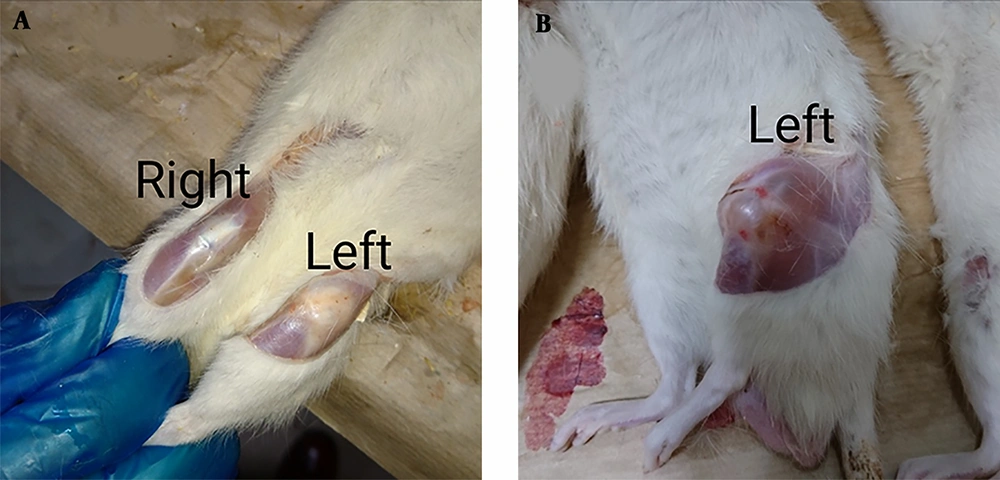
P. atlantica (OPa group) reduced gross symptoms of inflammation and lameness impressively, while inflamed joints in local injections were the same as or even worse than the control (
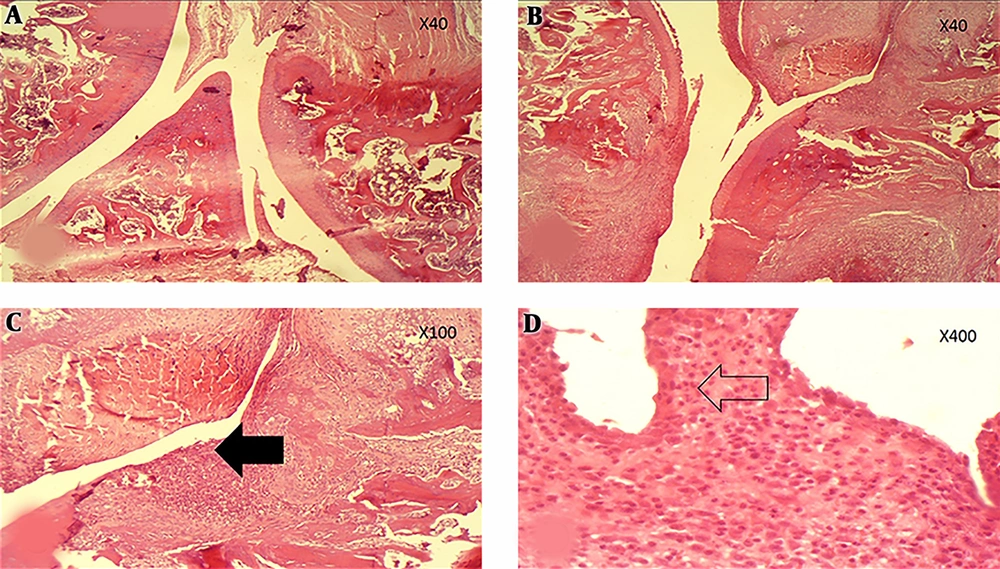
Figure 2). The WBC and platelet counts decreased in the control group, whereas RBC count, hemoglobin, and hematocrit increased in experimental groups. Histopathological findings showed synovitis and cartilage/bone destruction, which was ameliorated by P.O. administration of
P. atlantica extract.
The WBC counts illustrated a leukopenia in the control group and significant reflective leukocytosis in all experimental groups compared to the control group. Induced septic arthritis released chemotactic factors to activate leukocyte migration toward the infected/inflamed site (
22,
24). The leukopenia of the control group might show the microorganisms overcome the body and depletion of reservoir leukocytes. In reflective leukocytosis, WBCs egress from bone marrow reservoir to blood flow by stress, fever, trauma, a medical agent administration, or even an edible (
25). Phagocytic cells of innate immunity, as well as mast cells and platelets, will be affected by chemotaxis (
24). Here, the effect of stress and synovial trauma could not be ignored since no significant differences were detected between experimental groups. Stress leukogram is due to increased endogenous/exogenous corticosteroids (
25,
26). In this study, the OPa group had the most closed WBC count to the normal that may be probably attributed to the benefits of P.O.
P. atlantica. Similar to WBC counts, differential counts showed lymphopenia, monocytopenia and granulocytopenia in the control group and reflective lymphocytosis, monocytosis and granulocytes in the experimental groups. Lymphocytosis indicates the involvement of acquired immunity as well as the recovery stage of an infectious disease (
24,
25). So, close lymphocyte counts to the normal in the experimental groups might present improvement, especially in the OPa group ascribing to the benefits of P.O.
P. atlantica. This improvement could not be achieved by oral normal saline, as the highest lymphocytosis belonged to the OP group. Mononuclear phagocytic cells eliminate pathogens via specific receptors of pathogen-associated molecular patterns (PAMPs) (
24). Significant increases in monocyte count in the experimental groups indicated body reflection to medications and monocyte egression from bone marrow reservoirs to blood fellow. Strong stimulatory effect of daily gavage stress plus infected synovium was defeated by benefits of P.O.
P. atlantica in the OPa and ProOPa groups; compared to the OP group which had the highest monocyte count. Oral prophylactic
P. atlantica had the closest monocyte count to the normal group, possibly explaining accumulative effects of long-term P.O.
P. atlantica. Peripheral neutrophils will be attracted to the infected site by chemotaxis (
24). Here, all medications caused reflective agranulocytosis but P.O.
P. atlantica had the closest count to the normal group, whereas the ProOPa group had the highest granulocyte count probably due to stress dominancy prior to benefits of
P. atlantica on the granulocytes.
Intra-articular septic arthritis induction caused a significant RBC fall compared to the normal state, which means that the impact of the local infection was systemic and RBCs immigrated and settled down in the spleen. The RBC increment in all experimental groups explained the secretion of epinephrine/nor-epinephrine, affecting the spleen to release RBCs; thus stress might stimulate their secretion (
24,
25). With this respect, RBC alterations in the experimental groups seem to be due to daily gavage stress and painful stimulation of IA injected agent. The highest RBC count in the local injection of
P. atlantica after septic arthritis diagnosis (LIPa group) may be as a result of higher adrenal release from painful and erosive synovium, which remained high after 17 days, but it was alleviated after 25 days in the ProLIPa group with the closest RBC count to the normal group. Daily gavage stress was alleviated by P.O.
P. atlantica benefits in the OPa group. The same trend was seen in the hemoglobin and hematocrit values.
Platelets contribute to the inflammatory response as well as other innate immune cells (
24). The release of their granule ingredients results in excessive endothelial permeability and complement system activation (
24). The observed thrombocytopenia in the control group suggests the consumption of platelets beside the influence of catecholamines on the clearance of platelets by the spleen. Although it was not significant, the slightly higher platelet values in IA injected groups may be due to more damage than oral groups since P.O.
P. atlantica had the closest count to the normal group.
Pathological study illustrated that septic arthritis could significantly affect the histopathologic pattern of synovium, leading to synovitis followed by cartilage and bone destruction. it seems that wash out effect by normal saline had caused significant alleviation of the increased factors in placebo groups; the
P. atlantica-receiving groups exacerbated the condition by affecting erosive and stimulatory conditions. This is more obvious in hypertrophy of synovial tissue/pannus formation and cartilage/bone erosion that had the highest score in the ProLIPa group. Considering the arthritogenic properties of bacterial debris and released soluble components such as lipoteichoic acid and peptidoglycan (
22), it can correlate with
P. atlantica antibacterial activity (
11). Elimination of bacterial components, inflammatory mediators, and infiltrated immune cells and their harmful effects from synovium by normal saline, can encourage the idea. The observed synovitis indicates the involvement of innate immunity. Here, the degree of synovitis was ameliorated by P.O.
P. atlantica, confirming the least macroscopic symptoms. The therapeutic P.O. and IA
P. atlantica differed significantly from each other, but prophylactic
P. atlantica and local therapeutic
P. atlantica showed no significant differences. Increased infiltrated inflammatory cells into synovial cavity were also affected by washout effect of normal saline, while
P. atlantica extract slightly deteriorated it. Acquired immunity is needed by lymphocyte infiltration for the destruction of infected cells at the site (
24). Here, despite the lowest peripheral lymphocytes level of the control group, its pickup in histopathology of synovium explained the immigration of these cells apparently. Both infiltrated lymphocytes and degree of synovitis were reduced by P.O.
P. atlantica, but the local IA
P. atlantica showed the highest lymphocyte infiltration possibly due to more stimulation and destruction of synovium manifested by erosion scoring. In lymph nodes, B lymphocytes would change to plasma cells to form a specific immunoglobulin isotype and then leave the node (
24). Here, alterations can be attributed to the same reason. The PMNs as innate immune phagocytic cells destroy pathogens via PAMPs (
24). Although these infiltrated cells did not show significant alterations at any level,
P. atlantica medications showed lower values, indicating the effect of
P. atlantica on PAMPs.
Increased cartilage/bone erosion scoring in
P. atlantica-receiving groups reinforced in mind the subsequent arthritogenic outcome of
P. atlantica extract antibacterial activity, especially by a direct effect on local administration, in addition to painful stimulation and the amount of induced stress it causes. The first step of septic arthritis treatment is joint lavage or drainage to eliminate bacterial component (
1,
22). In this study, the painful and stressful needle arthrotomy was avoided, but the effects of diluting and washing out of microorganisms were found in the local injection of normal saline. To find erosive nature of
P. atlantica on synovial contents and other unexpectable effects (
27), future studies on detecting the erosive action of
P. atlantica in a non-infectious condition are suggested to differentiate possible arthritogenic properties of bacterial contents. Also, it is better to evaluate the effects of
P. atlantica on serum levels of immune mediators, and biopsy of spleen and lymph nodes plus the synovial tissues for more advanced serological and immunohistochemical tests.
5.1. Conclusion
In conclusion, P.O. P. atlantica could alleviate clinical symptoms of septic arthritis.
Systemic benefits of P.O. P. atlantica could improve the body condition, but local P. atlantica could not show good systemic effects.
Histopathological findings confirmed the cellular immunity involvement and antibacterial activity of P. atlantica, encouraged by more erosion of synovial cartilage and bone due to more bacterial debris and contents release with arthritogenic properties. Meanwhile, possible stimulatory effects of P. atlantica extract on synovial content should not be ignored. The P.O. P. atlantica showed reasonable reduction in the inflammation of the synovial capsule.