


1. Background
Pregnancy and childbirth are special conditions for pregnant women and those around them. Not adapting to the physical and psychological changes of pregnancy can cause much stress for the pregnant mother. The profession of midwifery is a subset of medical sciences playing a unique role in society’s reproductive health to maintain and promote mothers’ and neonates’ physical, mental, and social health during pregnancy, childbirth, and postpartum period (1, 2). Therefore, respecting pregnant women’s dignity and rights and observing ethics are vital issues in the health care system (3, 4).
Moral performance is one of the main components of maternal and fetal care (5). As the first level of contact between mother and newborn in health centers, midwives play a vital role in providing pregnant women services. The awareness of laws, regulations, and technical and scientific matters can effectively establish proper communication with patients and reduce complaints. The familiarity of employees of each profession with its governing rules significantly reduces the incidence of errors and improves the quality of services (6, 7). Therefore, those new to the midwifery profession should be aware of their profession’s ethical considerations (8). Moreover, any disruption to the observance of ethics in providing care can overshadow the most scientific and best care results (9, 10).
Due to the multiplicity of duties of midwives and their occupation descriptions, ethics are classified in the form of codes for midwifery services in many countries, especially in developed ones, according to their culture and social conditions and the structure of health services in the form of rules and laws. For this reason, in Iran, which is an Islamic country with a rich culture, the need to develop professional ethics using Islamic verses and traditions and medical experts’ advice for various professions, including midwifery, has been considered. The Midwifery Office of the Deputy Minister of Health developed the midwifery ethical codes in Iran in six areas in 2015. These six areas include (1) fulfillment of professional obligations (23 codes), (2) provision of services to the client and her companions (27 codes), (3) communication with colleagues (11 codes), (4) communication with self (6 codes), (5) education and research (8 codes), and (6) management (10 codes).
Adherence to ethical codes and reduction of the stress of service recipients, such as the mother and her family, increase their satisfaction, enhance the quality of services, and ultimately improve the community health. Midwives should always consider some important moral principles and virtues in midwifery care, including self-sacrifice, confidentiality, respect for the individual, justice, charity, benevolence, avoiding harming others, gaining knowledge, soul, faith, piety, and humility (11). However, since the observance of ethics based on beliefs and socio-cultural contexts of individuals causes different behaviors, it has always been tried to measure and monitor the observance of professional ethics codes by working midwives and some related factors through conducting various studies (12). One of the best sources for checking the quality of services and observing ethical and professional principles by midwives is pregnant women.
One of the rights of pregnant women and their families is to be fully aware of the advantages and disadvantages of different treatment methods and participate in the decision-making process of treatment and care. Therefore, examining this issue by pregnant women aware of their rights makes the evaluation result more reliable. In this regard, the accurate evaluation of compliance with these ethical principles by midwives requires an appropriate method and standard tool to consider the observance of fair assessment criteria, including validity, reliability, and objectivity (13). Therefore, in this study, a reliable and valid questionnaire was designed for the evaluation of midwives’ professional ethics by parturients.
2. Methods
This qualitative-quantitative study was conducted in 2018-2019 to assess the professional ethics of midwives by parturients. In this regard, this study designed a questionnaire and then examined the questionnaire validity and reliability. Initially, the modified Delphi method was used to determine the questionnaire content, identify the dimensions of professional ethics in pregnancy and childbirth, and review extensive studies on midwifery, gynecology, and medical ethics.
Based on reviewed studies and especially the Code of Ethics developed by the Ministry of Health in 2015, the questionnaire items were selected and sent to the experts (15 faculty members of Fasa University of Medical Sciences, Fars, Iran) via e-mail. Then, they were invited to a panel to discuss the items and dimensions of the questionnaire. The first version of the questionnaire with 26 items was developed. To evaluate its validity, content and construct validity were examined by 15 faculty members of Fasa University of Medical Sciences. The inclusion criteria were full consent of faculty members to participate in the study and experience and expertise in medical ethics, medical education, gynecology, and obstetrics. To determine the face validity, they reviewed and edited the questionnaire in terms of grammar, appropriate words, and placement of items in the right place (14). The content validity ratio (CVR) and content validity index (CVI) of Waltz and Bausell were used to determine the content validity.
The content validity was examined based on the Lawshe’s method. According to this method, the experts surveyed the items of the questionnaire on a 3-point scale, including “it is necessary”, “it is beneficial but not necessary”, and “it is not necessary”.
The following is the Lawshe’s CVR formula:
where NE is the number of experts who have chosen the necessary option, and N is the total number of evaluator experts. Values above 0.49 (for 15 raters) were acceptable according to the Lawshe’s table (15).
The CVI is related to sampling adequacy. To calculate the CVI of each item, 15 experts rated each item of the questionnaire based on the three criteria of “relevance”, “transparency and clarity”, and “simplicity and fluency”, and then calculated CVI according to the following formula:
The average CVI of the questionnaire items was defined as the total content validity. The acceptable score is at least 0.79 (16, 17). The questionnaire total CVI was reported as 0.92.
After this phase, the items of the questionnaire were reduced to 20. The Kaiser-Meyer-Olkin factor analysis was used in this study to ensure that the sample size was adequate. In the present study, according to the number of items entered for exploratory factor analysis (EFA) (n = 20), the sample size was 200 pregnant women (10 cases per item). The pregnant women who participated in this study were selected from mothers hospitalized in Valiasr Hospital of Fasa University of Medical Sciences and attended prenatal preparation classes (about childbirth stages and patient rights).
2.1. Reliability Assessment
Reliability means the power of repeatability and continuity of measurement. When the reliability is higher, the test measurement error will be lower. In this study, the internal consistency method was used to calculate reliability. A questionnaire has an internal consistency that is homogeneous, which means that its items measure similar characteristics. The most common method for calculating internal consistency is Cronbach’s alpha (or alpha coefficient). Cronbach’s alpha should be higher than 0.7. (18) In this study, a sample of 200 parturients completed the questionnaire, and Cronbach’s alpha was reported as 0.89.
2.2. Factor Analysis
Two EFA and confirmatory factor analysis (CFA) methods were used in this study. The goal of EFA is to discover the pattern or identify the underlying structure of the data. This underlying structure is, in fact, latent variables or factors. Using CFA, factors are identified, and the observed variables are placed in these factors. In other words, the data were summarized in a smaller set of factors. In EFA, there is no initial theory or pre-designed model for data related to a concept, and it is assumed that each factor can be associated with any observable variable. In EFA, the number of factors is not predetermined, and the goal of the underlying structure is based on the relationship between the data. In this study, the EFA of the data was performed using SPSS software (version 22) and principal component analysis.
The CFA is a multivariate statistical procedure used to test how well the measured variables represent the number of constructs. In CFA, researchers can specify the number of factors required in the data and which measured variable is related to which latent variable. The CFA is a tool that is used to confirm or reject the measurement theory.
3. Results
This study was carried out on a total of 200 postpartum mothers hospitalized in Valiasr Hospital of Fasa University of Medical Sciences. The mothers were within the age range of 15 - 40 years, and 60% of mothers attended delivery introduction classes during pregnancy. The items were modified and edited by performing face validity in terms of quality (i.e., clarity, simplicity, grammar, use of appropriate words, and placement of phrases in the appropriate place). None of the 26 items of the questionnaire were omitted at this stage.
When calculating the CVR based on Lawshe’s table, the items with a numerical value of equal to or higher than 0.49 were considered significant, and that item was retained. At this stage, 21 items had a score higher than 0.49 and were retained; however, five items with a score lower than 49 were deleted. The calculation of the CVI for one item showed a numerical value of less than 0.790 and consequently a questionnaire with 20 items. The item was approved for factor analysis (Table 1).
Table 1.Calculation of Content Validity Based on Lawshe’s Table
| Content Validity | Number of Experts | Accepted Values (Higher Than) |
|---|---|---|
| Content validity ratio | 15 | 0.49 |
| Content validity index | 15 | 0.79 |
Two types of EFA and CFA were performed to determine the content validity of the items. Therefore, after performing the EFA order in the first stage, the KOM index was calculated with a numerical value of 0.95, indicating the sample size adequacy. Furthermore, during the Bartlett’s sphericity test, since the measured significance level was 0 and less than the significance level of 0.05, the data construction was suitable for EFA, indicating the existence of detectable relationships between the analyzed variables (Table 2).
Table 2.Kaiser-Meyer-Olkin Test and Bartlett’s Test for Exploratory Factor Analysis
| Index | Values |
|---|---|
| Kaiser-Meyer-Olkin test statistic | 0.95 |
| Bartlett’s test | |
| Chi-square approximation | 4105.48 |
| Degree of freedom | 190 |
| Measured degree of freedom | 0.00 |
The second output of EFA, called the subscription table, includes the initial subscription and extractive subscription. Due to the expression of the initial subscription column before extracting the factors, all initial subscriptions are equal to 1. Regarding the calculated extraction coefficient, if the coefficient of determination for a variable is less than 0.50, that variable should be removed. The exploratory factor is re-analyzed because the insignificant value of the coefficient of determination means that this variable is not related to any of the hidden factors. In the present analysis, all the 20 items had a coefficient above 0.50, and there was no need to delete any items.
The third output of EFA includes the initial eigenvalue, eigenvalue of extraction factors without rotation, and eigenvalue of extraction agents with rotation (Table 3). In this study, based on the eigenvalues higher than 1 and the slope of the scree plot diagram (Figure 1), two factors with a predictive power of 80.31% of the total changes in the evaluation of midwifery professional ethics were extracted and selected.
Table 3.Table of Special Values and Explained Variance Based on First-Order Exploratory Factor Analysis
| Factor | Initial Special Values | Squared Sum of Extracted Factor Loads | Squared Sum of Factor Loads After Varimax Rotation | ||||||
|---|---|---|---|---|---|---|---|---|---|
| Special Values | Percentage of Explained Variance | Percentage of Accumulated Variance | Special Values | Percentage of Explained Variance | Percentage of Accumulated Variance | Special Values | Percentage of Explained Variance | Percentage of Accumulated Variance | |
| 1 | 14.88 | 74.43 | 74.43 | 14.88 | 74.43 | 74.43 | 11.89 | 59.46 | 59.46 |
| 2 | 1.17 | 5.87 | 80.31 | 1.17 | 5.87 | 80.31 | 4.17 | 20.84 | 80.31 |
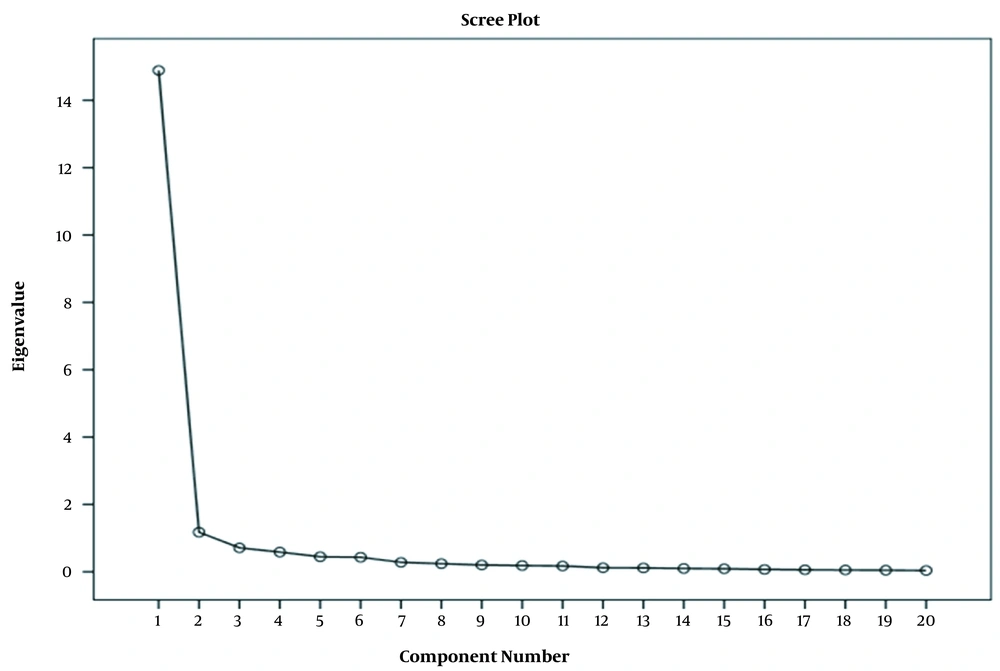
Figure 1.
Scree plot based on exploratory factor analysis to determine correlation between items
The rotated factor matrix was used to identify the items that make up each factor and determine which factor relates to each item (Table 4). In Table 4, each row represents a question. The most significant number in each row identifies the factor associated with that question. For example, in the first line, 0.54 is higher than the other numbers, and it was concluded that this item is related to the first factor. In general, in this analysis, two main factors were identified for the items based on the attitude of the mothers toward professional ethics. The first factor was the observance of ethical standards with 14 items, and the second factor was the provision of services with 6 items.
Table 4.Rotated Factor Matrix in First-Order Heuristic Factor Analysis
| Variables | Factor | |
|---|---|---|
| First | Second | |
| Q1 | 0.837 | |
| Q2 | 0.736 | |
| Q3 | 0.814 | |
| Q4 | 0.888 | |
| Q5 | 0.809 | |
| Q6 | 0.910 | |
| Q7 | 0.900 | |
| Q8 | 0.890 | |
| Q9 | 0.810 | |
| Q10 | 0.796 | |
| Q11 | 0.797 | |
| Q12 | 0.888 | |
| Q13 | 0.846 | |
| Q14 | 0.561 | |
| Q15 | 0.585 | |
| Q16 | 0.910 | |
| Q17 | 0.604 | |
| Q18 | 0.803 | |
| Q19 | 0.553 | |
| Q20 | 0.830 | |
Confirmatory factor analysis (CFA) was used to investigate construct validity. It assumed that the t-value is significant if the absolute t value is higher or equal to 1.96, meaning |t| ≥ 1.96 and α at .05. Moreover, to set α at .01, the t-value higher or equal to2.58 is significant, meaning |t| ≥ 2.58.
3.1. Reliability
One of the standard methods in the determination of reliability is Cronbach’s alpha method, which aims to calculate the internal consistency of measuring instruments, including questionnaires. Since Cronbach’s alpha value was 0.89, more significant than 0.70, the questionnaire had outstanding reliability.
A composite reliability criterion was used to evaluate the model reliability. Unlike Cronbach’s reliability, which considers the importance and weight of all the items equal, in the composite reliability, the reliability of each item is calculated based on the factor load of the item. This criterion should be above 0.70. As shown in Table 5, the composite reliability (P Delvin- Goldstein) of all items on the core categories of professional ethics is above 0.70. Therefore, the reliability of the measurement model was confirmed.
Table 5.Composite Reliability Values for Assessment of Midwiferies’ Professional Ethics from Parturients’ Viewpoint
| Components | Composite Reliability |
|---|---|
| Ethical principles | 0.894 |
| Service provision | 0.832 |
| Total | 0.892 |
4. Discussion
In this study, to design a valid and reliable questionnaire for the evaluation of midwifery professional ethics by parturients, an initial questionnaire with 26 items based on the views of experts was developed after extensive studies and numerous discussions in the field. The face validity, CVR, and CVI were calculated utilizing the comments of professors and midwifery staff in the next step. Then, according to completed questionnaires by 200 parturients hospitalized in the postpartum ward, two types of EFA and CFA were performed. In summary, the factor analysis results in the present study showed that this scale had sufficient validity and was saturated with two factors.
The first factor was positively correlated with the 14 items implying the observance of ethical standards and showing how midwives and nurses behave with parturients regardless of their service level. The second factor was positively correlated with the 6 items, reflecting the quality of service provision.
The results also showed that factor load values were desirable in the latent factor analysis, and the value of t related to each factor was more significant than its critical value (2.58) at a 0.001 level of 0.001. Moreover, the composite reliability value was 0.9820, indicating the high internal consistency of the variables. The average variance extracted (AVE)value was also 0.744, which was more significant than 0.50; therefore, the convergent validity of the model was confirmed. The designed questionnaire has the desirable reliability and validity to assess the midwifery professional ethics by parturients based on the available results.
In 2008, the Maternity Unit of the Istanbul Faculty of Medicine, University of Istanbul, Turkey, developed the scales to assess parturient satisfaction in natural and cesarean births. This study aimed to develop an instrument to measure pregnant women’s satisfaction and evaluate their experiences during childbirth. The measurement of maternal satisfaction was based on the Newcastle Satisfaction with Nursing Scale, including 19 items scored based on a 5-point Likert scale. The sample consisted of 500 low-risk postpartum women (250 natural and 250 cesarean cases) giving birth to a single healthy fetus over 37 weeks of gestation during the study period and agreed to participate. In the natural and cesarean birth scales, CVI scores were reported as 0.91 and 0.89, respectively. The validity assessment of construct via factor analysis resulted in 10 subscales, namely “perception of health professionals”, “comforting”, “nursing/midwifery care in labor (in cesarean version: preparation for cesarean)”, “information and involvement in decision-making”, “meeting newborn”, “hospital room”, “postpartum care”, “hospital facilities”, “meeting expectations”, and “respect for privacy”. With Cronbach’s alpha coefficients of 0.91, both scales exhibited good internal reliability (19).
In an additional study performed by Khadivzadeh et al., midwives’ communication skills were assessed using the researcher’s communication performance checklist. The checklist consisted of 26 items scored based on a 5-point Likert scale. The total score was within the range of 0-130. The midwives were classified under three classes based on the final score of communication skills as poor (0 - 43), moderate (44 - 87), and good (88 - 130) communication skills. The checklist was completed during different work shifts at maternity wards and in the researcher’s presence. The researcher observed and assessed the communicative behaviors of midwives with parturient women throughout various phases of labor, childbirth, and postpartum period. The checklist reliability was defined by internal consistency utilizing Cronbach’s alpha coefficient of 83%. At the Mashhad School of Nursing and Midwifery, 10 professors determined the content validity of the questionnaire; however, no additional explanation was offered (20).
In 2012, in six teaching hospitals of Tabriz, Iran, a descriptive study was performed on 345 nurses and 500 inpatients to study the knowledge and performance of nurses about nursing ethics codes. The nurses’ questionnaire had two sections, namely (A) demographic characteristics and (B) nurses’ knowledge of nursing ethics codes from the nurses’ perspective, comprising 35 statements according to a 3-item Likert scale. Patients’ questionnaire had two sections, namely (A) demographic characteristics and (B) performance of nurses about nursing ethics codes from the patients’ perspective, comprising 30 statements according to 6-item Likert scale (always, often, sometimes, rarely, never, and I do not know) scored from 0 to 5. Kuder-Richardson computed the reliability of the questionnaires for nurses’ knowledge at 1.012, Cronbach’s alpha for nurses’ performance from nurses’ perspective at 0.79 (n = 30), and Cronbach’s alpha for nurses’ performance from patients’ perspective at 0.74. No detailed description was provided on the steps and face and content validity determination results of the questionnaire (21).
Instrument development to measure satisfaction levels in critical patients was the aim of a study performed by De La Cueva Ariza et al. Grounded Theory was used in the research qualitative phase. The stage consisted of in-depth interviews after theoretical sampling, investigation of related articles, and expert discussion groups. In the next step, quantitative and descriptive phases designed the questionnaire and measured the instrument validity. Validation was based on content validity, and Cronbach’s alpha and test-retest approach were applied to calculate the construct and reliability of the tool. The protocol approval date was November 2010. Determinants for satisfaction mentioned in the final questionnaire included factors, such as self-perception, experiences, and beliefs, together with demographic, political, sociocultural, and epistemological factors (22).
4.1. Conclusions
This study aimed to design a valid and reliable questionnaire for the assessment of midwifery professional ethics in the delivery process. One strength of the present study, compared to those of the aforementioned studies, is performing both exploratory and confirmatory factor analyses. In this study, some goals of EFA consisted of determining questionnaire dimensions, standardizing questionnaires, reducing the items (from variables to factors), and assessing homogeneity and discrimination in construct validity. The EFA is often used in the early stages of study to collect information about the interactions in a set of variables. The obtained results revealed that the designed questionnaire is a valid and reliable tool for the evaluation of midwifery professional ethics by parturients, which can be applied in other studies in Iran.
4.2. Limitations
In the present study, one of the limitations was the distribution of the questionnaire only among the midwifery service providers in Fasa; therefore, this sample does not represent the whole midwifery population. Consequently, the generalizability of the results should be considered.

