
1. Background
The World Health Organization (WHO) declared the outbreak of COVID-19 as a public health crisis and a worldwide problem on January 30, 2020, the sixth global problem under international health care and a threat to global health. COVID-19 is an infectious disease caused by the coronavirus (1). Characterized by respiratory and gastrointestinal infections, as well as severe heart and brain damage, this condition can be viewed as a traumatic event (2). The diagnosis of COVID-19 may intensify the fear of the disease, the feeling of disability, and the social stigma (3-5). Concern for ill relatives can contribute to emotional strain and further exacerbate the person's psychological distress (6). It can lead to trauma-related symptoms, especially for those suffering from this disease (7, 8). The high prevalence of psychologic symptoms, such as post-traumatic stress symptoms, has been reported in patients with COVID-19 (9, 10).
Positive and negative changes after a trauma can be experienced simultaneously (11). Traumatic events such as diseases lead to traumatic stress as well as positive changes in people's lives. These positive changes are conceptualized as “post-traumatic growth” and can lead to changes in self-perception, interpersonal relationships, and one’s philosophy of life (12). Although it is possible to experience adverse effects of the disease after recovery from COVID-19, sometimes positive changes are also seen, which is called post-traumatic growth (PTG) (13).
PTG includes positive psychological changes and the perception of personal benefits in survivors of traumatic events that result from their efforts to cope with the trauma and its consequences in five areas: Self-confidence, change in relationship quality, new experience or different opportunities, more appreciation of life, more openness to spiritual issues and spiritual and existential changes (14). The COVID-19 pandemic may also boost such growth (15).
Responses to trauma such as COVID-19 can vary widely among individuals, but the role of personality traits in PTG is important and effective in preparing for this type of growth. In many cases, facing a very stressful event can lead to mental distress or mental disorders (16). Studies show that personality traits and coping styles are important variables related to PTG (17-21).
Since personality traits explain the process of a person's adaptation to stressful events or show the process of recovery from these events, they are considered key factors in this regard. Although there are many personality traits, one of the most important models in the investigation of personality traits in recent decades has been the five-factor model, which is the most popular field of personality research (22). McCrae and Costa (as cited by Dubey et al.) chose the five-factor model as their preferred classification for personality structure and connected them to a wide range of personal variables. These five factors are neuroticism, extroversion, openness, agreeableness, and conscientiousness. Each of these factors consists of five traits. Neuroticism is a tendency toward negative emotions such as anxiety, sadness, fear, guilt, and constant frustration. Neuroticism tends to adopt negative emotions toward events (23). Extraversion is defined as the tendency to make people comfortable in relationships, boldness, pleasantness, and excitement acceptance, with characteristics such as altruism, mutual trust, cooperation, compatibility in interpersonal relationships, humility, consideration, and honesty (24). Conscientiousness refers to regular effort towards goals and serious adherence to principles and includes characteristics such as responsibility, stability, hard work, structure, and reliability. Examining and studying these characteristics enables us to predict an essential part of behaviors, including drug abuse and dependence (25).
In a meta-analysis with multiple studies on different sample groups, including breast cancer patients, personality traits such as extroversion, openness, and agreeableness were shown with high levels of PTG and neuroticism with low levels of PTG (26). Researchers focus on personality as a variable that shows that openness, agreeableness, conscientiousness, extroversion, and neuroticism positively correlate with PTG (27, 28).
2. Objectives
Various studies have examined personality traits that can be related to post-traumatic stress disorder. However, limited studies have been implemented on the relationship between personality traits and PTG, with a particular focus on the role of the five major personality traits in predicting PTG. Therefore, the present study’s main goal was to answer whether the five major personality traits predict PTG in those who have recovered from COVID-19 (Figure 1).
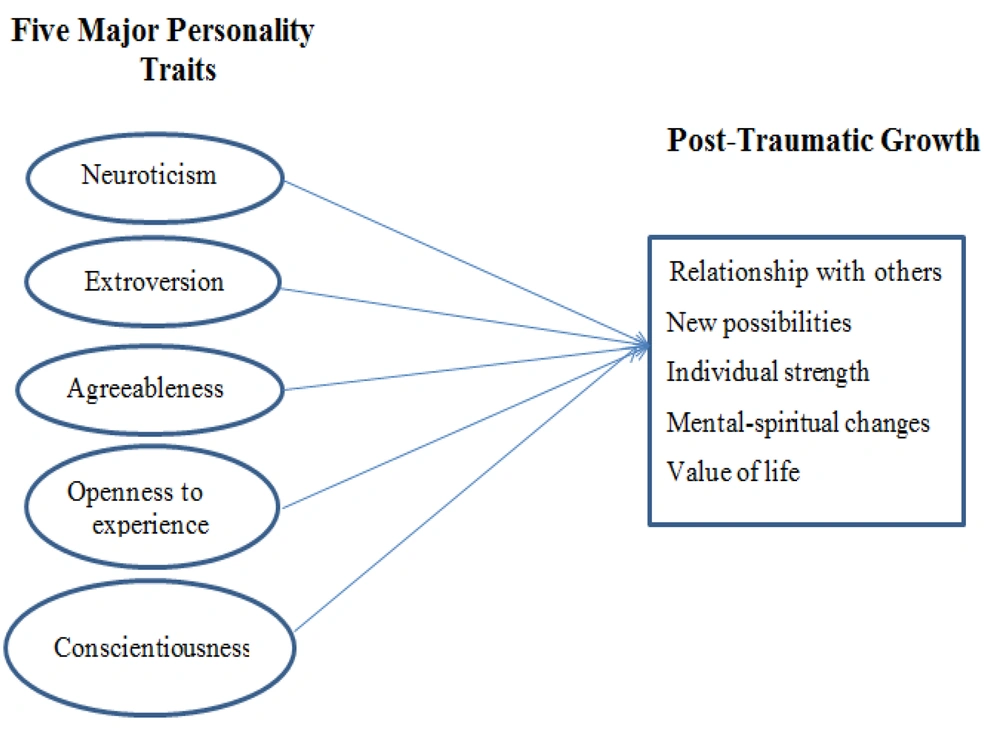
Figure 1.
Conceptual framework of predicting post-traumatic growth in COVID-19 survivors based on five major personality traits in Ilam City
3. Methods
The present study was a descriptive correlational study. The statistical population included all recoveries of the COVID-19 disease that were referred to the health centers of Ilam City in 1400. Participants (N = 200) were selected by available sampling based on inclusion and exclusion criteria. The inclusion criteria in this study were age between 18 and 65 years, history of COVID-19 with severe symptoms, and willingness to participate in the research. The exclusion criteria were unwillingness to participate in the study, incomplete or invalid questionnaire, having a history of psychiatric disorders and drug abuse, and chronic diseases such as cancer, diabetes, HIV, and cardiovascular problems.
The consent form was signed, and then questionnaires (post-traumatic growth questionnaires (PTGI) and Big Five personality traits questionnaire (NEO-FFI)) were provided to the participants. Ethical considerations in this research included obtaining an ethical code from the Ethics Committee of Islamic Azad University, Hamadan branch. IR.IAU.H.REC.1401.032, obtaining written consent, informing each candidate about the topic and method of conducting the study, protecting the candidates' private information, interpreting the results if they wished, and allowing them to withdraw from the research at any stage.
3.1. Research Tools
3.1.1. NEO-Five-Factor Inventory
The 60-question form of the NEO-Five-Factor Inventory (NEO-FFI) (1989) was used to measure the five major personality traits (29). This tool has a five-point response scale and five factors of neuroticism (against mental and emotional stability), extroversion (against introversion), openness to experience (against inflexibility), agreeableness (against narcissism), and conscientiousness (against negligence). Costa & McCrae reported Cronbach’s alpha of neuroticism, extroversion, openness to experience, agreeableness, and conscientiousness at 0.93, 0.90, 0.89, 0.95, 093, and 0.92, respectively (29). Moreover, the validity coefficients of this questionnaire have been reported from 0.56 to 0.62. Several versions of this questionnaire have been translated into Persian (30). In a study in Iran, the concurrent validity of the short and long form of this questionnaire was reported between 0.41 and 0.71 for five factors, and test-retest reliability between 0.65 and 0.86, and Cronbach’s alpha of the subscales was between 0.54 and 0.79 (31). In the present study, the reliability coefficient of this tool was 0.79 using Cronbach’s alpha.
3.1.2. Posttraumatic Growth Inventory
This self-assessment tool consists of 21 items designed by Tedeschi et al. to measure PTG (14). The answer to the test is ranged on a six-point Likert scale. The main form consists of five subscales: (1) Relationship with others, (2) New possibilities, (3) Individual strength, (4) Mental-spiritual changes, and (5) The value of life. The overall alpha coefficient of the questionnaire was 0.90. The range of Cronbach’s alpha for each of the subscales is estimated between 0.67 and 0.85 (14). In the present study, there was a positive relationship between optimism, religiosity, and major personality traits (NEO) except neuroticism and PTG, indicating the research tool’s validity. In Iran, Seyed Mahmoudi et al. reported Cronbach’s alpha coefficient for the whole scale as 0.92. In the present study, the tool's reliability was 0.87 using Cronbach's alpha coefficient. Data were analyzed using the Pearson correlation test and stepwise regression analysis using SPSS-26 software (32).
4. Results
In the present study, 200 individuals from Ilam who had recovered from COVID-19 participated. The mean age of the subjects was 32.58 ± 10.43. The majority of participants were female (72%). Bachelor's degrees were the most frequent among the participants (78.5%). Eighty-nine people were single (44.5%), and 111 were married (55.5%). One hundred eighty-two people (91%) had no history of hospitalization, and the majority of them, 71 (35.5%), were unemployed.
The summary of the descriptive indices of the five major personality traits and PTG and its subscales is presented in Table 1.
Table 1.
Descriptive Indices of Research Variables
| Minimum Variables/Statistical Index | Minimum | Maximum | Mean ± SD |
|---|---|---|---|
| The five major personality traits | |||
| Neuroticism | 9 | 44 | 23.82 ± 13.24 |
| Extraversion | 9 | 45 | 28.24 ± 12.22 |
| Openness | 9 | 42 | 26.84 ± 10.43 |
| Agreeableness | 9 | 41 | 27.34 ± 10.35 |
| Conscientiousness | 10 | 42 | 26.96 ± 11.97 |
| PTG | |||
| The value of life | 3 | 20 | 12.77 ± 5.51 |
| New possibilities | 3 | 20 | 13.47 ± 5.68 |
| Personal strength | 4 | 20 | 13.43 ± 5.03 |
| Mental-spiritual change | 3 | 20 | 13.94 ± 5.43 |
| Relationship with others | 2 | 20 | 13.95 ± 5.77 |
| Post-traumatic growth total score | 19 | 103 | 57.15 ± 20.72 |
Pearson’s correlation between the five major personality traits and the PTG of those who recovered from COVID-19 is presented in Table 2. The findings indicate a significant positive relationship between five PTG subscales and the overall PTG score at a significance level of 0.01. There was a significant negative relationship between neuroticism and total PTG score and its subscales (the value of life, new possibilities, personal strength, mental-spiritual change, and relationship with others). This means that with the increase in neuroticism, the amount of PTG and its subscales decreased, which is an inverse relationship. On the other hand, there was a significant positive relationship between the score of extroversion, openness, agreeableness, and conscientiousness with the overall score of PTG and its subscales, meaning that with the increase of these components of the five major personality traits, PTG, and its subscales also increased. Furthermore, there was a significant negative relationship between the scores of extroversion, openness, agreeableness, conscientiousness, and neuroticism.
Table 2.
Variable Correlation Matrix of the Five Major Personality Traits with PTG
| Variables | 1 | 2 | 3 | 4 | 5 | 6 | 7 | 8 | 9 | 10 | 11 |
|---|---|---|---|---|---|---|---|---|---|---|---|
| The value of life | - | ||||||||||
| New possibilities | 0.92 a | - | |||||||||
| Personal strength | 0.918 a | 0.958 a | - | ||||||||
| Mental-spiritual change | 0.922 a | 0.919 a | 0.941 a | - | |||||||
| Relationship with others | 0.934 a | 0.936 a | 0.913 a | 0.913 a | - | ||||||
| PTG | 0.876 a | 0.868 a | 0.860 a | 0.885 a | 0.894 a | - | |||||
| Neuroticism | -0.755 a | -0.700 a | -0.716 a | -0.749 a | -0.757 a | -0.728 a | - | ||||
| Extraversion | 0.803 a | 0.756 a | 0.770 a | 0.803 a | 0.806 a | 0.808 a | -0.908 a | - | |||
| Openness | 0.764 a | 0.724 a | 0.735 a | 0.764 a | 0.768 a | 0.775 a | -0.866 a | 0.944 a | - | ||
| Agreeableness | 0.756 a | 0.723 a | 0.730 a | 0.763 a | 0.764 a | 0.767 a | -0.857 a | 0.939 a | 0.931 a | - | |
| Conscientiousness | 0.771 a | 0.729 a | 0.749 a | 0.781 a | 0.775 a | 0.775 a | -0.876 a | 0.959 a | 0.914 a | 0.942 a | - |
a P < 0.01.
The result of Kolmogorov-Smirnov test for normality of the distribution of the variables is reported in Table 3. First, the parametric or non-parametric nature of the data was examined through the Kolmogorov-Smirnov test to check the data distribution’s normality. According to the decision criteria (P-value) results, a significance level of 0.05 was obtained. Therefore, the sample had a normal distribution, meaning that the research variables had a normal distribution.
Since we had a small sample size, determining the distribution of the PTG and subscales of NEO-FFI (neuroticism, extraversion, openness, agreeableness, and conscientiousness) was important for choosing an appropriate statistical method. Therefore, a Kolmogorov-Smirnov test was performed and did not show any evidence of non-normality (P-value = 0.52 and 0.5, 0.42, 0.54, 0.65, 0.56 respectively). Based on this outcome, and after a visual examination of the histogram and the QQ plot of PTG and NEO-FFI, we decided to use a parametric test. Also, the mean with the standard deviation was used to summarize the variables in Table 1.
A stepwise multiple regression analysis was conducted to investigate the role of the five major personality traits in predicting the PTG of people who had recovered from COVID-19. Table 4 indicates that the five major personality traits provide a meaningful explanation of PTG. The variance analysis test demonstrated that the regression model fitted well with the predictor and criterion variables, and the changes explained by the model were fundamental and not caused by chance and coincidence. According to Table 4, the information related to the determination coefficient and the ratios obtained from the regression analysis of the five major personality traits show that in the first step, the “neuroticism” variable entered the regression equation and could explain 52% of the variance of PTG (R2 = 0.529). In the second step, with the inclusion of the “extroversion” variable, the predictability increased by 12%, and these two variables together could explain 65% of the PTG (R2 = 0.653). In the third step, the “openness” variable was added to the model, and the predictability reached 65% (R2 = 0.655). In the fourth and fifth steps, when “agreeableness” and “conscientiousness” variables were added to the modality, no change in predictability was observed, and the predictability remained at 65% (R2 =0.655). Therefore, they could explain the PTG at 65% (R2 =0.655). Evaluating each of the components independently according to the significance and beta values revealed that neuroticism could effectively predict PTG. Afterward, it was found that extraversion had a positive and significant impact on predicting PTG. Beta values of other components showed that they did not have any contribution in predicting PTG.
Table 3.
Kolmogorov-Smirnov Test, a Test of the Presence of Autocorrelation and Collinearity Indicators
| Variables | Kalmogorov-Smirnov Test | Test of Independence of Errors | Test of Collinearity Indices of the Model | ||||
|---|---|---|---|---|---|---|---|
| n | M | Z | P-Value | Durbin-Watson | Tolerance | VIF | |
| PTG | 200 | 57.15 | 1.027 | 0.526 | 2.035 | 6.645 | 0.897 |
| Neuroticism | 200 | 23.82 | 1.118 | 0.508 | 1.913 | 9.876 | 0.570 |
| Extraversion | 200 | 28.24 | 1.019 | 0.421 | 1.765 | 8.765 | 0.632 |
| Openness | 200 | 26.84 | 1.032 | 0.543 | 2.021 | 7.534 | 0.769 |
| Agreeableness | 200 | 27.34 | 1.121 | 0.654 | 1.876 | 6.456 | 0.521 |
| Conscientiousness | 200 | 26.96 | 1.06 | 0.568 | 1.706 | 8.432 | 0.578 |
Table 4.
Stepwise Regression Analysis in Predicting PTG Based on the Five Major Personality Traits
| Model | SS | df | MS | F | P-Value | |||
|---|---|---|---|---|---|---|---|---|
| 73.644 | 0.001 | |||||||
| Regression | 5597.3327 | 5 | 11195.466 | |||||
| Remaining | 2949.1682 | 194 | 152.021 | |||||
| Total | 8546.5009 | 199 | ||||||
| Predictor variables | Step | R | R2 | ARS | SE a | B a | Beta b | T(p) b |
| Constant | 5.321 | 0.657 | - | 0.255 (0.103) | ||||
| Neuroticism | 1 | 0.728 | 0.529 | 0.527 | 14.252 | -1.139 | -0.728 | 14.925 (0.001) |
| Neuroticism c, extraversion | 2 | 0.808 | 0.653 | 0.650 | 12.266 | 0.322 | 0.123 | 8.177 (0.003) |
| Neuroticism c, extraversion c, openness | 3 | 0.809 | 0.655 | 0.649 | 12.280 | 27.829 | 0.002 | 0.725 (0.469) |
| Neuroticism c, extraversion c, openness, agreeableness | 4 | 0.809 | 0.655 | 0.648 | 12.299 | 0.123 | 0.001 | 0.324 (0.746) |
| Neuroticism c, extraversion c, openness, agreeableness, conscientiousness | 5 | 0.809 | 0.655 | 0.646 | 12.230 | 0.475 | 0.001 | 0.191 (0.849) |
a Non-standard coefficients.
b Standard coefficients.
c P < 0.01.
5. Discussion
The present study revealed a significant relationship between the five PTG subscales and the total PTG score. Additionally, there was a significant relationship between the five major personality traits and the PTG subscales, as well as the overall PTG score. Moreover, a significant negative relationship between neuroticism and the total score of PTG and its subscales (the value of life, new possibilities, personal strength, mental-spiritual change, and relationship with others) was observed. On the other hand, a significant positive relationship was found between the scores of extroversion, openness, agreeableness, and conscientiousness and the overall score of PTG and its subscales, and a significant negative relationship between the score of extroversion, openness, agreeableness, conscientiousness, and neuroticism was observed.
The results of the present study are consistent with the findings of other studies (2, 10, 17, 18, 21, 33-35). It is demonstrated that openness, agreeableness, conscientiousness, neuroticism, and extroversion positively correlate with PTG. Tedeschi and Calhoun showed that the personality traits of extroversion, openness, and optimism are positively related to creating new opportunities and personal strength (12).
Researchers have noted that people can simultaneously experience positive and negative changes after a trauma (11). Some patients who have recovered from COVID-19, despite enduring the adverse effects of the disease, have made positive changes in their lives, which is called PTG (13). The devastating effects of COVID-19 may be considered a shock to patients' belief systems, and thus, the disease has the potential to bring about significant positive change (6). Generally, a person’s perception of PTG is critical, and it mainly depends on the person’s ability to cope with the pain and complications caused by the trauma, personality characteristics, and the time duration after the accident (36). Therefore, personality traits play an important role in PTG and preparing for this type of growth. The response to trauma like COVID-19 can be very different from one person to another. For many, encountering a very stressful event can lead to psychological distress or psychiatric disorders (16). During these times, the survivors will probably feel more hopeless, depressed, and vulnerable (37). People's reactions to these psychological pressures are different. Some can deal with these stimuli and stressors better than others, while some have relatively little endurance and are prone to psychological pressures due to their personality traits (38).
There is evidence that personality traits are related to all human functions (39). In a study, Narimani and Basharpour examined the role of personality traits in predicting post-traumatic stress disorder in people exposed to trauma (19). The results revealed a significant difference between people with post-traumatic stress disorder and healthy trauma-exposed people in the personality traits of neuroticism, openness to experience, and conscientiousness. However, both groups showed no significant difference in terms of extroversion and agreeableness. The regression analysis results also showed that among the personality traits, only neuroticism positively and conscientiousness negatively can predict post-traumatic stress disorder. Also, the meta-analysis confirmed the association between personality traits such as extroversion, openness, and agreeableness and high levels of PTG and neuroticism with a low level of PTG (26). Some studies indicated that the personality traits of extroversion, openness, and optimism have a positive relationship with creating new possibilities and personal strength (12, 28).
Moreover, the present research results showed that personality traits significantly predict PTG in those who have recovered from COVID-19, which is in line with the findings of several studies (10, 17-21, 32-35, 40). Also, the present study’s findings were consistent with the results of Wilson and Cook (28), which showed that extroversion, openness, and agreeableness predict PTG through religiosity (15, 17-21, 32, 33, 35, 36, 40). Although conscientiousness predicts more satisfaction than social support, it could not be a predictor of PTG, which is not in line with the research results mentioned earlier. More research, however, is needed to determine this relationship.
Considering the principles related to PTG, the influence of personality traits on post-traumatic growth has been determined. It states that optimism and openness are among the characteristics that make people react to events. Hope and optimism allow people to reconsider their goals, behaviors, and motivations in the face of stressful life events and may lead to PTG (12). Extroversion, openness to experience, and new ideas may be related to PTG because they can facilitate emotional disclosure (41). One important feature that facilitates PTG is not having a history of neuroticism. People with poor mental health before the traumatic event are likely to be so overwhelmed that they cannot process the event cognitively or manage their initial emotional distress. In this way, they may experience uninvited ruminating and be unable to turn it into effective intentional ruminating. In addition, these people deal with their distress through strategies such as avoidance, which in turn prevents PTG. On the other hand, people with a better mental health status before the trauma are likely to perform more effectively in processing new information resulting from the traumatic event (12).
In general, considering the mental crises caused by the COVID-19 pandemic, mental health professionals and social workers can reduce their anxiety, stress, and fatigue with various interventions through social networks and telephone counseling. Therefore, medical and psychosocial interventions and training can cause psychological adjustment, improve mental health, and finally prevent psychological complications. According to the present study, PTG components and personality traits can be used as a model to reduce the severity of mental complications in recovered COVID-19 patients.