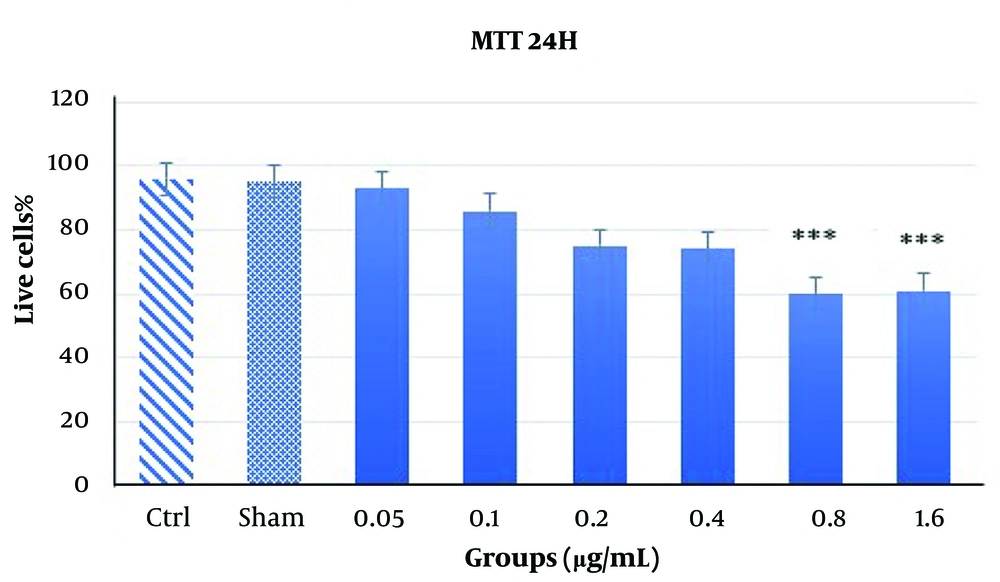
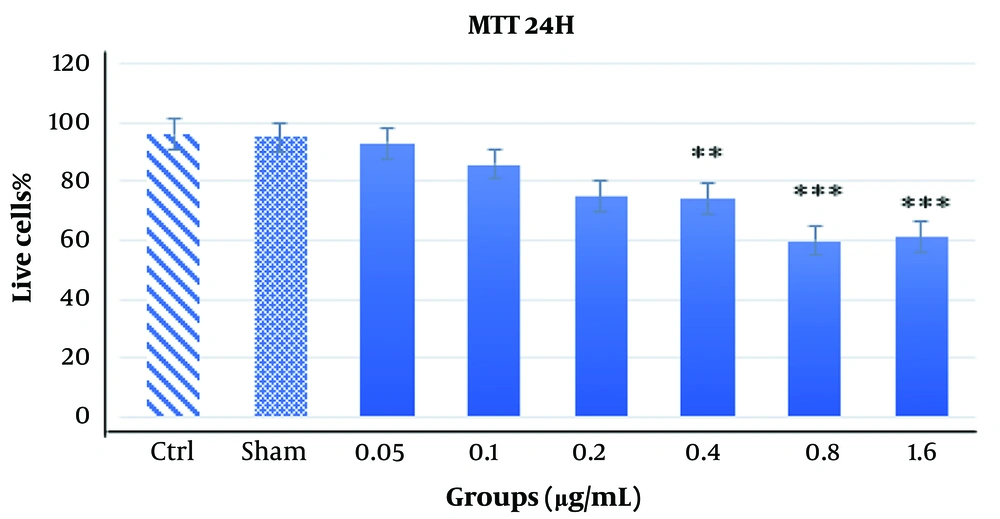
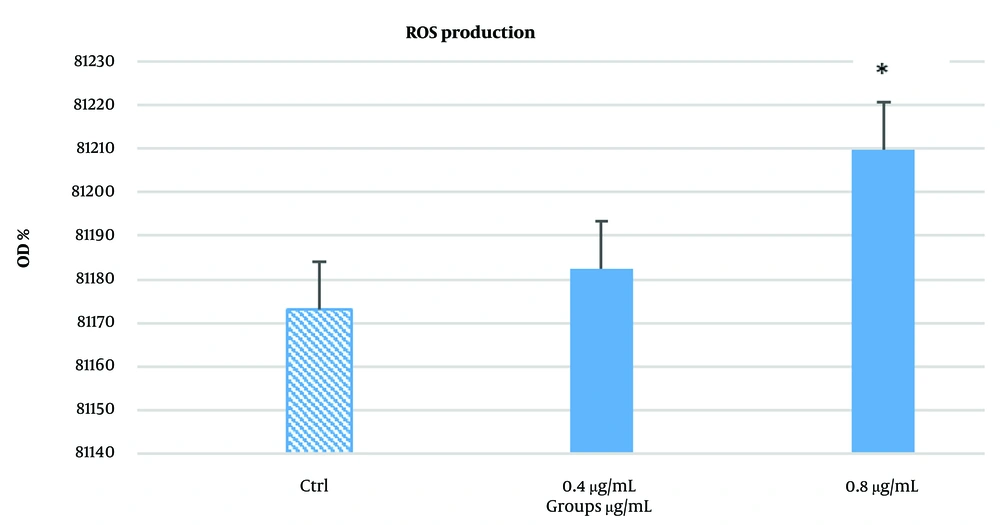
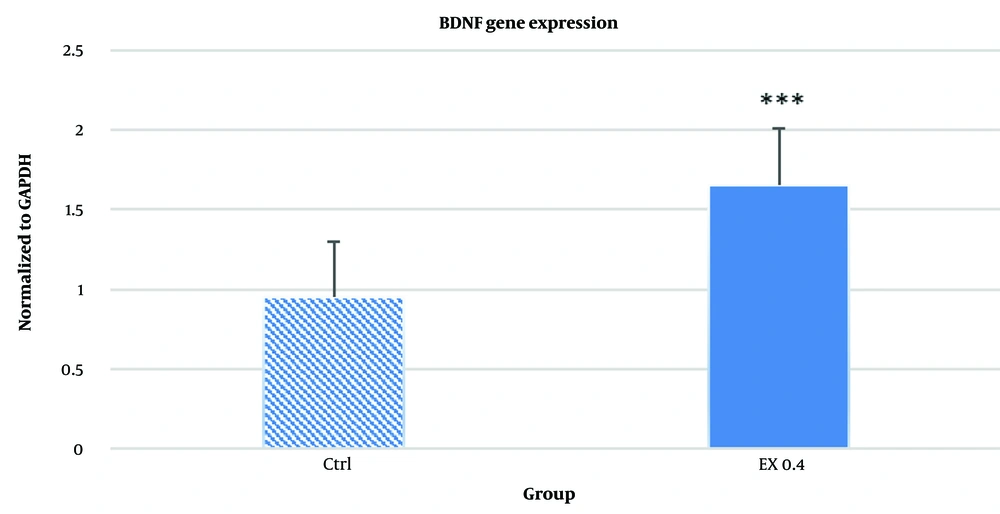
The findings of this study underscore the potential therapeutic properties of Acacia extract, particularly at low concentrations (0.4 µg/mL) and after short-term exposure (24 hours). These results suggest that bioactive compounds within the extract, including but not limited to N,N- DMT, may contribute to enhanced neurogenesis and thus offer promise in the treatment of neurodegenerative and psychological disorders. Previous research by Sadeghi et al. confirmed the presence of alkaloids and flavonoids in the hydroalcoholic extract of Boswellia, supporting its nootropic activities and memory-enhancing effects (
2). One of the active constituents of Boswellia, α-pinene, has been shown to inhibit acetylcholinesterase activity, thereby enhancing cholinergic neurotransmission, which may contribute to cognitive improvement.
The therapeutic properties of Boswellia are primarily attributed to boswellic acids and their derivatives. Laboratory studies have demonstrated that these acids can inhibit the synthesis of pro-inflammatory mediators through selective inhibition of the enzyme 5-lipoxygenase. Immunohistochemistry studies have revealed inflammation in specific brain regions of patients with Alzheimer’s disease, and the administration of non-steroidal anti-inflammatory drugs (NSAIDs) has been shown to reduce memory decline in such cases (
16-
18). Therefore, the memory-enhancing effects of Boswellia may be partially explained by its anti-inflammatory action. Furthermore, Hayashi et al. reported that boswellic acids and related extracts activate protein kinases, which are likely critical for maintaining long-term synaptic changes (
19). For instance, protein kinase A (PKA) influences synaptic vesicles and nerve terminals and activates the CREB signaling pathway, which regulates the expression of genes involved in long-term memory formation. This cascade enhances the sustained release of neurotransmitters at synapses and strengthens synaptic connectivity (
20).
In the present study, treatment of PC12 cells with Acacia extract at a concentration of 0.4 µg/mL led to a 6.1% increase in BDNF gene expression, suggesting a potential role in promoting neurogenesis. Additionally, the SubG1 assay indicated a significant rise in DNA synthesis during the S phase, pointing to enhanced neurogenic rather than merely proliferative activity. It is important to note that the extract used in this study was derived from Acacia leaves and contained a range of bioactive compounds. Although DMT, known for its psychoactive and neuroactive properties, was among the constituents, the observed effects should be attributed to the full-spectrum extract rather than DMT in isolation. Other compounds may have acted synergistically or antagonistically, influencing the final outcomes.
Lindvall and Bjorklund proposed the use of cell therapy as a strategy for treating neurodegenerative diseases, emphasizing the accessibility and suitability of somatic stem cells for such applications (
21). Similarly, Hermann et al. demonstrated that stem cells are responsive to neural markers, reinforcing the therapeutic potential of neural stem cells, which possess the capacity for self-renewal and differentiation into neurons, astrocytes, and oligodendrocytes (
22). The use of plant-derived compounds in medical treatments has gained increasing attention, and traditional medicine has long recognized Acacia species for their anti-nausea, analgesic, and anti-inflammatory effects (
23). However, little research has explored their influence on stem cells. Acacia extracts have also demonstrated antidiabetic, anxiolytic, antioxidant, and anticancer properties. Some studies report that these extracts can enhance glucose uptake and induce apoptosis in breast cancer cells while inhibiting their growth (
24).
Rajasekaran et al. showed that treatment of neuronal cells with rose essential oil increased neuronal cell numbers, indicating the potential for neurogenesis (
25). Many natural plant extracts contain compounds that mimic endogenous neurotrophic factors, promoting neuronal survival and possibly stimulating neurogenesis. In the central nervous system, neurotrophic factors closely interact with the cholinergic system, supporting the survival and phenotypic expression of damaged cholinergic neurons (
25).
Previous studies have demonstrated that DMT exerts neuroprotective effects against ischemic brain damage through sigma-1 receptor (S1R)-mediated mechanisms in murine models of middle cerebral artery occlusion (MCAO). Nardai et al. observed a significant reduction in infarct volume 24 hours post-MCAO, along with improved functional recovery of the impaired limb after 30 days of DMT treatment (
26). These findings are consistent with other preclinical studies that have confirmed DMT’s neuroprotective role in ischemia-reperfusion injury, including those involving human-based models such as brain organoids (
27). While earlier studies highlighted DMT’s action via S1R activation, the present study, due to the use of a complex extract, cannot isolate the specific contribution of DMT.
A proposed mechanism for the neuroprotective and neuroplasticity-promoting effects of psychedelics involves the upregulation of BDNF. The BDNF is a well-established mediator of neurogenesis, neurite outgrowth, dendritic branching, and spinogenesis — the formation of dendritic spines (
28). These processes are vital for the maturation of the nervous system and are largely driven by dynamic cytoskeletal remodeling. The PC12 cell line, derived from rat adrenal pheochromocytoma, was first introduced by Greene and Tischler in 1976 (
29). These cells produce and release catecholamines, including dopamine and norepinephrine, and are widely employed as a model for studying neuronal differentiation, neurotoxicity, and neurodegeneration (
30). Due to their neurochemical properties and neuronal phenotype, PC12 cells represent a reliable model in neurobiological research.
In the present study, this cell line was used to evaluate the cytotoxic effects of Acacia extract. Our findings suggest that DMT, especially at low concentrations, may exert neurogenic effects on neuronal cells, potentially offering therapeutic value in conditions such as Alzheimer’s disease and depression. However, as the extract contained other compounds, including potentially toxic rubranins, some of the observed toxic effects may be attributed to the extract mixture rather than DMT alone. It is plausible that treatment with pure DMT might yield more favorable outcomes. Nevertheless, toxicity was only observed at higher concentrations and with prolonged exposure. Notably, no apoptosis was observed at concentrations of 0.4 µg/mL and 0.8 µg/mL, and ROS levels at 0.4 µg/mL after 48 hours did not show a significant increase.
5.1. Conclusions
This study demonstrates the promising neurogenic potential of Acacia extract, particularly at a low concentration of 0.4 µg/mL and following short-term exposure (24 hours). The increase in BDNF gene expression observed under these conditions highlights the possible role of Acacia-derived bioactive compounds, especially N,N-DMT, in promoting neurogenesis and supporting neuronal health. Given DMT’s previously documented neuroprotective effects via S1R activation, its presence in the Acacia extract likely contributes to the observed outcomes. However, due to the use of a whole-plant extract that includes other active and potentially toxic compounds, such as rubranins, the specific role of DMT could not be isolated. It is possible that the observed toxic effects at higher concentrations and longer exposure durations were influenced by components other than DMT. Importantly, at concentrations of 0.4 µg/mL and 0.8 µg/mL, no signs of apoptosis were detected, and ROS levels remained within non-toxic ranges after 48 hours at the lower dose. The results suggest that pure DMT may yield even more favorable outcomes with fewer cytotoxic effects, warranting further investigation. Additionally, this study emphasizes the therapeutic promise of exploring various species of Acacia, particularly those indigenous to southern Iran, for their neuroprotective and neurogenic potential. Overall, these findings contribute to the growing body of evidence supporting the use of plant-derived compounds in neuroregenerative medicine. They point to new avenues for the development of novel therapeutic agents aimed at treating cognitive impairments and neurodegenerative disorders such as Alzheimer’s disease and depression.