
Abrupt Palpitation Following Taking Regular Doses of Oxazepam: A Rare Case Report

Author(s):
Seyed Hassan Seyed SharifiSeyed Hassan Seyed Sharifi1, Taha Mohammad RezapourTaha Mohammad Rezapour1, Mohsen YaghubiMohsen YaghubiMohsen Yaghubi ORCID2,*
1Student Research Committee, School of Medicine, North Khorasan University of Medical Sciences, Bojnurd, IR Iran
2Intensive Cardiac Care Unit, 9 Day Hospital, Torbat Heydariyeh University of Medical Sciences, Torbat Heydariyeh, IR Iran
*Corresponding Author: Corresponding author: Mohsen Yaghubi, Intensive Cardiac Care Unit, 9 Day Hospital, Torbat Heydariyeh University of Medical Sciences, Torbat Heydariyeh, IR Iran. Tel: +98-5152226016, Fax: +98-5152239311, E-mail: Email: [email protected]

Thrita Journal of Neuron:Vol. 4, issue 4; e23041
Published online:Dec 12, 2015
Article type:Case Report
Received:Aug 25, 2014
Accepted:Oct 01, 2015
How to Cite:Seyed Sharifi SH, Rezapour TM, Yaghubi M. Abrupt Palpitation Following Taking Regular Doses of Oxazepam: A Rare Case Report. Thrita J Neu. 2015;4(4):e23041. doi: https://doi.org/10.5812/thrita.23041

Abstract

Introduction:

The sensation of palpitations may either be the initial or the only symptom of cardiac arrhythmia. We describe a case of a visible clear temporal relationship between standard doses of oxazepam and palpitation.

Case Presentation:

A 48-year-old man presented to the cardiac care unit with systolic heart failure. He was commenced on a medication regimen of routine drugs of patient’s heart failure and oxazepam. After taking the second dose of oxazepam, he experienced palpitations. These were associated with lightheadedness, and retrosternal and upper abdominal discomfort. His electrocardiography (ECG) demonstrated atrial fibrillation (AF) with nonpathological premature ventricular contractions (PVCs) in trace. His symptoms ceased upon the cessation of the oxazepam therapy.

Conclusions:

Atrial fibrilation is the most common sustained rhythm disorder with serious clinical consequences such as hemodynamic impairment and ischemic stroke. Cardiologists and nurses should be aware of the possibility of adverse reactions when oxazepam is prescribed as hypnotic.

1. Introduction

Patients with heart failure (HF) have difficulty maintaining adequate oxygenation; therefore, they are likely to be restless and anxious and feel overwhelmed by breathlessness. These symptoms tend to intensify at night (1). Emotional stress stimulates the sympathetic nervous system, which causes vasoconstriction, elevated arterial pressure, and increased heart rate. This sympathetic response increases the amount of work that the heart has to do. By decreasing anxiety, the patient’s cardiac work also is decreased (2, 3).
Oxygen and other medication, such as anxiolytic agents, may be administered during an acute event to diminish the work of breathing and increase the patient’s comfort. In this case report, we describe a case of cardiac palpitations that temporally appears to be caused by standard doses of oxazepam, an event that has not been previously described in the medical literature.

2. Case Presentation

A 48-year-old man, weighing 55 kg, presented to cardiac care unit (CCU) with a history of systolic heart failure. He reported class 3 pectoris angina (CCS3) and significant dyspnea on exertion (DOE) and no history of hospitalization for his compliant. In physical examination, in heart sound auscultation, we found mitral click in midsystolic phase. He had a history of using drugs such as captopril (ACE i), carvedilol (β-blocker), hydrochlorothiazide (diuretic), and ASA 80 mg, and had no allergies. There was also no significant family medical history. A clinical diagnostic evaluation (echocardiography) showed that 45% ejection fraction and mild mitral regurgitation and his cardiac biomarker analysis showed that ck-MB is in a normal range (below 25) and troponin I is negative. Complete blood count (CBC) diff values were normal and biochemistry levels showed normal levels, except potassium level (K = 5.1 mEq/L). He had not any evidence of abnormal conductivity pathways; however, he had a degree 1 AV block (PR interval = 24 ms) in his electrocardiography (ECG).
He was commenced on a regimen of lozartan 25 mg; tds, metoprolol 50 mg; bid, ASA 80 mg; qd, hydrochlortiazide 5 mg; qd, nitrocantine 2.6 mg; bid, salbutamol 2 puff; tid and prn, and oxazepam 10 mg; qhs. His last vital signs before drug administration were heart rate, 67 bpm, respiratory rate, 17 RR, blood pressure = 137/72 mmHg, and axillary temperature measurement was 36.6˚C.
The last ECG before drug administration has shown in (Figure 1).
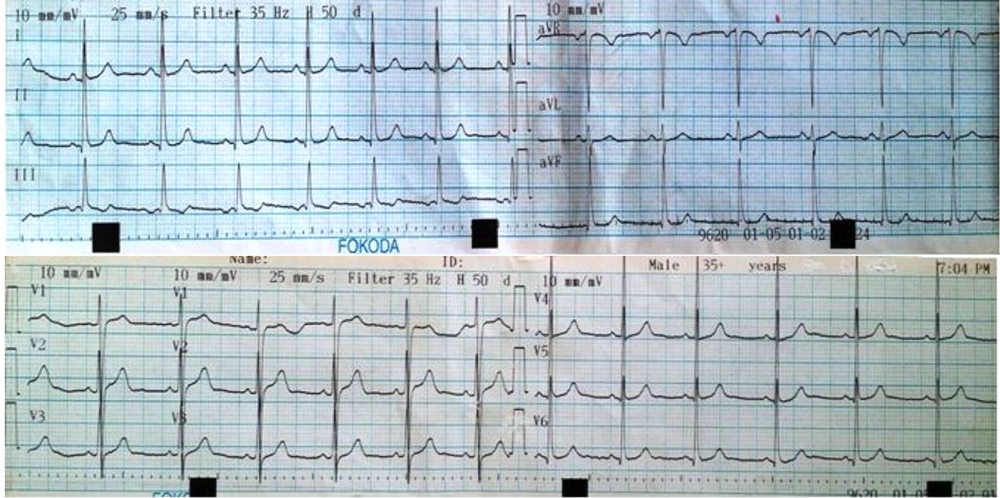
An Electrocardiography Before Using Oxazepam in the Patient
Figure 1.

An Electrocardiography Before Using Oxazepam in the Patient

Shortly after taking the second 10 mg dose of oxazepam, he felt sweaty and reported a sensation of palpitations. There were associated lightheadedness, retrosternal and upper abdominal discomfort, but felt no frank chest or abdominal pain. Electrocardiography concurrent with symptoms demonstrated atrial fibrillation (AF) with nonpathologic premature ventricular contractions (PVCs) in ECG trace. His heart rate in this situation is in normal range and with no rapid ventricular response (Figure 2).
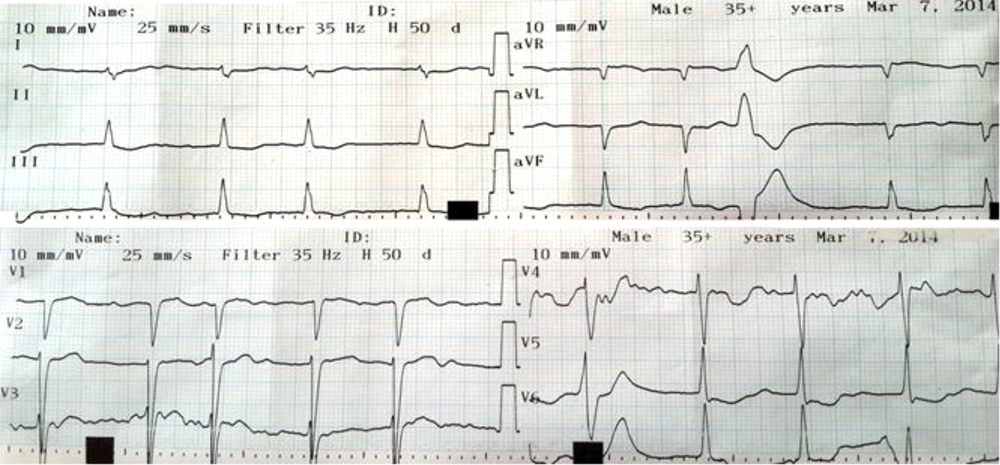
An Electrocardiography Performed Concurrent With the Patient’s Symptoms Demonstrated Atrial Fibrillation
Figure 2.

An Electrocardiography Performed Concurrent With the Patient’s Symptoms Demonstrated Atrial Fibrillation

The mentioned symptoms lasted only a few minutes. No other symptoms, in particularly those suggestive of either an allergic reaction or an acute coronary syndrome, were noted.
Our patient continued with oxazepam treatment for another day, with exacerbation of his symptoms after taking each oxazepam dose. After informing his cardiologist of her symptoms, his oxazepam medication was discontinued. His symptoms ceased thereafter. After discussion with our patient, a decision was made to not rechallenge his with oxazepam.

3. Discussion

Oxazepam is an anxiolytic- hypnotic drug that widely use in hospitalized patients after cardiac events. (4) Albeit, in previous studies (2, 5), was shown that anxiolytic medication use, is not associated with anxiety level and no effect on length of stay (LOS). Other studies (2) have demonstrated that adverse drug reactions (ADR) to anxiolytic and hypnotic drugs involve the psychomotor function disorder, central nervous system (CNS), accelerated depression, induction of hepatic drug-metabolizing enzymes, acute intermittent porphyria (AIP), and cardiovascular collapse. There is no powerful evidence that show any new cardiac arrhythmia due to anxiolytic use in patient with cardiac events.
Since our patient experienced only symptoms common to those associated with the sensation of palpitations with no symptoms suggestive of an allergic etiology, this case was not one of Kounis syndrome (6).
Atrial fibrillation is an important and potentially serious arrhythmia that is associated with a high prevalence of clinical consequences such as ischemic stroke, hemodynamic impairment and may predispose patients to systemic embolism. The symptoms in the patient were not intensified and following discontinuation of oxazepam administration and absence of its rechallenge, it is probable that standard dose of oxazepam was the causative link with the symptoms of palpitations. This case report appeared to be the first case of cardiac arrhythmia due to standard dose of oral oxazepam administration.
To identify the pathophysiological mechanism of oxazepam-induced cardiac arrhythmia, more research is required in electrophysiological studies.

3.1. Consent

A written informed consent was obtained from our patient for publication of this case report and any pendant image.
Acknowledgments

Footnotes

  • Authors’ Contribution:All authors contributed in the conducting concepts and revising the paper. Also, they confirmed the final draft for submission and accept the responsibility for the paper content.

References

  • 1.
    meltzer SC. Management of Patients with Complications from Heart Disease. 12th ed. Philadelphia: Lippincott Williams & Wilkins; 2010. 803 p.
  • 2.
    Abed MA, Frazier S, Hall LA, Moser DK. Anxiolytic medication use is not associated with anxiety level and does not reduce complications after acute myocardial infarction. J Clin Nurs. 2013;22(11-12):1559-68. [PubMed ID: 23311616]. https://doi.org/10.1111/jocn.12064.
  • 3.
    Frasure-Smith N, Lesperance F. Depression and anxiety as predictors of 2-year cardiac events in patients with stable coronary artery disease. Arch Gen Psychiatry. 2008;65(1):62-71. [PubMed ID: 18180430]. https://doi.org/10.1001/archgenpsychiatry.2007.4.
  • 4.
    Colman I, Wadsworth ME, Croudace TJ, Jones PB. Three decades of antidepressant, anxiolytic and hypnotic use in a national population birth cohort. Br J Psychiatry. 2006;189:156-60. [PubMed ID: 16880486]. https://doi.org/10.1192/bjp.bp.105.017434.
  • 5.
    Dixon RA, Edwards IR, Pilcher J. Diazepam in immediate post-myocardial infarct period. A double blind trial. Br Heart J. 1980;43(5):535-40. [PubMed ID: 6990946].
  • 6.
    Kounis NG, Zavras GM. Histamine-induced coronary artery spasm: the concept of allergic angina. Br J Clin Pract. 1991;45(2):121-8. [PubMed ID: 1793697].

Copyright

Copyright © 2015, Thrita. This is an open-access article distributed under the terms of the Creative Commons Attribution-NonCommercial 4.0 International License (http://creativecommons.org/licenses/by-nc/4.0/) which permits copy and redistribute the material just in noncommercial usages, provided the original work is properly cited.

Similar Articles

26
Jul
2021

Anesthetic Management of Rapid Ventricular Response Atrial Fibrillation in an Elderly Woman Using Remifentanil; A Case Report

Mahtab Poor Zamany Nejat Kermany,
Fereshte Kimia,
Fatemeh Roodneshin

Poor Zamany Nejat Kermany M, Kimia F, Roodneshin F. Anesthetic Management of Rapid Ventricular Response Atrial Fibrillation in an Elderly Woman Using Remifentanil; A Case Report. J Cell Mol Anesth. 2022;7(1):e151413. doi: https://doi.org/10.22037/jcma.v6i4.33514

15
Sep
2016

EP Testing in Asymptomatic Brugada Patients with Recurrent Palpitations. Just do it!

Patrizio Mazzone,
Filippo Maria Cauti,
Andrea Radinovic,
Damiano Regazzoli,
Fabrizio Guarracini,
Simone Sala
,et al.

Mazzone P, Cauti FM, Radinovic A, Regazzoli D, Guarracini F, et al. EP Testing in Asymptomatic Brugada Patients with Recurrent Palpitations. Just do it!. Int Cardiovasc Res J. 2016;10(3):e10178. doi:

15
Dec
2020

Atrial Standstill as a Probable Cause of Stroke in A Young Female Patient; A Case Report

Seyed Hamed Banihashem Rad,
Ali Reza Heidari-Bakavoli

Banihashem Rad SH, Heidari-Bakavoli AR. Atrial Standstill as a Probable Cause of Stroke in A Young Female Patient; A Case Report. Int Cardiovasc Res J. 2020;14(4):e105732. doi:

11
Oct
2020

Accelerated Idioventricular Rhythm After Lamotrigine Overdose

Zahra Parsian,
Ali Ostadi,
Fariborz Akbarzadeh,
Saina Gholipouri,
Hassan Soleimanpour

Parsian Z, Ostadi A, Akbarzadeh F, Gholipouri S, Soleimanpour H. Accelerated Idioventricular Rhythm After Lamotrigine Overdose. Shiraz E-Med J. 2020;22(7):e105822. doi: https://doi.org/10.5812/semj.105822

28
Feb
2016

The Brugada Syndrome Unmasked by Fever in a Two-Year-Old Child: Case Report

Yazdan Ghandi,
Parsa Yousefi Chaichi,
Mehrzad Sharifi,
Najmeh Bolandnazar

Ghandi Y, Yousefi Chaichi P, Sharifi M, Bolandnazar N. The Brugada Syndrome Unmasked by Fever in a Two-Year-Old Child: Case Report. J Compr Ped. 2016;7(1):e35129. doi: https://doi.org/10.17795/compreped-35129

Download PDF756.70 KB

Crossmark

Crossmark

Checking

Share on
Cited by
Metrics

Ordering Reprints

Articles are published under the Creative Commons license stated on each article. No permission or royalty fee is required for uses permitted by that license. CCC handles optional bulk and customized reprint orders. Any quotation covers production and delivery services only, not copyright permission. > Request Reprints from CCC 

Search Relations

Author(s):

Related Articles