1. Background
COPD (Chronic Obstructive Pulmonary Disease) is the fourth leading cause of death worldwide. Acute exacerbation of COPD like asthma attacks is associated with viral infections (1). Patients with COPD have a very low quality of life; the disease affects daily and social activities of these patients (2).
Wave capnography is indicator of continuous and quantitative measurement of expiratory CO2 (3). In patients with normal pulmonary function (apart from the age), the difference between ETCO2 and arterial carbon dioxide partial pressure (PaCO2) is constant (2 - 5 mmHg). This difference arises from the normal pulmonary alveolar dead space that does not affect ventilation (4). Changes in the shape of capnogram is diagnostics for disease conditions. Changes in ETCO2 can be used to assess disease severity and response to treatment (5).
In COPD condition or any cause of COPD or bronchospasm, the slope of ascending part of the capnogram curve, decreases as a shark fin called the shark sign. This pattern is more common in patients with asthma and COPD. The curve’s shape helps physicians to differentiate COPD from other causes of acute dyspnea, such as congestive heart failure (4). A defect of capnography in COPD, is that in these patients, ETCO2 measured by this method is not completely consistent with arterial CO2. However, capnography is a useful tool in treatment follow-up. There is a poor correlation between ETCO2 and PCO2 in respiration rate over than 30 per minute (5). At the study of Abdurrahman and his colleagues, 150 patients were evaluated in a six-month period; they observed a strong linear correlation between ETCO2 and PCO2 (6). Researchers found a strong correlation between ETCO2 and PaCO2 (7).
2. Objectives
The aim of this study was to compare the values of ETCO2 with arterial bicarbonate in patients with COPD exacerbation.
3. Patients and Methods
This study was a cross-sectional analysis study performed at Emergency Medicine Department of Tabriz University of Medical Sciences, on patients with COPD referred to Imam Reza hospital. ETCO2 levels were compared with blood bicarbonate in patients with COPD. To determine the sample size, the results of Mutlu Kartal and his colleagues study were used. In this study, in 25 mmHg ETCO2, 43% sensitivity and 83% specificity and in 35 mmHg ETCO2, 43% sensitivity and 83% specificity were determined. Finally, 50 samples were considered. To increase the accuracy of study, 57 patients entered the study (3). The current study was verified by the ethics committee of Tabriz University of Medical Sciences. Informed consent was obtained from each patient included in the study.
Inclusion criterion was all nonintubated patients with COPD admitted to the emergency department. Exclusion criteria were all patients with suspected sepsis, acute gastroenteritis, acute renal failure, diabetic ketoacidosis and any cause of acidosis other than COPD, patients who could not tolerate capnography, patients with impaired consciousness and lack of consent to participate in the study.
For all patients, after obtaining an ethical informed consent, capnography with Side Stream method using RESPIRONICS device (model number: 7100, RESPIRONICS, California Inc. California, USA) was performed with a nasal cannula. In these patients, initially, capnometry was performed and ETCO2 was recorded. Simultaneously pH, PaCO2 and bicarbonate were measured and recorded based on ABG results using AVL 995 analyzer of arterial blood gases. To avoid human errors, ABG sampling and recording of ETCO2 values were performed by a single person. PaCO2 levels above 45 mm Hg considered as respiratory acidosis. Then, capnography results were compared with the results of ABG.
SPSS 15.0 statistical software was used for data analysis. To determine normal distribution of data, Kolmogorov-Smirnov test was used. Descriptive statistical methods (Mean ± SD), frequency and percentage were used to describe data. Chi-square or Fisher’s exact test was used to compare qualitative data. Spearman test was used to evaluate the association between ETCO2 and PaCO2. In all cases, P value < 0.05 was considered significant.
4. Results
In this study, 57 patients with COPD referred to the emergency department of Imam Reza medical research and training hospital were selected. Thirty-five (62.5%) patients were male. The mean age of patients was 68.40 ± 11.30 years. Results of vital signs and laboratory findings in patients are presented in Table 1.
The mean of PaCO2 and ETCO2 were 64.74 ± 9.75 and 41.49 ± 9.80, respectively. The mean of PaCO2 in patients was significantly more than the mean of ETCO2 (P < 0.001). There was a significant reverse linear association between ETCO2 and pH of arterial blood in studied patients (P < 0.001 and r = -0.249, Figure 1). There was a significant linear association between levels of ETCO2 with PaCO2 in the studied patients (P < 0.001 and r = 0.611, Figure 2). There was no significant association between ETCO2 and arterial blood bicarbonate in studied patients (P = 0.136 and r = 0.04, Figure 3).
Table 1.
Results of Laboratory Finding and Vital Signs of Our Study Patients a
| Variables | Values |
|---|---|
| Vital Signs | |
| Systolic Blood Pressure, mmHg | 121.05 ± 17.08 |
| Systolic Blood Pressure, mmHg | 73.77 ± 10.18 |
| Heart Rate, , bpm | 93.96 ± 13.26 |
| Respiratory Rate, Per/min | 22.70 ± 5.64 |
| Body Temperature, C | 36.87 ± 1.33 |
| O2 sat | 81.85 ± 8.61 |
| Lab Finding | |
| White Blood Cells, ×109/L | 9635 ± 3208 |
| Hemoglobin, g/L | 14.48 ± 2.33 |
| Urea, mmol/L | 51.00 ± 14.30 |
| Creatinine, mg/dL | 1.25 ± 0.38 |
| Blood Sugar, mmol/L | 132.35 ± 44.90 |
| ABG Results | |
| pH | 7.28 ± 0.07 |
| PaCO2, mmHg | 64.74 ± 9.76 |
| HCO3, mmol/L | 29.81 ± 4.94 |
| End Tidal CO2, mmHg | 41.49 ± 9.80 |
a Data are presented as No. (%).
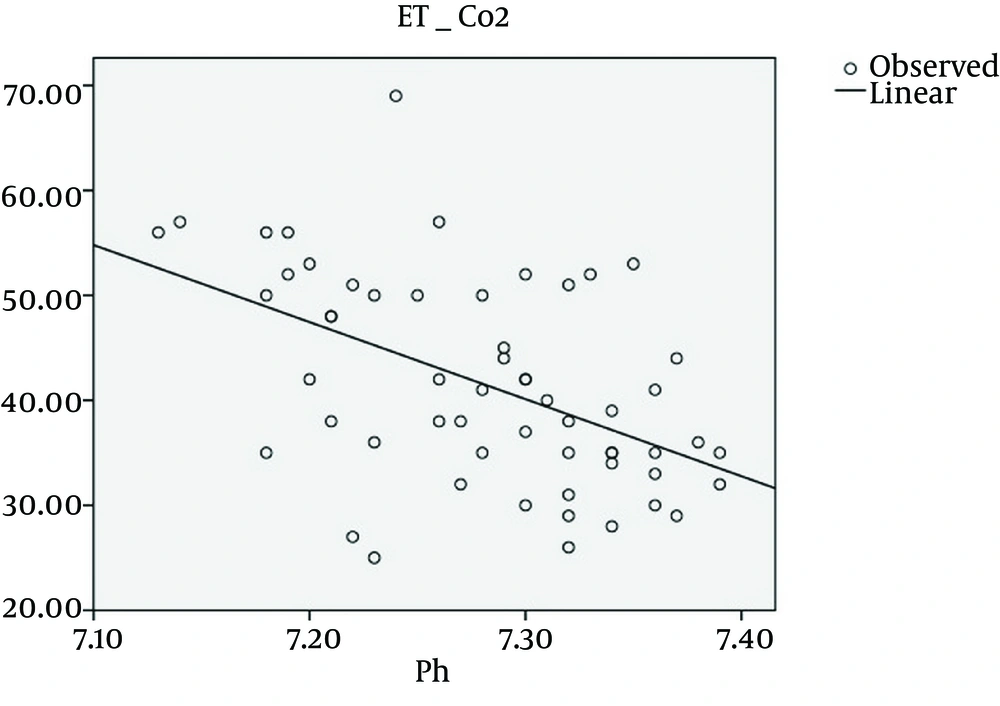
Figure 1.
(r = -0.249).
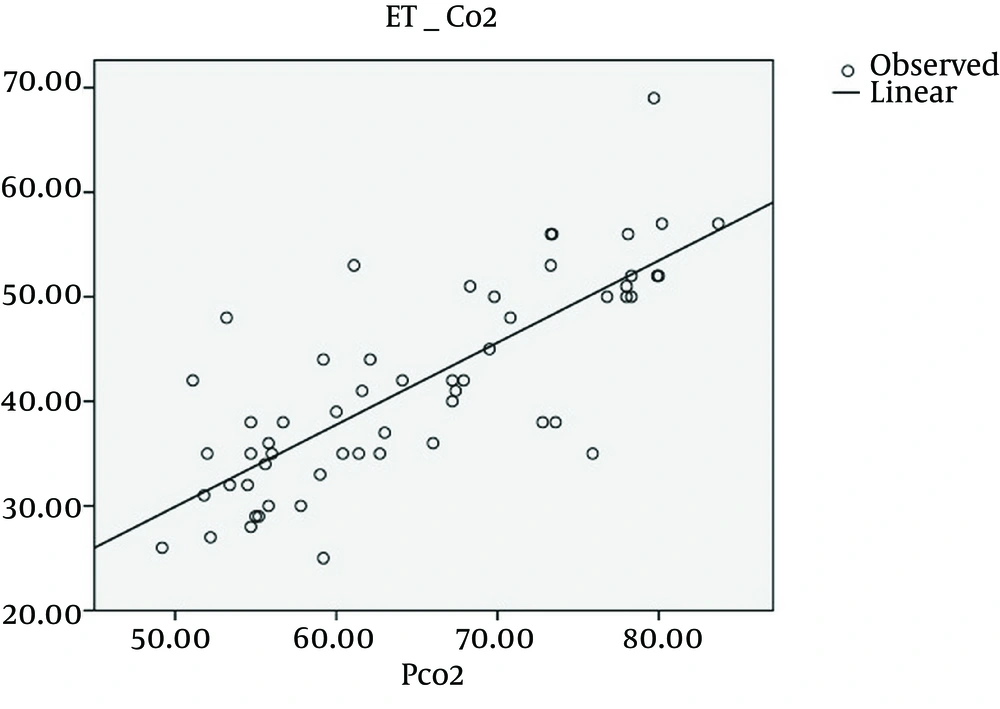
Figure 2.
(r = 0.611).
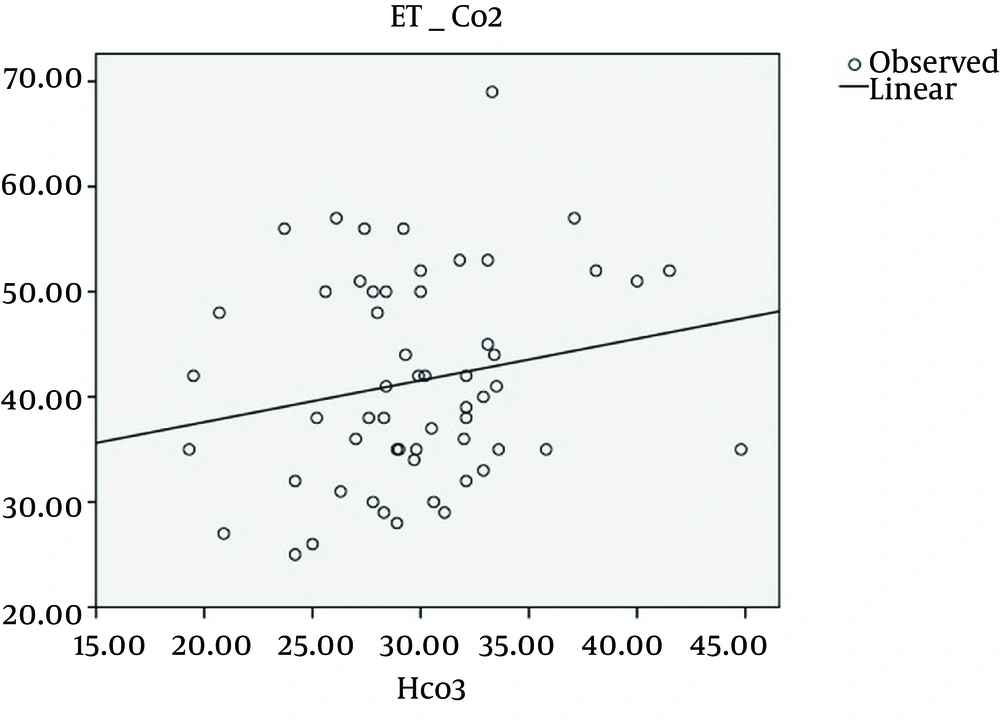
Figure 3.
(r = 0.04).
5. Discussion
In our study, we compared ABG findings of patients with COPD and ETCO2. Our study found no significant association between ETCO2 and arterial blood bicarbonate (P = 0.136 and r = 0.04), but there was a significant association between ETCO2 with pH and PaCO2 (P < 0.001 and r = -0.249, P < 0.001 and r = 0.611, respectively).
Measurement of ABG is the gold standard for monitoring oxygenation and assessing the PaCO2 retention in patients with acute exacerbation of COPD. This procedure is invasive and costly and can just do intermittent monitoring of oxygenation and PaCO2. However, capnography is a method measuring the amount of carbon dioxide in exhaled breath air and used for monitoring CO2 levels. PaCO2 is one of the factors determining blood PH, thus, its changes may produce problems for patient. Capnography in the recent years has become more spread and changed to a common method (8). Mechanism of capnography is to determine end-tidal partial pressure of carbon dioxide (ETCO2). It is closely related to PaCO2 (9). Capnography is a simple, inexpensive and noninvasive method and used at patients’ bedside (10).
Continuous measurement of ETCO2 with capnography is one of the ways to evaluate general anesthesia in operating room and used for intubated patients, but this method can even be a noninvasive, rapid and reliable method for predicting PaCO2 in non-intubated patients. This measurement allows estimation of arterial carbon dioxide pressure without arterial blood sampling. If there is a constant association between end-tidal and arterial carbon dioxide pressure, this method is reliable and no need to frequent blood sampling. Using this method can quantitatively and reliably provide necessary information about patient’s respiratory status (4, 10). In a study conducted by Magi and his colleagues (11) it was identified that in normal conditions, ETCO2 is a useful tool for monitoring PaCO2. But its accuracy relationship with PaCO2 may be reduced when using standard surgical techniques and different positions. However, predicted results of PaCO2, according to capnography are questionable and in different clinical conditions, previous studies reported conflicting results (12, 13). Some researchers attempted to measure ETCO2 by capnography to substitute ABG in clinical situations, but the results were not consistent. In a healthy adult, under natural conditions, ETCO2 levels is approximately 2 to 5 mm Hg less than PaCO2 (4). In a study conducted by Yosefy and colleagues (12) ETCO2 was successful to predict PaCO2 levels in patients of emergency department with respiratory distress. However, in another study by Warner on patients with trauma who underwent intubation, a poor correlation was reported between the results of PaCO2 and ETCO2 (13). Delerme and colleagues, evaluated ETCO2 and PaCO2 in COPD patients and found a significant association between the level of ETCO2 and PaCO2 (13). A study conducted by Yazigi (14) demonstrated that ETCO2 can be used for monitoring retained CO2 in obese patients in the recovery room following bariatric surgery.
In patients with pulmonary diseases along with shunt or mismatch of ventilation perfusion, studies indicated that the gradient of PaCO2-ETCO2 increases due to an increase in dead space ventilation. Aging likely with an increase in dead space can increase PaCO2-ETCO2 gradient (4, 15). The results of our study indicated a weak direct correlation between blood bicarbonate levels in patients with ETCO2. A strong and significant association was found between ETCO2 and PaCO2. Therefore, if our results be confirmed in future studies with larger sample size, it is recommended to use capnography instead of ABG in COPD patients admitted to emergency department.
One of the limitations of our study, given the descriptive nature of the study, was lack of a control group. During the study period, we were not able to do capnography for all patients with COPD admitted to our emergency. Moreover, some patients were excluded due to severe respiratory distress or impairment of consciousness.
Based on the results of our study, the association between arterial bicarbonate and ETCO2 was weak and not significant. Considering CO2 retention in patients with COPD, there was not a good association between PaCO2 and ETCO2.