1. Background
The education system can affect training efficiency by improving learning parameters. Skinner believed that an appropriate educational system cannot be established unless teaching-learning process is being recognized (1) and this recognition is based on various elements such as intelligence, motivation, proper environment, family and society elements, qualified education, and learning styles (2).
Educational strategies and teaching styles can greatly improve teaching-learning process. On the other hand, learner is the most important element in the learning system. Given that, attractiveness of the course to learners should be also considered prior to implementing programs (3). So, identifying effective elements of learning and applying adult learning principles are necessary to improve education performance (4-6). In fact, the educational managers’ role is to use resources to prepare the most desirable learning condition, which requires recognition of the educational factors. These factors can be divided into two general groups: learner characteristics and the social aspects of learning (7). In this article we decided to assess learning styles, as the most important factor of learning which can help educational system to determine proper curriculum.
As mentioned above, the most important factor affecting individual’s learning is learning style. Learning style is the method that helps an individual to process new information. Kolb defined it as “way of organizing concepts, rules and principles, which leads people to deal with new situations” (8). In another definition, learning style is “combination of cognitive, emotional and physiological aspects, which indicates how people receive information, interact with it, and respond to the learning environment” (9). In David Kolb’s model, 4 learning styles have 4 cycles: first, “apprehension” based on Kolb’s terminology (concrete experience), then, observing and thinking about experience (reflective observation), next, developing a hypothesis (abstract conceptualization), and finally, testing the hypothesis in practical position (active experimentation) (10).
And the four styles are as follows: 1) learner encounters with concrete learning experience, 2) learner shows experience. 3) Learner imagines and understands his or her observation or shows it, in ideas or theories. 4) Learner tests it actively in experimentation. So, there are 2 parts for understanding information: concrete experience and abstract conceptualization as well as 2 parts for processing information: active experimentation and reflective observation.
These 4 parts convert to 4 styles: convergent styles (combination of abstract conceptualization and active experimentation), accommodating style (combination of concrete experience and active experimentation), divergent style (combination of concrete experience and reflective observation), and assimilating style (combination of abstract conceptualization and reflective observation) (11).
People with convergent style succeed in expertise tasks through practical application of ideas. Those having divergent style are successful in artistic activities due to their capability of evaluating situation from different angles. People with assimilating style have ability to organize information. And those who have accommodating style possess the ability to adapt to new situations (8, 12-14).
Kolb theory can help students according to their learning styles by providing them various learning environments (15). To improve students’ learning ability, they should be familiarized to technical learning methods. So, using various learning environments is essential for better learning in different learning styles and helps learner moving from a beginner to expert level (14). This is an effective approach for medical students who equipped with multiple learning facilities to simulate the real environment (16). Felder stated that choosing suitable teaching method, based on learning styles, can improve learning’s quality and satisfaction (17). Shane stated that students’ learning styles are associated with professors’ teaching styles. The results of this study could justify the mutual relationship between learning styles and teaching methods, which emphasizes the importance of choosing the best teaching method based on learning styles (18). Thus, the coordination of learning style, courses, and learning environment can enhance learning motivation and academic achievement. Also, considering learning style in choosing teaching methods can lead to proper planning based on styles in classroom, practical field, and laboratory environments.
Considering the selection of students in Iran, it is not possible to choose people according to their learning styles. Therefore, educational administrators should emphasize the individual learning styles and considering it as an essential factor for choosing teaching method to provide effective learning to improve educational system performance.
In Iran, studies on learning styles have been mostly done in medicine and nursing fields. Therefore, in this study, we decided to examine learning styles of health care management students to help them select suitable pedagogical approaches in classes.
2. Objectives
The aim of the present study was to determine learning styles of health care management students and the preferred teaching methods based on their styles in Tehran University of Medical Sciences.
3. Patients and Methods
This was a cross-sectional study conducted in 2013. A total of 123 undergraduate students of health care management participated in our study.
Our study tool was Kolb learning style inventory. Reliability and validity of the questionnaire was approved (The Cronbach α: 0.7 - 0.9) (14, 19). The questionnaire consisted of 3 parts: the first part contains the purpose of study and answering guide, the second part has 6 demographic questions and the third section was Kolb questionnaire (Kolb learning style version 3). This questionnaire has 12 questions and respondents should choose the closest answer to their learning style; 4 is the highest score and the next options get 3, 2, and 1. Each option represents one of the models of learning: 1 = concrete experience, 2 = reflective observation, 3 = abstract conceptualization and 4 = active experimentation. Summation of scores of each model in 12 questions will result in 4 scores, which indicate the 4 learning styles. After that, we subtracted concrete experience scores from abstract conceptualization scores and reflective observation scores from active experimentation scores. In the end, results gave us two scores plotted on positive or negative axis. The resulting intersection numbers on the axis defined learning style. Data were analyzed using descriptive statistics (distribution, central and dispersion parameters) according to Kolb’s guide and on the next step, analytical statistics (Chi-square test and ANOVA) were conducted.
4. Results
In this study, 123 undergraduate health care management students were enrolled (Response rate 87%). Of them, 108 cases were female (87.8%) and 15 (12.19%) were male; 50% of female and 60% of male students chose assimilating as their preferred style.
The average age of all students was 20.8 ± 24 years. The distribution of students’ learning styles is presented in Figure 1. Table 1 presents the frequency of the learning styles with the highest belonged to assimilating style with 63 (51.26%), then the convergent with 56 (45.5%), next the accommodating style with 2 (1.62%), and finally the divergent with 2 (1.62%).
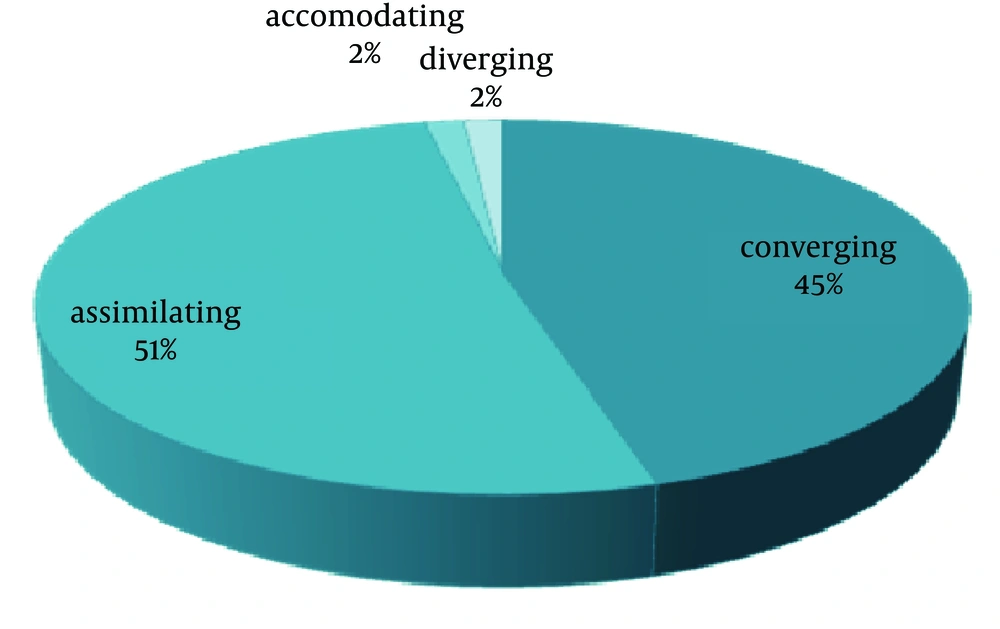
Figure 1.
The Learning Styles of Health Care Management Students
Table 1.
Learning Styles of Health Care Management Students by Gender a
| learning Styles of Health Care Management Students | Male | Female |
|---|---|---|
| Converging | 5 (23.34) | 51 (47.23) |
| Assimilating | 9 (60.0) | 54 (50.0) |
| Accommodating | 1 (6.66) | 1 (0.92) |
| Diverging | 0 (0) | 2 (1.85) |
| Total | 15 (100) | 108 (100) |
a The values are presented as frequency (%).
5. Discussion
Teachers usually wish that all of their students learn the whole subject (20). Previous studies have shown that there are different styles in various fields of study such as medicine, nursing, and allied health (15, 16, 21, 22), also there is an association between learning styles, critical thinking and academic performance. Therefore, teaching methods should match with students’ learning style to be more effective in this areas (23). In this regard, teachers’ duty is to determine students’ learning styles to lead them achieving effective learning.
The results of this study indicated that the prevailing learning style among students of health services management at Tehran University of Medical Sciences are assimilating and converging styles. Many studies at other universities of medical sciences have reported the same results. Studies of Ghazivakili e al. (23) in Alborz Medical University in Iran, Lai et al. (21) in Taiwan on neurosurgeons, Tuli et al. (24) in the USA on pediatric residents, Borracci and Arribalzaga (25) in Spain, Burger and Scholz (26) at Erlangen University in Germany, Shinnick and Woo (27) on nurses in America, Caulley et al. (19) in Toronto on orthopedic residents produced the same results. Although, these studies had been conducted in different fields, the results were similar to our findings, which is explainable by the related nature of medical sciences. Features of converging and assimilating learning styles (8) are match with the characteristics of students of medical sciences . So, it can help education directors, to select appropriate teaching strategies.
Student’s first and most common style was assimilating. As courses in health management are combination of management and medical sciences, these students need to learn a great deal of theoretical topics that should be organized by the teacher. These students need the ability to develop a conceptual map. With this style, they learn through deep thinking, and become more interested in theory and powerful in understanding and organizing information (2, 8, 12, 13). Characteristics of assimilating style are matched with the required skills to manage the health care field. According to Kolb theory, teaching methods matched with assimilating style includes: lecture, exploratory analysis methods, and self-learning methods. Assimilating teaching styles are combination of methods offered by teacher and analysis methods, including testing that makes learner to achieve the result by analysis (2, 8, 12, 13). This style fits with analytical teaching methods. As one of the managers’ tasks is decision-making in ambiguous situations, these students should be familiarized with analysis methods, for problem solving. So we suggested that teachers provide simulated learning environments and create appropriate measures for practical learning.
The second common style was converging. Several medical studies have reported the preference of the converging style, including studies of Caulley et al. (19), Mammen et al. (28), Richard et al. (29), Contessa et al. (30), French et al. (31) in Australia on Occupational therapy styles, and Tuli et al. in Florida on pediatrics resident students (24). In this style, students learn through decision making and practical activities. They like gathering data for problem solving and are empowered in using theories to solve problems and make decisions (2, 8, 12, 13). Thus, its selection as a popular style is justifiable in medical science field that requires having knowledge and using it. Besides, the features of this style are consistent with the managers’ needs in health care system. These students must use practical application of management theory and be able to solve problems in health system. So, followers of converging style are suitable for health system.
Preferred teaching methods in this style include problem-based approach, programmed activities for learning skills, using diagrams and showing images. Problem-based learning leads to acquisition of deep learning, problem-solving, and critical thinking skills, increase in motivation, quality of learning attraction of class, and practical use of knowledge (32-34). Problem-based approach is a method which is vital for curriculum of medical sciences, particularly fields which have no concrete apprenticeships. In the field of health management, because of occupational sensitivity, there is no possibility of tangible apprenticeships based on future career. Hence, educational managers in implementation of classrooms and apprenticeships need to use pedagogical approaches such as problem-based approaches and active teaching methods like role playing and simulating environment to make students encounter with the simulated conditions and issues of a manager. These educational opportunities provide application of management theory in problem solving, an opportunity for students to learn and prepare themselves for their future roles.
Sarabi et al. (1) in his study used VARK model. They mentioned that as long as using active learning methods could improve students learning and these methods encompass various types of learners, instructors and teachers should use active learning methods, which develop students’ abilities such as making decision, participation in class discussion, solving problems, and playing their role perfectly. Their results are consistent with our study results. In their study, they also emphasized on using active teaching-learning methods.
Our results showed no correlation between learning styles of these students and their age or gender. Previous studies reported similar results, including Ghazivakili in Alborz University of Iran (23), DeCoux (35) study on nurses in USA, Piane et al. (36) study in Illinois University of USA, and Jack et al. (37) study on medical students.
In fact, teachers’ idea about learner’s role manifest by choosing the best teaching method and learners’ behavior reflect through their views on interaction with the learning environment (38). Therefore, by selecting instructional strategies matched to individual characteristics, nature of the field, and essential abilities, learning expectations about students about their future job can be accomplished.
Kolb believed that learning styles are relatively stable. The qualitative changes that take place through development, maturation, and environmental stimuli are also fundamental to select appropriate teaching methods to develop students’ learning. Kolb and Kolb (8) believed that each style has its own strengths and weaknesses, so diversity of learning styles, even in the same field helps teachers to choose appropriate teaching style.
Due to the characteristics of medical sciences, effective teaching in this area must be compatible and committed to the objectives and characteristics of the education context. Also, it is important to consider learning styles and learning approaches. Thus, if the teacher uses variety of methods, learners encounter with several situations, which challenges them during learning process, eventually improves students’ learning in different situations (39). Therefore, we suggest that teachers and university learning managers consider students’ preferred learning styles while developing educational curriculum models to create suitable environment for their students (16).