
1. Background
Sexual relationship is one of the important aspects of the relationship between spouses that often is overlooked. Sexual need is a taboo in all communities and religions that is wrapped in an aura of superstitious things and talking about it is often associated with negative feelings such as shame, embarrassment, fear, and guilt. However, the sexual behavior and relationship are similar to other needs such as eating and drinking; in other words, it is the requirement of a healthy life and survival of the human race (1, 2). Sexual relationship is affected by the emotional relationship between the spouses and marital dissatisfaction and family problems may emerge after sexual dissatisfaction. Trudel (3) believes that the dispute between spouses on sexual relationships is due to the time and quality of this relationship. In addition, an improvement in sex has a positive impact on the main relationship in men; but in women, the sexual relationship would improve after intimacy (4). Studies show that communicative factors between spouses are mainly related to sexual satisfaction. It is believed that the sexual and non-sexual aspects of marital relationships need the same skills. In addition, longitudinal studies of the relationship between sexual satisfaction and marital satisfaction in the early years of marriage show that sexual satisfaction is important for both men and women and there is a significant relationship between sexual relationship and marital relationship (5-7).
In this regard, sexual function is influenced by biological, psychological, and sociological factors. The failure in one or more of these areas will lead to sexual dysfunction. The final result of all disorders is generating anxiety about sexual performance that inhibits sexual responses and enhances sexual problems (8). Dissatisfaction with sexual function is closely related to social problems such as crime and sexual aggression. In fact, sexual function is defined as sexual desire, sexual satisfaction, stimulation, and orgasm. Sexual dysfunction refers to the destruction of sexual pleasure or sex without satisfaction. According to current statistics, the prevalence of sexual dysfunction is 31 to 51% in women (8-10). Sexual dysfunction is defined as sexual cycle disorders (desire, arousal, and orgasm) or pain during sexual intercourse (11). This is due to multiple anatomical, physiological, and psychological factors that can cause discomfort and affect the quality of life and interpersonal relationships (12). According to a national review in Iran in 2005, 31.5% of women were suffering from sexual dysfunction, which is the widespread evidence to show health problems in Iranian women (13).
Past research showed that sexual skills training using non-pharmaceutical and theoretical approaches had an effective role in sexual function in women. For example, Tavakolizadeh and HajiVosogh (14) showed a significant relationship between the mean differences of marital satisfaction in women in both experimental and control groups, which indicated cognitive-behavioral training increased marital satisfaction in women with low sexual desire disorder. Kaplan and Passalacqua (15) studied fantasy and cognitive restructuring in women with mental arousal disorder by using Masters and Johnson behavioral therapy along with cognitive techniques. This treatment could greatly increase the amount of arousal by training focusing on a sexual relationship, exposure to stimulating issues (such as stimulus images and videos), inhibition of negative insights, and behavioral techniques.
Given the above, new and widespread therapeutic interventions still seem necessary to reduce sexual dysfunction in women because many different factors can affect different aspects of women’s marital quality. This led us to seek treatment for these patients with a faster effect. Thus, we chose an eclectic approach. According to this multifaceted approach, we are the result of the interaction between our genetic, social learning, and physical environment. Clinical disorders in the multifaceted approach are due to perceived associations but not reality conditioning. Also, the basic of biological aspects of the multifaceted approach are health. Actually, the eclectic approach seeks common elements among different treatments. The ultimate goal is to create the shortest and most effective therapies based on these common features (16, 17). The combination of theoretical and technical approaches had not been used in sexual function.
2. Objectives
This study aimed to make an appropriate conceptual framework for female sexual function and try to examine the effect of common factors in the eclectic approach on improving sexual function in Iranian women.
3. Methods
3.1. Study Type and Participants
This study was a randomized, single-blinded clinical trial conducted from April to September 2015. The assessor did not know about the experimental or control group membership. The study population consisted of all married women who referred to counseling centers of Yazd in 2015. Thus, the sample size was calculated with statistics such as mean and standard deviations from previous studies (13, 18). The sample required for this study was 30 people (15 in each group). The sample size was calculated using the following formula:
When visiting the counseling centers, each of the married women took necessary explanations of the research methods and goals. Women who expressed their consent to participate in the research were interviewed. Thus, in the first stage, the sampling method was purposeful. The inclusion criteria for selecting participants were getting a low-to-moderate score of sexual function (11 to 27) on the Female Sexual Function Index (FSFI-19), being 18-45-years-old, having at least one year experience of sexual relationship, having at least high school education, and completing the informed consent form. The exclusion criteria were getting a poor (2 to 10) or good (28 to 36) score of sexual function on the FSFI-19, severe physical diseases that interfered with patient training, and receiving psychiatric treatment or psychotherapy at the same time for the elimination of sexual and marital problems.
Out of 84 questionnaires gathered from participants, just 41 of them had the inclusion criteria. Of these, 11 women were excluded from the study due to the exclusion criteria. Finally, 30 participants were randomly assigned to intervention and control groups of 15. While the participants of both groups continued their physical therapy, the experimental group received sexual skills training with the eclectic approach in nine sessions of 90 min (two sessions per week) and the control group remained on the waiting list. The Consort flowchart is shown in Figure 1.
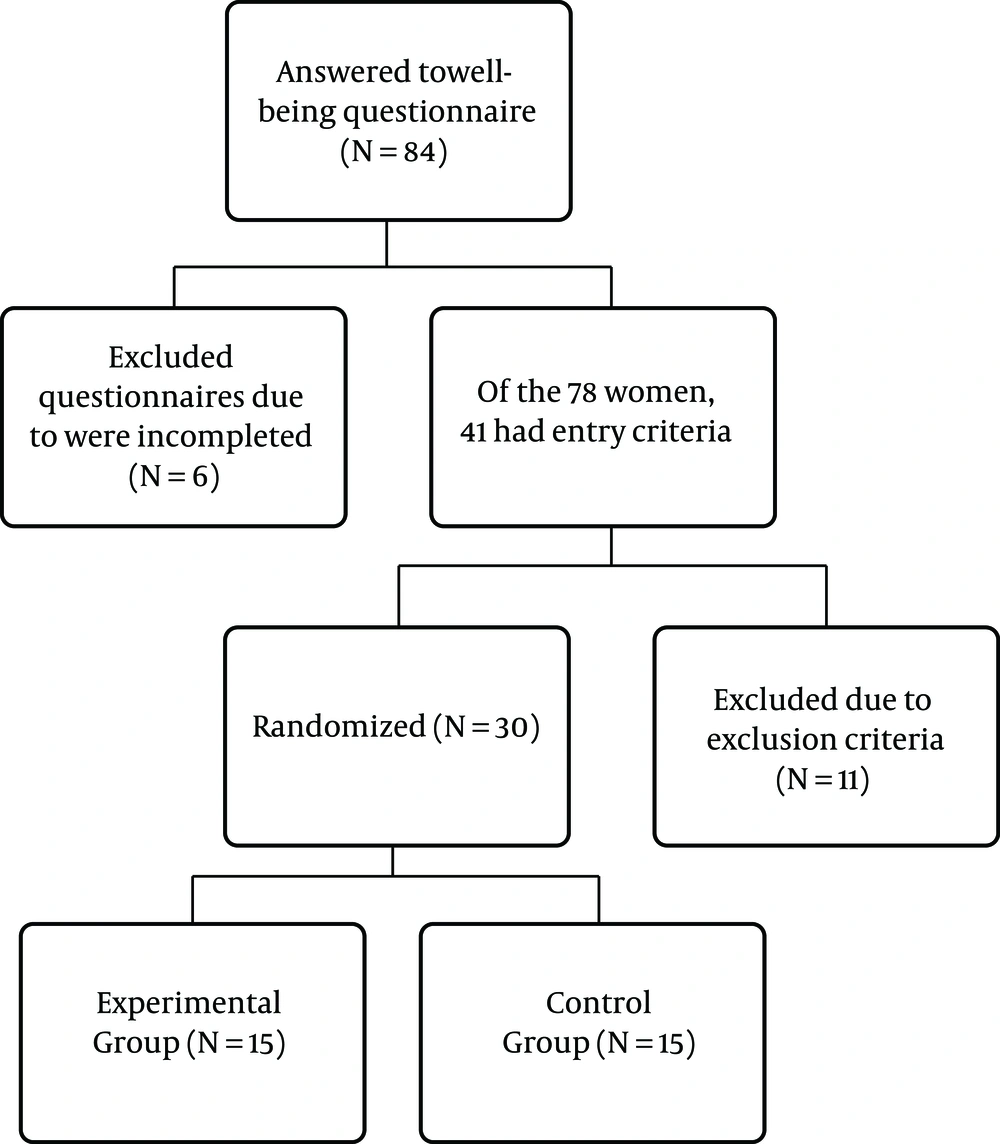
Figure 1.
Consort flowchart of women enrolled in this research
3.2. Research Tools
In this research, questionnaires were used for collecting data before the intervention and five weeks afterward. Thus, all participants from both groups completed the questionnaires before the first intervention session and after the last one. The following questionnaires were used to gather data.
3.2.1. Demographic Form
This questionnaire consisted of demographic information such as age, education, economic status, and occupation of participants.
3.2.2. Female Sexual Function Index (FSFI-19)
This questionnaire has been designed to measure multi-element sexual issues some of which have central roles in the sexual-marital function model. This was made by Rosen et al. (19) in 2000 and was normalized in a group of women with sexual arousal disorder. It has 19 questions in six domains of female sexual function including desire, arousal, lubrication, and orgasm (19). This was normalized by Mohammadi et al. (20) in Iran. The reliability of the scale and subscales for all subjects was 70% through Cronbach’s alpha coefficient, which shows the good reliability of this tool. Moreover, there was a significant difference in the average scores of the total scale and each of the domains between women with sexual dysfunction and healthy women (P < 0.001). Also, the scores of total scale, subscales, and psychiatrist diagnosis were specified by using the receiver operating characteristic (ROC) curve and area under the curve (AUC) and the cutoff point was obtained as 28. According to the cutoff point, 83% of women were classified in a disordered group and 82% in a normal group.
3.3. Sexual Skills Training with an Eclectic Approach
Sexual training is a short-term and multi-aspect process through which, people acquire information and knowledge about sexual issues and it helps improve attitudes, sexual health, interpersonal relationships, affection, intimacy, body image, etc. This training is related to the cognitive field (knowledge), affective field (feelings, values, and attitudes), and behavioral and communication skills field. In general, sexual skills training is a therapeutic approach that seeks the common elements among different treatments and its ultimate goal is to create the shortest and most effective treatment for reducing and resolving the women’s sexual function problems. In fact, sexual skills group training with an eclectic approach included nine sessions of 90 min (two sessions per week). The treatment was done by a doctor and a partner (counseling MA student) that were trained in sexual skills (Table 1).
Table 1.
The Summary of Sexual Skills Group Training with an Eclectic Approach in Women
| Details | |
|---|---|
| First session | Goals and basic framework of the program |
| Meeting the participating members and referral | |
| Getting informed consent of participants | |
| Familiarity with the necessity and importance of sexual training | |
| Second session | Familiarity with common attitudes about various sexual activities |
| Familiarity with the anatomy of male and female genitalia | |
| Third session | Familiarity with the sexual response cycle |
| Familiarity with sexual dysfunction | |
| Familiarity with decreasing sexual desire | |
| Sexual cycle and decreasing sexual desire | |
| Fourth session | Using desensitization techniques |
| Body massage with scented oils, without having sex | |
| Fifth session | Helpful sports for sexual relationship |
| Kegel recommended exercise | |
| Sixth sessions | Nutrition, sexual strengthening, and supplements |
| Sexual strengthening G. sexy | |
| Increasing blood flow in sexual areas | |
| Seventh session | Using the five senses in sexual relationship |
| Environmental triggers and the impact of bedroom decoration | |
| The effect of sense of smell and perfume on sexual arousal | |
| Eighth session | Sexual health and its related factors |
| Start-stop techniques | |
| Ninth session | Familiarity with wrong sex myths |
| The sexual reluctant in men and women | |
| Psychiatric disorders, internal diseases, and effective drugs |
3.4. Ethical Reviews
Initially, written consent was taken from the authorities of counseling centers to do the research. Then, an adequate explanation about the research was given to each of the participants and written informed consent was taken from them before doing the research. They also could withdraw from the study and be referred to a physician if sexual problems intensified. If there was no improvement in the sexual and marital status of those who were in the clinical control group, they would be referred to a psychiatric specialist. Also, the officials of counseling centers were assured of receiving the final results by researchers and the results would be attached at the end of the research.
3.5. Statistical Methods
We used SPSS-21 at the P < 0.05 level for analyzing the data. The Kolmogorov-Smirnov (K-S) test was used for evaluating the normality of data and the results indicated that all variables had normal distributions. In addition, the t-test and the analysis of covariance (ANCOVA) were used in this research.
4. Results
4.1. Demographic Characteristics
The study included women between the ages of 18 to 45 years. Of these 30 patients, 63.3% were native women and 36.7% were non-native women. The chi-square test showed no significant difference between the two groups in terms of economic status, job, and native or non-native status (Table 2). Also, the mean and standard deviation of the ages of women were 28 ± 4.33 and 29.4 ± 5.94 in the control and experimental groups, respectively. The mean and standard deviation of marriage duration was 9.53 ± 4.12 and 10.20 ± 4.84 in the control and experimental groups, respectively. The t-test results to check the consistency of these variables showed that there was no significant difference in age and marriage duration between the groups. Thus, it can be concluded that the demographic features were the same in both groups (P > 0.05) and both groups were similar in terms of demographic characteristics.
Table 2.
Demographic Comparison of Test and Control Groups by Chi-Square (N = 30)a
| Classification | Test Group | Control Group | Total | P Value |
|---|---|---|---|---|
| Economic status | > 0.698 | |||
| Good | 5 (33.3) | 4 (26.7) | 9 (30) | |
| Average | 7 (46.6) | 6 (40) | 13 (43.3) | |
| Weak | 3 (20) | 5 (33.3) | 8 (26.7) | |
| Job | > 0.864 | |||
| Worker | 8 (53.3) | 7 (46.7) | 15 (50) | |
| Housekeeper | 7 (46.7) | 8 (53.3) | 15 (50) | |
| Native women | > 0.562 | |||
| Yes | 10 (66.7) | 9 (60) | 19 (40) | |
| No | 5 (33.3) | 6 (63.3) | 11 (36.7) |
aValues are expressed as No. (%).
4.2. Analyzing Data Using ANCOVA
The Kolmogorov-Smirnov test was used to determine the normal distribution of data before analysis. The results showed that all variables had a normal distribution, so parametric tests were used to analyze the data. Table 3 shows that the mean scores of desire, arousal, and sexual function of the experimental group increased in the post-test compared to the pre-test scores while there was no difference between the pre and post-test scores of lubrication and orgasm. Also, there was no difference between the pre and post-test scores of sexual function and its subscales in the control group. Thus, ANCOVA was used to investigate the study hypothesis. The results in Table 3 show that there was a significant difference between the groups in the adjusted mean score of sexual desire considering the F coefficient. The effectiveness of sexual training was assessed with Eta squared of 0.380 and observed power of 0.975, which showed the effectiveness of sexual skills training with an eclectic approach for improving sexual desire in women (P < 0.001). Also, the results showed a significant difference between the groups in the adjusted mean score of arousal. The effectiveness of training was assessed with Eta squared of 0.202 and observed power of 0.713, which showed the effectiveness of sexual skills training with an eclectic approach for improving mental arousal in women (P < 0.014).
Table 3.
Analysis of Covariance of Sexual Function and its Subscales
| Variables | Experimental Group | Control Group | Mean Square | F | Sig. | Eta Squares | Observed Power | ||
|---|---|---|---|---|---|---|---|---|---|
| Pre-Test | Post-Test | Pre-Test | Post-Test | ||||||
| Desire | 3.68 (1.01) | 4.08 (0.64) | 3.24 (092) | 3.20 (0.43) | 4.211 | 16.52 | < 0.001 | 0.380 | 0.975 |
| Arousal | 3.74 (0.93) | 4.00 (1.13) | 3.16 (1.00) | 2.88 (0.82) | 6.548 | 6.84 | < 0.014 | 0.202 | 0.713 |
| Lubrication | 3.40 (0.73) | 3.44 (1.12) | 2.72 (0.89) | 3.04 (0.91) | 0.015 | 0.02 | 0.896 | 0.001 | 0.052 |
| Orgasm | 3.65 (0.75) | 3.70 (1.28) | 3.17 (1.06) | 3.18 (1.10) | 0.082 | 0.08 | < 0.786 | 0.003 | 0.058 |
| Sexual function | 21.39 (2.44) | 27.50 (3.47) | 18.85 (4.73) | 18.89 (4.59) | 234.73 | 43.79 | < 0.001 | 0.619 | 0.998 |
aValues are expressed as No. (%).
Other results in Table 3 showed no significant differences between the groups in the adjusted mean scores of lubrication and orgasm. Thus, the sexual skills training with an eclectic approach was not effective for increasing lubrication and orgasm in women (P < 0.05). The other results showed a significant difference between the groups in the adjusted mean score of sexual function. The effectiveness of training was assessed with Eta squared of 0.619 and observed power of 0.998, which showed the effectiveness of sexual skills training with an eclectic approach for improving sexual function in women (P < 0.001).
5. Discussion
According to our results, sexual skills training with an eclectic approach could improve sexual function and its subscales such as sexual desire and stimulation in women. These findings are in line with the results of previous research. For example, Fahami et al. (21) studied the effectiveness of sexual skills training with a cognitive approach in increasing sexual satisfaction in women and their results showed that sexual satisfaction in the experimental group increased after receiving sexual skills training compared to the control group. Eshghi et al. (22) studied the effectiveness of cognitive-behavioral counseling in sexual desire in women. Their results showed that cognitive-behavioral counseling was effective in improving the total score of sexual desire and its behavioral, cognitive, emotional, and physical dimensions. Also, the results showed that the counseling was effective in improving sexual knowledge, sexual confidence, and sexual assertiveness.
In fact, sex is one of the natural human needs and the lack of proper attention to it can cause social corruption. Sexual issues have significant roles in life satisfaction among couples. It should be said that low sexual desire is one of the sexual disorders such as sexual desire disorder, orgasm, arousal, vaginismus, and sexual fear. The prevalence of low sexual desire disorder is 58.3% in women that causes many family and marital problems. Some authors express that 90% of sexual issues are related to low sexual desire that causes plenty of problems for family and society. Moreover, divorce can root in sexual dysfunction (14, 23). Ziaee et al. (24) and Mohammadi et al. (25) showed that married women who used sexual skills training intervention for increasing marital satisfaction reported enhancement in their mental arousal and improvement in their sexual function. Other studies showed the effect of the behavioral approach on sexual problems and indicated that sexual training and information about sexual response cycle, anatomy, biology, and sexual techniques, changing negative sexual attitudes towards sexual issues, solving anxiety and sexual concerns, and increasing physical and verbal communication of couples are the basic principles of effective behavioral approaches in the treatment of sexual abnormalities (26, 27).
The information obtained by researchers emphasizes the effectiveness of sexual training in sexual function. The explanation for these findings is that marital problems can be taken into consideration through training and based on the problem-solving model. In this way, unrealistic expectations of couples change, so their sexual function improves. It is worth noting that there are several possibilities for justifying the effectiveness of sexual skills training in improving sexual function in married women as follows:
Prescribed exercises for patients with poor sexual function are mechanical and physical exercises that can lead to complex psychological reactions in people. For example, Kegel practices in the one hand strengthen enjoyable reactions and on the other hand prevent unwanted sexual tension.
Patients were allowed to express their emotions freely over the training sessions that led to anxiety reduction and facilitated the emotions of each person in communication.
Using information obtained from sexual skills training based on an eclectic approach instead of using limited and inaccurate sexual information is another reason for the effectiveness of this intervention.
Other results of this study showed that sexual skills training with an eclectic approach was not significantly effective on lubrication and orgasm in women. These findings are not in line with the results of previous research. For example, Hallvorsen and Metz (28) showed that relaxation training, hypnosis, mental guidance, group therapy, and special methods such as self-arouse, start-stop method, and systematic desensitization in sexual skills training with behavioral approach were successful treatments in treating poor sexual function. These methods had satisfactory outcomes in treating vaginismus, painful sexual intercourse, and orgasm disorders but had the lowest success in treating sexual desire disorder. Cognitive therapists acknowledge that cognitive processing is more important than physiological factors. Negative thinking about sexual activity makes symptoms severe and permanent. Therefore, the discovery of this negative indoctrination can help analyze sexual issues. Meston et al. (29) in their study on determining the best therapy for treating orgasm disorder declared that sexual skills training with the cognitive-behavioral approach through cognitive restructuring techniques, methods of reducing stress such as relaxation, sexual information, sensate focus exercises, and systematic desensitization were the best and most common methods of treatment. This can be noted that lubrication in the vagina is a physiological process and although training can improve it over time, interventions such as using drugs and gels in the short term can facilitate the sexual relationship. Also, orgasm is a complex and multi-factor process in women. Intervention through training can be effective if combined with intervention methods such as massage and relaxation.
5.1. Conclusions
Generally, the results showed that sexual skill training with an eclectic approach significantly increased sexual function and its subscales such as sexual desire and stimulation compared to the control group. However, there was no significant difference between the two groups in lubrication and orgasm subscales. It can be concluded from the mentioned discussion that sexual issues are both personal and social. Hence, authorities should consider sexual issues as a health problem and necessary for people, especially for the youth, in Iran and make some arrangements through easy methods for training with the help of researchers. However, this study had some limitations similar to any other research, the most important of which are the failure to generalize the results to the opposite sex (men) and no further follow-up tests in the long-term period. Although the results of the study showed no difference between two groups in terms of lubrication and orgasm, it is suggested that future research uses other training methods such as cognitive-behavioral strategies training, like visualization, film, and video training, to raise the awareness and the level of sexual function in women.