
1. Background
In all burn care systems, first aid, covering, and transferring of patients to the hospitals have an important role in managing and achieving a successful outcome (1). It seems that there are wide differences in the main methods of providing first aid and pre-hospital care for burn patients (2). If we can get a certain standard established between all ambulance technicians, we can achieve significant progress in management of this large and important group of patients (3). Burned patients are a big group of trauma patients that get care from first aid, people, ambulance technicians, nurses, and physicians, respectively before they get specific hospital cares (4). The caregivers of these patients often have poor or false instructions, which causes concern and prevents optimal care of patients (5). Intensive care and surgery has made significant progress in the field of burn wounds, however, urgent care of burns aren’t in the same scene. There is no “golden time” to determine how secondary operations will be done. An accurate estimate of the burns scale does not have a crucial role in the mortality rate, emergency calculation of the volume of intravenous (IV) infusion is not recommended, and choosing how to transfer the patient doesn’t have a significant effect on the estimation of patient recovery. Avoiding heat and the possible mental effect that it has in the stage of pre-hospital trauma burned patients is very important (3). Having a better concept of the pathophysiology and advances in burn management in the past 50 years highly helped reduce the mortality of major burn injuries. The aim in burn injuries should be healing the wound as soon as possible to minimize the complications of burns. Transmission of burn patients from the accident to the hospital should be done in a short period of time and we should remember that rescuing burn victims in the first hours of care has a vital role in saving the patient's life and continuous improving recovery is recommended (6). Burns are categorized based on the risk that they affect the patient into 3 categories: 1) Mild Burns, 2) Moderate Burns, and 3) Major Burns (7). Mild burns are burns of less than 50% of the adult’s body without burning of the face, hands, feet, or genitals. Moderate burns are burns of more than 50% of an adult’s body. If patients have mild burns but were under the age of 5, over the age of 60, or have underlying medical condition such as diabetes, heart failure, cirrhosis, chronic renal failure (CRF), and so on, it is considered as moderate burns. Major burns are any burns associated with airway burns, fractures, or other major trauma such as rupture of the organ (8). It also includes any kind of burning of the face, feet, hands, eyes, ears, or perineum that are important for the patient in terms of functional beauty.
2. Objectives
Despite several researches, the epidemiological specifications and level of care and offered treatments is various in different regions, this study was performed to determine the various aspects of pre-hospital management of burn patients in Sina and other hospitals affiliated to the Tabriz University of Medical Sciences. Using the results that can prevent and reduce the incidence and mortality of burns, short and long term plans are formulated.
3. Methods
In this retrospective study that was done in 2015, burn patients transferred by EMS (emergency medical service) to hospital emergency rooms were selected and the quality of care during transferring was evaluated. Training of EMS technicians as well as in terms of training primary care of burns was also investigated. Patients who have in some way, other than EMS, been admitted to the emergency department were excluded from the study; gathered data from 100 patients in 2015 were analyzed. Data were collected by a researcher designed structured questionnaire and the questions included the method of transferring and treatment of patients. The proper or insufficient care from pre-hospital EMS technicians were examined and recorded in the questionnaires. Variables of the study included: age, gender, time of transfer, the EMS staff training, and basic principles of patient transferring to hospital. The participants’ selection method was convenience and the sample size assessed by previous related studies.
Data were analyzed by SPSS V.21 and statistical tests such as the Chi-square and student sample t-test. P value for signification was considered to be less than 0.05.
4. Results
From the 100 patients in the burn unit of the hospital that were examined in 2015, the highest prevalence in the age groups were 16 - 30 and 31 - 45 years, with 31% and 27% of frequency, respectively; others have been shown in Table 1. patients (64%) were male and 36 (36%) were female. The transferring of patients to Sina hospital was 24 of the patients were taken from their home by EMS, 70 of the patients were transferred by ambulance from the city, and 6 patients transferred from other medical centers by EMS. In regards to burns, 96% of patients had thermal burns and 4% of patients had electrical, however, chemical burns wasn’t observed among patients. 6% of all patients had burn with trauma, which was 2% with explosion and 4% of the electric type Table 2. The education of EMS and pre-hospital care in 100 patients that was transferred; training of EMS technicians was 30% and the rest lacked necessary training. 22% of the burns were conducted in coordination with burn centers before sending and in 78% of them were inconsistent with the burn center before sending. Adjacent of the ambulance, temperature wasn’t done in all of the reported burns. Result of training status for pre-hospital care in EMS technicians was summarized in Figure 1. We also studied association between burn related deaths caused by a variety of mechanisms of burn with the training status of ambulance technicians. P values are in Table 2.
Table 1.
Distribution of Patients by Age by Frequency and Percentage
| Age | Frequency | Percentage |
|---|---|---|
| 0 - 15 | 18 | 18 % |
| 16 - 30 | 31 | 31 % |
| 31 - 45 | 27 | 27 % |
| 46 - 60 | 20 | 20 % |
| > 60 | 5 | 5 % |
| Total | 100 | 100 % |
Table 2.
Distribution of Mechanism of Burns and Association of Deaths and EMS Technicians Training Statusa
| Mechanisms of Burn | Frequency | % | Total | Mortality | P Value |
|---|---|---|---|---|---|
| Hot liquid | 10 | 10 | 96 | 4 | 0.003 |
| Fire | 50 | 50 | 5 | 0.001 | |
| Explosion | 36 | 36 | 3 | 0.013 | |
| Chemical | 0 | 0 | 0 | 0 | - |
| Electrical | 4 | 4 | 4 | 1 | 0.784 |
| Total | 100 | 100 | 100 | 13 | - |
a Chi-square. p value for signification was < 0.005.
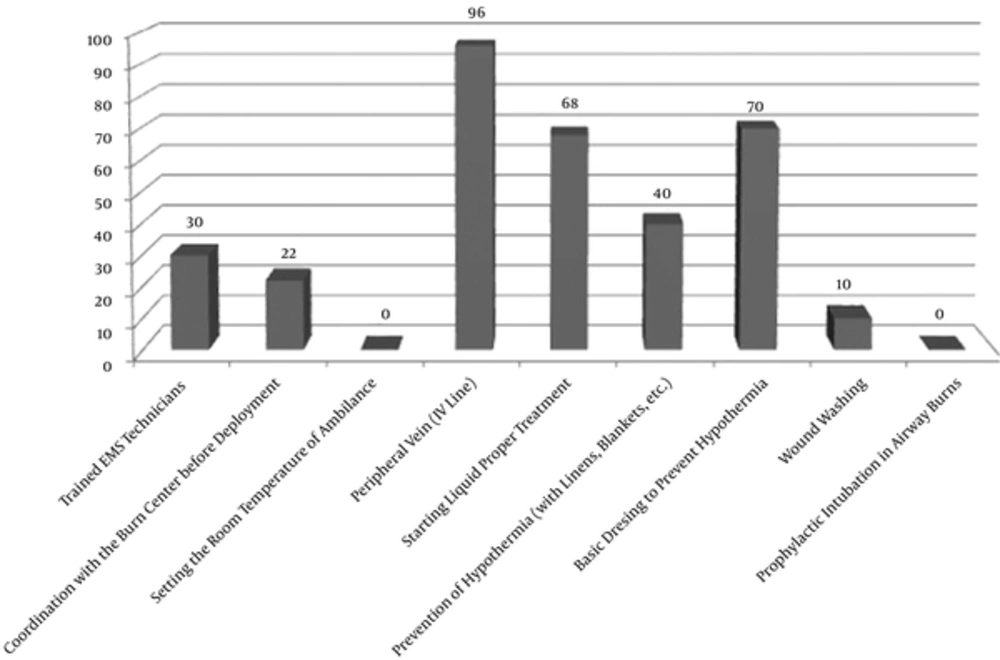
Figure 1.
The Status of Education of EMS Technicians and Pre-Hospital Care
EMS personnel training situations in relation to the pre-hospital care was scored. The base of the score was: For each item based on its impact on the quality of pre-hospital care, the score was considered from 0 to 100%. The mean of total scores for each of EMS personnel training status is given in Table 3. To examine the relationship between educational status of EMS personnel and quality of pre-hospital care, a significant relationship was observed only in trained EMS technicians (P = 0.031) and starting proper liquid treatment (P = 0.001).
Table 3.
The Status of Education of EMS Technicians and Pre-Hospital Care and Scoresa
| Questions | Status | Score | P Value |
|---|---|---|---|
| Trained EMS technicians | 30 | 37 | 0.031 |
| Coordination with the burn enter before deployment | 22 | 71 | 0.811 |
| Setting the room temperature of ambulance | 0 | - | - |
| Peripheral vein (IV Line) | 96 | 90 | 0.091 |
| Starting liquid proper treatment | 68 | 56 | 0.001 |
| Prevention of hypothermia (with linens, blankets, etc.) | 40 | 54 | 0.073 |
| Basic dressing to prevent hypothermia | 70 | 41 | 0.517 |
| Wound washing | 10 | 91 | 0.088 |
| Prophylactic intubation in airway burns | 0 | - | - |
a Chi-square. p value for signification was < 0.005.
5. Discussion
The developments that have helped in the reduction of mortality in the developed world are: 1) prevention programs (9), 2) improvements in pre-hospital care and intensive care management in equipped burn centers, and 3) early surgery of burn wounds and skin coating (8) as well as use of newer skin substitute (10). Among these, pre-hospital care and management in the intensive care burn center due to burn injuries reduction is very important (11).
In the Keith Allison’s study that was conducted in UK on ambulance crews (12), 84% of them used cooling methods, 12 different types of coverage for burn patients have been used, 74% and 97% of the crew of Talbufin hydrochloride and enenotox have been used, respectively, 74% of all patients have received oxygen to burn, 90% of the liquid injection was performed by injection tubes, 32% ambulance service said that they have received the necessary training for the care of burn patients, and 19% of they was referring to manuals for patients caring. In our study, only 30% of the technicians were trained and others did not have any training. Applying of proper liquid treatment for burns, only in 68% of the burns, was done properly and 32% were also deprived of it. Hypothermia prevention measures (with linens, blankets, etc.) were done in 40% of patients with burns. In another study conducted in Shanghai-China by Shi-zhaoJi and colleagues (1), 33.9% of burn patients benefit from care cooling before entering the hospital and 32.2% of them used (traditional methods of treatment) antibiotics for treatment of body burns. Only 12.2% of them were trained in the field of emergency management; in comparison with our technicians’ training in our study show a smaller percentage.
Provided care to burn patients immediately after the burn have a great effect on the breadth and depth of the wound. Although standard guidelines are formulated by various burn societies, they are still not well known to the people in our country. Primary care providers after burn accidents are often public audiences that was be here. Rapid implementation of appropriate first aid for thermal, chemical, electrical, and inhalation burns in the operating environment, and within a few minutes to burned patient, has a vital role in reducing deaths and saving lives. It seems somewhat obvious that results of this study could help the concept of pre-hospital emergency care. This could result in the pre-hospital services based on holistic patient’s needs for improving the outcomes and reducing admission fees in burn injuries. Furthermore, with identification of facilitators, barriers, and the concept of pre-hospital emergency care, EMS managers and technicians will be able to rely on insight based of scientific findings as well as manage their activities and training to effectively design and implement. Emergency trainings, especially via the Internet and work environment, plays an important role in pre-hospital emergency management and emergency training networks affects different age groups, social networks, and further academic education affects young youth, while family and friends affects more older people. Similar findings suggest that referral burn patients in Iran are much unexpected and authorities should pay more attention to their areas (13). The results of this study suggest that levels of emergency management and training burns are relatively low and therefore the level of education of pre-hospital emergency management is necessary to raise the level of emergency management burns. At the same time, more attention should be focused on Age-pivot and Group-pivot education and eventually, international emergency training in the future must be one of the main national educations. It seems that there were wide differences in the main methods of providing first aid and pre-hospital care of burn patients; if a certain standard established between all ambulances technicians, we can manage this large and important group of patients with significant progress.