
1. Background
Recently due to increase in antibiotic resistant strains of clinically important pathogens, a line of new bacterial strains that are multi drug resistant have emerged [1, 2]. Various plant extracts have been examined for their antibacterial activity with the objective of exploring safe alternatives of antibiotics [3]. Withania somnifera commonly known as Ashwagandha or Indian ginseng is a major Indian medicinal plant that belongs to family Solanaceae [4]. It can be found growing in Africa, the Mediterranean, and India. It has been used as an antibacterial, antioxidant, aphrodisiac, liver tonic and anti-inflammatory agent [5]. It counteracts the effects of stress and generally promotes wellness. The antimicrobial properties of this plant species have been widely reported in literatures [6, 7]. Previous reports on the activities of methanolic extracts of the whole W. somnifera plant against different pathogenic bacteria such as Escherichia coli, Pseudomonas aeruginosa, Staphylococcus aureus, Streptococcus mutans and Candida albicans, have found significant antibacterial properties [8]. Staphylococcus aureus is a major cause of nosocomial infections and produces numerous and serious infections in humans [9, 10]. Humans are natural reservoirs for S. aureus and asymptomatic colonization is far more common than infection. Colonization of the nasopharynx, perineum, or skin, particularly if the cutaneous barrier has been disrupted or damaged, may occur shortly after birth and may recur anytime thereafter [11, 12].
2. Objectives
Present study was carried out to screen antibacterial activity of W. somnifera leaf extract against antibiotic resistance S. aureus.
3. Patients and Methods
3.1. Isolates
A total of 17 isolates from 50 patients were cultured and screened in the Boo-Ali, Nabi-Akram and Imam-Ali hospitals (Zahedan, south-eastern Iran) during years 2011 - 2012. Isolated Gram and catalase positive cocci were further tested for biochemical characterization including lysostaphin sensitivity, coagulase, clumping factor, thermonuclease and haemolysin tests [13]. Subsequent to biochemical tests, staphylococcal isolates were identified using species-specific gene amplification (16S-rDNA) (Figure 1 and Table 1).
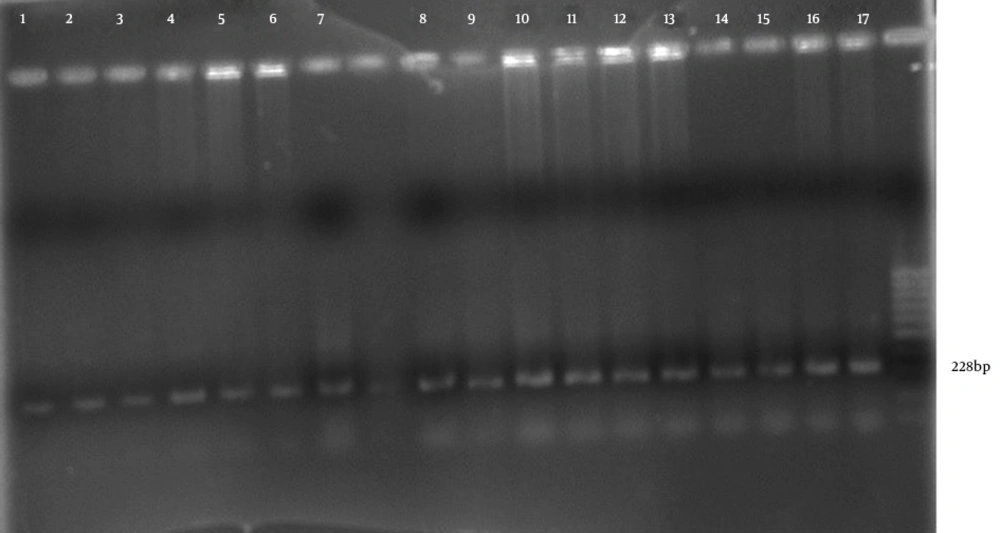
Figure 1.
PCR for Gene 16sr DNA
Table 1.
Oligonucleotide Primer for Identification S. aureus
| 16sr DNA | |
|---|---|
| Forward | GTAGGTGGCAAGCGTTACC |
| Reverse | CGCACATCAGCGTCAG |
3.2. Antibiotics Susceptibility
The susceptibility of the isolates for antibiotics was carried out using disc-diffusion method on Mueller-Hinton agar as recommended by Clinical and Laboratory Standards Institute with minor modification [14]. Briefly, colonies of S. aureus were suspended in a tube containing 0.5 mL of saline and bacterial strains were transferred to the surface of the Muller-Hinton agar using sterile cotton swabs. Antibiotic discs aseptically transferred on the surface of inoculated plates. The plates were incubated for 24 hours at 37°C and zones of growth inhibition were recorded. Antibiotics and their potencies were as follow: ceftazidime (30 μg), cefixime (30 μg), trimethoprim-sulfamethoxazol (1.25 + 23.15 μg), penicillin (10 μg), oxacillin (30 μg) and vancomycin (10 μg) (Patan-Teb-Iran).
3.3. Plant Materials
The leaves of W. somnifera were collected from countryside of Zabol (South-Eastern, Iran) and dried at room temperature. Samples were crashed and transferred into glass container and preserved until extraction procedure was performed in the laboratory.
3.4. Preparation of Extract
The leaves were pulverized into a coarse powder and 20 g grinded powder was soaked in 60 mL ethanol 95%, for one day (shaking occasionally with a shaker). After one day of dissolving process, materials were filtered (Whatman no. 1 filter paper). Then the filtrates were evaporated using rotary evaporator and 0.97 g of dried extract was obtained and stored at 4°C in air tight screw-cap tube.
3.5. Minimum Inhibitory Concentration (MIC) of Plant Extract
The broth micro-dilution method was used to determine MIC using Mueller Hinton broth supplemented with Tween 80 at a final concentration of 0.5% (v/v). Briefly, serial doubling dilutions of the extract were prepared in a 96-well microtiter plate ranged 500, 250, 126, 62 and 31 ppm. To each well, 10 μL of indicator solution and 10 μL of Mueller Hinton broth were added. Finally, 10 μL of bacterial suspension (106 CFU/mL) was added to each well to achieve a concentration of 104 CFU/mL. The plates were wrapped loosely with cling film to ensure that the bacteria did not get dehydrated. The plates were prepared in triplicates and then they were placed in an incubator at 37°C for 18 - 24 hours. The color change was then assessed visually and the lowest concentration at which the color change occurred was taken as the MIC value. The average of 3 values was calculated providing the MIC values for the tested extract. The MIC is defined as the lowest concentration of the extract at which the microorganism does not demonstrate the visible growth. The microorganism growth was indicated by turbidity.
4. Results
The isolated strains showed resistance to 6 antibiotics including oxacillin (83.3%), ceftazidime (66.6%), penicillin (50%), trimethoprim-sulfamethoxazol (41.6%), cefixime (33.3%) and vancomycin (8.3%) (Table 2).
| CN | SXT | V | CAZ | P | OX | |
|---|---|---|---|---|---|---|
| 58.3 | 50 | 50 | 25 | 25 | 0 | |
| 8.3 | 8.3 | 41.6 | 8.3 | 25 | 16.6 | |
| 33.3 | 41.6 | 8.3 | 66.6 | 50 | 83.3 |
a Values are presented as (%).
b Abbreviations: CAZ, Ceftazidime; CN, Cefixime; I, Intermediate; OX, Oxacillin; P, Penicillin; R, Resistant; S, Sensitive; SXT, Trimethoprim-Sulfamethoxazol V, Vancomycin.
Inhibitory effects of extract from W. somnifera against S. aureus were demonstrated in Table 3. The highest Minimum Inhibitory Concentrations (MIC) values of extract were found to be 250 ppm against 12 strains and the least value was 62 ppm against 2 strains (Table 3).
Table 3.
Antimicrobial Susceptibility (as MIC) of W. somnifera Extract for S. aureus (ppm)
| Bacterial Code | MIC for Extract, ppm |
|---|---|
| 250 | |
| 250 | |
| 250 | |
| 250 | |
| 250 | |
| 250 | |
| 250 | |
| 250 | |
| 126 | |
| 250 | |
| 250 | |
| 62 | |
| 250 | |
| 250 | |
| 126 | |
| 126 | |
| 62 |
5. Discussion
As our results, all isolates of S. aureus showed resistance to the antibiotics including oxacillin (83.3%), ceftazidime (66.6%), penicillin (50%), trimethoprim-sulfamethoxazol (41.6%), cefixime (33.3%) and vancomycin (8.3%). Emergence of bacterial resistance is critically an alarming situation in developing and developed countries. According to the study of Duran et al. the staphylococcal isolates showed resistance to tetracycline (41%), penicillin (92%) and trimethoprim-sulphamethoxazol (32.2%) [15]. Also in one study in Mashhad, staphylococcal isolates were highly resistant against ceftazidime (94%), followed by penicillin (91%), ampicillin (82%), cefotaxime (65%), erythromycin (60%) and oxacillin (43%) [16]. In another study, the overall susceptibility of isolated S. aureus strains to antimicrobial agents was 100% for vancomycin, 49.4% for amikacin, 43.8% for gentamicin, 36.8% for trimethoprim-sulfimethoxazole and tetracycline, 36.3% for cefazolin, 30.6% for cephalexin, 24.4% for oxacillin, 23.8% for erythromycin and 3.1% for penicillin [17]. Ghasemian et al. showed that the resistance of S. aureus to other antibiotics (by the disc diffusion test) are as follows: cephalotin (87.0%), gentamicin (26.0%), trimethoprim-sulfamethoxazole (19.3%), clindamycin (12.9%) and ciprofloxacin (9.7%) [18]. In the study of Rahimi et al. the resistance pattern was as follows: ampicillin (100%), ciprofloxacin (93%), methicillin and oxacillin (88%), kanamycin (66%), cephotaxim (65%), tetracycline (64%), erythromycin and sulphamethoxazole-trimethoprime (41%), chloramphenicol (40%), clindamycin (38%), gentamicin (20%) and vancomycin (0%) [19].
In our study, the highest MIC values of extract were found to be 250 ppm against 12 strains and two MIC values were 63 ppm. In a similar study, the ethanol extract of W. somnifera showed more activity against S. aureus (zone of diameter 20.1 ± 0.1 mm) compared with the ethanol extract [20]. In another study, on the other hand, maximum activity was observed in water solvent (zone of diameter 21.8 ± 0.2 mm) against R. planticola followed by benzene (zone of diameter 19.8 ± 0.2 mm) and chloroform solvent (zone of diameter 15.8 ± 0.2 mm) against S. aureus [20]. In the study of Srinu et al. W. somnifera plant extract showed more inhibitory activity on Gram positive organisms (S. aureus and B. cereus) [21]. Jain and Varshney reported the antibacterial activity of the methanolic extracts of the whole W. somnifera plant against E. coli, P. aeruginosa, S. aureus, S. mutans and C. albicans with zones of inhibition of 38, 36, 15, 38 and 32 mm, respectively [8]. As the results of Pandit et al. methanol extract of W. somnifera demonstrated a broad antibacterial rang against Streptococcus mutans and Streptococcus sobrinus (MIC 0.125 - 2 mg/mL) [22]. According to the study of Alam et al. methanol extract of the plant displayed the highest activity against S. typhi (32.00 ± 0.75 mm zone of inhibition), whereas the lowest activity was against K. pneumoniae (19.00 ± 1.48 mm zone of inhibition) [23]. Different parts of this plant show antimicrobial effects against wide range of microorganisms including Multiple Drug Resistant (MDR) strains. In one study, root extract of W. somnifera was effective against all the MDR S. aureus strains isolated from local and patient sources and different root extracts showed different degree of effectiveness against the isolates [24]. Flavonoid or other phenolic compounds may participate in selective inhibitory action of the extract. Lee and Kim have previously isolated flavonoids, including quercetin glycosides from the leaves of W. somnifera [25].
In conclusion, the present study demonstrated that the ethanol leaf extract of W. somnifera hold an excellent potential as an antibacterial agent. The leaf extract of W. somnifera was found on the other hand, to be more effective in inhibiting the antibiotic resistant S. aureus strains.