
1. Introduction
Resistin is a hormone and adipokine which is produces and secretes from adipose tissue. The molecule was discovered by Stephen et al. [1]. Resistin as a hormone has the endocrine effects including effects on obesity, insulin resistance and also plays a role in energy homeostasis. Insulin consider as inhibitor of resistin, so mRNA level of resistin is increased in insulin resistance. Resistin likely is a hormone that linking obesity to diabetes. It is a serine and cysteine rich molecule which is secreted from adipose tissue in rats and epithelial and immune cells in dogs and pigs and primates. This hormone contains 108 amino acids with a molecular weight 12.5 KDa in human [1]. Resistin gene belongs with RELM (Resistin-Like Molecules) family in mouse and human. This gene family already was discovered as FIZZES (Found Inflammatory Zone). FIZZ3 family genes are similar to resistin gene. Also resistin is well known as ADSF (Adipose Tissue-Specific Secretory Factor [2]. Resistin gene expression is mainly in white adipose tissue, and especially in abdominal fat [1, 3]. Studies have shown that serum resistin levels are increased in obese subjects, thus reducing resistin gene expression in obesity treatment has been proposed [4]. Furthermore, genetic variation in the resistin gene is not associated with obesity and type 2 diabetes in Italian population [5] and Japanese [6]. Also it has been observed that resistin levels are not associated with insulin resistance or obesity and it is not regulated by leptin [7]. Thyroid hormones regulate the body's energy balance and have effects on adipokine level [8]. Some studies with different results on resistin concentration in patients with hyperthyroidism and hypothyroidism have been reported [9]. The study showed that resistin levels in patients with thyrotoxicosis followed treated with radioactive iodine reduced[10]. Some studies have also shown that resistin levels are increased in patients with hyperthyroidism and its concentration decreased with normalizing thyroid hormone status following treatment[11]. In one study, sera resistin levels in patients with Graves' disease decreased and on the other hand it increased in Hashimoto’s and simple goiter patients [12]. In recent years the role of resistin in thyroid function has been noticed and considered by researchers. So far disagreements relation studies have been reported about resistin and thyroid disorders. This study aimed to evaluate serum resistin levels in patients with hypo and hyperthyroidism and relation the results to weight and body mass index.
3. Materials and Methods
This study was done as a cross sectional case-control study which performed on selected patients with thyroid disorders who came to endocrine clinic of Endocrinology and Metabolism Research Center, Shahid Beheshti University of Medical Sciences. The study included 82 patients, 48 persons with hypothyroidism and 34 persons with hyperthyroidism and totally 82 subjects as the control group, because of clinical and biochemical criteria for inclusion were evaluated. The sample size was based on the similar study and sample size determination formula, at least 32 patients in each group was determined. TSH levels greater than 10 mIU/L, consider as hypothyroidism criteria, and its levels less than 0.2 mIU/L was considered as hyperthyroidism status. To confirm the thyroid function status based on TSH, the amount of thyroxine determined in all subjects. In the first group T4 was less than 4 µg/dL and in the second group; it was higher than 13.5 µg/dL. All patients before entering the study were signed the informed consent from. Demographic data collection form for each of the participants in the study was completed. Anthropometric characteristics included measurement of weight and height, with a sensitivity of 100 g and 0.5 cm were obtained respectively. BMI by dividing weight (kg) by the square of height (m) was calculated too.In this study TSH levels were measured using Immuno Radio Metric Assay (IRMA) method (Turbo TSH [125 I] kit, Isotope, Hungary) and T4 concentration was determined using Radio Immuno Assay (RIA) method using the same company product (T4 RIA kit [125I] Isotope, Hungary). Serum resistin level was determined by Enzyme Linked Immuno Sorbent Assay (ELISA) method using an ELISA kit of human resistin, (Cusabio Biotech, and Wuhan, China); the assay sensitivity was 0.16 ng/mL.
In this study, data analysis was performed by SPSS-18 software. Normal distribution of data was tested by Kolmogorov-Smirnov test. For descriptive presentations, the data are expressed as mean ± standard error. Independent t-test for comparison among groups and Pearson´s test was used for examination of relationship among groups. Simultaneous comparison of three groups’ data including hyper, hypo and control subjects was done using one-way ANOVA test. Significance level was considered less than 0.05.
4. Results
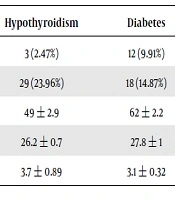
In this study, as mentioned before, 82 patients with thyroid disorders, 48 patients in hypothyroid group and 34 patients in hyperthyroidism participated. BMI and serum levels of hormones including resistin, TSH and T4 separately for controls and patients are shown in Table 1. The obtained results showed that BMI and resistin levels in patients with hypothyroidism was significantly (p<0.05) greater than the control group.
Data presented in Table 1 showed that no significant correlation between resistin, BMI, TSH and T4 in the hypothyroid group and also control group subjects.
Mean serum level of resistin, TSH, T4 levels and body mass index were compared between cases and controls [Table 2].
The results showed that the mean BMI in patients with hyperthyroidism (25.11±0.15) was significantly lower than control (25.98±0.18) group (p<0.05). The resistin serum levels in patients with hyperthyroidism (7.93±0.86) was significantly higher than the control (3.15±0.16) group (p<0.05). In patients with hyperthyroidism significant correlation between serum resistin levels,BMI, serum levels of TSH and T4 were not observed. The results are shown in Table 2.
Table 1.
Anthropometric and biochemical parameters of hypo, hyper and control groups a
| 27.40 ± 0.17 | 0.008 | 25.11 ± 0.15 | 0.008 | 25.98 ± 0.18 | |
| 14.26 ± 1.92 | 0.54 | 0.02 ± 0.003 | 0.94 | 2.42 ± 0.13 | |
| 3.49 ± 0.14 | 0.032 | 14.59 ± 0.71 | 0.021 | 8.82 ± 0.24 | |
| 6.24 ± 0.63 | 0.000 | 7.93 ± 0.86 | 0.000 | 3.15 ± 0.16 |
[object Object]
Table 2.
Pearson’s correlation coefficient of resistin, BMI, TSH and T4 among hypo, hyper thyroid and control groups
| 0.15 | 0.22 | 0.08 | |
| 0.07 | 0.04 | -0.13 | |
| -0.17 | 0.03 | 0.04 |
5. Discussion
The obtained results showed that serum resistin levels in patients with thyroid disorders including hypothyroidism and hyperthyroidism are higher than the control group.
In this study, a significant relationship between hormones including TSH, T4, and resistin and body mass index in patients with hypothyroidism and hyperthyroidism were not observed. In general, few studies assessed the resistin levels in patients with thyroid disorders but the results of those studies differed with the present study. A study on 43 patients with hypothyroidism showed that resistin levels are increased in these patients. After treatment with thyroid hormone and normalization of thyroid hormones level, resistin levels are also reduced. In mentioned study, there was no relation among resistin levels with weight, fat mass, and waist circumference and body mass index before and after treatment [11]. Other research suggested resistin levels positively correlated with FT4 and FT3 but TSH levels were negatively correlated [13]. In a study mentioned that resistin level regulated by thyroid hormone, it was shown that resistin levels in patients with hypothyroidism increased and conversely, in patients with hyperthyroidism resistin levels decreased. Also an increased resistin level in obese patients has been reported. In animal studies, injection of antibodies against to resistin decreases insulin resistance in obese mice and improved blood sugar and insulin function [14]. However, another report on 76 patients and 30 controls showed that serum resistin levels are no different in patients with hyperthyroidism and controls [15]. This result is similar to our study, no significant correlation between levels of thyroid hormones and resistin in patients with hyperthyroidism has been reported. Also another report titled resistin levels in patients with hypothyroidism showed that resistin concentrations in the control group were similar to hypothyroidism group and the thyroid hormone and resistin had not relationship [16]. In this study, the correlation between resistin level and thyroid hormones in patients with hypothyroid was not seen.
Little information on the effects of weight reduction on the regulation of resistin levels is achieved. Recent studies have shown that energy restriction and weight loss has no associated with changes in resistin levels in healthy individuals with normal weight [17]. These results are similar to results of studies in obese subjects with insulin resistance who participated in a behavior modification program for weight loss [17].
In summary, the results of this study suggests that serum resistin is likely to be consider as a confirmation extra test for the diagnosis of thyroid disorders including hypothyroidism and hyperthyroidism in patients probably. Thus, the measurement of resistin, possibly can prevent the false diagnosis of thyroid assessment and maybe offer more effective interventions to improve patient care and the economy aspect.