1. Background
Parasitic diseases as one of the most important health problems in the society, has a higher prevalence in developing countries and economically depressed communities [1, 2]. According to a report by the world health organization (WHO), about three billion of world population is infected with intestinal parasite [3, 4] and 450 million people, including children experience the adverse effects of intestinal parasitic disease [5]. A careful perusal of literature indicates that the prevalence rate of intestinal parasite infection is 7% - 20% in developed countries while 30% - 60% children in rural areas are affected by parasite infection in these countries [6-11]. Malnutrition, diarrhea, weight loss, anemia pose a mortal threat to human populations and cause about 16 million deaths in the developing countries every year [1, 12-14].
Previous surveys in Iran indicate that, the rate of intestinal parasitic disease in this country is between 4.7% - 19.7% [15-19]. Compared with any other age group, children are more susceptible to intestinal parasite. The rate of infection among elementary school students is 22.2% - 47.7% [20-22]. Children in day care centers are more prone to experience parasitic diseases. This could be associated with poor hygiene or presence of asymptomatic children [23, 24].
Parasitic diseases can be transmitted directly and indirectly. The direct transmission mostly occurs in crowded places such as kindergartens, dormitories, barracks and sanatoriums. In this way, the cysts of parasites are usually transmitted by hands or through contaminated tools or objects. The cysts can be also transmitted through water or by eating utensils [1, 25, 26]. Many children spend long hours together and use common things like toys. Hand- and object-to-mouth contacts with contaminated toys and objects can be a major culprit for the transmission of infection.
Different studies have been carried out on the prevalence of intestinal parasites in the day care centers, in Iran [22-24]. Some studies have documented a significant relationship between parent’s education and the rate of intestinal parasite infection among their children [23, 24]. Low frequency of hand washing is reported to increase the risk of infection about 1.94 times [23]. So far, no study has been conducted on the prevalence of intestinal parasite infections in the day care centers in Gonbad-e Kavus. Therefore this study is an attempt to address this gap. The results of this study can help district health authorities and those who are in the charge of day care centers to make some measurements to prevent and control the spread of the parasites.
2. Methods
2.1. Research Setting
Gonbad-e Kavus (55°18′ E, 37°17′ N) lies up the north of Golestan province, Iran. In 2015, it had a population of 377,327of which 38,860 were children under the age of 5. (Statistics unit of Gonbad-e Kavus Health Center, unpublished data).
2.2. Methodology
This study is a cross-sectional study was carried out on the children of different day care centers in Gonbad-e Kavus. All children in 45 day care centers (23 urban and 22 rural centers) were studied through survey. From1191 children, 932 children between 1-9 years old were recruited to participate in this study.
Data on children’s socio demographical information including parent’s occupation, parent’s education and the place of residence were collected through a questionnaire. To collect the morning stool samples of the participants, special containers with a particular number on, were given to parents and they were asked to send the samples to the laboratory of the health center in less than two hours. To diagnose Entrobius vermiculari,s scotch tape test was used. Three sets of samples were prepared, and then the samples were examined by direct wet mount, formalin-ether concentration and Trichrome staining techniques according to WHO protocol [27]. Also, the prepared scotch tape samples were observed under the microscope for the eggs of worms and trophozoites or cysts of protozoa. The obtained data was analyzed using SPSS version 16 software Descriptive statistics including the percentage and frequency were used to describe the survey data. Then association between socio demographic variables and intestinal parasite infection were analyzed using chi-square test. Variables with a P value less than 0.1 were included in the model of Multinomial Logistic Regression. The odds ratio at 95% Confidence Interval was determined using Logistic Regression to evaluate the effect size of each variable on the rate of intestinal parasite infections.
3. Results
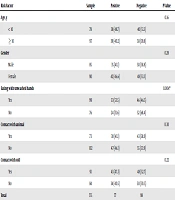
In this study, from 932 investigated children in different day care centers in Gonbad-e Kavus County, 2796 stool samples and scotch tape were collected and analyzed. Data showed that 248 (26.6%) of the children were infected with the parasites. There was a significant relationship between some demographic characteristics of participants (children’s age, parent’s education and their place of residence) and the rate of infection to the parasites (P < 0.05) However, there was no significant relationship between the children’s gender and the risk for intestinal parasite infections (P = 0.239) (Table 1).
Table 1.
The Frequency of Intestinal Parasite Infection Among Children in the Day Care Centers: in Gonbad-e Kavus by Gender, Age, Parent’s Education and Residency Statusa
| Variables | Subgroup | Infected Students | Healthy Students | Total | P Value |
|---|---|---|---|---|---|
| Genus | Male | 111 (24.8) | 336 (75.2) | 447 (100) | 0.239 |
| Female | 137 (28.2) | 348 (71.8) | 485 (100) | ||
| Age | < 2 | 5 (11.9) | 37 (88.1) | 42 (100) | 0.001 |
| 3 - 4 | 39 (18.9) | 167 (81.1) | 206 (100) | ||
| 5 - 6 | 204 (29.8) | 480 (70.2) | 684 (100) | ||
| Mother’s education | Illiterate | 12 (41.4) | 17 (58.6) | 29 (100) | < 0.0001 |
| Under-diploma | 101 (38.4) | 162 (61.6) | 263 (100) | ||
| Diploma | 73 (22.2) | 256 (77.8) | 329 (100) | ||
| Academic | 62 (19.9) | 249 (80.1) | 311 (100) | ||
| Father’s education | Illiterate | 16 (32) | 34 (68) | 50 (100) | < 0.0001 |
| Under-diploma | 105 (40.9) | 152 (59.1) | 257 (100) | ||
| Diploma | 67 (22.5) | 230 (77.5) | 297 (100) | ||
| Academic | 60 (18.3) | 268 (81.7) | 328 (100) | ||
| Residence areas | Urban | 150 (22) | 530 (78) | 680 (100) | < 0.0001 |
| Rural | 98 (38.9) | 154 (61.1) | 252 (100) |
aValues are expressed as No. (%).
Age, sex, mother’s and father’s educational level, place of residency, history of drug consumption and history of infection were studied using univariate regression model. Among the mentioned variables, mother’s and father’s education, place of residency and age were significantly associated with children infection rate. Analyzing the relationship between variables in multivariate regression model showed that the significance of mother’s or father’s educational level depends on the order of entering the data into this model. For example, when the data on father’s level of education was entered first, mother’s level of education did not show any significant relationship. To show the co-effect of these variables, their interactions were considered .An increase in parent education for one level decreased the risk of infection in their children by 6% (OR = 0.94 ). The children in rural areas were 1.55 times more likely than the children in urban areas to be infected with intestinal parasites with a rise in the age of participants for a year, the risk of infection increased by 44% (OR = 1.44) (Table 2). One hundred fifty (16.1%) children were infected with Enterobius vermicularis and 129 (13.8%) were at least infected with a species of Protozoa. Thirty one (3.3%) children were infected with both worm and protozoa (Table 3).
Table 2.
Multinomial Logistic Regression Analysis of the Factors Associated with the Risk for Parasite Infections Among the Children Different Day Care Centers in Gonbad-e Kavus
| Outcome | Unadjusted Odds Ratio | P > z | Adjusted Odds Ratio |
|---|---|---|---|
| Residence areas | 0.445 | < 0.0001 | 1.55 |
| Age | 1.8 | < 0.0001 | 1.444 |
| Parent’s Education | 0.912 | < 0.0001 | 0.94 |
| Constant | 0.487 |
Table 3.
The Frequency of Infection with Various Intestinal Parasites Among the Children Different Day Care Centers in Gonbad-e Kavus
| Demographic Characteristic Species of Parasites | Genus | Residence Areas | Age | Total Infected Childrena | ||||
|---|---|---|---|---|---|---|---|---|
| Male | Female | Rural | Urban | 2 ≥ | 3 - 4 | 5 - 6 | ||
| Enterobius vermicularis | 85 | 65 | 64 | 86 | 2 | 22 | 126 | 150 (1/16) |
| Blastocystis hominis | 45 | 27 | 24 | 48 | 3 | 10 | 59 | 74 (9/7) |
| Giardia lamblia | 11 | 13 | 12 | 12 | 2 | 1 | 21 | 24 (6/2) |
| Endolimax nana | 13 | 12 | 13 | 12 | 0 | 6 | 19 | 22 (4/2) |
| Dientamoeba fragilis | 11 | 4 | 11 | 4 | 0 | 1 | 14 | 17 (8/1) |
| Entamoeba coli | 3 | 5 | 5 | 3 | 0 | 0 | 8 | 8 (8/0) |
| Iodamoeba buetschlii | 1 | 0 | 0 | 1 | 0 | 0 | 1 | 2 (2/0) |
| Chilomastix mesnili | 0 | 2 | 0 | 2 | 0 | 0 | 2 | 1 (1/0) |
| Trichomonas hominis | 0 | 1 | 0 | 1 | 0 | 1 | 0 | 1 (1/0) |
| Total | 169 | 129 | 129 | 169 | 7 | 41 | 250 | 298 (32) |
aValues are expressed as No. (%).
4. Discussion
The prevalence of intestinal parasitic infection among 932 children in different day care centers in Gobad-e Kavus, Iran was analyzed. Data analysis showed that 26.6% were infected with intestinal parasites. In the previous studies carried out in Iran, the reported rates were 68.1%, 47%, 36.6%, 22% and 10% [22, 24, 28-30]. The results of this study on the rate of infection with the intestinal parasites in Gobad-e Kavus were consistent with those reported in Shahroud city [22]. However, this rate was lower than the rate reported in Damghan and Bam [28, 29] but significantly higher than that in Illam and Yazd [24, 30]. Such differences in the prevalence of different parasitic diseases could be associated with environmental, or socio –economic factors such as, the rate of humidity, temperature and dust, lack of health facilities in families or in day care centers; unhealthy handling of sewages; the residence place(rural or urban) and also the time of the study [22, 29, 31].
In the tested samples in this study; Enterobius vermicularis was observed in 16% of samples. In a study conducted in Bam [29], the rate was 15.9% but in Semnan and Damghan [28], the rates were 8.15 and 33.8% respectively. In the current study, no soil transmitted worms such as Ascaris, hook worms and strongyloides were observed in the tested samples. However, in the studies carried out in Venezuela and Keshmir [14, 32] Ascaris was reported to be the most prevalent worm. The rates of prevalence in these two countries were 28.4% and 49.3%. Some studies in Illam and Bam [24, 29], showed the rate of infection with Ascaris lumbricus were 3.8% and 1.8% and this rate for strongyloides stercoralis was 0.8% . This confirms that the children in our area of study are much healthier and are at the lower risk of infection.
In this study, 8 species of protozoa were observed in the tested samples. Blastocystis hominis had the highest frequency rate 7.9%. This specie along with Giardia lamblia (2.8%) and Dientamoeba fragilis (1.8%) were among pathogenic protozoa observed in the study. Among non-pathogenic protozoa, including Endolimax nana had the highest infection rate (2.4%), but Entamoeba coli, Iodamoeba buetschlii, Chilomastix mesnili and Trichomonas hominis had a lower frequency. In a study carried out in our country [33], the infection rates with G. lamblia were 14.7% and15% children under the age of 10. In a study conducted in Yazd [30], the infection with B. homonis and G. lamblia showed the highest rate, the infection rate with G. lamblia was 45.1% in San Franciso and Venezuela [34]. However, the rate was quite lower in children (2.8%) in our study. Consistent with the studies conducted in Iran [22, 28-30], the rates of intestinal parasite infection for boys and girls were 28.2% and 24.8%, respectively. Data showed that the difference between boys and girls was not statistically significant. This means that gender doesn’t have a big effect on intestinal parasite infection .This could be attributed to similar condition of boys and girls in our country.
In this study, a significant relationship was found between the age of children and their rate of infection with the intestinal parasites. However, in the other studies conducted in this country, there was no significant relationship between these two variables [28, 30]. With an increase in the age of the participant, the risk of infection increased by 44% (OR = 1.44).In children smaller than two, the species of Enterobius vermicularis, Blastocystis hominis and Giardia lamblia were the major culprit for the infections, while in children over two, other parasites caused infection. This is probably is associated with easy transmission of parasite diseases through direct contact. In this study, a significant difference between the rate of and literacy level of parents was observed. These results were consistent with other studies carried out in Iran [24, 28-30]. An increase in parents’ education for one level decreased the risk of infection in their children by 6% (OR = 0.94). Simply put, level of education can significantly contribute to prevention of children’s infection to parasites. Perhaps, the knowledge of parents about the ways parasites can be transmitted or their awareness of the prevention techniques can decrease the risk for intestinal parasite infection among children. There was a significant relationship between the rate of and the children’s residence place in this study. This result was echoed in studies conducted in Yazd, Bam, Illam and Damghan [24, 28-30]. Such a difference could be attributed higher health standard and knowledge of people in the urban areas. Also the children from urban areas were only infected with the parasites Iodamoeba buetchlii, Chilomastix mesnili and Trichomonas hominis.
4.1. Conclusions
Comparing the results of this study with the available research in literature shows that the general health condition in day care centers in Gonbad-e Kavus is satisfactory. However, the risk of intestinal parasite infection among children is still high. The prevention and health associated risk for parasitic infections require immediate attention of parents, district health authorities and those who work in day care centers. Due to the high rate of intestinal parasite infections among children, parents and child care workers need to learn about the various means by which parasites can be transmitted in day care centers.