
1. Background
Needle-stick injuries (NSIs) are penetrating wounds caused by a needle or other sharp object potentially contaminated with the body fluid of another person (1). Needle sticks are usually caused by objects such as subcutaneous needles, needles used for bleeding, and intravenous injections (2). Needle-stick injuries are the biggest occupational hazard for healthcare staff, especially nurses (3). NSIs can transmit blood-borne diseases such as hepatitis B (HB), hepatitis C (HC), human immunodeficiency virus (HIV), gonorrhea, syphilis, malaria, etc. (4). Hepatitis B and HC viruses and HIV are the three most common blood-borne pathogens mentioned in studies (5, 6). Needle-stick is a common cause of blood-borne diseases among nurses, as previous studies have shown 33.7% of Ethiopian nurses (7), 37% of nurses in the United Kingdom (8), and 70.3% of nurses in Nepal (9) experienced NSIs. Worldwide consequences of NSIs are around 66,000 HBV, 16,000 HCV, and 1,000 HIV infections annually (3). Previous studies in Iran have shown that every healthcare staff experiences NSIs between one and four times yearly (10).
According to a study, organizational factors (reporting policies), behavioral factors (needle recapping), and engineering factors (designing devices and tools) are important causes of NSIs (11). Some other reasons for NSIs are sudden patient movement during injection; situational factors during childbirth; handling specimens; collecting hospital waste, and lack of personal protective equipment (12).
According to the Center of Disease Control and Prevention of Iran, only 10% of staff with NSIs reported their injury (11). The reported rate of NSIs is higher in some developing countries (13). Reasons for not reporting NSIs include high occupancy, lack of awareness, and fear of some consequences, such as job loss (14), which may lead to an increase in blood-borne disease rates, such as AIDS and HB.
Estimating the NSI rate and related factors in each geographical area helps local health policymakers to control its prevalence. No previous studies have assessed the prevalence of NSIs among nursing staff and its related factors in Sirjan. On the other hand, the high prevalence of NSIs among nurses, high costs of NSIs-related infections, and probable transmission of these infections to others led our research team to assess the prevalence of NSIs among nursing staff and the factors affecting it in Sirjan in 2020.
2. Methods
2.1. Study Design and Sample Size
This cross-sectional study was performed on nurses working in the hospitals of Sirjan (from September to October 2020) to investigate the prevalence of NSIs and some related factors. Inclusion criteria were having at least one year of work experience in a hospital, willingness to participate, and having a bachelor’s degree or higher in nursing. The needle-stick recall period was considered one year, such as in a similar study (14). Finally, 312 nurses were included in the census method. Nurses on long-term leave (more than 6 months) were excluded from the study.
2.2. Data Collection and Instruments
The tools used in this study include:
(1) Demographic characteristics: age, sex, marital status, educational degree, work experience, working shifts, nurse position, and type of employment;
(2) The needle-stick questionnaire: The Needle-stick Questionnaire, developed and used by Ghanei Gheshlagh et al. (14), evaluates the status of the needle stick and the factors associated with this injury. It consists of 2 parts. The first part includes 20 questions for assessing: the status of NSIs, previous education about NSIs, awareness about diseases transmitted by blood-borne and body fluids, previous HB vaccination, injurious objects, and activities. The second part of the questionnaire consists of 10 yes or no questions, which assesses the reasons for not reporting NSIs. The test-retest method was used for assessing the reliability of quantitative data, with reliability ranging from 0.74 to 0.78. For qualitative data, the Kappa agreement coefficient had been reported as 0.84 (14).
To reduce errors, the participants were informed about the aim of the study, and they were assured of the confidentiality of their data before the study.
2.3. Statistical Analysis
Categorical variables were then presented as the numbers (percent). Analytical statistics (chi-square or Fisher’s exact test and univariate and multiple logistic regression model) also were used to compare prevalence among different groups and indicate risk factors associated with NSIs using SPSS-19. The significant level was set at 0.05.
3. Results
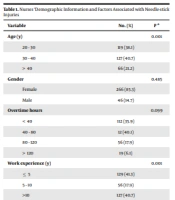
The mean ± SD of nurses’ age was 33.8 ± 7.15 years, and the mean ± SD of nurses’ work experience was 8.6 ± 6.3 years. Nurses’ demographic information and factors associated with NSIs are shown in Table 1. According to the chi-square test, nurses with younger ages and lower work experience (P = 0.001), nurses who had been vaccinated against HB (P = 0.021), and nurses who were knowledgeable about AIDS (P = 0.038) were more likely to experience NSIs.
Table 1.
Nurses ‘Demographic Information and Factors Associated with Needle-stick Injuries
| Variables | No. (%) | P a |
|---|---|---|
| Age (y) | 0.001 | |
| 20 - 30 | 119 (38.1) | |
| 30 - 40 | 127 (40.7) | |
| > 40 | 66 (21.2) | |
| Gender | 0.485 | |
| Female | 266 (85.3) | |
| Male | 46 (14.7) | |
| Overtime hours | 0.099 | |
| < 40 | 112 (35.9) | |
| 40 - 80 | 12 (40.1) | |
| 80 - 120 | 56 (17.9) | |
| > 120 | 19 (6.1) | |
| Work experience (y) | 0.001 | |
| ≤ 5 | 129 (41.3) | |
| 5 - 10 | 56 (17.9) | |
| >10 | 127 (40.7) | |
| Education | 0.141 | |
| B.Sc. | 292 (93.6) | |
| M.Sc. | 20 (6.4) | |
| Employment status | 0.061 | |
| Provisional | 73 (23.4) | |
| Contractual | 60 (19.2) | |
| Permanent | 179 (57.4) | |
| Awareness of hepatitis disease | 0.568 | |
| Yes | 170 (89.9) | |
| No | 19 (10.1) | |
| Awareness about AIDS | 0.038 | |
| Yes | 169 (89.4) | |
| No | 20 (10.6) | |
| Interested in nursing | 0.125 | |
| Yes | 161 (85.2) | |
| No | 28 (14.8) | |
| Lack of nurses staff | 0.729 | |
| Yes | 64 (33.9) | |
| No | 125 (66.1) | |
| Overtime | 0.171 | |
| Mandatory | 248 (79.5) | |
| Optional | 64 (20.5) | |
| Hospital ward | 0.399 | |
| Emergency | 42 (22.2) | |
| Internal | 38 (20.1) | |
| Surgery | 28 (14.8) | |
| Pediatric | 20 (10.6) | |
| ICU | 21 (11.1) | |
| CCU | 23 (12.2) | |
| Operating room | 11 (5.8) | |
| Neurology and psychiatry | 6 (3.2) | |
| Interested in workplace | 0.473 | |
| Yes | 20 (10.6) | |
| No | 169 (89.4) | |
| Hepatitis B vaccination | 0.021 | |
| Yes | 172 (91.0) | |
| No | 17 (9.0) |
a P values were calculated by χ2 or Fisher’s exact test.
Most of the participants (60.6%) reported one or more cases of NSIs; most of the NSIs are caused by needles (35.4%) during recapping (45.5%) and venipuncture (24.3%). Most of the injured nurses were working in the emergency department (22.2%), and most of them (65.6%) reported NSIs during the night shifts. Other situations related to NSIs are shown in Table 2.
Table 2.
Prevalence and Situations Related to Needle-stick Injuries
| Variables | No. (%) |
|---|---|
| NSIs | |
| Yes | 189 (60.6) |
| No | 123 (39.4) |
| Number of NSIs per year | |
| 1 | 129 (68.3) |
| 2 - 3 | 48 (25.4) |
| > 3 | 12 (6.3) |
| The first action after needling | |
| No action | 14 (7.4) |
| Wound area pressure and bleeding | 64 (33.9) |
| Wash the wound area | 111 (58.7) |
| The shift in which needle sticks occur | |
| Morning | 46 (24.3) |
| Evening | 19 (10.1) |
| Night | 124 (65.6) |
| The person being blamed | |
| Himself | 134 (70.9) |
| Colleague | 26 (13.8) |
| Patient | 29 (15.3) |
| Number of reports | |
| No times | 94 (49.7) |
| 1 | 72 (38.1) |
| 2 - 3 | 18 (9.6) |
| > 3 | 5 (2.6) |
| Kind of an injurious device | |
| Suture needle | 25 (13.2) |
| Syringe needle | 67 (35.4) |
| Venipuncture needle | 12 (6.3) |
| Glucometer needle | 13 (6.9) |
| Angio catheter | 24 (12.7) |
| Infected ampule pockets | 48 (25.4) |
| Cause of the needle stick | |
| Recapping | 86 (45.5) |
| Veins | 46 (24.3) |
| Blood sampling | 35 (16.9) |
| Stitching | 25 (13.2) |
Abbreviation: NSI, needle-stick injury.
Based on the results of multiple logistic regression (Table 3), the odds of NSIs in nurses aged 20 - 29 years were 3.9 (OR = 3.94, CI:1.12 - 13.84; P = 0.032) times nurses older than 40 years. The odds of NSIs in nurses with 5 to 10 years of work experience were 2.5 (OR = 2.50, CI: 1.12 - 5.57; P = 0.02) times nurses with more than 10 years of work experience. Also, the odds of NSIs in nurses vaccinated were 74% (OR = 0.26, CI: 0.07 - 0.98; P = 0.04) less than in nurses who had not.
Table 3.
Risk Factors Associated with the Occurrence of Needle-stick Injuries
| Variables | Univariable OR (CI 95%) | P Value | Multiple OR (CI 95%) | P Value |
|---|---|---|---|---|
| Age (y) | ||||
| 20 - 29 | 4.45 (2.34 - 8.46) | 0.00 | 3.94 (1.12 - 13.84) | 0.032 |
| 30 - 39 | 2.52 (1.37 - 4.65) | 0.003 | 1.75 (0.85 - 3.61) | 0.12 |
| >40 | Ref | . | Ref | . |
| Work experience (y) | ||||
| ≤ 5 | 0.02 (1.81 - 5.08) | 0.00 | 1.09 (0.36 - 3.25) | 0.87 |
| 5 - 10 | 3.80 (1.89 - 7.65) | 0.00 | 2.50 (1.12 - 5.57) | 0.02 |
| >10 | Ref | . | Ref | . |
| Vaccination | ||||
| Yes | 0.25 (0.07 - 0.88) | 0.03 | 0.26 (0.07 - 0.98) | 0.04 |
| No | Ref | . | Ref | . |
| Lack of nurses | ||||
| Yes | 0.91 (0.57 - 1.48) | 0.72 | 0.89 (0.52 - 1.50) | 0.67 |
| No | Ref | . | Ref | . |
| Overtime | ||||
| Yes | 1.48 (0.85 - 2.58) | 0.16 | 1.30 (0.70 - 2.41) | 0.40 |
| No | Ref | . | Ref | . |
| Awareness about AIDS | ||||
| Yes | 0.35 (0.13 - 0.98) | 0.04 | 0.50 (0.16 - 1.52) | 0.22 |
| No | Ref | . | Ref | . |
| Awareness of hepatitis disease | ||||
| Yes | 0.79 (0.35 - 1.76) | 0.56 | 2.14 (0.79 - 5.77) | 0.13 |
| No | Ref | . | Ref | . |
Abbreviation: Ref, reference category; OR, odds ratio.
In this study, 49.7% of nurses with NSIs did not report their injuries. The three most reasons for that were mentioned as considering the injurious device noninfectious (52.1%), busy schedule (43.6%), and the patient hasn’t a known infection (28.7%). More information is in Table 4 (Some nurses chose more than one reason).
Table 4.
Frequency of Factors Related to Non-reporting Needle-stick (n = 94)
| Variables | No. (%) |
|---|---|
| No previous use of the device for the patient High busy | 49 (52.1) |
| High busy | 41 (43.6) |
| Assume that the patient or source of infection does not have a specific infection or disease | 27 (28.7) |
| Injury only affects you | 9 (9.6) |
| No special work is done in case of reporting | 8 (8.5) |
| be ashamed | 6 (6.4) |
| Lack of knowledge of the relevant follow-up process | 6 (6.4) |
| Fear of being labeled a disease | 5 (5.3) |
| Fear of losing a job | 3 (3.2) |
4. Discussion
This study showed that the frequency of NSIs in nurses of Sirjan hospitals was 60.6%. This result is consistent with the results of previous studies in Pakistan (66.3%) and China (64.9%) (15, 16) and much higher than the Ethiopian (33.7%) and Australian (17.7%) studies (7, 17). It is also a little lower than studies in South Korea (70.4%) and Nepal (70.3%) (9, 11), so the results show that the prevalence of NSI was high among our participants.
Based on the results, age and work experience are significant factors in the occurrence of NSIs, as the younger the age, the higher the rate of NSI. In similar studies, NSI rates were also reported higher at younger ages (7, 18). The results of this study, in line with other studies, mentioned low work experience as an effective factor in the higher prevalence of NSIs (14, 15, 19). In another study, half of all exposure cases occurred within the first 3 years of work (20). Younger nurses are at greater risk of NSIs due to low work experience, lower practical skills, and high workloads. Older nurses with more work experience are at lower risk, which may be related to their skills and job positions as managers, therefore, less direct contact with patients and injurious devices.
The study’s results showed that 91% of the nurses with NSIs had received the HB vaccine. These results align with the previous studies in Iran (14, 21, 22). Also, the logistic regression model results showed that vaccinated nurses reported NSIs 0.2 times more than nurses who had not. In another study, the chance of NSIs in people receiving hepatitis booster doses was about two times higher than others (15); receiving the hepatitis vaccine may have led to false assurance and carelessness among healthcare workers.
Recapping was the most reported activity leading to NSIs in the current study, as in other similar studies (7, 9, 19, 23), which may be related to lack of knowledge, lack of needle-crushing machines, mandatory hospital instructions, and the high workload of staff (24).
As the results showed, nurses forced to work overtime are more likely to suffer from NSIs. These results are consistent with a previous study (25). In another study, the injury rate was reported to be 4.2 times higher in people who worked more than 35 hours per week and 5 times higher in those who did more than 10 injections per day (26).
In this study, like some other studies, the syringe needles were the main injurious devices (14, 27, 28) related to their common usage. Results of the study showed that nurses who suffered from NSIs blamed themselves (70.9%), which is consistent with the results of other studies (29, 30).
The highest incidence of NSIs in this study was at night shifts (65.6%), similar to previous studies’ results (2, 27). Nurses, physicians, and hospital staff have rotating shifts and irregular sleep, which may reduce general alertness, cause fatigue and drowsiness, and increase the incidence of injuries, such as NSIs and medical errors (31), which may incur irreparable problems for patients and themselves. In some studies, the prevalence of NSIs was reported higher on morning shifts (32, 33), which may be related to high workload during this shift.
In this study, the emergency ward nurses also faced more NSI events than others, which could be due to the emergency and stressful situation of this ward (7). In a study, 40.3% of nurses experienced emergency NSIs (34). In another study, the risk of NSIs in the emergency ward was reported 3 times higher than in other wards (35). Wang et al. reported a direct relationship between stressful situations and increasing the risk of NSIs among nurses (36). Emergency nurses usually provide care to critically ill patients; this situation and long working hours, rotating shifts, overcrowding, and constant contact with clients in critical conditions (emerging disease and death) are the most important issues that may expose them to NSIs (37).
Failure to report NSIs is one of the challenges beyond injured staff and authorities. Reporting injury leads to post-exposure prophylaxis, early detection of probable infection, and provide effective treatment (38). Common reasons for not reporting NSIs are disease phobia or the probability of losing a job (39). According to the results, 49.7% of needle-stick victims did not report their injuries. Costigliola et al. stated that one-third of nurses did not report their NSIs (40). A systematic review in Iran reported that more than half of the NSIs victims do not report their injuries and deprive themselves of treatments (41). The appropriate reaction of hospital authorities to victims plays an important role in reducing this problem (41). Inadequate knowledge and considering the injury an unimportant event cause staff to ignore the NSIs and not report them (39, 40).
In the present study, the most common reasons for not reporting NSIs were mentioned as considering needle noninfectious and nurses’ busy schedules, which was consistent with previous studies (10, 42). Therefore, nurses should be educated to report NSIs as a habit by knowing their importance, and also, they should support in this regard.
4.1. Conclusions
In the present study, more than half of the nurses experienced NSIs. In order to reduce these injuries, hospital managers should assess needle-stick-related factors and provide safety devices and a calm and stress-free environment for staff. Hospital managers should teach safety principles to young nurses and support nurses who are injured to create a culture of reporting NSIs.