
1. Background
Self-care in health is a set of purposeful activities aiming to promote and restore health, prevent disease, and limit illness (1). The most important self-care behaviors include proper nutrition and physical activity, healthy eating, and taking responsibility for one's own health (1, 2). Self-care in patients can alleviate symptoms and prevent complications of disorders; in healthy individuals, it can prevent infection and help detect disorders in the early stages (1-3). Self-care can improve the quality of life, increase patient satisfaction, increase the efficiency of service rationalization, and reduce health costs (1, 4). Proper nutrition, physical activities, and not smoking are the main components of chronic disease prevention (1, 5). These factors can reduce 80% of cardiovascular diseases and type 2 diabetes, and 40% of cancers (6, 7). Due to the physiological changes in different stages of life and the physical requirements related to reproduction, women are more vulnerable to physical and emotional complications (8, 9). Therefore, self-care has a crucial role in improving longevity and quality of life in women. In addition to biological reasons, women and girls are more vulnerable to diseases due to socioeconomic and cultural factors. For instance, they are 2 - 4 times more susceptible to acquired immunodeficiency syndrome (AIDS), and about 50% of new cases of AIDS in the world are women (10).
Many studies have assessed the effect of self-care on controlling various diseases (11-13). There is scarce information on the effect of self-care on healthy people, especially women, to improve their quality of life. The average self-care during pregnancy in pregnant women in southeast Iran is low, and the rate of death among pregnant women is about three times higher than the average national rate.
2. Objectives
With regards to the important role of women in the family and society and the limited support and understanding of self-care in the healthcare system in Iran, this study assessed the self-care status of 15- to 60-year-old women visiting the Comprehensive Health Care Centers in Zahedan, southeast Iran.
3. Methods
3.1. Study Population
This descriptive-analytical study was carried out on 15-60-year-old women visiting the Comprehensive Health Care Centers in Zahedan. The study was approved by the Ethical Committee of Zahedan University of Medical Sciences, and written consent was obtained from all the participants. A total of 250 women in this group who could write were included. Women from several Comprehensive Health Care Centers were included in the study. This study was performed after the approval of the Biomedical Research Ethics Committee (IR.ZAUMS.REC.1399.320).
3.2. Data Collection
All the women were interviewed by a trained staff to obtain the demographic data (age, occupation, education, income satisfaction, comorbidity, marital status, number of children, etc.) of the sample. In addition, all the women filled out the personal self-care assessment questionnaire. We previously assessed the validity and internal consistency of the questionnaire (14). This questionnaire includes 75 self-care assessment items in 5 dimensions, including physical health (questions 1 - 15), mental and emotional well-being (questions 16 - 30), management priorities (questions 30 - 45), supportive relationships (questions 46 - 60), and meaning (question 61 - 75). Each dimension contains 15 items. A 5-point Likert scale (never, rarely, occasionally, often, and always) is used to answer the questions. The minimum and maximum scores are 75 and 375, respectively. The results of the questionnaire were interpreted as follows: Scores of 285 and above: Good; scores of 284-190: Relatively good; and scores of 189 or less: Unfavorable.
3.3. Statistical Analysis
Initially, the normality of the data was assessed using the Lilliefors modification of the one-sample Kolmogorov-Smirnov test. For the data with a normal distribution, appropriate parametric methods such as Student's t-test and analysis of variance (ANOVA) were used. For nominal scale data, the chi-square test and Fisher's exact test were used. All the statistical analyses were performed in SPSS V. 20 (IBM Corp., Armonk, NY, USA) at the 0.05 level of significance.
4. Results
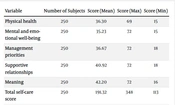
A total of 250 women with a mean age of 40 ± 11.6 years completed the study. The total score of self-care was 191.3 ± 44.9 (Table 1).
Table 1.
Mean and Standard Deviation of Self-care Scores and the Subscales
| Variables | Number of Subjects | Score (Mean) | Score (Max) | Score (Min) |
|---|---|---|---|---|
| Physical health | 250 | 36.30 | 69 | 15 |
| Mental and emotional well-being | 250 | 35.23 | 72 | 15 |
| Management priorities | 250 | 36.67 | 72 | 18 |
| Supportive relationships | 250 | 40.92 | 72 | 18 |
| Meaning | 250 | 42.20 | 72 | 16 |
| Total self-care score | 250 | 191.32 | 348 | 113 |
According to the results of the study, 63.6% of the women had an unfavorable self-case score, while only 6.4% and 30% had good and relatively good scores, respectively. There was a direct and significant correlation between age, mental and emotional well-being (r = 0.618 and P <0.001), and meaning (r = 0.229 and P <0.001), but an inverse and significant correlation was found between age, physical health (r = -0.413 and P <0.001), and supportive relationship (r = -0.204 and P <0.001).
The mean of physical health (46.44 ± 17.234), management priorities (41.88 ± 14.056), supportive relationships(49.42 ± 18.154), and total self-care score in the women with university education was significantly higher than those with lower education levels (P <0.001, 0.003, 0.002, <0.001, respectively ). The mean of mental and emotional well-being in people with a high-school diploma was higher than others (37.96 ± 13.653) (P = 0.007), but no difference was observed in meaning (P = 0.134). The prevalence of unfavorable self-care was the highest among women with elementary education (77.2%) and the lowest among women with a university education (39.5%) (P = 0.001).
The mean of physical health (44.05 ± 16.187) and supportive relationship (45.75 ± 18.536) in single women was significantly higher than in married ones (P < 0.001, P = 0.043). However, the mean of mental and emotional well-being in single women was significantly lower than in married ones (27.61 vs. 37.69) (P < 0.001). The mean physical health was the highest in childless women (43.64 ± 15.263), while the mean mental and emotional well-being was the highest among women with three children (40.76 ± 12.521) (P < 0.001). No difference was seen in the other subscales and total self-care score (P = 0.069, P = 0.083, P = 0.054). The mean physical health (46.55 ± 20.767), management priorities (40.64 ± 15.416), supportive relationship (49.73 ± 19.581), and total self-care scores (213.36 ± 64.735) in women with excellent financial satisfaction were significantly higher than in other women (P = 0.028, P = 0.031, P = 0.027, P = 0.043, respectively), but no difference was seen in mental and emotional well-being and meaning (P = 0.78). The mean of physical health in women without an underlying disease was significantly higher than in those with an underlying disease (37.49 ± 14.071) (P = 0.002), whereas the mean of mental and emotional well-being in women without an underlying disease was significantly lower than those with an underlying disease (33.70 ± 11.134) (P < 0.001). The comparison of the total score of self-care according to each of the independent variables is shown in Table 2. In the regression model, age, education, and financial status has a significant relationship with self-care score (Table 3).
Table 2.
A Comparison of the Total Score of Self-care According to Each Independent Variable
| Variables | Number of subjects | Mean ± SD | P-value |
|---|---|---|---|
| Total score of self-care | |||
| Education level | <0.001 | ||
| Elementary | 92 | 178.82 ± 33.424 | |
| Junior high school and high school | 65 | 184.88 ± 34.867 | |
| High school diploma | 50 | 199.42 ± 54.549 | |
| University | 43 | 218.37 ± 54.898 | |
| Total score of self-care | |||
| Marital status (independent samples t-test) | 0.114 | ||
| Single | 61 | 193.54 ± 37.030 | |
| Married | 189 | 190.60 ± 47.323 | |
| Total score of self-care | |||
| Number of children (analysis of variance) | 0.304 | ||
| 0 | 74 | 192.34 ± 36.475 | |
| 1 or 2 | 98 | 188.87 ± 44.694 | |
| 3 or more | 78 | 193.42 ± 52.445 | |
| Total score of self-care | |||
| Job (analysis of variance) | <0.001 | ||
| Unemployed | 6 | 154.33 ± 21.667 | |
| Housewife | 156 | 191.78 ± 47.348 | |
| Employed | 49 | 184.43 ± 44.420 | |
| Student | 39 | 203.79 ± 33.443 | |
| Total score of self-care | |||
| Financial status (analysis of variance) | 0.043 | ||
| Bad | 131 | 188.68 ± 43.864 | |
| Medium | 64 | 184.20 ± 38.601 | |
| Good | 44 | 204.00 ± 48.515 | |
| Excellent | 11 | 213.36 ± 64.735 | |
| Total score of self-care | |||
| Underlying disease (independent samples t-test) | 0.792 | ||
| Yes | 195 | 190.61 ± 43.216 | |
| No | 55 | 193.82 ± | |
Table 3.
Results of the Regression Model of Significant Variables Related to Self-care Status
| Variables | B-Coefficient | B-Coefficient | P-Value |
|---|---|---|---|
| Age | 0.318 | 1.2 | 0.003 |
| Education | 0.407 | 16.51 | <0.001 |
| Financial status | 0.128 | 6.37 | 0.034 |
5. Discussion
This study investigated the self-care status of 15- to 60-year-old women visiting the Comprehensive Health Care Center in Zahedan. The total score of self-care was 191.3 ± 44.9. In fact, only 6.4% of the women had a good self-care score, while the majority (~ 64%) had unfavorable self-care scores. Since a suitable self-care program can significantly reduce the risk of some chronic disorders, such as cardiovascular diseases and diabetes, the absence of self-care behaviors in southeast Iran can be considered an important risk factor for chronic diseases in the near future.
Our results showed that age was directly and significantly related to mental and spiritual health (r = 0.618 and P <0.001) and meaning (r = 0.229 and P <0.001) but had a significant inverse correlation with physical health (r = -0.413 and P <0.001) and supportive relationship (r = -0.204 and P <0.001). We also found that the prevalence of unfavorable self-care was the highest among women with elementary education (77.2%) and the lowest among women with university education. In the study by Hartweg DL on healthy middle-aged women, education, age, and the number of children had significant correlations with the type of self-care actions (15). In the study by Yang et al. on low-income elderly women with hypertension in South Korea, younger women were more likely to have higher self-care behavior scores (16). In our study, we found that older women had lower physical health and supportive relationships.
In a study by Anari and Ahmadipour in 2015 in Kerman Province (Iran), physical self-care was not significantly related to job, income, or education. Only sleep quality was better in housekeepers (P = 0.02) compared to the employed women. Their study showed that physical activity, as well as screening for common cancers in women visiting health centers, is not favorable (17). Therefore, they concluded that educational interventions are necessary to increase people's awareness and identify the barriers to the application of interventions aimed at raising the standard of self-care. However, in our study, it was found that women's jobs, income, and education affected their self-care behaviors. This difference may be due to differences in sampling, inclusion and exclusion criteria, the type of questionnaires used, and sample size.
In a study by Nasresabetghadam et al. on Iranian old women with hypertension, education had a significant effect on different self-care behaviors, including medication adherence, weight control, physical activity, and nutrition behaviors (18). In the study by Masinaienejad et al., similar results were found after providing self-care education to patients with β-thalassemia major (19).
Regional healthcare providers should focus on the education and training of women to improve their self-care behaviors and prevent chronic diseases in the near future. Self-care behaviors are powerful and inexpensive tools to prevent an increase in the rate of chronic diseases. Therefore, healthcare providers should have a continuous program to increase self-care behaviors among women and decrease the cost of treatment of chronic diseases in the near future.
5.1. Conclusions
Our study showed that 6.4% of the women had a good self-care score, while 30% and 63.9% had relatively good and unfavorable scores, respectively. Older age, lower education, worse economic status, more children, and unemployment were associated with a lower self-care score. Based on the results, the prevalence of poor self-care status in women is high. Thus, it is recommended that appropriate training and educational programs be administered to increase their knowledge and self-care behaviors and reduce the burden of diseases.