
1. Background
The prevalence and severity of hypertension increase significantly with age in women, and a higher percentage of women than men have hypertension in older age (1, 2). The vascular wall is an integral functional component of the circulatory system that is constantly remodeling in response to hemodynamic and disease conditions (3). These components interact to form a complex network that provides the vessels with elasticity for optimal blood flow. If the structural and physical integrity of the matrix is not maintained, the mechanical stresses of continuous blood flow weaken the vessel wall (1). In addition to the physical elastic properties of the wall, the vascular matrix composition has molecular cellular components that are regulated by growth factors stored in the matrix and growth factor activation. Repair and remodeling of connective tissue to maintain matrix integrity involves the synthesis and removal of metalloproteinase proteins, a process that depends on the action of a variety of proteases and inhibitors of these proteins (1, 3).
Studies have shown that high levels of matrix metalloproteinases (MMPs) are found in patients with hypertension. These can predict an increased risk of vascular complications associated with hypertension, while tissue inhibitors (TIMPs) may counteract these effects. Circulating levels of MMPs and their TIMPs may play an important role in cardiovascular remodeling and hypertension (4). A more active lifestyle can improve body composition and reduce the risk of age-related conditions, particularly high blood pressure. Exercising as we get older is a key part of staying healthy (5-7). One of these methods is resistance training, which can help improve fitness and overall health in various age groups (7, 8). In addition to improving glucose metabolism and body composition, this type of exercise also increases muscle strength (7, 8). Activities such as pilates, as a safe and economical option, have many positive effects on exercise in older adults (7). Given the positive effects of this type of exercise in reducing fat mass and increasing muscle mass, incorporating it into exercise programs for older adults may improve their quality of life (9).
Previous studies have also shown the beneficial effects of resistance training and pilates in older adults (7). Pilates training, in addition to improving motor function in the elderly, may also regulate blood pressure in the elderly (10). Serum levels of tissue inhibitor of metalloproteinase-1 change in response to aerobic exercise, and these changes, in conjunction with improvements in blood pressure, indicate the effect of this type of exercise on serum levels of tissue inhibitor of metalloproteinase-1 (11, 12). Controlling hypertension and other complications in the elderly population is a challenge in modern society (1, 4). Pilates is also becoming increasingly popular among women (7). Since fitness exercises are routinely performed by all age groups, we believe that a combination of fitness and pilates exercises may have a better response in society and be more welcomed by the elderly. However, few studies have been conducted on this topic. A combination of the two types of exercise can be used to identify and improve the effectiveness and may be an important factor in the adjustment of high blood pressure in the elderly.
2. Objectives
Based on vascular dysfunction and hypertension in old age, and on the effect of physical activity on elderly people, this study aimed to investigate the effect of selected combined exercise (fitness and pilates) on serum metalloproteinase-1 levels and blood pressure indices in elderly women in Ahvaz.
3. Methods
Volunteers registered and completed a demographic questionnaire through an announcement and social networks. They agreed to take part in the research by signing an informed consent form. Before the intervention, participants completed a Three-Day Food Recall Questionnaire and were given dietary advice (13, 14). One day before the test, participants ate the same foods. Every two weeks, participants received dietary advice and recommendations for similar foods. Before the post-test sampling, they received The Food Recall Questionnaire and were asked to eat the same food as at the pre-test.
The study measured plasma levels of metalloproteinase-1 before and after six weeks. Blood samples were taken 48 hours before and after exercise (13, 14). To minimize effects, samples were taken in the morning after at least 8 hours of sleep and 10 hours of overnight fasting. The subject was placed in a sitting position, and 5 mL of blood was drawn from the forearm vein. The blood sample was poured into a test tube containing a clotting agent (15). It was then centrifuged and frozen. Metalloproteinase-1 levels were measured using a commercially available kit (12).
3.1. Human Care
First, volunteers registered through announcements and contacts via social networks and completed a demographic questionnaire. They entered the research process by agreeing and signing a written consent form. Prior to the intervention, participants' dietary information was collected using a Three-Day Food Recall Questionnaire (two working days and one day off), and participants were given recommendations for food consumption and similar calorie intake. One day prior to blood collection in the pre-test, participants were asked to consume the same foods. In addition, participants received nutritional counseling every two weeks and were given recommendations for similar foods and portion sizes. Before the post-test sampling, they were given the Three-Day Food Recall Questionnaire again and asked to consume the same food on the day before sampling as they had the day before the pre-test.
This quasi-experimental study was conducted to investigate the effect of selected exercise on serum levels of metalloproteinase-1 in elderly Ahwazi women. In this study, 30 women over the age of 60 were purposively selected and randomly divided into two groups: An exercise group that included a combination of pilates and fitness exercises, and a control group that included only daily activities. Inclusion criteria included no regular exercise, no use of medication or dietary supplements, and no specific physical condition. The duration of the exercise program was estimated to be eight weeks (16).
3.2. Training Protocol
The exercise group completed three 60 - 75 minute sessions per week, including warm-up, main exercise, and cool-down. The program began with basic strength training for the upper and lower body. Advanced stretching, strength, balance, flexibility, and coordination exercises were performed in three positions. The warm-up included standing, breathing, and stretching, and the cool-down ended with spinal stretching and breathing.
The intensity of the activity started at 50 to 55 percent of predicted heart rate and gradually increased to 65 to 70 percent by week eight. The intensity of the exercise gradually increased by five percent every two weeks. Each session included a 5-minute rest period. Strengthening exercises were performed using bodybuilding equipment. To increase safety, the intensity of the exercise was increased gradually.
- First two weeks: Twenty repetitions.
- Third and fourth week: Fifteen repetitions.
- Fifth and sixth week: Twelve repetitions.
- Seventh and eighth week: Ten repetitions.
Weights were based on the maximum number of repetitions to failure. The Karonen method was used for calculating maximum and reserve heart rates, and a Polar monitor was used during exercise (16).
3.3. Sample Collection
The participants were asked to refrain from strenuous physical activity and the use of diuretics the day before the test. Blood pressure indices were measured before and after the test at 8 a.m. in the sitting position using a German digital blood pressure monitor (Beurer) on the arm, 24 hours before and after the exercise intervention. The metalloproteinase-1 index was measured by ELISA using kits from Sunlong Biotech Ltd with a sensitivity of 0.8 pg/mL (17, 18).
3.4. Statistical Analysis
The Shapiro-Wilk test was used to determine the normality of the data distribution, and the Levene test was used to assess the equality of variances. Two paired t-tests and the dependent t-test were employed to compare within-group differences in variables (metalloproteinase-1) and blood pressure index variables. The ANCOVA test was used to compare differences between groups. The data were analyzed using SPSS version 22 software (13).
4. Results
The results of the paired t-test (Table 1) show the effect of combined exercise on the measured blood pressure indices (systolic, diastolic, mean blood pressure, and resting heart rate) in elderly women in the control and selected exercise groups. According to the table, there is a significant difference in the selected exercise group between the pre-test and post-test stages. The results of the analysis of covariance test indicated a significant difference between the control and selected exercise groups at the post-test stage. In other words, the selected exercises reduced systolic and diastolic blood pressure, mean heart rate, and resting heart rate.
| Variables | Control (n = 15) | Combined Exercise (n = 15) | Paired t-Test | ANCOVA | |||
|---|---|---|---|---|---|---|---|
| Pre-test | Post-test | Pre-test | Post-test | Control | Exercise | ||
| Systolic blood pressure | 130.20 ± 14.90 | 133.00 ± 15.99 | 133.93 ± 13.40 | 125.33 ± 10.06 | 0.085 | 0.001 | 0.001 |
| Diastolic blood pressure | 80.13 ± 5.23 | 80.66 ± 5.53 | 81.60 ± 8.07 | 76.46 ± 7.17 | 0.150 | 0.001 | 0.001 |
| Mean blood pressure | 95.41 ± 8.30 | 96.59 ± 9.25 | 98.68 ± 8.93 | 92.83 ± 7.34 | 0.068 | 0.001 | 0.001 |
| Resting heart rate | 74.53 ± 6.56 | 75.06 ± 6.61 | 76.06 ± 7.62 | 71.66 ± 5.09 | 0.096 | 0.005 | 0.001 |
| Metalloproteinase 1 level | 2.81 ± 0.41 | 3.09 ± 0.53 | 2.76 ± 0.34 | 2.38 ± 0.31 | 0.173 | 0.001 | 0.001 |
a Values are expressed as mean ± standard deviation.
b Fifteen women/group control: Selected exercise group (pilates and fitness); blood pressure indices and metalloproteinase-1 levels; control group vs. exercise group; P < 0.05.
The results of the paired t-test regarding the effect of the selected exercise on the level of metalloproteinase-1 showed a significant difference between the mean and standard deviation of the data obtained from the level of metalloproteinase-1 in the pre-test and post-test stages only in the selected exercise group. In the control group, although there is a difference, it is not statistically significant. According to the results of the analysis of covariance test, there is a significant difference between the control group and the selected exercise training in the post-test phase. In other words, the selected sports training reduced the level of metalloproteinase-1 (P < 0.05) (Figure 1).
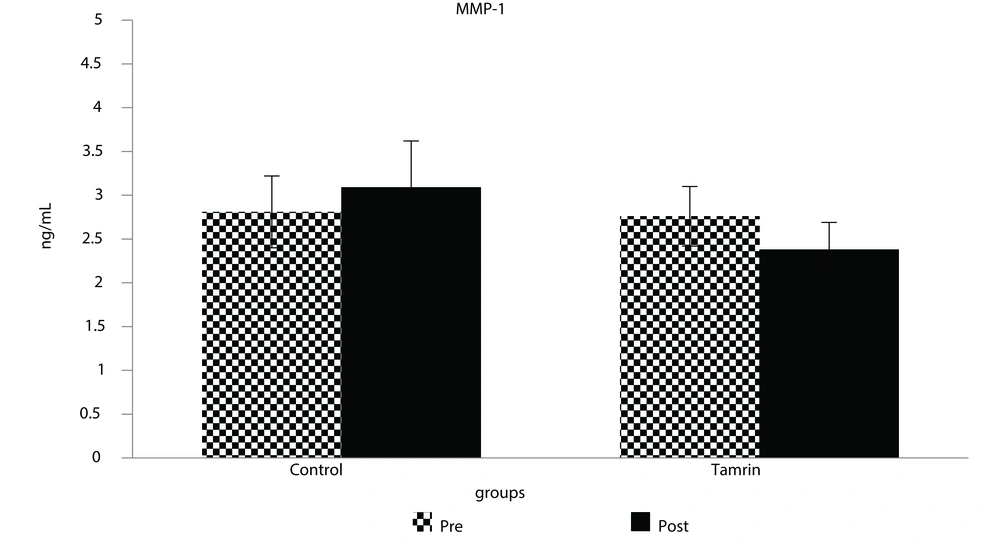
Figure 1.
Comparison chart of the average level of metalloproteinase 1 in the research groups before and after the test
The main findings of the present study were a significant decrease in the levels of hemodynamic indicators, including systolic blood pressure, diastolic blood pressure, mean blood pressure, and heart rate after eight weeks of combined training compared with the pre-test (P < 0.05). The results of the study also showed that the serum metalloproteinase-1 level was significantly decreased after eight weeks of combined training compared to the pre-test (P < 0.05).
5. Discussion
Our study was conducted to investigate the effect of eight weeks of selected exercise on blood hemodynamic indices and serum levels of metalloproteinase-1 in elderly women in Ahvaz. The results indicate that the selected exercise used in the study had a positive effect on all the indices measured, improving the vascular wall and blood pressure of the subjects. The most important finding of this study is the significant decrease in metalloproteinase-1 in elderly subjects, indicating an improvement in the vascular status of these subjects in the exercise group compared to the pre-test and control groups.
In hypertension, elevated serum MMP-1 levels may be associated with increased collagen degradation in the extracellular matrix of the cardiovascular system, suggesting that early changes in the MMP-1/TIMP-1 profile favor extracellular matrix accumulation and are associated with left ventricular hypertrophy (LVH) and diastolic dysfunction (17). As the process progresses, increased degradation of extracellular matrix components in the left ventricle (LV) may be a marker of myocardial systolic dysfunction. Many age-related degenerative disease processes are associated with increased extracellular matrix degradation. Accompanying abnormal matrix degradation are changes in the levels of reactive oxygen species (ROS) production and detoxification systems (19, 20).
The ROS act as second messengers due to their ability to react with a wide range of biomolecules, leading to the modification of a number of signaling networks. The ROS can activate upstream kinases (MKKs) responsible for MAPK activation and limit the activity of their inhibitory phosphatases. Sensitive regulatory signals that control the expression of the primary initiator protease MMP-1 are affected by aging and ROS (19). Resistance training has been shown to improve cardiovascular function in older people, based on previous research (21).
It has also been reported that pilates exercises, in addition to improving mobility in older people, can regulate blood pressure in this population. In our study, eight weeks of combined fitness and pilates exercise had a significant effect on blood pressure in older women, causing a significant reduction in systolic, diastolic, and mean blood pressure, as well as heart rate, in the combined exercise group compared with the pre-test. These findings are consistent with those reported in previous studies (8, 22-26). Of course, in all these studies, the effect of physical activity was examined using different approaches. Our exercises were a combination of fitness and pilates exercises.
The results of our study also showed that combined exercises were able to reduce serum metalloproteinase-1 levels in older women compared to the pre-test. Gatta et al. investigated the effect of short-term exercise training on serum metalloproteinase in patients with chronic heart failure and showed a decrease in serum metalloproteinase levels with exercise intervention (27). Other researchers have found that exercise training reduces fibrosis and matrix metalloproteinase disorders in the aged rat heart and improves cardiac function (28). In another study, Mammi et al. investigated the effect of exercise training on the serum capacity to induce endothelial cell death in patients with chronic heart failure and found that metalloproteinase levels were significantly reduced (29).
Therefore, the assessment of these variables could be important to improve current knowledge to find the best treatment to lower hypertension in the elderly. Physical activity in older people could be an effective approach to treating hypertension in this demographic (17). Different types of exercise affect various physiological systems and functions related to several risk factors for cardiovascular disease. Aerobic exercise generally improves hemodynamics, lipid profile, and cardiorespiratory fitness, whereas resistance exercise improves glucose metabolism, body composition (e.g., lean mass), and muscle strength (23).
Despite the significant benefits and consequences of exercise, levels of physical activity in older people are very low. Strategies are therefore needed to increase levels of exercise or physical activity in older people (1).
5.1. Conclusions
In summary, the results showed that pilates and fitness modified hemodynamic indicators and decreased serum metalloproteinase-1 levels in older women. Combined exercise may reverse the age-related increase in these indicators and help improve blood pressure complications.