
1. Background
Child growth is a fundamental indicator of public health and a critical marker for a nation’s overall development. Proper physical growth — reflected in measures such as height and weight — is not only indicative of adequate nutrition and health care access but also mirrors the broader socioeconomic conditions within a community (1, 2). In recent decades, growth disorders including stunting, undernutrition, and overweight/obesity have emerged as pressing concerns, particularly in regions facing economic challenges (3, 4).
These disorders can adversely affect cognitive development, academic achievement, and long-term economic productivity, thereby perpetuating cycles of poverty and poor health (5). In Zahedan, a city characterized by marked socioeconomic disparities and nutritional challenges, preliminary observations suggest an increasing prevalence of growth disorders among elementary school children (6, 7). Contributing factors may include limited access to high-quality nutrition both at home and in schools, food insecurity, and varying levels of healthcare support (8, 9). Moreover, environmental factors, such as living conditions and regional disparities, may further exacerbate these issues. The need to investigate these factors is urgent, as understanding the underlying determinants of growth impairments is essential for the formulation of targeted public health interventions (10, 11). By comparing local data with international studies from contexts like Pakistan and China, this research aims to provide a comprehensive insight into the multifaceted nature of growth disorders and to propose evidence-based strategies for improving child health outcomes in Zahedan.
2. Objectives
The primary objective of this study was to evaluate the prevalence of growth disorders among elementary school children in Zahedan. Secondary objectives included assessing the associations between growth disorders and factors such as family economic status, school feeding programs, maternal employment, and birth order.
3. Methods
A cross-sectional study design was employed to assess growth patterns among elementary school students in Zahedan. A stratified, multistage random sampling method was used to select a representative sample of students from first to sixth grades across various public schools in the region. Prior to initiating the study, ethical approval was obtained from the relevant institutional review board, and informed consent was secured from the parents or legal guardians of all participating children. Anthropometric data were collected by trained examiners using standardized and calibrated equipment. Height was measured to the nearest 0.1 cm using a stadiometer, with students standing shoeless and in an upright position, while weight was recorded to the nearest 0.1 kg using a digital scale, ensuring minimal clothing interference. Each measurement was taken twice, and the average of the two readings was used in the analysis to enhance reliability.
In parallel, socioeconomic data were obtained through structured, self-administered questionnaires distributed to parents. These questionnaires captured detailed information on family income, living conditions (with residential areas classified as central, peripheral, or suburban) (Table 1), maternal employment status, and participation in school feeding programs. The results (Table 1) show that the P-value for both types of disorders is greater than 0.05, indicating that living location (suburban, central, affluent) does not have a significant effect on growth disorders.
Table 1.
Chi-square Test Results for the Relationship Between Living Location and Growth Disorders
| Growth Disorder Type | Chi-square Statistic | Significance Level (P-Value) |
|---|---|---|
| Weight disorder | 2.68 | 0.6124 |
| Height disorder | 3.98 | 0.1367 |
Additional demographic variables, including the child’s age, grade level, and birth order, were also recorded. Data entry was performed systematically using a secure database, and analyses were conducted with statistical software. Descriptive statistics (mean, standard deviation, frequency distributions) were calculated for both anthropometric and socioeconomic variables. To explore associations between categorical variables — such as family economic status, school feeding participation, and the occurrence of growth disorders (e.g., underweight, overweight, and stunting) — chi-square tests were applied. Additionally, Pearson correlation coefficients were computed to assess linear relationships between continuous variables, such as birth order and growth measurements. The level of statistical significance was set at P < 0.05, providing a robust framework for evaluating the multifaceted factors influencing child growth in Zahedan.
4. Results
The study found that both height and weight increased progressively with grade level for both boys and girls. Boys’ mean weight increased from 22.85 kg in the first grade to 39.26 kg in the sixth grade, while girls’ weight increased from 22.89 kg to approximately 39.75 kg. Similarly, boys’ mean height rose from 121.53 cm to 148.83 cm, and girls’ from 123.09 cm to 145.92 cm.
The prevalence of growth disorders, including both weight and height abnormalities, was higher among students in the upper grades. Chi-square analyses revealed significant associations between lower family economic status and increased prevalence of both weight (P = 0.0092) and height disorders (P = 0.0182). The results (Table 2) show that the P-value for height disorder is less than 0.05, indicating a significant relationship between economic status and short stature. This suggests that poor nutrition in low-income families may negatively affect children's height growth. Additionally, for weight disorder, the P-value is also less than 0.05, meaning that economic status has a significant effect on underweight and obesity.
Table 2.
Chi-square Test Results for the Relationship Between Economic Status and Growth Disorders
| Growth Disorder Type | Chi-square Statistic | Significance Level (P-Value) |
|---|---|---|
| Weight disorder | 10.85 | 0.0092 |
| Height disorder | 8.01 | 0.0182 |
Additionally, receiving regular, quality school feeding was significantly associated with lower rates of weight disorders (P = 0.021), while the association with height disorders was notable though less robust. The results (Table 3) indicate that the P-value for both types of disorders is less than 0.05, meaning that the relationship between receiving school nutrition and growth disorders is statistically significant. These findings suggest that school-provided meals likely have a positive impact on reducing underweight and short stature in children. However, further assessment of the quality and quantity of school nutrition is necessary to optimize its effectiveness.
Table 3.
Chi-square Test Results for the Relationship Between School Nutrition and Growth Disorders
| Growth Disorder Type | Chi-square Statistic | Significance Level (P-Value) |
|---|---|---|
| Weight disorder | 14.32 | 0.021 |
| Height disorder | 16.89 | 0.08 |
Maternal employment did not show a statistically significant impact on growth outcomes. The results (Table 4) indicate that the P-value for both types of disorders is greater than 0.05. This means that maternal employment (working or stay-at-home status) does not have a significant effect on growth disorders (underweight, obesity, or short stature). This result likely reflects the greater influence of other factors, such as family economic status and the child's overall diet quality.
Table 4.
Chi-square Test Results for the Relationship Between Maternal Employment and Growth Disorders
| Growth Disorder Type | Chi-square Statistic | Significance Level (P-Value) |
|---|---|---|
| Weight disorder | 1.37 | 0.8496 |
| Height disorder | 4.46 | 0.1076 |
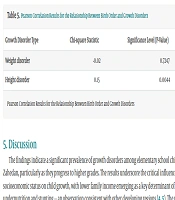
Furthermore, Pearson correlation analysis indicated a modest but significant relationship between birth order and short stature (R = 0.15, P = 0.0044), suggesting that later-born children may be at a slightly higher risk of stunting. The results (Table 5) show that the P-value for height disorder is less than 0.05, indicating a significant relationship between birth order and short stature. The positive correlation coefficient (R = 0.15) suggests that later-born children are slightly more likely to experience short stature. However, for weight disorder, the P-value is greater than 0.05, showing that birth order does not have a significant effect on a child's weight.
Table 5.
Pearson Correlation Results for the Relationship Between Birth Order and Growth Disorders
| Growth Disorder Type | Chi-square Statistic | Significance Level (P-Value) |
|---|---|---|
| Weight disorder | -0.02 | 0.7247 |
| Height disorder | 0.15 | 0.0044 |
5. Discussion
The findings indicate a significant prevalence of growth disorders among elementary school children in Zahedan, particularly as they progress to higher grades. The results underscore the critical influence of socioeconomic status on child growth, with lower family income emerging as a key determinant of both undernutrition and stunting — an observation consistent with other developing regions (4, 5). The protective effect of quality school feeding programs highlights the potential of school-based nutritional interventions in mitigating these disorders (9). Although maternal employment did not appear to significantly affect growth outcomes in this study, previous research suggests that maternal education and occupation can influence child health indirectly (8). The modest association between birth order and short stature observed in our data is in line with some international findings that later-born children may receive fewer resources or attention (11). Limitations of the study include its cross-sectional nature, which restricts causal inferences, and the reliance on self-reported socioeconomic data, which may introduce bias. Future research should consider longitudinal designs and broader geographic sampling to better understand the dynamics of child growth in relation to socioeconomic and environmental factors.