
1. Background
Thalassemia is one of the most common inherited anemias, caused by defects in the synthesis of globin chains. Thalassemia syndromes are clinically classified into three forms: mild (minor), moderate (intermedia), and severe (major). In thalassemia major (TM), the absence of beta-globin chain production results in severe, transfusion-dependent anemia (1-3).
Patients with TM require lifelong blood transfusions, which often lead to iron overload and subsequent complications such as cardiomyopathy, diabetes mellitus, hypothyroidism, hypoparathyroidism, osteoporosis, and delayed puberty (4, 5).
Over the past decades, increasing global migration has led to a rise in TM cases, even in countries where the disease was previously rare (6, 7). In Iran, an estimated 20,000 individuals are affected by TM, and 2 to 3 million people (approximately 4% of the population) are carriers of thalassemia-related genes (8). In the southern and northern coastal provinces, the carrier rate is particularly high—reaching up to 10% in some regions. National screening programs have identified the highest prevalence of carrier couples in the provinces of Hormozgan, Sistan and Baluchestan, and Khuzestan, with 27, 14, and 13 suspected carrier couples per 1,000 screened, respectively. One of the key contributing factors to the continued high incidence of thalassemia in Iran is the common practice of consanguineous (especially cousin) marriages within various ethnic groups (9).
In Sistan and Baluchestan Province, located in southeastern Iran, approximately 3,100 patients live with TM, of whom around 780 are under regular treatment and follow-up in Zahedan. Notably, 18% of the affected families have more than one child with TM (5).
Thanks to advancements in medical care and iron chelation therapy, TM is now considered a chronic condition, and patients are living significantly longer than in past decades (9, 10). Despite improved survival, their quality of life and psychosocial well-being often remain suboptimal (11, 12).
Previous studies have shown that patients with TM experience a lower quality of life compared to the general population (13). Prolonged use of medications, frequent hospital visits, and physical limitations negatively impact both their mental health and social functioning (14). These patients often face challenges in pursuing higher education, obtaining employment, and forming families—especially during youth and early adulthood—posing additional emotional and economic burdens on families and the healthcare system alike (15).
A study by Pakbaz et al. found that 30% of TM patients were unemployed; among them, 53% were male and 67% had a history of regular transfusion. Furthermore, 48% had at least two comorbidities, and nearly half of those with osteoporosis were jobless (16). In another study by Miri Aliabad et al., 28% of TM patients were above 15 years of age; among them, 14% were married, and the age range of married individuals was 15 to 33 years (17).
Despite the high prevalence of TM in Iran, particularly in Sistan and Baluchestan Province, limited research has explored the social dimensions of the disease.
2. Objectives
The present study aimed to evaluate the educational attainment, employment status, and marital status of adult patients with thalassemia major (aged 18 years and older) in southeastern Iran.
3. Methods
This descriptive-analytical cross-sectional study was conducted between 2018 and 2019 in southeastern Iran. The study population consisted of all transfusion-dependent thalassemia major (TM) patients aged 18 years and older. A total of 170 eligible patients were included based on predefined inclusion criteria. Data were collected through face-to-face interviews and review of patients' medical records.
Following approval from the Ethics Committee of Zahedan University of Medical Sciences (Ethics Code: IR.ZAUMS.REC.1397.099) and after obtaining informed consent from all participants, the study was carried out in the thalassemia ward of Ali Asghar Children’s Hospital in Zahedan. This tertiary care center provides regular blood transfusions to approximately 780 TM patients. The enrolled participants were receiving transfusions every 2 to 5 weeks and had confirmed diagnoses based on hemoglobin electrophoresis and genetic testing.
Data collection included demographic, clinical, and social variables such as age, sex, educational level (categorized as illiterate, below diploma, diploma, or bachelor’s degree and above), employment status (employed or unemployed), marital status (single, married, or divorced), type of iron chelation therapy, and common TM-related complications (e.g., diabetes mellitus, cardiomyopathy, osteoporosis, hypothyroidism, and viral hepatitis). Information was obtained from both patient interviews and medical records.
Data were analyzed using IBM SPSS Statistics software, version 20. The chi-square test was used to assess associations between categorical variables. A p-value of less than 0.05 was considered statistically significant.
4. Results
A total of 170 adult patients with thalassemia major (TM) participated in the study, including 78 males (45.9%) and 92 females (54.1%). The mean age of the participants was 25.44 ± 5.3 years.
The most common comorbidities among the patients were cardiomyopathy (58.8%), osteoporosis (51.8%), hypogonadism (13.5%), hepatitis C (11.8%), diabetes mellitus (11.8%), and hypothyroidism (8.8%). Regarding iron chelation therapy, the most frequently used regimen was a combination of desferrioxamine and deferiprone (50%), followed by deferasirox (30%), desferrioxamine alone (12%), and deferiprone alone (8%).
The majority of patients (83.5%) were single. Among the married participants, 28.6% had spouses with TM, 3.6% were married to partners with thalassemia minor, and the remainder were married to individuals without thalassemia. Only 25% of married patients had children, and among them, 17.9% had two or more children (Table 1).
Table 1.
Family Structure and Marital Characteristics of Adult Thalassemia Major Patients (N = 170)
| Parameters and Category | Frequency (n) | Percentage (%) |
|---|---|---|
| Affected Siblings | ||
| Yes | 77 | 45.3 |
| No | 93 | 54.7 |
| Marital Status | ||
| Single | 142 | 83.5 |
| Married | 28 | 16.5 |
| Number of Siblings | ||
| 3 or fewer | 28 | 16.5 |
| 4 - 5 | 44 | 25.9 |
| 6 - 7 | 52 | 30.6 |
| 8 or more | 46 | 27.1 |
| Spouse's Health Status | ||
| Healthy | 19 | 67.9 |
| Beta Thalassemia Minor | 1 | 3.6 |
| Beta Thalassemia Major | 8 | 28.6 |
| Number of Children | ||
| None | 21 | 75.0 |
| One | 2 | 7.1 |
| Two or three | 5 | 17.9 |
Table 1 also shows that 45.3% of the patients had siblings with thalassemia. The average number of siblings per participant was 6.24 ± 2.88 (range: 1 - 23), and approximately 57% reported having more than six siblings.
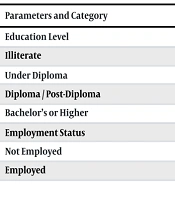
As presented in Table 2, 55.9% of the patients had a diploma-level education or lower, including some who were illiterate. Only 18.2% of participants were employed. The mean serum ferritin level was 3,760 ± 2,852 ng/mL. Patients who were illiterate had the highest serum ferritin levels, while those with a bachelor's degree or higher had the lowest. This difference was statistically significant (P < 0.001). However, no significant association was found between serum ferritin levels and employment status (P > 0.05).
Table 2.
Educational and Employment Status and Their Association with Mean Serum Ferritin Levels in Adult Thalassemia Major Patients
| Parameters and Category | Frequency (n) | Percentage (%) | Mean Serum Ferritin (ng/mL) | P-Value a |
|---|---|---|---|---|
| Education Level | < 0.001 | |||
| Illiterate | 28 | 16.5 | 4779 ± 2855 | |
| Under Diploma | 67 | 39.4 | 4525 ± 2603 | |
| Diploma / Post-Diploma | 59 | 34.7 | 2767 ± 2491 | |
| Bachelor’s or Higher | 16 | 9.4 | 2432 ± 3585 | |
| Employment Status | > 0.05 | |||
| Not Employed | 139 | 81.8 | 3971 ± 2933 | |
| Employed | 31 | 18.2 | 3760 ± 2852 |
a P-value ≤ 0.05 was considered statistically significant.
5. Discussion
This study aimed to investigate the marital status, educational attainment, and employment situation of adult patients with thalassemia major (TM) in Zahedan, southeastern Iran. Among the 170 patients included, 54.1% were female. Over half (55.9%) of the participants were either illiterate or had a diploma or lower level of education, and the majority (81.8%) were unemployed. Additionally, 45.3% had siblings with thalassemia, and only 16.5% were married. Among the married participants, 28.6% had a spouse with TM, and only 25% had children.
A study from South America reported that 30% of TM patients were unemployed, with 53% of the unemployed group being male. In that study, 61% of adult patients had a university degree, and only 8% had a diploma or lower (16). In contrast, our study revealed a significantly higher unemployment rate (81.8%) and a much lower proportion of patients with higher education (only 4.9%). These discrepancies may be due to differences in sample size, study settings, inclusion criteria, socio-economic background, government policies, and labor market accessibility for individuals with chronic illnesses.
An Iranian study found that 28% of β-thalassemia patients were over 15 years old, with 14% being married (17), which is consistent with our findings (16.5% married). Another national study involving transfusion-dependent TM patients reported that 25% were married, with a mean age at marriage of 21.8 ± 4.5 years (18). Compared to our findings, the lower rate of marriage in our sample may be attributed to socio-cultural differences, disease severity, and fewer opportunities for social integration.
A study from Mazandaran Province found that 87.6% of TM patients were single, and 67.7% held bachelor’s or master’s degrees (19). While the marital status in that study aligns with our findings, the educational status was markedly higher—likely due to regional differences in access to education and public support systems.
In a study conducted in Sari, 84.2% of participants had thalassemia major and 15.8% had thalassemia intermedia, with a mean age of 23 years and a marriage rate of 10% (20). The age distribution of patients in that study reflects the effectiveness of national prenatal screening programs and improved survival due to advancements in medical care. However, since most patients were still young, they continued to require lifelong blood transfusions and iron chelation therapy. The demographic characteristics and prevalence of associated comorbidities in that study were consistent with our findings. Notably, the proportion of married individuals (10%) in the Sari study was slightly lower than in our cohort (16.5%), which may be attributed to the lower mean age of participants in that study.
The mean serum ferritin level in a study from Dezful was 2,760 ng/mL—significantly lower than the 3,760 ng/mL reported in our study (21). Despite comparable average ages across both studies, differences in disease management, adherence to chelation therapy, and access to healthcare services may account for this discrepancy. Moreover, our study demonstrated a statistically significant relationship between education level and serum ferritin, with lower education correlating with higher iron overload. This finding highlights the impact of health literacy on treatment outcomes.
5.1. Conclusions
The findings of the present study demonstrate that the majority of adult patients with thalassemia major in southeastern Iran have low educational attainment, are unemployed, and remain unmarried. These indicators reflect a low socio-economic status, which may adversely affect both their physical and psychological well-being.
In light of these challenges, it is imperative to implement strategies aimed at enhancing educational opportunities, promoting job placement programs, and facilitating social support systems for TM patients. By improving income stability and access to education, these individuals may be better equipped to form families and lead more fulfilling lives.
Based on our findings and those of other regional and international studies, we recommend the development of targeted educational and vocational training programs tailored to the needs of TM patients. These initiatives, supported by healthcare administrators and policymakers, can foster a more inclusive environment and significantly improve the quality of life of this vulnerable population.