


1. Background
Urinary tract infections (UTIs) are prevalent infectious conditions, disproportionately impacting women, with a recurrence rate of 20 - 30%. Diagnosis involves clinical evaluations and microbiological testing (1, 2).
Escherichia coli is the primary bacterium identified in both UTIs and asymptomatic bacteriuria (ASB) during pregnancy, representing over half of reported cases globally (3). Nanotechnology was initially introduced by Richard Feynman in 1959. The extensive use of nano-based techniques over recent decades has created new avenues in materials science, even as NPs have significantly transformed their chemical, biological, and physical properties. In addition, it has several pharmaceutical and scientific applications, including the synthesis of NPs for bioimaging, cancer treatment, carbon nanotubes, and drug delivery, as well as antimicrobial purposes (4-6). The advancement of metal oxide and metal NPs has recently captured the interest of the global scientific research community (7, 8).
Zinc oxide nanoparticles (ZnO-NPs) have been extensively developed and utilized across a variety of commercial products and additives (9, 10). Due to its distinctive features and a wide range of applications, ZnO-NP has been the subject of extensive scientific research (11). Each year, 20,000 people are hospitalized in the UK due to foodborne illnesses (12, 13). The ZnO-NPs interact directly with the cell surface membrane, which subsequently infiltrates the cells of the microorganism and causes oxidative stress (14).
2. Methods
A questionnaire was completed on 50 urine samples from patients who had visited the outpatient clinic of Zabol City Hospital. In this study, we conducted the biosynthesis of oxide NPs using a shoot extract of Ducrosia anethifolia, a medicinal plant. Zinc (Zn) acetate dihydrate and sodium hydroxide were employed as precursors in the process (15, 16). The structure and morphology of the synthesized NPs were analyzed using several analytical techniques (Figure 1).
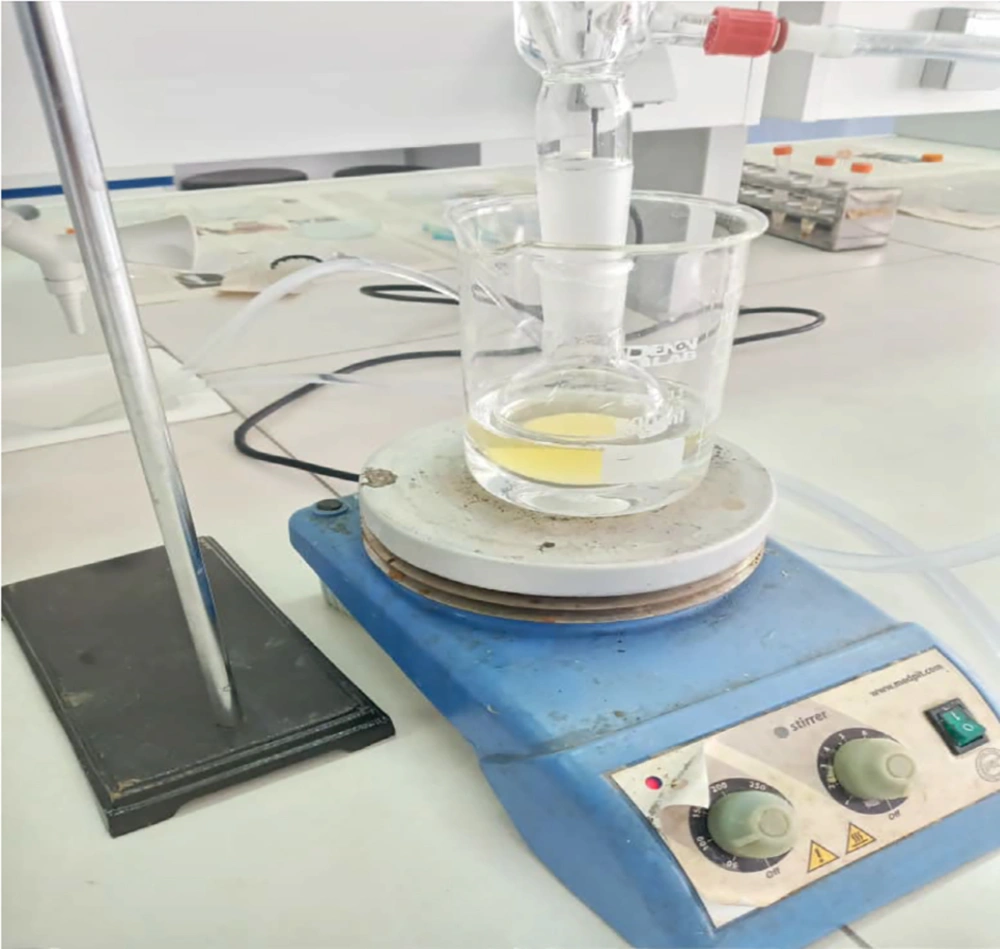
Figure 1.
Green zinc (Zn) nanoparticles (NPs) synthesis process in Ducrosia anethifolia
Determination of MIC and MBC was carried out by assessing bacterial susceptibility to zinc (Zn) using the well-dilution method.
3. Results
3.1. Antibiotic Resistance Pattern
The highest resistance of E. coli was to ampicillin (19.4%) and the lowest resistance was to vancomycin (0.9%). The highest susceptibility to antibiotics was observed with gentamicin (22.2%) and imipenem (21.3%) (Figure 2).
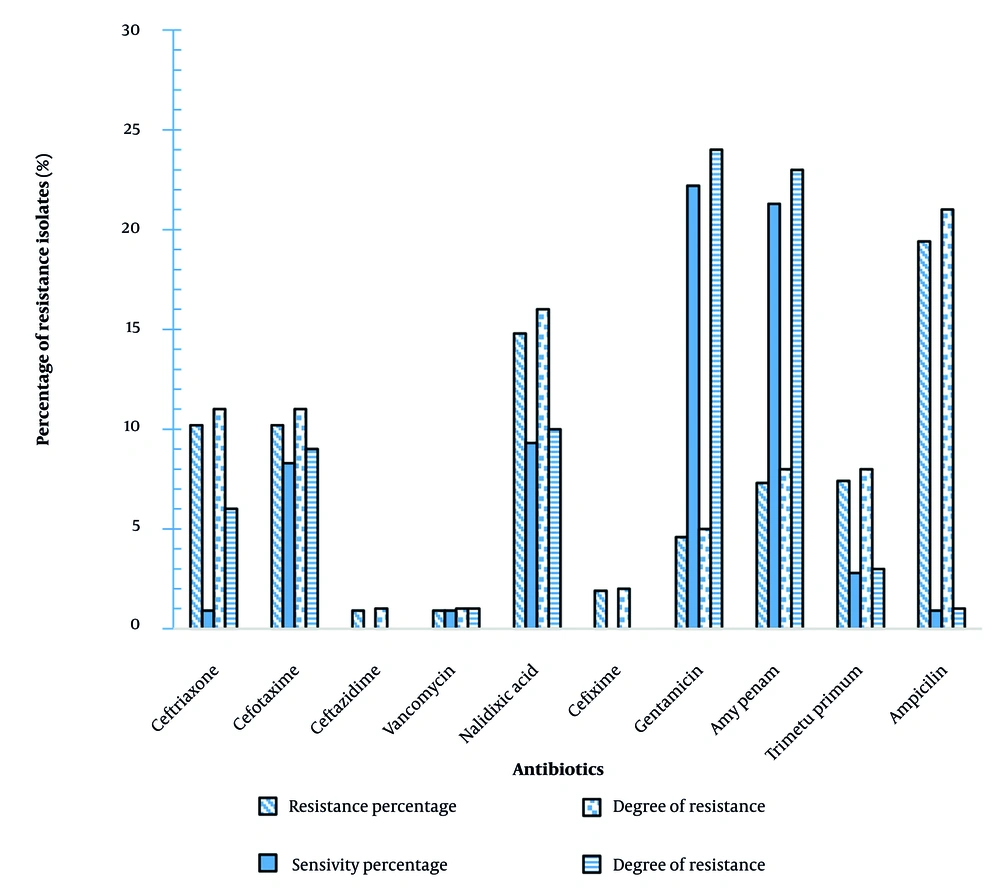
Figure 2.
Percentage of bacterial resistance to different antibiotics
3.2. Fourier Transform Infrared Spectroscopy Results
3.2.1. Analysis of Zinc Nanoparticles Synthesized in Ducrosia anethifolia Extract
The presence of a variety of functional groups in the sample is revealed (Figure 3).
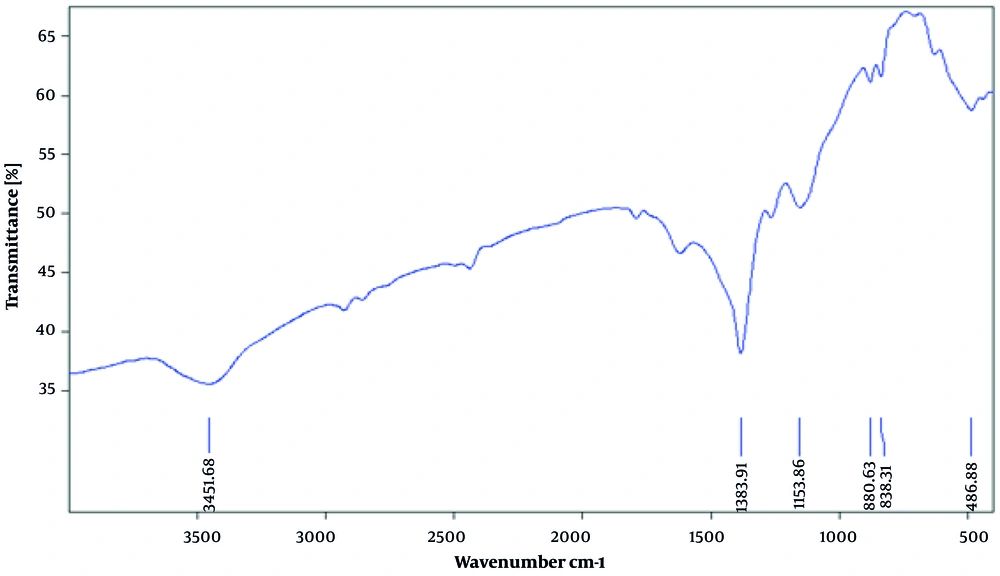
Figure 3.
Fourier transform infrared spectroscopy (FTIR) analysis of Ducrosia anethifolia samples
The Fourier transform infrared spectroscopy (FTIR) results obtained from seepage and extracts indicate an absence of clear and distinct structural information about the compounds present. This ambiguity can arise from several factors.
3.3. Determination of the MIC and MBC of Synthesized Zinc Nanoparticles
The highest inhibitory concentration was 3000 μg/mL, which inhibited 5 strains. The lowest inhibitory concentration was 750 μg/mL, with 3 strains being inhibited at this level. Additionally, 12 strains showed inhibition at a concentration of 1500 μg/mL.
4. Discussion
Bacterial infection during pregnancy has been very common, with the highest mortality rate observed between 2000 and 2008 (17-19). Bacteremia during pregnancy is also life-threatening for fetuses, with a retrospective study indicating a 10% fetal death rate (20). Pathogens can be a concern for expectant mothers. The anatomical and physiological changes that occur in the body during pregnancy can increase women's susceptibility to developing UTIs. Escherichia coli is the leading cause of bacteremia worldwide (21), and it is also prevalent during pregnancy, as indicated by Cape et al. (22). The data regarding antibiotic resistance patterns indicated that E. coli exhibited the greatest resistance to ampicillin, with a rate of 19.4%. Conversely, the lowest level of resistance in E. coli was observed for vancomycin, at 0.9%.
While the highest susceptibility to antibiotics was observed with gentamicin (22.2%) and imipenem (21.3%), it has been indicated (23). This research sought to contrast the antibiotic resistance profiles of E. coli found in the urine of generally healthy women who visited the Emergency Department (ED) due to either uncomplicated UTIs or pyelonephritis, with the resistance data documented in the ED's antibiogram (24). The results indicate that 45 patients tested positive for E. coli, with pyelonephritis suspected in nine of these subjects, representing 20% of the cases. Compared to the ED antibiogram, resistance rates were notably lower: Two percent for ciprofloxacin (versus 42%, P < 0.001), 2% for levofloxacin (versus 26%, P < 0.001), and 16% for trimethoprim-sulfamethoxazole (TMP-SMX) (versus 33%, P = 0.016). Additionally, six patients were found to have non-E. coli uropathogens, and all of these cases were susceptible to both levofloxacin and TMP-SMX (24). The findings of this research showed that E. coli was isolated more frequently from female individuals (70.7%) in comparison to male individuals (29.3%) (25). In urine samples, E. coli demonstrated a high degree of susceptibility to ertapenem (97.6%) and imipenem (96.4%). However, these isolates showed a considerable resistance rate of 87.8% to ampicillin (25).
In a study that examined the antibiotic resistance pattern in E. coli samples from pregnant women, the results showed that the highest susceptibility was to amikacin, nitrofurantoin, amoxicillin/clavulanic acid, and meropenem, respectively (26). The results of scanning electron microscopy photos showed that the highest inhibitory concentration was 3000 μg/mL, while the lowest inhibitory concentration was 750 μg/mL (27). In a study that biosynthesized NPs from plant extracts, NPs with a diameter of 20 to 30 nanometers were obtained that inhibited E. coli and Klebsiella pneumoniae bacteria (28). The photocatalytic and antibacterial properties of ZnO-NPs, synthesized via a green approach using extracts of Lupinus albus and L. pilosus, were examined. Antibacterial experiments demonstrated that the sample created a zone of inhibition against both gram-positive and gram-negative bacteria (29). Another study focused on the synthesis and characterization of ZnO nanomaterials from Cassia sieberiana. Synthetic NPs inhibited bacteria S. typhi, S. aureus, E. coli, and C. albicans at a concentration of 25 mg/mL (30). Naseer's study explored a green method for synthesizing ZnO-NPs using leaf extracts from C. fistula and Melia zedaran, assessing their antibacterial potential. The ZnO-NPs mediated by C. fistula and M. zedaran demonstrated strong antimicrobial activity (31).
4.1. Conclusions
The results of the study indicated that synthetic NPs possess a significantly high capability to inhibit bacterial growth and may be applicable in the treatment of female infections.
