


1. Background
The family, as a fundamental social, emotional, and character-forming unit, originates from the marital union between a man and a woman. This union serves as the foundation for fulfilling numerous psychological and social needs, including intimacy and love (1). Scholars in family studies have identified a wide array of factors associated with family and marriage that can either promote or impede marital well-being (2). Among these factors, marital infidelity stands out as a primary contributor to marital dissolution, frequently manifesting as extramarital affairs (3). Extramarital affairs extend beyond purely sexual encounters, encompassing any relationship, whether heterosexual or homosexual, that is concealed from one's spouse (4). Attitudes toward extramarital affairs reflect an individual's propensity or acceptance of engaging in relationships outside the marital framework (5). Notably, the past decade has witnessed a significant increase in extramarital affairs among women. This escalation in such relationships precipitates a decline in trust, emotional intimacy, and sexual intimacy within couples, thereby creating conditions conducive to marital crises and divorce (6).
Intolerance of uncertainty represents a salient variable influencing the propensity for extramarital affairs. Defined as a dispositional characteristic rooted in a constellation of negative beliefs concerning uncertainty and its inherent ambiguity, intolerance of uncertainty dictates how individuals process information within ambiguous contexts, eliciting a spectrum of cognitive, emotional, and behavioral responses (7). Empirical evidence provided by Bozoyan and Schmiedeberg (8) suggests that individuals exhibiting difficulty in managing ambiguous or uncertain situations are more susceptible to experiencing dissatisfaction within their current relationships, thereby increasing their inclination towards extramarital involvement. Consistent with these findings, Apostolou and Demosthenous (9) revealed that individuals with elevated levels of intolerance of uncertainty demonstrate a greater tendency to hold favorable attitudes toward extramarital relationships. Collectively, these findings underscore the notion that anxiety stemming from uncertain and stressful circumstances can predispose individuals to engage in infidelity.
Within the domains of marital psychology and interpersonal relationships, sexual satisfaction emerges as a critical determinant of marital quality. Sexual satisfaction encompasses the positive and gratifying experience of sexual intimacy, thereby fostering both physical and emotional connectivity between spouses (10). Conversely, dissatisfaction with sexual performance and the onset of sexual dysfunction can precipitate physical and psychological strain within couples, culminating in overall dissatisfaction and impaired well-being (11). Tan et al. (12) have shown that sexual dissatisfaction, especially when compounded by communication deficits and recurrent conflict, may predispose individuals to seek gratification outside the marital bond. Nazari et al. (13) have further established that individuals reporting higher levels of sexual satisfaction exhibit a reduced propensity to engage in extramarital affairs, with marital commitment serving to further bolster this inverse relationship.
Marital commitment serves as a predictor of either sustained marital satisfaction over time or the progression towards marital discord and extramarital involvement (14). Operationally, marital commitment is defined as the degree to which individuals maintain a long-term orientation towards their marriage, engage in relational sacrifices, undertake efforts to preserve and enhance dyadic cohesion, and remain committed to their spouse even amidst non-rewarding marital experiences (15). Conceptually, theorists have characterized marital commitment as an individual's volitional dedication to the enduring maintenance of the marital union and unwavering fidelity to their spouse, family, and core values, encompassing behavioral, cognitive, and affective dimensions (16). Empirical evidence presented by Sarhani and Homaei (17) demonstrates that marital commitment attenuates the influence of sexual satisfaction on attitudes regarding extramarital affairs, with heightened sexual satisfaction correlating with a diminished propensity for infidelity.
The escalating prevalence of marital dissolution, coupled with the documented increase in extramarital involvement — particularly among the vulnerable demographic of married students — underscores the critical need for a thorough exploration of contributing factors. This study is particularly important in the field of clinical psychology, as it addresses a gap in understanding how psychological constructs like intolerance of uncertainty and sexual satisfaction interact with marital commitment to influence infidelity attitudes. By elucidating these dynamics among married female students, who face unique stressors from academic and familial roles, the research provides foundational insights for developing targeted interventions to bolster marital stability and prevent relational breakdown in this understudied population.
The unique stressors inherent to student life, compounded by the developmental exigencies of early adulthood, may amplify pre-existing vulnerabilities within marital dyads. Moreover, the intricate interrelationship between psychological constructs such as intolerance of uncertainty and sexual satisfaction, and their subsequent impact on attitudes toward infidelity, mandates rigorous empirical inquiry. By delineating the mediational role of marital commitment within these associations, this research endeavors to furnish salient insights for the development of targeted interventions designed to fortify marital resilience and cultivate fidelity.
2. Objectives
This study aimed to determine if marital commitment mediates the relationship between intolerance of uncertainty, sexual satisfaction, and attitudes towards extramarital affairs among married students.
3. Methods
This study adopted a descriptive-correlational design, utilizing structural equation modeling (SEM) for data analysis. The target population comprised married female students at the Islamic Azad University, Ahvaz Branch, in the 2024 academic year. The sample size was determined based on guidelines for SEM, which recommend a minimum of 10 participants per estimated model parameter. With the path model involving approximately 20 free parameters (including paths, variances, and covariances), a minimum sample of 200 was required; however, 341 participants were recruited to ensure adequate statistical power and account for potential data loss.
A sample of 341 participants was selected via multi-stage cluster random sampling, involving the random selection of seven faculties, followed by two classes per faculty. Participants completed standardized questionnaires. Inclusion criteria required participants to be married women aged 20 - 50, willing to participate, and free from severe cognitive or psychological disorders (e.g., major depressive disorder, severe anxiety, or personality disorders). Exclusion criteria included incomplete questionnaires, inconsistent or invalid responses, voluntary withdrawal, or inability to address questions on sexual satisfaction or extramarital affairs due to cultural, social, or religious constraints. Ethical compliance was ensured through institutional review board approval, voluntary participation, strict data confidentiality, and minimal risk to participants.
3.1. Measure
3.1.1. The Attitudes Toward Infidelity Scale
The Attitudes Toward Infidelity Scale (ATIS), developed by Whitely (18), was utilized to evaluate attitudes concerning extramarital affairs. This instrument comprises 12 items, each assessed on a 7-point Likert scale ranging from 1 (strongly disagree) to 7 (strongly agree). Total scores range from 12 to 84, with higher scores reflecting more favorable attitudes toward marital infidelity. Content validity was assessed with a Content Validity Index (CVI) of 0.82 and a content validity ratio (CVR) of 0.78 for this scale, exceeding acceptable thresholds. The internal consistency reliability of the ATIS, as measured by Cronbach's alpha, was reported as 0.71 (19).
3.1.2. The Intolerance of Uncertainty Scale
The Intolerance of Uncertainty Scale (IUS), developed by Freeston et al. (20), comprises 27 items designed to assess individuals' perceived unacceptability of uncertainty and ambiguity, which are posited to engender frustration, stress, and behavioral inhibition. Participants respond to each item using a five-point Likert scale ranging from "never" to "always", with corresponding scores of 1 to 5, respectively. The scale’s total scores range from 27 to 135. Content validity was assessed with a CVI of 0.85 and a CVR of 0.80 for this scale, exceeding acceptable thresholds. The original validation study reported a Cronbach's alpha coefficient of 0.89 (21). In the current study, the internal consistency reliability of the IUS, as determined by Cronbach's alpha, was found to be 0.79.
3.1.3. The Sexual Satisfaction Scale
To evaluate sexual satisfaction, participants completed the Sexual Satisfaction Scale (SSS), a 25-item measure developed by Hudson et al. (22). This instrument assesses perceptions of sexual fulfillment through items reflecting aspects of quality and partner satisfaction, with responses recorded on a five-point Likert scale (1 = “always” to 5 = “never”). The SSS yields total scores ranging from 25 to 125, where higher scores denote greater perceived sexual satisfaction. Content validity was assessed with a CVI of 0.87 and a CVR of 0.82 for this scale, exceeding acceptable thresholds. Previous validation studies have established the scale’s internal consistency, reporting a Cronbach’s alpha of 0.77 (23). In the present investigation, the SSS exhibited robust reliability, with a Cronbach’s alpha coefficient of 0.83.
3.1.4. The Dimensions of Commitment Inventory
Marital commitment was assessed using the Dimensions of Commitment Inventory (DCI), a 44-item instrument designed by Adams and Jones (24) to quantify personal, moral, and structural dimensions of commitment within marital relationships. Participants responded to items using a 5-point Likert scale ranging from 1 (strongly disagree) to 5 (strongly agree), with aggregate scores reflecting overall commitment levels. Total scores ranging from 44 to 220 were calculated by summing responses across all items, with higher scores indicating greater marital commitment. Content validity was assessed with a CVI of 0.88 and a CVR of 0.85 for this scale, exceeding acceptable thresholds. Prior validation research has demonstrated the DCI’s reliability, reporting a Cronbach’s alpha of 0.85 (25). In the current investigation, the DCI exhibited strong internal consistency, as evidenced by a Cronbach’s alpha coefficient of 0.84.
3.2. Statistical Analyses
Data analysis involved both descriptive and inferential statistical procedures. Descriptive statistics, specifically means and standard deviations, were calculated to delineate the distributional properties of the study variables. Pearson’s correlation coefficients were computed to examine bivariate associations between variables. Furthermore, SEM was employed to evaluate the hypothesized structural relationships within a multivariate context. Initial data screening and descriptive analyses were conducted using SPSS version 26.0, while AMOS version 26.0 was utilized for the SEM analyses.
4. Results
The study sample comprised 341 married female student participants, with a mean ± SD age of 28.5 ± 4.2 years. Most participants were housewives (52%), followed by part-time employees (30%) and full-time professionals (18%). Regarding marital duration, 45% had been married for 1 - 5 years, 35% for 6 - 10 years, and 20% for more than 10 years. Educationally, 214 (62.76%) were undergraduate students, 93 (27.27%) were master’s students, and 34 (9.97%) were doctoral students. Table 1 displays the correlation matrix, means, and standard deviations for all research variables.
Table 1.Correlation Matrix, Means, Standard Deviations, Score Ranges, Skewness, and Kurtosis of Research Variables
| Variables | 1 | 2 | 3 | 4 | Range | Mean ± SD | Skewness | Kurtosis |
|---|---|---|---|---|---|---|---|---|
| Intolerance of uncertainty | 1 | - | - | - | 27 - 135 | 67.63 ± 9.81 | 0.40 | -0.55 |
| Sexual satisfaction | 0.25 a | 1 | - | - | 25 - 125 | 81.44 ± 9.11 | 0.44 | 0.57 |
| Marital commitment | -0.34 a | 0.36 a | 1 | - | 44 - 220 | 141.54 ± 15.82 | 1.32 | 1.69 |
| Attitudes towards extramarital affairs | 0.30 a | -0.19 a | -0.28 a | 1 | 12 - 84 | 39.97 ± 6.38 | 0.68 | -0.33 |
a P < 0.01.
Table 1 reveals a significant positive correlation between intolerance of uncertainty and attitudes toward extramarital affairs (R = 0.30, P < 0.01). In contrast, significant negative correlations were observed between sexual satisfaction (R = -0.19, P < 0.01) and marital commitment (R = –0.28, P < 0.01) with attitudes toward extramarital affairs. Prior to path analysis, data assumptions were evaluated. Skewness and kurtosis values confirmed the approximate normality of variable distributions. The Durbin-Watson statistic (2.01), within the acceptable range of 1.5 - 2.5, verified the independence of residuals. Multicollinearity was assessed using the variance inflation factor (VIF), with all predictor variables yielding VIF values below 10, indicating no multicollinearity.
Table 2 presents the goodness-of-fit indices for the refined structural model. Because the direct path from sexual satisfaction to attitudes toward extramarital affairs was not significant, the model was revised by removing this path. The modified model achieved a satisfactory fit, as indicated by the root mean square error of approximation (RMSEA = 0.04). Figure 1 illustrates the final structural model, with the non-significant path from sexual satisfaction to attitudes toward extramarital affairs removed to enhance model parsimony and optimize fit.
Table 2.Fit Indicators of the Refined Structural Model
| Fit indicators | (χ2/df) | IFI | GFI | CFI | NFI | RMSEA |
|---|---|---|---|---|---|---|
| Model | 1.18 | 0.99 | 0.99 | 0.99 | 0.99 | 0.04 |
Abbreviation: RMSEA, root mean square error of approximation.
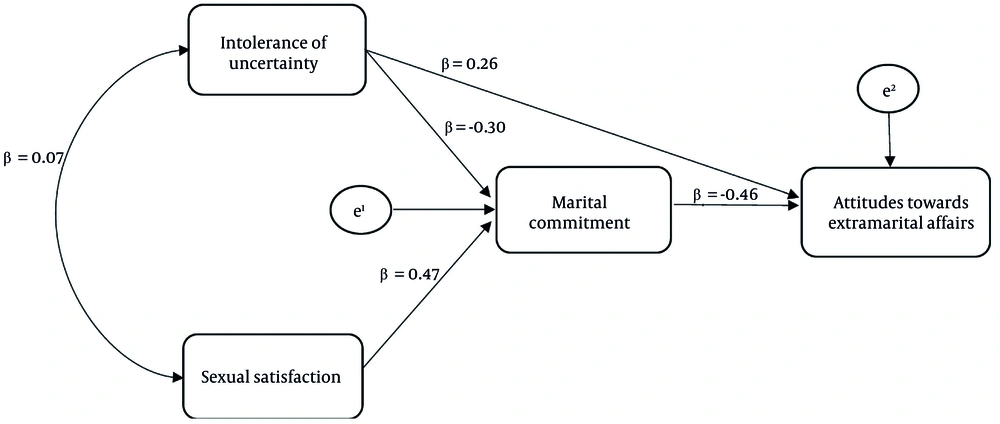
Figure 1.
Modified model of the relationship between intolerance of uncertainty and sexual satisfaction with the mediating role of marital commitment on attitudes toward extramarital affairs
As presented in Table 3, the findings revealed that intolerance of uncertainty and marital commitment exhibited statistically significant direct relationships with attitudes toward extramarital affairs, with standardized beta coefficients of 0.26 (P < 0.001) and -0.46 (P < 0.001), respectively. Similarly, intolerance of uncertainty and sexual satisfaction demonstrated significant direct relationships with marital commitment, with standardized beta coefficients of -0.31 (P < 0.001) and 0.47 (P < 0.001), respectively. Notably, the direct path from sexual satisfaction to attitudes toward extramarital affairs was not statistically significant. Moreover, the results indicated a significant indirect effect of intolerance of uncertainty on attitudes toward extramarital affairs, mediated by marital commitment. Likewise, a significant indirect effect of sexual satisfaction on attitudes toward extramarital affairs, mediated by marital commitment, was observed.
Table 3.Path Coefficient Estimates for Direct and Indirect Relationships in the Refined Structural Model
| Paths | β | P |
|---|---|---|
| Intolerance of uncertainty → attitudes towards extramarital affairs | 0.26 | 0.001 |
| Intolerance of uncertainty → marital commitment | -0.31 | 0.001 |
| Sexual satisfaction → marital commitment | 0.47 | 0.001 |
| Marital commitment → attitudes towards extramarital affairs | -0.46 | 0.001 |
| Intolerance of uncertainty → attitudes towards extramarital affairs through the mediating role of marital commitment | -0.22 | 0.005 |
| Sexual satisfaction → attitudes towards extramarital affairs through the mediating role of marital commitment | -0.19 | 0.007 |
5. Discussion
This study investigated the mediating role of marital commitment in the relationships between intolerance of uncertainty, sexual satisfaction, and attitudes toward extramarital affairs among married students. Employing a descriptive-correlational design with SEM, the research revealed significant direct associations between intolerance of uncertainty and marital commitment with attitudes toward extramarital affairs. These associations exhibited opposing directional effects. Additionally, intolerance of uncertainty and sexual satisfaction demonstrated significant direct relationships with marital commitment. Notably, the direct pathway from sexual satisfaction to attitudes toward extramarital affairs was non-significant. However, significant indirect effects were observed, indicating that marital commitment mediated the influence of both intolerance of uncertainty and sexual satisfaction on attitudes toward extramarital affairs. These findings align with prior studies by Sarhani and Homaei (17) and Namazi and Yavari Kermani (26), which underscore the mediating role of commitment in marital dynamics.
Intolerance of uncertainty, characterized by discomfort with ambiguity, appears to heighten emotional and relational tension, thereby increasing susceptibility to extramarital involvement. Individuals with high intolerance of uncertainty often experience diminished perceived control in decision-making, leading to anxiety-driven and sometimes irrational responses (27). This psychological state may foster attitudes that rationalize extramarital affairs as a means of mitigating uncertainty (7). Conversely, marital commitment serves as a protective factor, buffering against favorable attitudes toward infidelity. Commitment models suggest that heightened relational uncertainty increases the likelihood of desiring extramarital relationships, whereas marital commitment attenuates this propensity (28). Khorramabadi et al. (29) found that marital commitment mitigates positive attitudes toward extramarital affairs, an effect particularly evident when modulated by tolerance for uncertainty. These results reinforce the role of marital commitment as a critical mediator.
Sexual satisfaction also plays a pivotal role in marital dynamics. Higher levels of satisfaction correlate with stronger marital commitment and a reduced inclination toward extramarital affairs. Eftekhari Moghaddam et al. (30) demonstrated that couples with robust affective and pragmatic commitment exhibit greater sexual satisfaction and lower psychological interest in extra-dyadic relationships. This reciprocal reinforcement between commitment and sexual satisfaction suggests that committed couples experience enhanced sexual gratification, further diminishing favorable attitudes toward infidelity. Hadi et al. (31) corroborated these findings, observing that couples with high relational commitment hold more negative views toward extramarital involvement. Commitment acts as a catalyst for increased sexual satisfaction. Bordbari et al. (32) further elucidated this dynamic through affective and cognitive frameworks, highlighting that emotionally and cognitively reinforced marital commitment enhances sexual satisfaction while reducing the desire for extramarital connections.
The interplay of these factors underscores the centrality of marital commitment as a mediator. Individuals with high intolerance of uncertainty may adopt attitudes toward extramarital affairs as a strategy to alleviate anxiety, whereas those with elevated sexual satisfaction tend to exhibit stronger emotional commitment, thereby reducing the appeal of extra-dyadic relationships. Marital commitment regulates these dynamics by fostering relational stability and diminishing positive attitudes toward infidelity. Couples with high levels of commitment prioritize their marital bond and show less inclination toward extramarital involvement. These findings suggest that interventions aimed at strengthening marital commitment could enhance relationship quality and reduce favorable attitudes toward extramarital affairs. By addressing intolerance of uncertainty and promoting sexual satisfaction within the context of commitment, couples may achieve greater marital stability. Future research should employ longitudinal designs to establish causal relationships and examine cultural or contextual factors that may influence these dynamics, particularly among diverse populations.
5.1. Conclusions
This study empirically validates the mediating role of marital commitment in the relationships between intolerance of uncertainty, sexual satisfaction, and attitudes toward infidelity among married female students. The key results indicate that higher intolerance of uncertainty directly predicts more permissive attitudes toward infidelity, whereas stronger marital commitment inversely predicts such attitudes. Furthermore, intolerance of uncertainty is negatively associated with marital commitment, while sexual satisfaction is positively associated with it. Although sexual satisfaction showed no direct effect on attitudes toward infidelity, both intolerance of uncertainty and sexual satisfaction exerted significant indirect effects through marital commitment. This underscores commitment as a relational buffer that mitigates uncertainty-related distress and moderates the impact of sexual well-being on infidelity attitudes. These insights enhance understanding of the psychological factors influencing marital stability and emphasize the protective role of marital commitment against permissive attitudes toward extramarital relationships, particularly under stressors unique to married students. Integrating these findings, clinicians can prioritize commitment-building strategies in therapeutic settings to foster resilience against infidelity risks.
5.2. Limitations
This study has notable limitations. Its focus on married students limits generalizability across diverse populations. Additionally, the study was conducted solely at a single university location (Islamic Azad University, Ahvaz Branch), which may restrict applicability to other geographic or institutional contexts. The cross-sectional design hinders causal inference. Moreover, while the mediating role of marital commitment was examined, variables such as cultural background, education, socioeconomic status, and emotional intelligence — factors that may influence attitudes toward extramarital affairs — were not included. The use of self-reported data may also introduce social desirability bias, particularly when addressing sensitive topics like infidelity within a conservative cultural context.
5.3. Future Research
Future research should explore these factors, along with age and gender differences, to deepen the understanding of intolerance of uncertainty, marital commitment, sexual satisfaction, and attitudes toward extramarital affairs.
5.4. Strengths
Strengths of this study include the use of a robust sample size for SEM analysis, ensuring reliable mediation estimates, and the application of validated Persian-adapted scales with strong psychometric properties. Additionally, the focus on married female students addresses an understudied group facing dual academic and familial stressors, providing novel insights into mediation pathways within this specific context.
