
1. Background
Research serves as a critical component of education, with thesis projects providing essential research training for students (1). As the primary scholarly requirement in many medical programs, the thesis represents students' first substantial research experience (2). This process develops fundamental skills in scientific inquiry while assessing clinical reasoning and analytical abilities (3). Effective supervision plays a crucial role in thesis completion, with multiple studies demonstrating its impact on student outcomes (4, 5). Supervisors fulfill several key functions: Providing scientific guidance, offering methodological support, facilitating research progress, assisting with academic writing, and preparing students for thesis defense.
The thesis experience differs significantly from standard coursework, presenting unique challenges and learning opportunities (6, 7). International research has identified several factors influencing supervision quality (8-13). Despite the important place the dissertation holds in medical students' curriculum, various factors — including limited time, limited access to supervisors, students facing personal and organizational problems in carrying it out, and insufficient methodological training — require serious attention from educational planners. Research, which is one of the concerns of improving the quality of education and university systems, requires continuous evaluation of processes (3).
Systematic evaluations using validated tools like the Postgraduate Research Experience Questionnaire (PREQ) show that supervisor availability and support significantly affect student satisfaction (14, 15). Comparative studies reveal consistent patterns, with students reporting highest satisfaction with examination processes and direct supervision, while identifying institutional support as an area needing improvement (16, 17). Previous study showed that the lack of necessary training in strengthening research method skills, including a lack of sufficient experience in conducting research, a lack of familiarity with the method of preparing research reports, a lack of self-confidence in conducting research, and managing and planning a project have been identified as the most important factors of anxiety among students (16). In Iranian medical education, where thesis completion remains mandatory, understanding supervision dynamics is particularly important.
2. Objectives
This study examined satisfaction levels among medical students at Zahedan University of Medical Sciences, aiming to identify factors that could enhance research training quality.
3. Methods
3.1. Study Design and Participants
This cross-sectional analytical study was conducted at Zahedan University of Medical Sciences, examining medical students and residents who defended their theses between September 2021 and July 2022. Participants were required to be currently enrolled as medical students or residents and to have completed their thesis defense within the specified timeframe. Exclusion criteria consisted of unwillingness to participate or submission of incomplete questionnaires. The sample size was 118 people, considering the frequency of satisfaction with the thesis supervision process (63%) in a study at Iran University of Medical Sciences, a type I error of 0.05, and a margin of error of 0.087, using the sample size estimation formula with a proportion (5). Using a census sampling approach, we enrolled all 118 eligible participants who met these criteria.
3.2. Data Collection and Measurements
Data collection was performed using the validated PREQ), originally developed by the Australian Council for Educational Research. For the Iranian context, the questionnaire was culturally adapted through comprehensive literature review and expert consultation to ensure relevance to local educational norms. To validate the questionnaire in previous studies, the items were revised several times after translation, and the content validity was confirmed by the opinions of professors and experts. Also, to assess the questionnaire's internal consistency, Cronbach's alpha was calculated as α = 0.935 (15). The adapted instrument comprised three main sections: Demographic characteristics, thesis supervision satisfaction assessment, and evaluation of research challenges. Satisfaction items were measured using a standard 5-point Likert scale ranging from "strongly disagree" to "strongly agree", with total satisfaction scores categorized into four levels: Low (59 - 118), moderate (119 - 177), satisfied (178 - 236), and very satisfied (237 - 295).
3.3. Data Analysis
For statistical analysis, data were processed using SPSS version 26. We performed descriptive analyses and comparative analyses through independent t-tests and ANOVA. Correlation analyses were performed using Pearson's coefficient. Notably, we employed linear regression analysis with the Enter method to identify significant predictors of supervision satisfaction, entering all independent variables simultaneously into the model. All statistical tests were conducted with a predetermined significance level of α = 0.05.
4. Results
The questionnaire was distributed to 144 eligible students and residents, with 118 complete responses received, yielding an 81% response rate [53 (73%) electronically and 65 (90%) in paper form]. Participants had a mean age of 28.33 ± 4.67 years, with 62.7% (n = 74) being female. The sample consisted of 73.7% (n = 87) interns and 26.3% (n = 31) residents, with 64.4% (n = 76) being single. Regarding departmental distribution of supervisors, gynecology (22%, n = 26) and psychiatry (11.9%, n = 14) were most represented. Supervisor academic ranks included assistant professors (52.6%, n = 62), associate professors (34.7%, n = 41), and full professors (12.7%, n = 15). Participants had a mean GPA of 16.49 ± 1.06 (out of 20) and mean thesis scores of 18.4 ± 0.64 (out of 20).
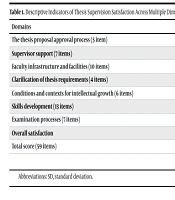
The overall satisfaction score for thesis supervision was 179.84 ± 37.8, corresponding to 3.04 out of 5 per question. Satisfaction levels were distributed as follows: Low satisfaction (5.1%, n = 6), moderate satisfaction (46.6%, n = 55), satisfied (39%, n = 46), and very satisfied (9.3%, n = 11). Examination processes received the highest satisfaction scores (3.68/5), followed by supervisor support (3.61/5), the thesis proposal approval process (3.47/5), and clarification of thesis requirements (3.07/5). The lowest satisfaction scores were reported for skill development (2.80/5), faculty infrastructure and facilities (2.75/5), and conditions and contexts for intellectual growth (2.43/5). The descriptive indicators of thesis supervision satisfaction across multiple dimensions are summarized in Table 1.
Table 1.
Descriptive Indicators of Thesis Supervision Satisfaction Across Multiple Dimensions
| Domains | Min - Max Score | Mean ± SD | Mean Score per Each Item |
|---|---|---|---|
| The thesis proposal approval process (5 item) | 6 - 25 | 17.11 ± 4.27 | 3.47 |
| Supervisor support (7 items) | 7 - 35 | 25.32 ± 7.61 | 3.61 |
| Faculty infrastructure and facilities (10 items) | 10 - 48 | 27.59 ± 7.17 | 2.75 |
| Clarification of thesis requirements (4 items) | 6 - 30 | 11.83 ± 3.42 | 3.07 |
| Conditions and contexts for intellectual growth (6 items) | 4 - 20 | 14.56 ± 5.15 | 2.43 |
| Skills development (13 items) | 13 - 65 | 36.40 ± 11.39 | 2.80 |
| Examination processes (7 items) | 11 - 35 | 25.77 ± 5.65 | 3.68 |
| Overall satisfaction | 7 - 35 | 21.24 ± 5.37 | 3.20 |
| Total score (59 items) | 89 - 276 | 179.84 ± 37.8 | 3.04 |
Abbreviations: SD, standard deviation.
Analysis of research challenges revealed time constraints as the most significant barrier (3.29/5), followed by administrative processes (3.28/5), statistical analysis (3.00/5), and topic selection (2.99/5). Notably, 89.8% (n = 106) of respondents believed thesis work should be optional, and 55.1% (n = 65) reported using paid research assistants, while only 13.6% (n = 16) completed their theses independently. A majority (65.3%, n = 77) expressed limited interest in research activities.
Statistical analysis identified a significant positive correlation between age and satisfaction scores (R = 0.261, P = 0.004), indicating that increasing students' age was associated with higher satisfaction scores. There was no statistically significant difference in overall satisfaction scores and their domains between males and females (P > 0.05). ANOVA revealed no significant differences in satisfaction by supervisor rank (P = 0.338). Married participants reported significantly higher satisfaction than single participants in infrastructure (P = 0.02), intellectual environment (P = 0.008), goal clarity (P = 0.008), and examination processes (P = 0.03). Residents demonstrated higher satisfaction than medical students in supervisor support (P = 0.04), infrastructure (P = 0.08), and intellectual growth contexts (P = 0.003). No significant differences emerged by gender or academic performance. These relationships are detailed in Table 2.
Table 2.
The Relationship Between Thesis Supervision Satisfaction Scores (Mean ± Standard Deviation) and Participant Characteristics a
| Domains of Questionnaire | Gender | Marital Status | Educational Level | Average Grade | ||||||||
|---|---|---|---|---|---|---|---|---|---|---|---|---|
| Male | Female | P-Value | Single | Married | P-Value | Medical student | Resident | P-Value | < 17 | 17 ≤ | P-Value | |
| The thesis proposal approval process (5 item) | 3.47 ± 0.8 | 3.38 ± 0.8 | 0.59 | 3.32 ± 0.8 | 3.59 ± 0.75 | 0.11 | 3.31 ± 0.8 | 3.72 ± 0.6 | 0.22 | 3.33 ± 0.9 | 3.58 ± 0.6 | 0.08 |
| Supervisor support (7 items) | 3.74 ± 1.1 | 3.54 ± 1.0 | 0.34 | 3.52 ± 1.0 | 3.78 ± 1.0 | 0.21 | 3.49 ± 1.1 | 3.95 | 0.04 | 3.58 ± 1.1 | 3.67 ± 1.0 | 0.6 |
| Faculty infrastructure and facilities (10 items) | 2.83 ± 0.7 | 2.71 ± 0.7 | 0.38 | 2.65 ± 0.6 | 2.95 ± 0.7 | 0.02 | 2.69 ± 0.6 | 2.49 ± 0.7 | 0.08 | 2.68 ± 0.7 | 2.89 ± 0.6 | 0.14 |
| Clarification of thesis requirements (4 items) | 3.07 ± 0.8 | 2.88 ± 0.8 | 0.25 | 2.80 ± 0.8 | 3.23 ± 0.8 | 0.008 | 2.87 ± 0.8 | 3.20 ± 0.7 | 0.06 | 2.90 ± 0.8 | 3.05 ± 0.8 | 0.36 |
| Conditions and contexts for intellectual growth (6 items) | 2.43 ± 0.9 | 2.42 ± 0.8 | 0.94 | 2.27 ± 0.8 | 2.70 ± 0.8 | 0.008 | 2.29 ± 0.8 | 2.81 ± 0.7 | 0.003 | 2.34 ± 0.8 | 2.57 ± 0.8 | 0.17 |
| Examination processes (7 items) | 3.78 ± 0.7 | 3.62 ± 0.8 | 0.29 | 3.56 ± 0.8 | 3.88 ± 0.7 | 0.03 | 3.60 ± 0.8 | 3.90 ± 0.7 | 0.07 | 3.64 ± 0.8 | 3.74 ± 0.8 | 0.55 |
| Overall satisfaction | 3.2 ± 0.7 | 2.93 ± 0.7 | 0.07 | 2.95 ± 0.7 | 3.10 ± 0.7 | 0.12 | 2.97 ± 0.7 | 3.21 ± 0.7 | 0.13 | 2.96 ± 0.7 | 3.15 ± 0.7 | 0.21 |
a Values are expressed as mean ± SD.
Linear regression analysis (enter method) revealed a statistically significant model [F(8,109) = 3.221, P = 0.003] explaining 13.2% of satisfaction variance (adjusted R2 = 0.132). Findings showed that decreased research interest predicted lower supervision satisfaction score (P = 0.005), while other variables were not significant in the final regression model (Table 3).
Table 3.
Linear Regression Analysis of Thesis Supervision Satisfaction Predictors
| Variables | Standardized Coefficients Beta | P-Values | 95% Confidence Interval for B | |
|---|---|---|---|---|
| Lower Bound | Upper Bound | |||
| Age | 0.163 | 0.254 | -0.96 | 3.60 |
| Gender | -0.151 | 0.106 | -26.12 | 2.55 |
| Educational level | 0.059 | 0.703 | -21.17 | 31.29 |
| Marital status | 0.118 | 0.231 | -5.97 | 24.50 |
| Average grade | 0.036 | 0.709 | -5.49 | 8.04 |
| Research interest | -0.252 | 0.005 | -33.61 | -6.23 |
| Academic rank of the thesis professor | 0.117 | 0.193 | -3.20 | 15.75 |
| Number of articles | 0.035 | 0.695 | -14.15 | 21.17 |
5. Discussion
This study examined satisfaction with the thesis supervision process among medical students and residents at Zahedan University of Medical Sciences. The findings revealed that thesis examination (3.78/5) and supervisor support (3.74/5) received the highest satisfaction ratings, while conditions for intellectual growth (2.43/5) and university infrastructure and facilities (2.83/5) received the lowest scores. Overall, 48.3% of participants reported being satisfied or very satisfied with the supervision process. Notably, supervisor's academic rank, student gender, and overall GPA showed no significant relationship with satisfaction levels, whereas residency status was significantly associated with higher satisfaction scores in supervisor support and intellectual growth factors. Additionally, married participants reported statistically higher satisfaction than single participants across multiple domains, including infrastructure, intellectual growth environment, clarity of criteria, and thesis examination processes. These results highlight critical weaknesses in fundamental research conditions at Zahedan University of Medical Sciences, particularly in infrastructure and intellectual development environments, suggesting the need for both short-term and long-term improvement programs.
The findings are consistent with similar studies conducted in other Iranian medical institutions. For example, Imani et al. found comparable patterns among graduates from Tabriz Faculty of Management and Medical Information, with the lowest satisfaction reported for infrastructure (33.9%) and intellectual growth conditions (34.7%), while skill development (61%), thesis examination (60.3%), and supervisor support (54.2%) received higher ratings (16). Dehghani also reported similar results at Tabriz University of Medical Sciences, where students expressed the highest satisfaction with supervisor accessibility (15). The present study further aligns with research conducted at Ardabil University of Medical Sciences, which identified intellectual environments and research infrastructure as areas of lowest satisfaction, while clarity of criteria and skill development were rated more favorably. Like our study, no significant gender differences in satisfaction were observed in these comparable settings (18).
International research corroborates many of these findings. A study of medical students in Saudi Arabia identified lack of sufficient time as the most frequently reported barrier, along with inadequate mentoring, disinterest in research, and insufficient research knowledge — all of which mirror challenges identified in our study (19). Similarly, a German study on medical thesis failures cited statistical difficulties, time constraints, and communication problems with supervisors as major obstacles, emphasizing that poor scientific communication and inadequate preparation on both sides were key contributing factors. These issues closely align with the concerns raised by participants in our study (20). Furthermore, research from Spain documented a widespread lack of interest in research activities among medical students, with many reporting insufficient encouragement from professors and citing limited skills and financial resources as significant barriers. Approximately half of the students in that study expressed no interest in research, a finding that parallels our own observations. Administrative processes and university regulations were also identified as significant obstacles in our study, indicating that clearer communication about thesis procedures — from proposal registration to final approval — could help mitigate some of these challenges (21). Assessing quality through various methods across different levels and dimensions of service delivery, including hospital services, is becoming increasingly significant today (22).
In various research areas, especially those on medical education, fewer studies have been conducted using a standard tool. Therefore, we conducted this study to identify the dimensions of the problems in this area, although there were some limitations. First, the exclusion of faculty perspectives means the findings reflect only the student experience, potentially omitting valuable insights from supervisors. Second, the single-institution focus limits the generalizability of the results, although the consistency of our findings with studies from other Iranian universities suggests broader applicability. Although this research is a single-center study at Zahedan University of Medical Sciences, given that it is a large medical academic center in southeastern Iran that has recently been permitted to accept international students, the results have good generalizability to universities at this level. To address the need for cautious interpretation while maintaining the utility of our findings, we now more carefully frame our recommendations for improving infrastructure, intellectual environments, and administrative processes as context-specific interventions that should be suggested to local circumstances.
Despite structural similarities in medical students’ research challenges globally (such as lack of time and communication problems), interpreting these findings in the cultural-educational context of Zahedan University of Medical Sciences requires special considerations. For example, the multi-ethnic identity of the Sistan and Baluchestan region and differences in communication styles can affect the professor-student relationship and the way problems are expressed. Also, the infrastructural and geographical constraints of this region may place greater emphasis on the distribution of professors’ time between teaching, research, and healthcare tasks, further highlighting the issue of “lack of time”. On the other hand, the centralized structure and uniform administrative regulations in the Iranian higher education system make the findings related to administrative problems of this study largely generalizable to other medical universities in the country.
5.1. Conclusions
The study revealed that about half of students were satisfied with thesis supervision, while the other half expressed low to moderate satisfaction. Lowest satisfaction appeared in skill development, infrastructure, and intellectual environment, indicating a need for improvement. While Zahedan University has made research advancements, further reforms remain necessary. Implementing training workshops, improving administrative processes, and enhancing research facilities would significantly boost both satisfaction and research quality. Our suggestions are now directly tied to the specific findings of our study: Implementing structured research mentorship programs and research communication workshops to address poor supervision; creating a visual guide of the thesis process to simplify complex procedures; and establishing a statistical consulting service to overcome knowledge barriers.