
1. Background
Divorce stands as one of the most stressful and disruptive life events, capable of exerting profound and lasting consequences on the mental and emotional well-being of individuals, particularly women (1). Within this context, divorced women often confront a unique confluence of emotional, social, and economic challenges, necessitating robust psychological mechanisms to navigate this crisis and mitigate its long-term negative effects (2). Researchers characterize divorce as a complex and traumatic experience that deeply impacts various facets of personal and social life (3). The severity of this upheaval demands effective strategies for psychological adaptation and healing. Without such mechanisms, women are highly susceptible to prolonged emotional distress, including debilitating feelings of anger, resentment, and a heightened risk of developing conditions such as anxiety and depression (4). Therefore, fostering resilience and emotional closure is crucial for this population to transition successfully into a new, independent phase of life. The ability to cope successfully with this life transition is fundamentally linked to psychological processes that enable the release of negative attachment to the past experience (5).
A pivotal concept that facilitates the repair of psychological wounds inflicted by divorce is forgiveness. Extensive research unequivocally positions forgiveness as a psychological shield against mental distress, noting that individuals who forgive are less prone to being trapped by negative emotions and generally report superior mental health (6). In the aftermath of divorce, this capacity becomes vital: Forgiveness lessens the heavy psychological burden of the separation and paves the way for adjustment and recovery (7). For a divorced woman, forgiveness represents the act of releasing negative emotions tied to the past, allowing her to move toward an unburdened future. Specifically, in this context, forgiveness entails releasing the rage, resentment, and desire for revenge toward the former spouse (8). This process not only improves the individual's mental health but also lays the groundwork for initiating a positive new chapter in life. However, achieving this beneficial psychological state is complex and influenced by various intrinsic factors (9).
In seeking the factors that underpin forgiveness, deeper psychological variables, particularly mindfulness, warrant close attention. Mindfulness is defined as an individual’s ability to maintain full presence in the current moment, characterized by complete openness and non-judgmental acceptance of both internal and external experiences (10). This skill allows individuals to engage with their emotions and thoughts more effectively, resulting in reduced stress and anxiety (11). A woman with a higher level of mindfulness can observe and accept intense emotions — such as anger, sorrow, or a sense of betrayal — without becoming consumed by them. This quality of awareness grants her greater clarity in viewing the divorce situation, freeing her from persistent rumination and thereby enabling her to make conscious decisions about forgiveness (12). Consequently, mindfulness is posited to be positively associated with forgiveness in challenging interpersonal contexts.
In addition to mindfulness, the process of emotion regulation emerges as another essential mechanism on the path to post-divorce recovery. Emotion regulation refers to the conscious and unconscious strategies individuals employ to manage, modify, and adjust their intense and unpleasant emotions (13). The deployment of adaptive emotion regulation strategies is a critical skill for a healthy transition through the divorce crisis, helping individuals show more adaptive responses to the grief of separation and reducing the intensity of their psychological distress (14). Research confirms that individuals equipped with this skill exhibit greater flexibility in the face of life changes and adapt more quickly to new circumstances (15). In practice, effective emotion regulation empowers the individual to correctly identify, manage, and express feelings in a healthy manner. When a woman can effectively manage her emotions through strategies like cognitive reappraisal or acceptance, she creates the necessary psychological space to consider and enact forgiveness (16). Moreover, there appears to be a dynamic interaction between these two variables: The practice of mindfulness can significantly enhance one's capacity for emotion regulation. By non-judgmentally observing emotions, an individual takes the first step toward managing them intelligently, positioning emotion regulation as a crucial mechanism linking mindfulness to forgiveness (17).
Despite the existing theoretical and empirical connections, there is a distinct need to specifically investigate the network of relationships among mindfulness, emotion regulation, and forgiveness within the population of divorced women in the socio-cultural context of Qom, Iran. Examining these variables provides not only a deeper theoretical understanding but also significant practical applications. By identifying the predictive roles of mindfulness and emotion regulation, targeted psychological interventions can be designed and implemented to enhance these fundamental skills. Such interventions would ultimately help divorced women cope with emotional pain, move towards self- and other-forgiveness, foster post-crisis growth, and restore their mental health. Therefore, considering the importance of factors affecting forgiveness in the context of divorce, the present study sought to answer the fundamental question: Can forgiveness in the context of divorce be predicted on the basis of mindfulness and emotion regulation in divorced women in Qom County?
2. Objectives
The current study aimed to investigate the predictive relationship between mindfulness and emotion regulation and forgiveness in the context of divorce among divorced women.
3. Methods
3.1. Design and Participants
This study employed a correlational descriptive design to investigate the nature and magnitude of the relationships between mindfulness, emotion regulation, and forgiveness in the context of divorce. The target population comprised all divorced women residing in Qom County, Iran, in 2024. A convenience sample of 209 participants was selected. Sampling involved a multi-stage approach combining random and convenience techniques. Initially, three active counseling centers in Qom County were randomly chosen. Eligible clients from these centers were then enrolled using convenience sampling. Of 220 distributed questionnaires, 209 were complete and usable. The demographic analysis revealed a mean age of 39.42 ± 9.15 years and a mean time since divorce of 4.18 ± 2.67 years. The sample showed a balanced age distribution, with 97 participants (46.4%) younger than 39 years and 112 (53.6%) aged 39 years or older. Inclusion criteria were being a divorced woman, residing in Qom County, and providing willingness to participate. Exclusion criteria included incomplete questionnaires. The study adhered to all ethical principles, including informed consent, confidentiality, anonymity, and privacy.
3.2. Instruments
3.2.1. Forgiveness in the Context of Divorce Questionnaire
The Forgiveness in the Context of Divorce Questionnaire (FCDQ) is a specialized instrument developed by Rivera-Ottenberger et al. (18) to specifically assess forgiveness related to the experience of divorce. This questionnaire comprises 5 items designed to evaluate various facets of forgiveness in the aftermath of marital dissolution. Items are scored on a 5-point Likert scale, ranging from 0 (never) to 4 (often). Items 1, 2, and 5 are reverse-scored. Total scores range from 0 to 20, with higher scores reflecting a greater capacity for forgiveness. In the present study, the FCDQ demonstrated good internal consistency, with a Cronbach's alpha of 0.81, which was consistent with its composite reliability of 0.88.
3.2.2. Mindfulness Attention Awareness Scale
The Mindfulness Attention Awareness Scale (MAAS), developed by Brown and Ryan (19), is a 15-item unidimensional measure designed to assess individual differences in the frequency of mindful states and non-judgmental attention to present experience, in contrast to automatic mental states or preoccupation with the past/future. Participants rate the extent to which they experience certain situations or thoughts on a 6-point Likert scale, ranging from 1 (almost never) to 6 (almost always). Total scores range from 15 to 90, with higher scores indicating higher levels of dispositional mindfulness. Previous studies (20) have confirmed the scale's reliability, with Cronbach's alpha coefficients between 0.80 and 0.87. In the current study, the internal consistency was high, with a Cronbach's alpha of 0.86.
3.2.3. Cognitive Emotion Regulation Questionnaire
The Cognitive Emotion Regulation Questionnaire (CERQ), developed by Garnefski et al. (21), was utilized to examine the strategies individuals employ to manage and regulate their emotions. The questionnaire measures both adaptive and maladaptive strategies of emotion regulation. In the present study, the analysis focused on the distinction between adaptive and maladaptive facets. The CERQ consists of 36 items, where responses are recorded on a 5-point Likert scale ranging from (not at all) to (almost always). Abdi et al. (22) reported a Cronbach’s alpha of 0.82 for the overall scale, alongside subscale values ranging from 0.84 to 0.93. For the current research, the internal consistency of the adaptive and maladaptive emotion regulation components yielded alpha coefficients of 0.85 and 0.83, respectively, reflecting excellent reliability.
3.3. Procedure
Data collection was conducted following the acquisition of necessary institutional approvals and coordination. Potential participants meeting the inclusion criteria were approached at the designated counseling centers. After receiving an explanation of the research goals and providing their informed consent, participants were given the standardized set of questionnaires to complete. The self-report instruments were administered in a private setting to maximize honesty and accuracy. The researchers ensured the anonymity of all responses, with data processed and analyzed at the aggregate level.
3.4. Data Analysis
The collected data were processed using SPSS version 27. Descriptive statistics (mean, standard deviation, Skewness, and Kurtosis) were calculated. Inferential statistical analysis included Pearson correlation coefficients to examine the relationships and simultaneous multiple regression to predict forgiveness based on the predictor variables.
4. Results
The mean score for forgiveness in the context of divorce was 15.48± 7.78, suggesting moderate to high forgiveness capacity on average. Mindfulness showed a mean score of 52.14 ± 9.28, indicating moderate dispositional mindfulness. Adaptive emotion regulation (30.64 ± 5.52) was slightly more frequently reported than maladaptive emotion regulation (24.81 ± 3.33). Skewness and Kurtosis values confirmed approximate normality.
Table 1 presents the descriptive statistics for the main study variables. The mean score for forgiveness in the context of divorce (15.48 ± 7.78) suggests that, on average, the participants exhibited a moderate to high capacity for forgiveness following their divorce. Mindfulness showed a mean score of 52.14 ± 9.28, indicating moderate levels of dispositional mindfulness among the group. Both adaptive emotion regulation (M = 30.64) and maladaptive emotion regulation (M = 24.81) scores suggest that participants utilize both sets of strategies, though adaptive strategies were slightly more frequently reported. Crucially, the values for Skewness (ranging from -0.10 to 0.28) and Kurtosis (ranging from 0.35 to 1.41) for all variables fall well within the acceptable range of ±2, confirming that the data distribution is approximately normal, which satisfies the prerequisite assumptions for employing parametric statistical tests such as Pearson correlation and multiple regression.
Table 1.
Mean, Standard Deviation, Skewness, and Kurtosis of Research Variables
| Variables | Mean ± SD | Skewness | Kurtosis |
|---|---|---|---|
| Forgiveness in divorce | 15.48 ± 7.87 | -0.28 | -1.41 |
| Mindfulness | 52.14 ± 9.28 | -0.10 | -0.35 |
| Adaptive emotion regulation | 30.64 ± 5.52 | -0.16 | -0.63 |
| Maladaptive emotion regulation | 24.81 ± 3.33 | -0.08 | -0.70 |
Table 2 displays the Pearson correlation coefficients illustrating the zero-order relationships between the predictor variables and the criterion variable. The analysis demonstrates statistically significant relationships for all variables (P < 0.001). Specifically, mindfulness exhibited a moderate positive correlation with forgiveness in the context of divorce (R = 0.37), suggesting that women who are more present and non-judgmental tend to forgive more. Adaptive emotion regulation showed a strong positive correlation (R = 0.51), indicating that using positive coping strategies is highly associated with greater forgiveness. Conversely, maladaptive emotion regulation had the strongest relationship, showing a high negative correlation (R = -0.56).
Table 2.
Bivariate Correlations Between Research Variables
| Variables | Forgiveness In Divorce (R) | P |
|---|---|---|
| Mindfulness | 0.37 | 0.001 |
| Adaptive emotion regulation | 0.51 | 0.001 |
| Maladaptive emotion regulation | -0.56 | 0.001 |
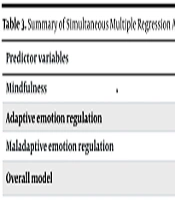
The results of the simultaneous multiple regression, presented in Table 3, confirm the significant collective and independent predictive power of the variables. The overall model was highly significant (F = 50.06, P < 0.001), explaining a substantial 42.3% of the total variance in forgiveness in the context of divorce (R2 = 0.42). Examining the individual standardized beta coefficients (β) reveals that all three predictors made a unique and statistically significant contribution. Maladaptive emotion regulation (β = -0.39, P < 0.001) emerged as the strongest negative predictor, followed by adaptive emotion regulation (β = 0.24, P < 0.001) as the strongest positive predictor, and mindfulness (β = 0.22, P < 0.001) also significantly and positively predicted forgiveness.
Table 3.
Summary of Simultaneous Multiple Regression Analysis Predicting Forgiveness in the Context of Divorce (N = 209)
| Predictor variables | B | SE | β | t | P |
|---|---|---|---|---|---|
| Mindfulness | 0.17 | 0.04 | 0.22 | 4.03 | 0.001 |
| Adaptive emotion regulation | 0.34 | 0.09 | 0.24 | 3.86 | 0.001 |
| Maladaptive emotion regulation | -0.92 | 0.15 | -0.39 | -6.35 | 0.001 |
| Overall model | F = 50.06, P < 0.001, R = 0.65, R2 = 0.423 | ||||
5. Discussion
The primary objective of the present study was to investigate the predictive role of mindfulness and emotion regulation strategies on forgiveness in the context of divorce among divorced women. The present findings indicate that mindfulness and adaptive emotion regulation strategies are positively associated with forgiveness, whereas maladaptive emotion regulation strategies are negatively associated with it. The regression analysis showed that the three predictors collectively accounted for 42.3% of the variance in forgiveness. This finding underscores the vital importance of these cognitive-emotional constructs in the psychological recovery process following marital dissolution.
The regression findings highlighted that maladaptive emotion regulation emerged as the strongest negative predictor of forgiveness in the context of divorce. This result is consistent with theoretical models positing that maladaptive strategies, such as rumination, self-blame, or catastrophizing, trap the individual in a vicious cycle of anger, resentment, and persistent attachment to past harm. Forgiveness fundamentally requires psychological detachment from the painful event and the offending party; conversely, maladaptive strategies continually focus cognitive attention on the past injury, thereby impeding healthy emotional processing (23). A divorced woman relying on these strategies expends mental energy on rehearsing resentment rather than healing her wounds. Convergent studies have supported this notion, confirming that rumination regarding a traumatic event has a significant, direct relationship with non-forgiveness (24), and emotional suppression leads to protracted distress and inability to adapt following stressful life events. Therefore, to facilitate forgiveness, interventions must primarily focus on reducing the frequency and reliance on these destructive thought patterns.
In contrast, the results indicated that adaptive emotion regulation strategies were a significant positive predictor of forgiveness. These strategies, including positive reappraisal, acceptance, and positive refocusing, equip women with the ability to interpret the meaning of the divorce event in a more constructive manner. Cognitive reappraisal, for instance, helps a divorced woman view the divorce not merely as a failure, but as an opportunity for learning, growth, and future independence. This cognitive restructuring provides the necessary emotional distance to moderate anger and enables the possibility of forgiveness (8). An individual who can effectively manage intense emotions is capable of making a conscious, proactive choice toward forgiveness, rather than reacting impulsively. This finding aligns with numerous studies demonstrating that adaptive emotional strategies not only successfully predict post-traumatic growth but are also directly linked to increased empathy and interpersonal forgiveness in conflict situations (25).
The study's findings emphasize that mindfulness also significantly and positively predicts forgiveness. By cultivating moment-to-moment awareness and non-judgmental acceptance, mindfulness enhances an individual's capacity to observe the negative thoughts and feelings associated with divorce without being consumed by them. This reduction in automatic reactivity, often the main driver of chronic anger and resentment, is critical for the forgiveness process (26). Essentially, mindfulness acts as a cognitive prerequisite that strengthens an individual's emotion regulation capacity: By reducing engagement with negative thought content, the person can apply adaptive emotion regulation strategies with greater efficacy (19). This result is consistent with research showing that mindfulness practice substantially reduces rumination and self-criticism (27), and studies reporting that mindfulness-based interventions facilitate an increase in empathy and the propensity to forgive others (28). This finding affirms the role of mindfulness not only as an isolated construct but as a foundational factor for psychological repair following crisis.
The cross-sectional and correlational design precludes causal inferences or conclusions about temporal precedence. The use of convenience sampling from counseling centers in Qom County, together with the specific socio-cultural and religious context of the sample, limits generalizability to divorced women in other regions or cultures. Several potentially important variables — such as number of children, duration of marriage, reasons for divorce, time since divorce, and socioeconomic status — were not assessed and may moderate the observed associations. Although the results are consistent with theoretical models positing emotion regulation as a mechanism linking mindfulness to forgiveness, the mediating role of emotion regulation was not empirically tested. Future studies could employ longitudinal designs or structural equation modeling to examine directional pathways and mediation more rigorously.
5.1. Conclusions
The present findings suggest that higher levels of mindfulness and adaptive emotion regulation are associated with greater forgiveness in the context of divorce, whereas maladaptive emotion regulation is associated with lower forgiveness. These correlational results provide preliminary support for the potential utility of incorporating mindfulness training and adaptive emotion regulation strategies into interventions for divorced women; however, randomized controlled trials would be needed to establish efficacy and causal effects. Such interventions may enhance forgiveness capacity, reduce distress, and promote long-term psychological adjustment following divorce.