1. Background
Infertility, defined as the inability to conceive after one year of regular, unprotected intercourse, affects approximately 15% of couples worldwide. Its prevalence varies by region, influenced by genetic, environmental, and socioeconomic factors, making infertility a significant global health concern (1). Women of reproductive age are particularly impacted, experiencing not only the physical inability to conceive but also psychological challenges, including stress, anxiety, and reduced self-efficacy (2). The causes of female infertility are diverse and include ovulatory dysfunction, tubal or pelvic issues, uterine abnormalities, and age-related ovarian decline. Endocrine disorders such as polycystic ovary syndrome, hypothyroidism, and hyperprolactinemia frequently result in ovulatory irregularities. Structural factors, including blocked fallopian tubes due to pelvic inflammatory disease or endometriosis, also contribute significantly. In some cases, the cause remains unexplained, underscoring the complexity of infertility (3).
The mechanisms underlying infertility differ according to the specific condition. In polycystic ovary syndrome, hormonal imbalances and insulin resistance disrupt the hypothalamic-pituitary-ovarian axis, impairing ovulation. Endometriosis leads to inflammation and adhesions, compromising tubal function. Uterine abnormalities, such as fibroids or congenital malformations, can hinder implantation or fetal development, further affecting conception (4). Infertility presents in various ways, often related to its underlying causes. For instance, polycystic ovary syndrome may manifest as irregular menstrual cycles, excessive hair growth, and acne, while endometriosis often presents with chronic pelvic pain and painful menstruation. Beyond physical symptoms, infertility frequently results in psychological effects, including anxiety, depression, and a diminished quality of life (5).
Diagnosing infertility involves comprehensive evaluations, including medical history, physical examinations, hormone level assessments, imaging studies, and sometimes invasive procedures such as laparoscopy (6). Treatment approaches depend on the underlying cause and may involve medications, surgical interventions, or assisted reproductive technologies such as in vitro fertilization. The emotional burden of infertility is considerable, highlighting the importance of holistic care that addresses both physical and psychological needs (7).
Psychological interventions, including cognitive-behavioral therapy and relaxation techniques, play a crucial role in managing infertility-related stress. Benson's relaxation technique, which combines breathing exercises and mindfulness to induce relaxation, has demonstrated effectiveness in reducing stress and enhancing mental clarity. Delivering this technique via podcasts offers a practical and scalable solution for women facing logistical or emotional barriers to in-person interventions (8). Benson’s relaxation method is thought to positively influence self-efficacy, empowering women to better manage stress and adhere to infertility treatment regimens. Incorporating such interventions into infertility care supports a holistic biopsychosocial model, addressing mental health alongside physical well-being. Nevertheless, the use of podcasts to deliver relaxation therapies in this context remains underexplored, highlighting the need for further research to assess their effectiveness (9). Another study reported that Benson's relaxation technique is an effective intervention for reducing stress and improving quality of life among women with infertility (10).
2. Objectives
This study aims to investigate the impact of Benson’s relaxation technique, delivered via podcasts, on stress and self-efficacy in infertile women. The results are expected to provide valuable insights for the development of accessible psychological interventions, advancing mental health support within reproductive medicine. By integrating relaxation techniques into infertility care, this research seeks to enhance the overall well-being of individuals navigating the challenges of infertility.
3. Methods
The present study utilized a semi-experimental, before-after group design. All infertile women referred to the Zabol Infertility Clinic in 2024 who met the inclusion criteria and provided written informed consent were enrolled through a census approach. Inclusion criteria comprised obtaining informed consent, a clinical diagnosis of infertility with a duration between 1 and 13 years, no history of sedative use, no prior sedation, no history of mental disorders, and no previous psychiatric treatments. Exclusion criteria included withdrawal from the study for any reason, such as pregnancy, voluntary discontinuation, death, participation in other courses related to the research topic during the study period, or relocation to another city.
This study recruited 46 eligible patients using accessible sampling, ensuring that all participants met the inclusion criteria. After obtaining informed consent and guaranteeing confidentiality, participants completed pre-test assessments using the Persian versions of the Perceived Stress Scale-10 (PSS-10) and the Infertility Self-efficacy Scale. Participants received Benson relaxation training delivered via audio CD for eight weeks, practicing relaxation for 15 minutes twice daily on alternate days (11). The relaxation technique included deep breathing, muscle relaxation, and focusing mentally on a calming word while listening to relaxing music. After completing the exercise, participants remained in the relaxed position for a few minutes. Relaxing music was played through headphones (11, 12). Post-test assessments were conducted after the intervention.
Data were analyzed using SPSS-27 software, employing descriptive statistics to summarize participant characteristics and inferential statistics for group comparisons. The Kolmogorov-Smirnov test assessed data normality, followed by paired t-tests or non-parametric equivalents for within-group comparisons. Regression analyses were conducted to evaluate the effectiveness of the intervention while controlling for confounding variables. A significance level of 0.05 was applied throughout the analysis.
3.1. Research Tools
3.1.1. Infertility Self-efficacy Questionnaire
The Infertility Self-efficacy Scale, developed by Cousineau et al., is an 11-item questionnaire with high internal reliability (Cronbach's alpha = 0.94) designed to measure infertility self-efficacy. The original validation was conducted in the United States with 213 participants (159 women, 54 men) diagnosed with infertility lasting two or more years. In Iran, the scale was translated into Persian, back-translated, and adapted for cultural and linguistic relevance with input from psychologists. The original 9-point Likert scale was modified to a 5-point scale to enhance cultural suitability. Psychometric validation, including exploratory factor analysis, was performed on 203 Iranian women with infertility of at least two years’ duration at a specialized institute in 2017, yielding a Cronbach's alpha of 0.90, indicative of high reliability and internal consistency (13, 14).
3.1.2. Perceived Stress Scale
The Perceived Stress Scale (PSS), widely used to assess perceived stress, evaluates how individuals appraise stressful life situations. Initially developed by Cohen as a 14-item scale (PSS-14), it was later refined to a 10-item version (PSS-10) by removing four items with low factor loadings (15, 16). A 4-item version was also developed for use in time-constrained settings. The PSS has been adapted across various cultures and languages, including Persian. Among its versions, the PSS-10 is preferred due to its superior psychometric properties (17, 18). Maroufizadeh et al. confirmed the reliability and validity of the Persian PSS-10 for assessing perceived stress in women with infertility (19).
4. Results
In this study, the average age of participants was 27.67 years. Twelve participants were employed, and 34 were homemakers. The average duration of marriage was 7.04 years, and all participants were women. Fifty percent of the participants were overweight, and 71.7% resided in urban areas. Additionally, 73.9% were homemakers. The primary source of information for 60.9% of participants was the internet, while 13% obtained information from doctors and medical staff (Table 1). A total of 89.1% had no family history of infertility, and 91.3% had no history of hospitalization due to infertility.
Table 1.
Comparison of the Stress Questionnaire in Infertile Women
| Variables | Mean | P-Value |
|---|---|---|
| Stress Questionnaire in infertile women | 0.000 | |
| Before | 29.67 | |
| After | 27.69 | |
| Self-efficacy Questionnaire in infertile women | 0.000 | |
| Before | 55.74 | |
| After | 63.96 |
Furthermore, 54.3% reported no difficulties obtaining medication, while 45.7% faced financial challenges. All participants were in their first marriage, and 89.1% of their spouses were also in their first marriage. The age distribution was as follows: 18 - 22 years (21.7%), 23 - 26 years (17.4%), 27 - 30 years (19.6%), and 31 - 34 years (23.9%). Participants’ education levels were distributed as follows: Elementary and middle school (28.3%), high school (10.9%), diploma (17.4%), and university-level education (43.5%, Table 2). The average duration of infertility was 4.24 years, with a minimum of 1 year and a maximum of 20 years. Among the participants, 47.8% had experienced infertility for 2 years or less, 26.1% for 3 to 5 years, 19.6% for 6 to 10 years, and 6.5% for more than 10 years (Table 3).
Table 2.
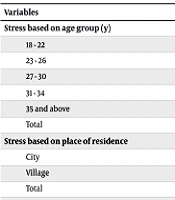
Stress Based on Age Group, Place of Residence, and Education Level
| Variables | Mean | P-Value |
|---|---|---|
| Stress based on age group (y) | 0.197 | |
| 18 - 22 | 29.00 | |
| 23 - 26 | 28.57 | |
| 27 - 30 | 29.25 | |
| 31 - 34 | 23.67 | |
| 35 and above | 28.09 | |
| Total | 27.69 | |
| Stress based on place of residence | 0.691 | |
| City | 27.48 | |
| Village | 28.25 | |
| Total | 27.69 | |
| Stress based on education level | 0.109 | |
| Primary and middle school | 25.25 | |
| High school | 28.80 | |
| Diploma | 31.38 | |
| University | 27.40 | |
| Total | 27.69 |
Table 3.
Mean of Self-efficacy Based on Place of Residence, Age Group, and Education Level
| Groups | Mean | P-Value |
|---|---|---|
| Age group (y) | 0.247 | |
| 18 - 22 | 20.57 | |
| 23 - 26 | 25.64 | |
| 27 - 30 | 25.65 | |
| 31 - 34 | 25.00 | |
| 35 and above | 28.09 | |
| Total | 63.96 | |
| Education level | 0.308 | |
| Primary and middle school | 59.54 | |
| High school | 65.60 | |
| Diploma | 68.63 | |
| University | 64.55 | |
| Total | 63.96 | |
| Place of residence | 0.897 | |
| City | 64.09 | |
| Village | 63.62 | |
| Total | 63.96 |
Table 1 presents the comparison of stress and self-efficacy scores in infertile women before and after the study. The P-values indicate significant changes in both measures.
The mean stress score before the study was 29.67, and after the study, it was 27.69. Data analysis using the paired t-test showed a P-value of 0.000. Since the significance level is less than 0.05, these findings indicate a significant relationship. The mean self-efficacy score before the study was 55.74, and after the study, it was 63.96. Data analysis using the paired t-test showed a P-value of 0.000. Since the significance level is less than 0.05, these findings also indicate a significant relationship.
The data were further analyzed using the univariate analysis of covariance (ANCOVA) method. No significant relationship was found between age group, education level, or place of residence and stress levels before and after relaxation (P > 0.05).
The data were analyzed using the univariate ANCOVA method. No significant relationship was found between age group, education level, or place of residence and self-efficacy levels before and after relaxation (P > 0.05).
5. Discussion
This study investigated the effects of Benson relaxation, delivered via podcasts, on stress and self-efficacy in infertile women at Amir al-Momenin Hospital in Zabol. Infertility frequently leads to significant psychological challenges, including stress, anxiety, and feelings of inadequacy, which may intensify during treatment and adversely affect self-efficacy and quality of life. The findings underscore the importance of non-pharmacological interventions such as Benson relaxation in alleviating these psychological burdens (7).
The results demonstrated that Benson relaxation significantly reduced stress, as well as sexual, relationship, and social anxiety in infertile women. Although direct research on this intervention in infertile women is limited, related studies in other populations — such as the elderly (20), cancer patients (21), individuals with irritable bowel syndrome (21), and patients with rheumatoid arthritis (22) — have reported similar positive effects. These findings are supported by research indicating that Benson relaxation effectively reduces stress and alleviates sexual, relational, and social anxiety in diverse populations (23).
Studies such as those by Pahlavani et al. have highlighted the heightened stress and diminished mental health experienced by individuals with infertility (24). Complementary therapies, including relaxation techniques, have shown promise in alleviating stress by reducing muscle tension, lowering anxiety levels, and addressing physiological stress markers. Relaxation techniques decrease muscle tension, reduce anxiety, and mitigate the undesirable physiological effects of stress. They achieve this by creating a balance between the posterior and anterior hypothalamus, thereby preventing complications caused by stress (25).
Benson relaxation, by balancing posterior and anterior hypothalamic activity, effectively counteracts stress-related complications, offering benefits such as reduced blood pressure, regulated breathing, and decreased muscle tension. Research by Valiani et al. and Eckes Peck supports the effectiveness of Benson relaxation in reducing stress in infertile women and patients with chronic conditions like osteoarthritis. Additionally, Hanifi et al. demonstrated its efficacy in alleviating anxiety, stress, and depression in patients with coronary artery disease, while Torabi and Salavati reported similar benefits in individuals awaiting kidney transplants (26-30).
In this study, Benson relaxation significantly reduced stress levels among infertile women, consistent with previous research. This method, based on the relaxation response, counters the body’s stress response by lowering physiological stress markers such as heart rate and blood pressure. Delivering this intervention through podcasts enhances accessibility and convenience, promoting greater adherence to relaxation practices (11).
Other studies corroborate these findings. For example, Bauzin and Viskermi highlighted the role of relaxation in mitigating sexual, relational, and social concerns in infertile women (31). In a study by Bae et al., guided imagery was shown to be an effective nursing intervention for reducing stress, particularly emotional stress and anxiety, in infertile women undergoing in vitro fertilization in outpatient infertility centers (32).
The present study supports previous research and suggests that relaxation techniques can serve as effective coping strategies in the context of infertility. Stress management is particularly important for this population, as chronic stress has been linked to negative effects on fertility and may potentially impact the outcomes of assisted reproductive treatments. By reducing stress levels, Benson relaxation may contribute to improved mental well-being and possibly better fertility outcomes (33), although further investigation is required to confirm this effect.
Self-efficacy, defined as an individual’s belief in their ability to manage life’s challenges, is especially important for women undergoing infertility treatments. The findings of this study indicate that Benson relaxation, delivered via podcasts, significantly improved self-efficacy among participants. This is consistent with previous research suggesting that relaxation techniques and mindfulness-based interventions can empower individuals by enhancing their sense of control over stressful situations (34).
The improvements in self-efficacy observed in this study can be attributed to regular engagement in relaxation exercises, which may enhance an individual’s sense of personal agency and mastery over their stress responses. Increased self-efficacy can positively influence various aspects of well-being, including adherence to treatment regimens, engagement in self-care, and overall resilience when facing infertility-related challenges (35). The study found significant improvements in self-efficacy among participants, which is particularly important for women undergoing infertility treatments. Regular participation in relaxation exercises enhanced participants' sense of control and their ability to manage stress. Enhanced self-efficacy contributes to better treatment adherence, improved self-care, and greater resilience.
The effectiveness of Benson relaxation is rooted in its dual impact: Physiologically, it reduces sympathetic nervous system activity, enhances parasympathetic function, lowers cortisol levels, and alleviates stress symptoms; psychologically, it fosters mindfulness, reduces negative thoughts, and supports cognitive restructuring, collectively reducing stress and boosting self-efficacy (36). According to a study by Ebrahimifar et al., two infertility self-efficacy interventions — the Relationship Quality Inventory and the Meaning of Life Questionnaire — were effective in promoting self-efficacy, improving relationship quality, and enhancing meaning in life among infertile women (14).
Delivering Benson relaxation via podcasts enhances its effectiveness by providing a flexible, portable, and accessible platform for regular practice, thereby encouraging participants to integrate relaxation into their daily routines (37). This approach offers significant clinical benefits, serving as a cost-effective, non-invasive method for improving psychological well-being in infertile women. It addresses both the mental and physical health challenges associated with infertility treatment (38). Podcasts are especially valuable in regions with limited access to mental health services, as they overcome barriers to in-person therapy and make stress management resources more widely available. Healthcare professionals are encouraged to incorporate podcast-based relaxation into infertility care plans to enhance the treatment experience (39).
Although this study provides valuable insights, it is not without limitations. The sample size was relatively small, and the research was conducted in a single clinic, which may limit the generalizability of the findings. Additionally, the study relied on self-reported measures of stress and self-efficacy, which may be subject to bias. Future research should seek to replicate these findings in larger, more diverse populations and examine the long-term effects of Benson relaxation on stress and self-efficacy in infertile women. Another limitation is that this study did not investigate the potential impact of Benson relaxation on fertility outcomes, such as pregnancy rates or treatment success. While reduced stress and improved self-efficacy are valuable outcomes in themselves, further research is needed to determine whether these psychological improvements translate into better fertility outcomes.
5.1. Conclusions
In conclusion, Benson relaxation delivered via podcasts appears to be an effective intervention for reducing stress and increasing self-efficacy in infertile women. This study contributes to the growing body of evidence supporting the use of relaxation techniques as part of comprehensive care for individuals experiencing infertility. By providing a simple, accessible, and flexible method of relaxation, podcasts may serve as a valuable tool for improving the mental health of women undergoing infertility treatment.