1. Background
With advancing age and the onset of elderly years, the emergence of certain physical and psychological disorders is not unexpected. The progressive loss of cognitive function that often occurs in older age is identified by the term dementia (1). The most common form of dementia is Alzheimer’s disease, a brain disorder characterized by the deterioration of attention and personality (2). Alzheimer’s disease is one of the chronic conditions that frequently manifests in the elderly, leading to a gradual decline in cognitive function among affected individuals. The most vital functions that are initially lost are attention to tasks and memory. Major impairments relate to mental abilities and memory (3). Personality changes often manifest as reduced self-reliance, increased apathy, and social withdrawal, alongside a deterioration in self-care and the emergence of behavioral problems. This disease is one of the most concerning disorders, as it has devastating consequences for the patient and their family, often referred to as an “endless funeral” (4).
In addition to the cognitive impairments that constitute the core of this disease, the presence of other psychiatric disorders, including behavioral and mood disorders, exacerbates the progression and outcomes of Alzheimer’s disease. The treatment of these comorbid disorders also requires special clinical attention. One of the common comorbidities associated with Alzheimer’s is depression. This disorder has very unfavorable consequences and not only creates challenges for the patients themselves but also poses difficulties for their caregivers. Depression in patients with Alzheimer’s can lead to suicidal behavior, increased disability, higher mortality rates, physical complaints, and a deterioration in cognitive status (5).
Among the factors influencing depression are maladaptive attitudes and existential anxiety. Maladaptive attitudes are essentially part of dysfunctional intermediary beliefs that, along with automatic thoughts, affect an individual’s behavior within their cognitive system. These dysfunctional intermediary beliefs are associated with negative predictive views (6). Maladaptive attitudes are those beliefs that predispose individuals to depression or, more generally, psychological distress. These beliefs, acquired through experiences related to oneself and the world, prepare individuals to interpret specific situations in an excessively negative and dysfunctional manner (7). Falah conducted a study in 2019 (in the Persian calendar) and found that 40% of patients with Alzheimer’s disease suffer from depression, and psychological factors such as dysfunctional attitudes are influential in this regard (8).
On the other hand, existential anxiety is one of the fundamental and thought-provoking concepts in existentialism. Existential anxiety is a basic and foundational form of anxiety that can serve as a source for mental disorders, including pathological anxiety. In pathological anxiety, individuals perceive feelings of worry, distress, and a sense of psychological insecurity and threat as stemming from a specific source, although they do not clearly understand it. In some individuals, it is this existential anxiety that leads to their psychological insecurity and anxiety (9).
Although the attention to different temperaments and temperament theory has a long history, the recognition of the significance of this perspective in the field of psychology is relatively recent. Today, it is believed that considering temperaments and their interactions in individuals can facilitate the process of diagnosis and interventions. In traditional medicine, a significant portion of diseases, including mental health disorders such as depression, fall under the category of temperament disorders or, colloquially, maladaptive temperaments. According to ancient medical theories, depression arises from an increase in black bile, with certain foods known to produce this substance; thus, they are considered dietary restrictions for patients with a black bile imbalance. Experts assert that having sufficient knowledge about the temperaments of Alzheimer’s patients can aid in constructing a meaningful framework for understanding the depression and anxiety experienced by these individuals (10). In this context, Kales and Gitlin conducted a study examining the role of temperament and coping styles in relation to depression among Alzheimer’s patients. The results indicated that different temperaments, including personality traits such as extraversion and introversion, can influence how patients respond to psychological and social challenges. Additionally, ineffective coping styles, such as avoidance and denial, were significantly associated with higher levels of depression in these patients. The findings suggest that paying attention to temperament characteristics can contribute to improving the psychological state and quality of life of Alzheimer’s patients (11).
2. Objectives
Overall, considering the serious implications of Alzheimer’s disease and the psychological issues faced by these patients, along with the emphasis from traditional medicine specialists on the importance of this diagnostic and therapeutic aspect, this research aims to investigate the relationship between maladaptive attitudes and existential anxiety with depression in individuals exhibiting symptoms of Alzheimer’s disease, mediated by temperament.
3. Methods
The statistical population of the present study consisted of all individuals exhibiting symptoms of Alzheimer’s disease in the city of Tabriz. Given the semi-clinical nature of the research population, a convenience sampling method was employed. Based on recommendations from experts, a sample size between 200 and 500 individuals has been deemed appropriate for complex correlation analyses (12). Accordingly, a total of 366 individuals were selected, utilizing the convenience sampling method due to the semi-clinical characteristics of the research population. The following tools were used for data collection.
3.1. Maladaptive Attitudes Scale by Weissman and Beck
The Weissman and Beck Maladaptive Attitudes Questionnaire (DAS-26) was developed by Weissman and Beck based on Beck’s theory regarding the content of cognitive structure in depression (13). They designed two parallel forms to measure this construct, with form A containing 40 items and form B containing 100 items. The Iranian version of this scale, which is one of the most recognized tools in cognitive research, includes 26 statements that measure four factors: Perfectionism, need for approval from others, need to please others, and vulnerability. In this study, the 26-item version of this questionnaire was utilized. Scoring for this questionnaire is based on a 5-point Likert scale (ranging from strongly disagree to strongly agree), with a minimum score of 26 and a maximum score of 130. In the study conducted by Ebrahimi and Moosavi, the reliability of this questionnaire was obtained using Cronbach’s alpha, which was reported as 0.89, indicating adequate reliability for this instrument (14).
3.2. Existential Anxiety Scale by Lawrence Good (1974)
The Existential Anxiety Questionnaire designed and validated by Lawrence Good in 1974 consists of 32 items. The scoring method for this test is binary (0 and 1). Therefore, the maximum score for this questionnaire is 32, while the minimum score is 0 (15). In Iran, the validity of this test was established by NoorAlizadi and GanBoozergi using Cronbach’s alpha, which yielded a coefficient of 0.88. The internal consistency of this questionnaire was also assessed using the split-half method, resulting in scores of 0.72 for the first half and 0.86 for the second half. Etemad et al. reported the convergent validity of the Existential Anxiety Questionnaire with Good’s Existential Anxiety Questionnaire and Aronson’s Spirituality Questionnaire, finding a correlation of 0.85. They also reported the reliability of this instrument using Cronbach’s alpha to be 0.83 (16).
3.3. Beck Depression Inventory, Second Edition
The Beck Depression Inventory (BDI), Second Edition, is a revised version of the original Beck Depression Questionnaire designed to assess the severity of depression (17). The revised form of the questionnaire aligns more closely with the DSM-IV compared to the initial version. It was developed to evaluate the feedback and symptoms of depressed patients, and its items are primarily based on the observation and summarization of common attitudes and symptoms among depressed psychiatric patients. The content of this questionnaire comprehensively addresses the symptomatology of depression, with a particular emphasis on cognitive aspects. The BDI is a self-report measure that can be completed in five to ten minutes. The test consists of a total of 21 items related to various symptoms, which respondents must rate on a four-point scale from zero to three. These items pertain to areas such as sadness, pessimism, feelings of helplessness and failure, guilt, sleep disturbances, loss of appetite, self-hatred, and more. Specifically, 2 items relate to affect, 11 items to cognition, 2 items to overt behaviors, 5 items to somatic symptoms, and 1 item to interpersonal symptomatology. Thus, this scale determines varying degrees of depression from mild to very severe, with scores ranging from a minimum of zero to a maximum of 63 (17). Psychometric studies conducted on the second edition of this questionnaire indicate that it possesses adequate reliability and validity. Beck reported internal consistency for this tool ranging from 0.73 to 0.93, with a mean of 0.86, and a Cronbach’s alpha of 0.86 for the patient group and 0.81 for the non-patient group (17). The psychometric properties of this questionnaire were examined in an Iranian sample of 74 individuals. Accordingly, the Cronbach’s alpha for this questionnaire was found to be 0.91, the reliability using the test-retest method was 0.94, and the reliability using the split-half method was 0.89 (18).
3.4. Alzheimer’s Test
The Alzheimer diagnostic test is a comprehensive assessment tool for the potential diagnosis of Alzheimer’s disease and the evaluation of cognitive abilities in individuals predisposed to Alzheimer’s. It assesses cognitive abilities, attention, memory, emotional perception, and is self-administered. It is suitable for individuals aged 40 and above and is one of the latest diagnostic tests. This test evaluates various abilities, including spatial recognition, retrospective memory, verbal communication, executive calculation, conceptual understanding, language, attention, visual perception, visuospatial abilities, perceptual skills, and olfactory abilities. It is noteworthy that a neurologist was consulted to enhance the validity of the diagnosis.
3.5. Temperament Evaluation of the Memphis, Pisa, Paris, and San Diego Auto-questionnaire
The short version of the Memphis Mood Assessment was used to evaluate emotional temperaments (19). This questionnaire consists of five subscales measuring cyclothymic, depressive, irritable, hyperthymic, and anxious temperaments. The test includes 39 statements, and respondents are asked to indicate whether each statement describes them. A score of 1 is assigned for “yes” and a score of 0 for “no”. As the score on the Emotional Temperament Questionnaire increases, it indicates a negative temperament, meaning the individual has depressive, irritable, cyclothymic, hyperthymic, and anxious temperaments, and vice versa. The Temperament Assessment Questionnaire is a self-report measure of the yes/no type, designed to determine temperament in both patients and healthy individuals. To date, this questionnaire has been translated and validated in over 25 languages. The coefficient alpha for internal consistency has been reported as 0.91 for moodiness, 0.81 for depression, 0.77 for irritability, 0.76 for excitement, and 0.67 for anxiety (20).
3.6. Method of Implementation
For the execution of the research, permission was obtained from the Islamic Azad University, Tabriz Branch, for the distribution of the questionnaires. After selecting samples through convenience sampling and adhering to ethical considerations and confidentiality, participants were asked to complete the research questionnaires. Initially, the purpose of the study and the procedure for completing the questionnaires were explained, and with the participants’ consent to participate in the study, the questionnaires were completed by the participating individuals.
4. Results
In this study, descriptive statistical methods such as mean and standard deviation were employed, and the Kolmogorov-Smirnov test was used to assess the normality of distribution. For data analysis, correlation methods within the framework of structural equation modeling were utilized, with a significance level set at 0.05.
As shown in Table 1, the frequency of respondents’ gender is reported. Given that the skewness and kurtosis of the distribution fell within the range of -2 to +2, it can be concluded that the research data follow a normal distribution. After conducting univariate analyses and describing the characteristics of the studied population based on the research variables, the analysis of bivariate relationships among the variables was performed.
Table 1.
Frequency Distribution of Respondents’ Gender
| Genders | No. (%) | Cumulative Percentage (%) |
|---|---|---|
| Female | 206 (56.3) | 56.3 |
| Male | 160 (43.7) | 100 |
| Total | 366 (100) | - |
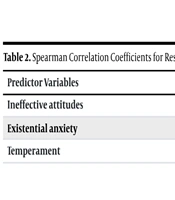
The results of the Spearman correlation coefficient calculations are presented in Table 2. All coefficients are confirmed at a 99% confidence level. Therefore, it can be stated that there is a direct and significant relationship between the research variables in pairs.
Table 2.
Spearman Correlation Coefficients for Research Variables
| Predictor Variables | Criterion Variable: Depression (N) | Status (P-Value Level) |
|---|---|---|
| Ineffective attitudes | 366 | 0.001 |
| Existential anxiety | 366 | 0.001 |
| Temperament | 366 | 0.001 |
As can be observed, the KMO values for all variables are above 0.60, and the significance level of Bartlett’s test is below 0.05. Therefore, it can be concluded that the research data are suitable for factor analysis (Table 3).
Table 3.
Results of Sample Adequacy Test
| Variables | KMO Index | Bartlett’s Test | P | |
|---|---|---|---|---|
| Approx. Chi-square | Degrees of Freedom | |||
| Ineffective attitudes | 0.871 | 5569.086 | 325 | 0.000 |
| Existential anxiety | 0.870 | 8101.002 | 496 | 0.000 |
| Temperament | 0.815 | 8609.785 | 741 | 0.000 |
| Depression | 0.872 | 3429.376 | 210 | 0.000 |
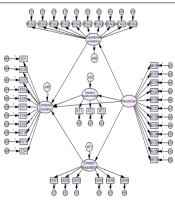
In path analysis, the path coefficients represent the standardized beta (β) in regression, the critical value indicates the t coefficient for each path, and the significance level reflects the reliability of the obtained values. The results of this analysis can be expressed in terms of direct effects, which examine the relationship between two variables, and indirect effects, which explore the relationship among more than two variables. The following sections will discuss these two components.
According to the results obtained in Table 4, the path coefficient for this hypothesis is positive, and its t-statistic is greater than the critical value (5.542 > 1.96). Therefore, it can be concluded that ineffective attitudes have a positive and significant impact on the depression of individuals exhibiting symptoms of Alzheimer’s disease. In other words, the higher the level of ineffective attitudes in individuals with Alzheimer’s symptoms, the greater their level of depression.
Table 4.
Results of Direct Path Analysis
| Paths | Path Coefficient | Critical Value | P | Result |
|---|---|---|---|---|
| Ineffective attitudes-depression | 0.343 | 5.542 | 0.000 | Confirmed |
| Existential anxiety-depression | 0.321 | 6.058 | 0.000 | Confirmed |
Based on the results in Table 5, the presence of an indirect effect between ineffective attitudes and depression suggests that the influence of independent variables on dependent variables is conditional and indirect. Thus, the mediating role of temperament in the relationship between ineffective attitudes and depression is confirmed, with an indirect effect size of 0.098. Consequently, it can be concluded that the influence of independent variables on dependent variables is also conditional and indirect. Therefore, the mediating role of temperament in the relationship between existential anxiety and depression is confirmed, with an indirect effect size of 0.142.
Table 5.
Results of Indirect Path Analysis a
| Independent Variables | Mediating Variables | Dependent Variables | Direct Effects | Indirect Effects | Total Effects | P |
|---|---|---|---|---|---|---|
| Ineffective attitudes | Temperament | Depression | 0.343 | 0.098 | 0.441 | 0.000 |
| Existential anxiety | Temperament | Depression | 0.321 | 0.142 | 0.463 | 0.000 |
a Mediating path.
5. Discussion
The aim of the present study was to determine the relationship between ineffective attitudes and existential anxiety with depression in individuals exhibiting symptoms of Alzheimer’s disease, with temperament as a mediating factor. Based on the first finding of this research, it was established that ineffective attitudes can predict depression in individuals with symptoms of Alzheimer’s disease. This finding is consistent with the results of studies by Ruthirakuhan et al. (21), Bozgeyik et al. (22), and Deyo et al. (23). For instance, Mousazadeh and Haji Alizadeh concluded in their research that traits such as neuroticism and extraversion could explain the depression of patients, suggesting that training and intervention aimed at improving personality traits are effective in reducing patients’ depression (24). In another study, Gonzalez Hernandez et al. found that depression is identified as a risk factor for the development of Alzheimer’s disease. Their results indicated that the association between depression and Alzheimer’s disease is stronger when individuals present with both depressive symptoms and either memory complaints or signs of mild cognitive impairment. These findings underscore the importance of considering depression as a risk factor in both the assessment and management of Alzheimer’s disease and may contribute to developing more effective preventive strategies and clinical interventions (25).
To explain this finding, it can be said that ineffective attitudes are, in fact, part of the maladaptive beliefs that, alongside automatic thoughts, influence an individual’s behavior within their cognitive system. These maladaptive beliefs are associated with negative predictions. Ineffective attitudes are those beliefs that predispose individuals to depression or overall psychological distress. These beliefs, acquired through experiences related to oneself and the world, prepare individuals to interpret specific situations in an excessively negative and maladaptive manner. From the perspective of ineffective attitudes, the criteria used for self-judgment and judgment of others are rigid and perfectionistic. Ineffective attitudes are stable personality traits that make individuals vulnerable to emotional disorders. They are composed of negative schemas about oneself, the world, and the future, referring to the negative cognitive triad (26). Furthermore, ineffective attitudes are cognitive vulnerabilities that remain hidden after emotional disorders improve, only to be reactivated by negative mood (27). Since these attitudes are inflexible, extreme, and resistant to change, they are deemed ineffective or unproductive. In fact, ineffective attitudes, which form the disruptive foundations of individuals, have two fundamental characteristics: First, they contain rigid, specific, and powerful expectations that are often expressed in terms like “must”, “have to”, “necessarily”, and “urgently”. Second, they lead to highly unreasonable attributions and excessive, catastrophic generalizations. Therefore, it can be concluded that these attitudes can lay the groundwork for various psychological problems, including depression.
Based on another finding of this research, it was established that existential anxiety can predict depression in individuals exhibiting symptoms of Alzheimer’s disease. The results of this hypothesis align with the theories and findings of studies by Botto et al. (28) and Moradi and Enferadand (29). No studies contradicting the results of this hypothesis were found. To explain this finding, it can be said that existential anxiety is one of the fundamental and contemplative concepts in existentialism; it is a basic and fundamental type of anxiety that can be a source of mental disorders, including pathological anxiety. In pathological anxiety, the individual feels worry, distress, and a sense of psychological insecurity and threat, attributing these feelings to an unclear source. However, in some individuals, it is this existential anxiety that causes their psychological insecurity and anxiety. Existential anxiety is a constructive type of normative anxiety and can serve as a stimulus for growth. We experience this anxiety when we become increasingly aware of our freedom and the consequences of accepting or rejecting it. In fact, when we make a decision that involves reconstructing our lives, the accompanying anxiety signifies that we are ready for change. If we learn to listen to the subtle messages of anxiety, we gain the courage to take the necessary steps to change our lives. Furthermore, studies by Ilieva et al. have also examined the impact of anxiety on the depression of Alzheimer’s patients, with their findings indicating that anxiety has a significant effect on the level of depression in these individuals (30). Thus, existential anxiety is more concerned with abstract concepts such as death, despair, alienation, and the meaninglessness of life. Consequently, existential anxiety lays the groundwork for various psychological problems, including depression.
It was also found that ineffective attitudes have an indirect effect on the depression of individuals with Alzheimer’s symptoms through temperament. This finding is consistent with the results of Kales and Gitlin (11). In terms of explanation, it can be noted that early in the twentieth century, specialists believed that specific temperaments were likely risk factors for psychological pathology. As research advanced, there was a significant consensus regarding the very important role of emotional temperaments in mental health; the unstable cyclothymic temperament is considered a predictor of type II bipolar disorders. One of the described types of temperament that is more related to bipolar disorder is cyclothymic, while another more prominent type is hyperthymic. Individuals with hyperthymic temperament exhibit milder stable features compared to their hypomanic symptoms: High energy, liveliness, fluency, humor, excessive optimism, unwarranted self-confidence, a high capacity for productive functioning, a busy schedule with short-sighted activities, a wide range of interests, versatility, impatience, sensitivity, intrusiveness, curiosity, and impulsive and risky behaviors (20).
Furthermore, it was found that existential anxiety has an indirect effect on the depression of individuals exhibiting symptoms of Alzheimer’s disease through temperament. One of the described types of temperament that is more related to bipolar disorder is cyclothymic, while another more prominent type is hyperthymic. Individuals with a hyperthymic temperament exhibit milder stable characteristics compared to their hypomanic symptoms: High energy, liveliness, fluency, humor, excessive optimism, unwarranted self-confidence, a high capacity for productive functioning, a busy schedule with short-sighted activities, a wide range of interests, versatility, impatience, sensitivity, intrusiveness, curiosity, and impulsive and risky behaviors (20). It is assumed that emotional temperaments and psychopathological traits (related to mental disorders) influence the clinical manifestation and episodes of bipolar disorder. However, their value for predicting outcomes still requires further research.
Based on the comprehensive findings of this study, it can be concluded that ineffective attitudes significantly contribute to the depression experienced by individuals exhibiting symptoms of Alzheimer’s disease. The positive path coefficient, coupled with a t-statistic that surpasses the critical value, underscores the robust relationship between these ineffective cognitive patterns and depressive symptoms. This suggests that as the prevalence of ineffective attitudes increases, so too does the severity of depression among this vulnerable population. Moreover, the analysis revealed an indirect effect of ineffective attitudes on depression through temperament, with a measured indirect effect of 0.098. This finding highlights the critical role of temperament as a mediating factor, suggesting that individuals with certain temperamental traits may be more susceptible to the negative impacts of ineffective attitudes, thereby exacerbating their depressive symptoms. Similarly, existential anxiety was also found to exert an indirect influence on depression through temperament, with an indirect effect size of 0.142. This suggests that existential concerns, such as the fear of loss of self and meaning in life, further complicate the emotional landscape for individuals with Alzheimer’s, influencing their overall mental health.
These results elucidate the intricate interplay between cognitive, emotional, and temperamental factors in the manifestation of depression among Alzheimer’s patients. They underscore the need for comprehensive therapeutic interventions that not only address ineffective attitudes and existential anxiety but also consider individual temperamental differences. Such an integrative approach could enhance the effectiveness of treatment strategies, ultimately improving the quality of life for individuals affected by Alzheimer’s disease. By acknowledging and addressing these multifaceted influences, mental health professionals can better tailor interventions to meet the unique needs of this population, fostering resilience and promoting emotional well-being.