
1. Background
The family is one of the most fundamental social institutions, and its health is commonly assessed through indicators such as marital satisfaction, commitment, intimacy, and the quality of interactions between spouses. Rising rates of family conflict and divorce in many countries, including Iran, have posed serious challenges to family and societal well-being. In this context, preventive interventions such as premarital education and counseling have attracted attention as relatively low-cost strategies aimed at empowering couples (1-3). Systematic and critical reviews have shown that couple education and counseling programs, especially when they are structured, multi-session, and grounded in specific theoretical frameworks, can improve communication skills, increase marital satisfaction, and partly prevent decline in relationship quality during the early years of marriage (1, 2). Longitudinal studies on newlywed couples have further demonstrated that receiving premarital education and counseling is associated with long-term outcomes such as greater readiness to seek professional help when problems arise and a slower decline in marital satisfaction over time (3, 4). Williamson et al. reported that couples who received premarital education were more likely to turn to counseling services in later years, which may play a protective role against relationship breakdown (3).
Beyond counseling per se, marital relationship quality is shaped by several internal constructs, including marital commitment, intimacy, and patterns of interaction between spouses. Marital commitment has been identified as one of the strongest predictors of relationship stability and is often conceptualized in the form of three components: Personal, moral, and structural commitment (5, 6). In the Adams and Jones model, marital commitment reflects a combination of the personal desire to remain in the relationship, a sense of moral obligation to marriage, and perceived constraints or costs of leaving the relationship, all of which are tightly linked to marital stability and continuity (5).
Marital intimacy is a multidimensional construct that encompasses emotional, cognitive, sexual, and spiritual closeness, and refers to the deep sharing of feelings, thoughts, and experiences between spouses (7). Numerous studies have demonstrated that lack of intimacy is associated with a wide range of adverse outcomes, including stress, marital dissatisfaction, severe conflict, and ultimately an increased likelihood of divorce, whereas enhancing intimacy through educational and therapeutic interventions can increase marital satisfaction and cohesion (7, 8).
Positive marital interactions (e.g., expressions of affection, active listening, collaborative problem-solving, and respectful feedback) are considered core mechanisms in process-oriented models of marriage. Longitudinal evidence suggests that constructive and positive communication patterns play a significant role in maintaining marital satisfaction and preventing relationship erosion, whereas an imbalance in favor of negative interactions (e.g., blame, contempt, withdrawal) is one of the strongest predictors of separation and divorce (1, 2, 9).
In Iran, premarital counseling has been formally institutionalized in recent years in the form of classroom-based education and counseling workshops for couples on the threshold of marriage. Several Iranian studies have examined the impact of these programs on marital satisfaction, communication skills, and sexual health, and generally support their short-term effectiveness, although the quality and content of such programs vary considerably across cities and centers (6, 10-12). However, most available studies have focused on newlyweds or couples about to marry, and there is limited information regarding how couples with several years of marital life perceive the effectiveness of previously received counseling and how this perception is related to current relationship indicators.
From a theoretical standpoint, one may expect that perceived effectiveness of premarital counseling as an early educational and therapeutic experience would, through improving communication skills, modifying dysfunctional beliefs, and increasing awareness of marital roles and expectations, be associated in the long run with higher levels of commitment, intimacy, and positive interactions (1-3, 5). Nevertheless, this relationship has been less frequently examined empirically in the Iranian cultural context and among couples who have been married for several years.
2. Objectives
The present study sought to address part of this gap by examining the role of perceived effectiveness of premarital counseling in predicting marital commitment, intimacy, and positive interactions among married couples residing in the city of Zahedan.
3. Methods
3.1. Study Design
This research was a cross-sectional correlational study conducted to investigate the association between perceived effectiveness of premarital counseling and marital commitment, intimacy, and positive interactions among couples. The study was carried out in 2025 (Iranian calendar year 1404) in the city of Zahedan, southeast Iran.
3.2. Population, Sample and Sampling Method
The study population consisted of all married couples living in Zahedan who had been married for at least three years. Given logistical constraints and the correlational nature of the study, participants were selected using convenience sampling. A total of 30 couples (60 individuals) who met the inclusion criteria and were willing to participate were enrolled in the study.
Sample size justification: An a priori estimate indicated that approximately 29 couples would be sufficient to detect a moderate correlation (r = 0.50) with 80% power at α = 0.05; therefore, 30 couples were targeted as a feasible sample for this exploratory correlational study.
3.3. Inclusion Criteria
- Being legally married and cohabiting with one’s spouse.
- At least three years have passed since marriage (to ensure relative stabilization of interaction patterns and relationship dynamics).
- Residence in Zahedan.
- Ability to read and write in Persian.
- Provision of informed consent to participate in the study.
3.4. Exclusion Criteria
- Self-reported severe psychiatric problems (e.g., psychosis or severe substance dependence) that would interfere with meaningful participation.
- Incomplete questionnaires to the extent that data could not be analyzed.
3.5. Instruments
3.5.1. Adams and Jones Marital Commitment Questionnaire
This questionnaire was developed by Adams and Jones (1997) based on an integrative model of marital commitment and assesses three dimensions: Personal, moral, and structural commitment (5). Higher scores indicate higher levels of marital commitment. The Persian version has been translated and validated by Iranian researchers, with satisfactory Cronbach’s alpha coefficients reported for the total scale and subscales (9). In the present study, the total commitment score was used.
3.5.2. Miller Marital Intimacy Scale
This scale assesses marital intimacy across emotional, cognitive, and behavioral dimensions through a set of Likert-type items. Higher scores indicate greater intimacy between spouses (7). The version used in the underlying thesis had previously been translated into Persian, with its face and content validity confirmed by a panel of experts, and its reliability reported as acceptable in an Iranian study.
3.5.3. Positive Marital Interactions Scale
In this study, positive interactions between spouses were operationalized as the score obtained on a Positive Marital Interactions Scale comprising items related to expressions of affection, constructive dialogue, emotional support, and joint problem-solving. Higher scores reflect greater frequency and quality of positive interactions in the marital relationship. The content validity of this instrument was confirmed by a panel of family counseling and psychology experts, and its reliability was found to be acceptable using Cronbach’s alpha. Item content was developed based on established marital interaction literature and relationship education frameworks (1, 2, 9).
3.5.4. Premarital Counseling Effectiveness Questionnaire
Perceived effectiveness of premarital counseling was assessed using a questionnaire developed and validated by Mohammadi (2011). This instrument evaluates several dimensions, including satisfaction with the counseling process, perceived usefulness of the content, applicability of the skills taught, and the extent to which couples use what they learned in their marital life. Higher scores indicate higher perceived effectiveness of premarital counseling. In this study, the total score was used as the main indicator of counseling effectiveness.
3.5.5. Demographic Information Form
This form collected data on age, gender, educational level, occupation, duration of marriage, number of children, and history of attending premarital counseling.
3.6. Validity and Reliability of Instruments
In the underlying thesis, the face and content validity of the instruments were confirmed by several faculty members in psychology and counseling. Reported Cronbach’s alpha coefficients for marital commitment, intimacy, positive interactions, and counseling effectiveness instruments were within acceptable ranges (above 0.70). In the present article, the same data and reliability indices were used; no new reliability analyses were conducted.
3.7. Procedures
After obtaining the necessary ethical and administrative approvals, eligible couples were identified by contacting counseling centers as well as through social networks and participant referrals (snowballing). Couples who met the inclusion criteria and expressed willingness to participate were provided with an explanation of the study objectives, and written informed consent was obtained. The questionnaires were then completed by both spouses via self-report. Completing the questionnaire set took approximately 20 – 30 minutes per couple. The researcher was present to provide clarifications in case of questions, while avoiding any influence on participants’ responses.
In Iran, couples typically receive routine premarital education/counseling before marriage. In this study, the item “history of premarital counseling” referred to attending additional premarital counseling sessions beyond the routine program; the counseling effectiveness questionnaire was completed by all participants based on their premarital education/counseling experience.
3.8. Ethical Considerations
In this study, all ethical principles were carefully observed. The research protocol was reviewed and approved by the institutional ethics committee (IR.IAU.ARDABIL.REC.1404.002). Before data collection, participants were provided with a clear explanation of the study objectives, and written informed consent was obtained from all of them. Confidentiality of information was strictly maintained, and data were analyzed only at the group level with no identifying details reported. Participants were also assured that they could withdraw from the study at any stage without any negative consequences.
3.9. Statistical Analysis
Data were coded and entered into SPSS (version 26) for analysis. First, descriptive statistics (means, standard deviations, frequencies, and percentages) were used to summarize demographic characteristics and study variables. Primary analyses were conducted at the couple level (n = 30 couples) by aggregating spouses’ scores. To examine associations between perceived effectiveness of premarital counseling and marital commitment, intimacy, and positive interactions, Pearson correlation coefficients were calculated. Subsequently, simple linear regression analyses were conducted to assess the association of counseling effectiveness with each outcome variable. Assumptions for Pearson correlation and linear regression (linearity, normality of residuals, and homoscedasticity) were checked and were generally met. A P-value < 0.05 was considered statistically significant in all analyses.
4. Results
4.1. Demographic Characteristics
A total of 30 married couples (60 individuals) participated in the study. The mean age of participants was 33.9 ± 5.39 years. Women and men each comprised 50% of the sample.
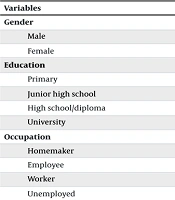
Regarding educational level, 6.7% had primary education, 20.0% junior high school, 60.0% high school/diploma, and 13.3% university education. In terms of employment status, 43.3% were homemakers, 40.0% employees, 6.7% workers, and 10.0% unemployed. The mean duration of marriage was 9.97 years. With respect to number of children, 30.0% had no children, 50.0% had one child, 13.3% had two children, and 6.7% had three children. In addition, 36.7% of couples reported a history of attending premarital counseling, whereas 63.3% did not (Table 1).
Table 1.
Demographic Characteristics of Participating Couples (n = 30 Couples) a
| Variables | No (%) |
|---|---|
| Gender | |
| Male | 30 (50.0) |
| Female | 30 (50.0) |
| Education | |
| Primary | 4 (6.7) |
| Junior high school | 6 (20.0) |
| High school/diploma | 18 (60.0) |
| University | 4 (13.3) |
| Occupation | |
| Homemaker | 13 (43.3) |
| Employee | 12 (40.0) |
| Worker | 2 (6.7) |
| Unemployed | 3 (10.0) |
| Number of children | |
| 0 | 9 (30.0) |
| 1 | 15 (50.0) |
| 2 | 4 (13.3) |
| 3 | 2 (6.7) |
| History of premarital counseling | |
| Yes | 11 (36.7) |
| No | 19 (63.3) |
a History of premarital counseling” indicates attendance at additional sessions beyond routine premarital education.
4.2. Descriptive Statistics of Main Variables
As shown in Table 2, mean scores for marital commitment, intimacy, and positive interactions were in the moderate-to-high range. The relatively large standard deviations indicate considerable variability in relationship quality among the participating couples.
Table 2.
Descriptive Indicators of Main Study Variables (n = 30 Couples) a
| Variables | Mean ± SD | Minimum-Maximum |
|---|---|---|
| Marital commitment | 27.70 ± 11.06 | 14 - 45 |
| Marital intimacy | 30.40 ± 11.98 | 18 - 48 |
| Positive marital interactions | 28.40 ± 10.30 | 16 - 47 |
| Premarital counseling effectiveness | 27.00 ± 10.91 | 17 - 44 |
a Higher scores indicate higher levels of each construct; total scores were computed by summing item responses.
4.3. Correlations Between Counseling Effectiveness and Outcome Variables
To test the correlational hypotheses, Pearson correlation coefficients were calculated between perceived effectiveness of premarital counseling and marital commitment, intimacy, and positive interactions. As shown in Table 3, perceived counseling effectiveness was positively and significantly correlated with all three marital variables. In other words, couples who perceived premarital counseling as more effective reported higher levels of commitment, intimacy, and positive interactions.
Table 3.
Pearson Correlations Between Premarital Counseling Effectiveness and Marital Variables (n = 30 Couples)
| Variables Pair | Correlation (r) | P-Value | 95% CI |
|---|---|---|---|
| Counseling effectiveness-marital commitment | 0.56 | 0.001 | 0.25 - 0.77 |
| Counseling effectiveness-marital intimacy | 0.62 | < 0.001 | 0.33 - 0.80 |
| Counseling effectiveness-positive marital interactions | 0.68 | < 0.001 | 0.42 - 0.84 |
4.4. Simple Linear Regression Models
To examine the association of counseling effectiveness with marital commitment, intimacy, and positive interactions, simple linear regression models were fitted with each marital variable as the dependent variable and counseling effectiveness as the independent variable.
As presented in Table 4, perceived effectiveness of premarital counseling was significantly associated with marital commitment, intimacy, and positive marital interactions, and accounted for 31%, 38%, and 46% of the variance in these variables, respectively (all P ≤ 0.001).
Table 4.
Simple Linear Regression Models of Association Between Counseling Effectiveness and Marital Variables (n = 30 couples)
| Dependent Variables | β | R² | P-Value | 95% CI (β) |
|---|---|---|---|---|
| Marital commitment | 0.56 | 0.31 | 0.001 | 0.25 - 0.77 |
| Marital intimacy | 0.62 | 0.38 | < 0.001 | 0.33 - 0.80 |
| Positive marital interactions | 0.68 | 0.46 | < 0.001 | 0.42 - 0.84 |
5. Discussion
This study aimed to examine the association between perceived effectiveness of premarital counseling and three key constructs: Marital commitment, intimacy, and positive interactions among couples in Zahedan. In summary, the findings indicated that: Because the study is cross-sectional, the findings should be interpreted as correlational associations rather than causal effects.
1. Perceived counseling effectiveness was positively and significantly correlated with marital commitment, intimacy, and positive interactions
2. Counseling effectiveness accounted for a considerable proportion (31 - 46%) of the variance in these three variables. These proportions reflect statistical association and should not be interpreted as causal effects.
The findings of the present study are consistent with international and Iranian evidence regarding the positive role of premarital educational and counseling interventions in marital relationship quality. Systematic reviews in the field of relationship education indicate that couple-based programs — particularly those focusing on communication skills, conflict resolution, emotion regulation, and realistic expectations — contribute to improved marital satisfaction and relationship stability (1, 2). Halford and Bodenmann showed that structured relationship education can help maintain marital satisfaction over long-term follow-up, especially among couples at risk due to factors such as economic stress or adverse childhood experiences (1). Similarly, Williamson et al. reported that experience of premarital education or counseling is associated with a greater likelihood of seeking professional help in response to marital conflicts later in the relationship (3).
In Islamic and Middle Eastern contexts, several studies have highlighted the role of premarital counseling workshops in enhancing marital satisfaction and improving relationship indicators (4, 6, 10). Our finding that perceived counseling effectiveness is associated with higher levels of commitment, intimacy, and positive interactions aligns with these results. A key distinction of the present study, however, is that rather than focusing solely on global marital satisfaction, it examined three more fundamental constructs: Commitment, intimacy, and behavioral interactions.
Regarding marital commitment, the tripartite model (personal, moral, and structural commitment) suggests that commitment, beyond satisfaction, plays a central role in marital stability (5, 6). Recent Iranian studies have shown that interventions such as Emotion-Focused Therapy (EFT) and positive psychology-based training can enhance both commitment and marital satisfaction among Iranian couples (8, 9). Our finding that perceived counseling effectiveness explains 31% of the variance in marital commitment supports the notion that preventive interventions can strengthen personal and moral commitment by clarifying values, beliefs, and expectations.
In the domain of marital intimacy, multiple studies have demonstrated that programs targeting communication and emotional skills increase closeness, mutual understanding, and trust between spouses. A systematic review of interventions to enhance marital intimacy reported generally positive effects on emotional and cognitive intimacy, although the durability of these effects over longer follow-ups remains to be fully established (7, 8). The present finding that perceived counseling effectiveness explains 36% of the variance in intimacy suggests that a high-quality premarital counseling experience may lay a foundation for enduring intimacy patterns in later years, particularly if sessions emphasize skills such as safe self-disclosure, empathy, and active listening.
With regard to positive marital interactions, evidence shows that educating couples in problem-solving, anger management, constructive feedback, and avoidance of contempt and criticism can shift the balance of positive/negative interactions in favor of positive behaviors, thereby strengthening marital satisfaction and stability (1, 2, 9). Our study found that perceived counseling effectiveness accounted for 42% of the variance in positive interactions, a larger proportion than for commitment and intimacy. This may suggest that the content of premarital counseling received by this sample placed relatively greater emphasis on behavioral and communication skills — that is, couples may more readily recall “how to interact” than deep-seated changes in attitudes or emotional experience. This is consistent with research indicating that communication skills are among the most immediate observable outcomes of couples’ education (1, 3)
5.1. Possible Explanations for the Findings
Several mechanisms may help explain the observed associations between counseling effectiveness and marital indicators.
- Enhancement of communication and problem-solving skills: Premarital counseling provides an opportunity to teach skills such as negotiation, emotional expression, active listening, and conflict resolution. These skills are directly linked to positive interactions and indirectly support intimacy and commitment.
- Correction of unrealistic marital beliefs and expectations: Many couples enter marriage with idealized or unrealistic expectations (e.g., expecting a conflict-free relationship). Counseling can help shift expectations toward more realistic views, thereby facilitating acceptance of responsibilities and strengthening personal and moral commitment (5, 6).
- Clarification of roles and responsibilities: Exploring spousal and parental roles, awareness of legal and religious rights and responsibilities, and discussing preferred family structures may enhance a sense of moral and structural commitment (6, 10)
- A “gateway” effect of counseling: Positive early experiences with counseling may foster favorable attitudes toward subsequent use of professional services. Couples who have such experiences may be more likely to seek help promptly when problems arise later, preventing the accumulation of unresolved conflicts (3)
5.2. Strengths and Contributions
Focus on three core constructs (commitment, intimacy, and positive interactions) rather than global marital satisfaction alone.
Examination of perceived premarital counseling effectiveness among couples who have been married for several years, rather than only those on the threshold of marriage.
Use of standardized and validated instruments to assess commitment and intimacy.
Combined use of correlational and regression analyses to examine both associations and predictive power.
5.3. Limitations
Despite its promising findings, this study has several important limitations that should be considered when interpreting the results
- Small sample size: A sample of 30 couples is insufficient to generalize the findings to the broader population of couples in Zahedan or Iran. With such a small sample, estimates of correlation and regression coefficients are susceptible to sampling error, and confidence intervals are relatively wide.
- Convenience sampling: Use of convenience sampling may introduce selection bias. For example, couples more interested in counseling topics or those with higher commitment may have been more likely to participate, potentially leading to overly optimistic estimates of relationships.
- Cross-sectional design: The cross-sectional nature of the study precludes causal inference. Although the analytic model assumes that counseling effectiveness affects commitment, intimacy, and positive interactions, reverse or bidirectional effects and the influence of unmeasured confounders (e.g., personality traits, religiosity, extended family support) cannot be ruled out.
- Self-report measures: All variables were assessed via self-report questionnaires, which are vulnerable to social desirability bias and recall errors — particularly regarding the perceived effectiveness of counseling that may have occurred years earlier.
- Limited information on counseling quality and content: The study measured only a global perception of counseling effectiveness and did not collect detailed data on theoretical orientation, duration, structure of sessions, or counselors’ qualifications. Thus, it is not possible to determine which types or components of counseling were most beneficial.
5.4. Implications for Practice and Future Research
Taking these limitations into account, the findings have several practical and research implications:
- For policymakers and family health authorities: The results underscore the need to strengthen the structural foundations of premarital counseling programs, standardize content, monitor implementation quality, and use evidence-based approaches.
- For family counselors and therapists: It is recommended that interventions and educational programs explicitly target the three domains of commitment, intimacy, and positive interactions as central axes of their work with couples.
- For future research: Longitudinal studies with larger samples, quasi-experimental or interventional designs, control of potential confounders, and the use of multi-informant and multi-method assessments (e.g., combining self-report with observational data or therapist ratings) are warranted. Comparative studies of different types of premarital counseling (e.g., religious, cognitive-behavioral, EFT-based) may also help identify the most effective components and approaches.
5.5. Conclusions
The present study demonstrated that perceived effectiveness of premarital counseling is associated with higher levels of marital commitment, intimacy, and positive interactions among married couples in Zahedan, and explains a substantial portion of the variance in these constructs. These findings suggest that premarital counseling — if well designed, evidence-based, and culturally tailored — can play a protective and strengthening role not only in the short term but also in subsequent years of marriage. Strengthening and continuously evaluating such programs may serve as an important strategy for promoting family health and reducing the individual and societal costs of divorce. Importantly, due to the cross-sectional correlational design, causal inference is not warranted.