
1. Background
Emotional divorce occurs when partners lack positive interactions, resulting in unmet emotional needs, sexual dissatisfaction, perceived physical unattractiveness, infidelity, financial difficulties, chronic illness, physical abuse, and other related problems. This condition often leads to anxiety, depression, guilt, despair, social withdrawal, and persistent negative thoughts about oneself, one’s partner, and the future (1).
Emotional divorce is prevalent among couples who choose to live together despite emotional detachment. This decision may be influenced by adherence to family traditions, irrational beliefs, social stigma surrounding divorced women, fear of loneliness, concerns about separation from children, or financial insecurity (2).
Cognitive distortions are thoughts that lead to inaccurate perceptions of reality due to exaggeration or irrationality (3). These distortions may contribute to the development or persistence of psychological conditions such as depression and anxiety (3). One study showed that repetitive negative thoughts, a form of cognitive distortion, were negatively correlated with post-divorce adjustment in women (4). Another study found that dysfunctional beliefs, resulting from cognitive distortions, adversely affected emotional divorce by mediating the effects of psychological variables, including thinking styles (5).
Communication is the exchange of messages to achieve marital goals. It enables couples to discuss and exchange information and to understand each other’s needs (6). Communication styles can predict emotional divorce among couples (7). One study found that constructive, avoidant, and expectant/withdrawal reciprocity mediated the relationship between differentiation and emotional divorce (8). Another study also reported significant differences in various aspects of communication patterns between couples undergoing divorce and those in stable, healthy relationships (9).
Early maladaptive schemas contribute to predicting emotional divorce in couples (10). These schemas are rooted in unmet emotional needs during childhood and adolescence. They are persistent, dysfunctional patterns that influence how individuals perceive themselves and others (11). Early experiences, particularly emotional deprivation or trauma, can give rise to schemas that compromise emotional intimacy and self-worth in adult relationships (12). Furthermore, early maladaptive schemas and emotional schemas have been associated with the emotional states of women pursuing divorce (13).
Despite the growing body of research on emotional divorce, most studies have focused on divorce in general. Previous studies have primarily described associations among variables related to emotional divorce, and few causal-comparative studies have been conducted in this area. Given the paucity of studies comparing early maladaptive schemas, communication patterns, and cognitive distortions between couples with and without emotional divorce, the present study examined differences between couples experiencing emotional divorce and those not experiencing it.
2. Objectives
This study was designed and conducted to identify differences in early maladaptive schemas, communication patterns, and cognitive distortions between couples with and without an emotional divorce.
3. Methods
3.1. Study Design and Participants
This study used a causal-comparative (ex post facto) design. It was considered causal-comparative because it compared three variables presumed to be affected by emotional divorce. The statistical population comprised couples who had experienced emotional divorce and couples who had not experienced emotional divorce, all of whom referred to psychological service centers in Mianeh County in 1403 and requested help.
Following the call for participation, 398 couples volunteered and completed the Gottman Emotional Divorce Questionnaire (14). Of these, 120 couples with emotional divorce scores above the cutoff point, including 60 couples with emotional divorce and 60 couples without emotional divorce, were selected purposively based on the inclusion criteria.
The inclusion criteria were being a couple, obtaining a score above 8 on the Gottman Emotional Divorce Questionnaire, providing informed consent to participate in the intervention, having no specific mental or physical illness, and not having an active divorce case in the judicial system. The exclusion criteria were unwillingness to continue cooperation and having an active divorce case in the judicial system.
To comply with research ethics principles, an ethics code was obtained for conducting the clinical research (IR.IAU.TABRIZ.REC.1403.267).
3.2. Research Instruments
3.2.1. Gottman Emotional Divorce Scale
The Gottman Emotional Divorce Scale consists of 24 items (14). In this scale, "yes" responses are scored as 1, whereas "no" responses are scored as 0. The total score ranges from 0 to 24. A higher number of "yes" responses indicates a greater likelihood of emotional divorce. The cutoff score is 8; individuals scoring above 8 are considered to be experiencing emotional divorce. The validity of the Gottman Emotional Divorce Scale was confirmed through factor analysis using the Varimax rotation method and the scree test, with a validity coefficient of 0.79 (14). In an Iranian sample, the scale validity was 0.93, and its reliability, assessed using Cronbach alpha, was 0.83 (15).
3.2.2. Revised Ritchie and Fitzpatrick Communication Patterns Questionnaire
The Revised Ritchie and Fitzpatrick Communication Patterns Questionnaire was developed in 1990 (16). This questionnaire consists of 26 items. Items 1 to 15 assess the conversational communication pattern, and items 16 to 26 assess the conformity communication pattern. The psychometric properties of the questionnaire have been reviewed and approved by its developers (16). The Cronbach alpha coefficients for the conversational and conformity subscales were 0.92 and 0.89, respectively.
3.2.3. Interpersonal Cognitive Distortion Scale
The Interpersonal Cognitive Distortion Scale was designed by Hamamci and Büyüköztürk in 2004 (17). This scale consists of 19 items and includes three subscales: rejection in interpersonal relationships, unrealistic expectations in relationships, and misunderstandings in interpersonal relationships. The validity of this test was satisfactory, and the overall reliability coefficient of the questionnaire was 0.816, based on Cronbach alpha (17). This test was translated into Persian and then administered to 60 male and female participants.
3.2.4. Young Schema Questionnaire-Revised
The Young and Baron Schema Questionnaire, created in 2001, is designed to assess early maladaptive schemas (18). A shorter version of this questionnaire was also developed to evaluate 15 early maladaptive schemas based on the original format. Each item is rated using a 6-point Likert scale. The reliability and validity of this instrument have been demonstrated in numerous studies (18). In Iran, the questionnaire was standardized and showed internal consistency, based on Cronbach alpha, of 0.97 in the female population and 0.98 in the male population (19).
In the present study, the level of analysis for the variables was general; therefore, the variables were analyzed as a whole rather than by subvariables.
4. Results
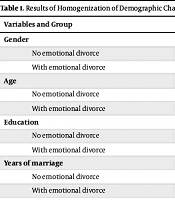
The couples in the present study were homogeneous with respect to demographic characteristics. Table 1 presents the results of demographic homogenization across the study samples.
Table 1.
Results of Homogenization of Demographic Characteristics of the Samples
| Variables and Group | Values a | Sig |
|---|---|---|
| Gender | 1 | |
| No emotional divorce | Man: 30; Woman: 30 | |
| With emotional divorce | Man: 30; Woman: 30 | |
| Age | 0.106 | |
| No emotional divorce | 34.40 ± 8.01 | |
| With emotional divorce | 32.86 ± 10.10 | |
| Education | 0.70 | |
| No emotional divorce | Elementary = 2; Guide = 6; Diploma = 9; Bachelor = 28; Higher = 15 | |
| With emotional divorce | Elementary = 3; Guide = 4; Diploma = 10; Bachelor = 28; Higher = 15 | |
| Years of marriage | 0.65 | |
| No emotional divorce | 10.32 ± 8.61 | |
| With emotional divorce | 11.09 ± 8.26 | |
| Number of children | 0.58 | |
| No emotional divorce | 51 ± 3.61 | |
| With emotional divorce | 53 ± 2.88 |
a Values are expressed as mean ± SD unless indicated.
Table 2 presents the means and standard deviations of the dimensions of the study variables.
Table 2.
Description of Research Variables
| Variables and Group | Mean ± SD | Min-Max |
|---|---|---|
| Early maladaptive schemas | ||
| Emotional deprivation | ||
| No emotional divorce | 12.8 ± 7.14 | 5 - 30 |
| With emotional divorce | 16.6 ± 23.8 | 5 - 30 |
| Abandonment | ||
| No emotional divorce | 12.18 ± 7.29 | 5 - 30 |
| With emotional divorce | 16.16 ± 7.24 | 5 - 28 |
| Mistrust/abuse | ||
| No emotional divorce | 10.14 ± 5.67 | 5 - 30 |
| With emotional divorce | 13.74 ± 6.56 | 5 - 30 |
| Social isolation | ||
| No emotional divorce | 9.36 ± 6.14 | 5 - 30 |
| With emotional divorce | 12.2 ± 6.85 | 5 - 26 |
| Defectiveness/shame | ||
| No emotional divorce | 7.80 ± 5.39 | 5 - 30 |
| With emotional divorce | 10.42 ± 6.37 | 5 - 30 |
| Failure | ||
| No emotional divorce | 9.62 ± 5.76 | 5 - 30 |
| With emotional divorce | 12.26 ± 7.24 | 5 - 30 |
| Dependence/incompetence | ||
| No emotional divorce | 7.48 ± 4.40 | 5 - 29 |
| With emotional divorce | 9.38 ± 5.67 | 5 - 30 |
| Vulnerability to harm or illness | ||
| No emotional divorce | 12.74 ± 7.34 | 5 - 30 |
| With emotional divorce | 15.98 ± 8.27 | 5 - 29 |
| Enmeshment/undeveloped self | ||
| No emotional divorce | 9.8 ± 5.49 | 5 - 30 |
| With emotional divorce | 10.52 ± 6.81 | 5 - 27 |
| Subjugation | ||
| No emotional divorce | 11.64 ± 5.48 | 5 - 30 |
| With emotional divorce | 13.08 ± 6.4 | 5 - 28 |
| Self-sacrifice | ||
| No emotional divorce | 18.46 ± 5.91 | 6 - 30 |
| With emotional divorce | 17.92 ± 5.99 | 7 - 30 |
| Emotional inhibition | ||
| No emotional divorce | 11.4 ± 5.98 | 5 - 30 |
| With emotional divorce | 12.94 ± 7.01 | 5 - 28 |
| Unrelenting standards | ||
| No emotional divorce | 16.8 ± 5.8 | 5 - 30 |
| With emotional divorce | 19.84 ± 5.84 | 9 - 29 |
| Entitlement/arrogance | ||
| No emotional divorce | 15.1 ± 5.19 | 6 - 29 |
| With emotional divorce | 18.18 ± 6.00 | 5 - 27 |
| Insufficient self-control/self-discipline | ||
| No emotional divorce | 12.46 ± 5.37 | 5 - 30 |
| With emotional divorce | 15.6 ± 5.5 | 5 - 25 |
| Communication patterns | ||
| Conformity | ||
| No emotional divorce | 35.4 ± 11.46 | 11 - 54 |
| With emotional divorce | 34.04 ± 13.24 | 11 - 55 |
| Conversational | ||
| No emotional divorce | 51.02 ± 14.54 | 16 - 73 |
| With emotional divorce | 43.08 ± 17.46 | 15 - 75 |
| Cognitive distortions | ||
| Unrealistic expectations in relationships | ||
| No emotional divorce | 23.08 ± 6.33 | 12 - 40 |
| With emotional divorce | 25.58 ± 5.32 | 12 - 34 |
| Rejection in interpersonal relationships | ||
| No emotional divorce | 22.5 ± 4.67 | 14 - 40 |
| With emotional divorce | 25.64 ± 5.23 | 13 - 34 |
| Interpersonal misunderstanding | ||
| No emotional divorce | 8.46 ± 2.73 | 3 - 15 |
| With emotional divorce | 8.78 ± 2.71 | 3 - 15 |
Before the multivariate analysis of variance, all assumptions were assessed and found to be satisfactory. These assumptions included data normality assessed using the Kolmogorov-Smirnov test (Early Maladaptive Schemas: statistic = 1.092, sig = 0.184; Communication Patterns: statistic = 0.687, sig = 0.733; Cognitive Distortions: statistic = 0.541, sig = 0.932), homogeneity of variance-covariance matrices assessed using Box's test (Box's M = 241.427; F = 11.36; sig = 0.112), and homogeneity of variances assessed using Levene's test (Maladaptive Schemas: Levene statistic = 3.62, sig = 0.06; Communication Patterns: Levene statistic = 3.149, sig = 0.79; Cognitive Distortions: Levene statistic = 0.712, sig = 0.401). Table 3 presents the results of the multivariate analysis of variance conducted in the present study.
Table 3.
Results of the Multivariate Analysis of Variance
| Test | Value | F | Sig | df | Effect Size |
|---|---|---|---|---|---|
| Wilks' Lambda | 0.703 | 2/368 | 0/007 | 20 | 0.297 |
Based on the results in Table 3, at least one criterion variable differed significantly between the two groups. To examine differences in the dimensions of the variables between the study groups, a between-subjects effects test was conducted. The results are presented in Table 4.
Table 4.
Results of the Between-Subjects Effects Test
| Variables | SS | df | MS | F | Sig | η |
|---|---|---|---|---|---|---|
| Emotional deprivation | 361 | 1 | 361 | 6.077 | 0.015 | 0.058 |
| Abandonment | 396/01 | 1 | 396/01 | 7.498 | 0.007 | 0.071 |
| Mistrust/abuse | 324 | 1 | 324 | 8.61 | 0.004 | 0.081 |
| Social isolation | 201/64 | 1 | 201/64 | 4.767 | 0.031 | 0.046 |
| Defectiveness/shame | 171/61 | 1 | 171/61 | 4.926 | 0.029 | 0.048 |
| Failure | 174/24 | 1 | 174/24 | 4.074 | 0.046 | 0.040 |
| Dependence/incompetence | 90/25 | 1 | 90/25 | 3.498 | 0.064 | 0.034 |
| Vulnerability to harm or illness | 262/64 | 1 | 262/64 | 4.282 | 0.041 | 0.042 |
| Enmeshment/undeveloped self | 12/96 | 1 | 12/96 | 0.338 | 0.562 | 0.003 |
| Subjugation | 51/84 | 1 | 51/84 | 1.46 | 0.230 | 0.015 |
| Self-sacrifice | 7/29 | 1 | 7/29 | 0.206 | 0.651 | 0.002 |
| Emotional inhibition | 59/59 | 1 | 59/59 | 1.396 | 0.240 | 0.014 |
| Unrelenting standards | 231/04 | 1 | 231/04 | 6.814 | 0.010 | 0.065 |
| Entitlement/arrogance | 237/16 | 1 | 237/16 | 7.546 | 0.007 | 0.071 |
| Insufficient self-control/self-discipline | 246/49 | 1 | 246/49 | 8.351 | 0.005 | 0.079 |
| Conformity | 605/16 | 1 | 605/16 | 4.872 | 0.030 | 0.047 |
| Conversational | 1576/09 | 1 | 1576/09 | 6.105 | 0.015 | 0.059 |
| Unrealistic expectations in relationships | 156/25 | 1 | 156/25 | 4.574 | 0.035 | 0.045 |
| Rejection in interpersonal relationships | 246/49 | 1 | 246/49 | 10.031 | 0.002 | 0.093 |
| Interpersonal misunderstanding | 2/560 | 1 | 2/560 | 0.345 | 0.558 | 0.004 |
Based on the results in Table 4, the dimensions of abandonment, mistrust/abuse, social isolation, defectiveness/shame, failure, vulnerability to harm or illness, unrelenting standards, entitlement/arrogance, and insufficient self-control/self-discipline from early maladaptive schemas; conformity and conversational patterns from communication patterns; and unrealistic expectations in relationships and rejection in interpersonal relationships from cognitive distortions differed between couples with and without emotional divorce. Couples with emotional divorce showed poorer conditions across all these dimensions. Higher conformity and conversational skills are considered positive variables for couples.
5. Discussion
This study aimed to examine differences in early maladaptive schemas, communication patterns, and cognitive distortions between couples with and without emotional divorce. The results indicated that couples with emotional divorce had higher scores for unrealistic expectations in relationships and rejection in interpersonal relationships than couples without emotional divorce. This finding is consistent with previous research in this area (4, 5). Direct paths from dysfunctional beliefs to emotional divorce have also been reported to be statistically significant (5). Given the substantial emotional basis of emotional divorce, previous findings have shown that lower emotional dysregulation and repetitive negative thoughts, along with a higher sense of self-continuity, were correlated with improved post-divorce adjustment in women (4). In fact, moving away from an undesirable marital life, of which emotional divorce is a clear symbol, can significantly reduce the emotional tension associated with this problem. Cognitive distortions can create a basis for emotional distance between couples. Ultimately, cognitive distortions in a relationship can contribute to emotional distance and emotional divorce between partners.
The findings showed that the conformity and conversational dimensions of communication patterns were more unfavorable in couples with emotional divorce than in couples without emotional divorce. Couples with emotional divorce had lower conformity and conversational scores. Higher conformity and conversational skills are considered positive variables for couples. This finding is consistent with previous findings in this area (7-9). Emotional divorce is negatively correlated with a compatible motivational structure and communication pattern but positively correlated with an incompatible motivational structure and a conformity pattern (7). One study also showed that communication patterns mediated the relationship between differentiation and emotional divorce (8). Ultimately, this may lead couples to actual divorce, as one study found significant differences in communication patterns between divorce-seeking couples and couples in stable, healthy relationships (9). Communication patterns characterized by reduced dialogue and lower empathy may provide a basis for emotional tension and an unwillingness to resume productive exchanges, ultimately leading to emotional divorce between couples.
The results also indicated differences in some dimensions of early maladaptive schemas between couples with and without emotional divorce. Couples with emotional divorce had higher scores in some dimensions of early maladaptive schemas than couples without emotional divorce. This finding is consistent with the limited evidence in this area (10, 13). Research indicates a strong positive correlation between emotional divorce and early maladaptive schemas. By identifying and challenging these schemas, couples can improve intimacy and marital satisfaction, thereby reducing the likelihood of emotional divorce (10). There is also a connection between early maladaptive schemas and emotional schemas in relation to the emotional states of women seeking divorce (13). Early maladaptive schemas, as thought patterns, can shape emotional exchanges between couples and shift the relationship toward emotional divorce and separation.
Despite its important findings, the present study had several limitations. The causal-comparative method cannot establish true cause-and-effect relationships between variables and relies on assumed causes. In addition, random selection was not possible for several reasons, and purposive sampling cannot provide the generalizability associated with random sampling. Accordingly, longitudinal studies and random sampling in other communities may help address these limitations.