Cover image of the article: Investigation of the Correlation Between FTIR Spectral Characteristics and Antimicrobial Activity (MIC) of Neem (Azadirachta indica) Extracts Obtained by Different Extraction Methods

Image Credit:Zahedan J Res Med Sci

Investigation of the Correlation Between FTIR Spectral Characteristics and Antimicrobial Activity (MIC) of Neem (Azadirachta indica) Extracts Obtained by Different Extraction Methods

Authors

Mohammad Javad Abghary1, Marziye Rezaei2,*

Abstract

Background:

Neem (Azadirachta indica) contains diverse bioactive compounds with established antimicrobial properties, and the efficiency of extracting these compounds depends strongly on the solvent polarity.

Objectives:

This study aimed to investigate the correlation between Fourier-transform infrared (FTIR) spectral characteristics and antimicrobial activity, specifically the minimum inhibitory concentration (MIC), of neem extracts obtained using different extraction solvents.

Methods:

Neem samples were collected from the Sistan and Baluchestan region, shade-dried, and extracted using different solvents, including ethanol and acetone. Antimicrobial activity against Staphylococcus aureus strains was assessed, and the MIC and minimum bactericidal concentration (MBC) values were determined using the microdilution method. Chemical functional groups were analyzed by FTIR spectroscopy.

Results:

FTIR analysis identified key functional groups, including hydroxyl (-OH) and carbonyl (C=O) groups. A strong correlation was observed between the intensities of these peaks and antimicrobial potency. The acetone extract exhibited the highest antibacterial activity and showed greater absorption intensity at specific FTIR wavenumbers.

Conclusions:

Neem antimicrobial activity may be associated with bioactive compounds such as tannins, flavonoids, and terpenoids. These findings indicate that the extraction solvent influences the yield of these compounds and, consequently, antimicrobial efficacy.

How to Cite:Abghary MJ, Rezaei M. Investigation of the Correlation Between FTIR Spectral Characteristics and Antimicrobial Activity (MIC) of Neem (Azadirachta indica) Extracts Obtained by Different Extraction Methods. Zahedan J Res Med Sci. 2026;28(4):e170065. doi: https://doi.org/10.5812/zjrms-170065

1. Background

Neem (Azadirachta indica A. Juss.), a tropical evergreen tree in the Meliaceae family, is widely recognized in traditional medicine for its pharmacological properties (1, 2). Native to the Indian subcontinent and naturally distributed in the warm regions of southern and southeastern Iran, neem contains a diverse range of secondary metabolites, including glycosides, coumarins, tannins, azadirachtin, nimbin, and various polyphenolic compounds (3, 4).
Various parts of the neem tree, including the leaves, bark, and fruit, are used to treat conditions such as diabetes, hypertension, and certain types of cancer (5). Recently, interest has grown in using plant-derived essential oils and extracts as alternatives to synthetic antimicrobial agents because of their antifungal and antibacterial properties (6). Tannins, which are high-molecular-weight phenolic compounds, contribute importantly to this activity by binding to proteins and microbial cell-wall components, thereby inhibiting microbial growth (7).
The efficiency of extracting these bioactive compounds depends strongly on the polarity of the solvent used (8). Therefore, identifying an optimal solvent is important for maximizing antimicrobial activity.

2. Objectives

This study aimed to evaluate the correlation between the FTIR spectral characteristics and the MIC of neem extracts to establish a rapid, nondestructive method for predicting antimicrobial potency.

3. Methods

3.1. Plant Preparation and Extraction

Neem leaves were collected from the Sistan and Baluchestan region, washed with distilled water, and shade-dried. The samples were then dried in an oven at 50°C for 24 hours, powdered, and stored at -80°C. The powder was mixed with solvents (eg, ethanol and acetone) at a 1:10 ratio (10 g of sample per 100 mL of solvent) and processed in an ultrasonic bath (Kodo2040, Japan) for 20 minutes. The suspension was homogenized on a shaker (SK-0180-Pro, USA) at 200 rpm for 24 hours at room temperature. After centrifugation at 3500 g for 35 minutes (5810, Germany), the supernatant was filtered through a 0.45-µm Whatman filter and concentrated using a rotary evaporator at 70°C and 120 rpm.

3.2. Antimicrobial Activity Assay

Mueller-Hinton broth (MHB) and Mueller-Hinton agar (MHA) were prepared according to standard protocols and sterilized by autoclaving at 121°C for 35 minutes. Ten strains of Staphylococcus aureus were isolated from native sheep in the Sistan region and cultured on blood agar. The MIC and MBC were determined using the microdilution method.

3.3. FTIR Spectroscopic Analysis

The chemical functional groups of the extracts were analyzed using an FTIR spectrometer. Spectra were recorded over the range of 4000 to 1000 cm-1, and shifts in peak positions and intensities were compared among extracts to assess correlations with antimicrobial activity.

4. Results

4.1. Antimicrobial Activity

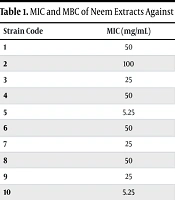
The extracts exhibited inhibitory activity against S. aureus. The lowest MIC was 5.25 mg/mL for two strains, whereas the highest MIC was 100 mg/mL for one strain (Table 1).
Table 1.
MIC and MBC of Neem Extracts Against S. Aureus Strains
Strain CodeMIC (mg/mL)MBC (mg/mL)
150100
2100200
32550
450100
55.2510.5
650100
72550
850100
92550
105.2510.5

4.2. FTIR Analysis

The FTIR spectra of the extracts showed prominent peaks in the 3000 - 3500 cm-1 region, corresponding to hydroxyl (-OH) groups. A decrease in wavenumber and changes in peak intensity were observed across different solvents, suggesting differences in the concentration of phenolic compounds. Peaks in the 1600 - 1700 cm-1 region were attributed to carbonyl (C=O) groups. The intensity of these peaks correlated positively with antimicrobial activity, with the acetone extract showing the strongest absorption.

5. Discussion

The results of this study confirm the antimicrobial activity of neem extracts against S. aureus. This activity is primarily attributed to tannins and phenolic compounds, which disrupt the microbial cell membrane. Specifically, compounds such as nimbidin and nimbin increase membrane permeability, leading to leakage of cytoplasmic contents and cell death (9, 10).
The correlation between FTIR peaks, specifically the -OH and C=O groups, and MIC values suggests that these functional groups may be important in the antimicrobial mechanism. This finding is consistent with previous research showing that hydroxyl groups are associated with stronger inhibition of bacterial growth (11). Furthermore, our results indicate that acetone is a more efficient solvent than the other tested solvents for extracting these bioactive phenolic compounds, resulting in lower MIC values.
Inhibition of vital enzymes, such as ATPase and DNA gyrase, by azadirachtin and quercetin may further explain the bactericidal effect observed in this study (12). Overall, the combined use of FTIR and antimicrobial assays provides a useful approach for the rapid screening of medicinal plant extracts.
In a study investigating the antimicrobial activity of several medicinal plants against standard bacteria, F. subpinnata inhibited S. dysenteriae, with an inhibition-zone diameter of 6 mm (13).
Saeidi et al. reported that P. harmala and M. comminus L. extracts showed strong antimicrobial activity against S. aureus, Escherichia coli, and Enterobacter cloacae (14).
A study investigating the antimicrobial activity of plants collected from the Sistan region reported that the lowest inhibitory concentration of pecan extract against Vibrio cholerae was 3.1 ppm and the highest inhibitory concentration was 6.25 ppm (15).
In a study investigating the effects of Mentha piperita and Zataria multiflora essential oils, the minimum and maximum inhibitory concentrations required to inhibit Pseudomonas aeruginosa were 1.25 and 5 mg/mL, respectively (16).
In a study investigating the antimicrobial properties of several extracts against standard bacterial strains, P. nigrum and C. cyminum L. showed inhibitory activity against the Gram-positive bacterium Bacillus cereus and the Gram-negative bacteria Proteus mirabilis, Serratia marcescens, Pseudomonas aeruginosa, and Enterobacter cloacae (17).

5.1. Conclusions

This study demonstrates that neem extracts exhibit antimicrobial activity against S. aureus. The correlation between FTIR spectral intensity and MIC values highlights the potential importance of phenolic and carbonyl groups in the plant’s bioactivity. These findings support further investigation of neem extracts for the development of antimicrobial agents against S. aureus infections.
Footnotes

  • AI Use Disclosure:The authors declare that no generative AI tools were used in the creation of this article.

  • Authors' Contribution:Study Concept and Design: M. R.; Analysis and Interpretation of Data: M. J. A.

  • Conflict of Interests Statement:The authors declare no conflict of interest.

  • Data Availability:The dataset presented in the study is available on request from the corresponding author during submission or after publication.

  • Ethical Approval:uoz1395.5.

  • Funding/Support:No funding was received for this study.

References

  • 1.
    Deng Y, Shi D, Yin Z, Guo J, Jia R, Xu J, et al. Acaricidal activity of petroleum ether extract of neem (Azadirachta indica) oil and its four fractions separated by column chromatography against Sarcoptes scabiei var. cniculi larvae in vitro. Experimental Parasitology. 2012;130(4):475-477. [PubMed ID: 22349080]. https://doi.org/10.1016/j.exppara.2012.02.007.
  • 2.
    Aneesa N, Gayathri R. Beneficial effects of neem oil-an updated review. J Pharm Sci Res. 2016;8(8):756-758.
  • 3.
    Mondali, N.k, Mojumdar, A, Chatterje, S.k, et al. and Gupta, S. 2009.
  • 4.
    Mondali, N.k, Mojumdar, A, Chatterje, S.k, et al. and Gupta, S. 2009.
  • 5.
    Islas JF, Acosta E, G-Buentello Z, Delgado-Gallegos JL, Moreno-Treviño MG, Escalante B, et al. An overview of neem (Azadirachta indica) and its potential impact on health. Journal of Functional Foods. 2020;74. 104171. [PubMed Central ID: PMC8118514]. https://doi.org/10.1016/j.jff.2020.104171.
  • 6.
    Khaledi N, Hassani F. Antifungal activity of Bunium persicum essential oil and its constituents on growth and pathogenesis of Colletotrichum lindemuthianum. J Plant Prot Res. 2018;58(4):431-441. https://doi.org/10.24425/jppr.2018.124646.
  • 7.
    Scalbert A. Antimicrobial properties of tannins. Phytochemistry. 1991;30(12):3875-3883. https://doi.org/10.1016/0031-9422(91)83426-L.
  • 8.
    Eloff JN. Which extractant should be used for the screening and isolation of antimicrobial components from plants? J Ethnopharmacol. 1998;60(1):1-8. [PubMed ID: 9533426]. https://doi.org/10.1016/S0378-8741(97)00123-2.
  • 9.
    Biswas K, Chattopadhyay I, Banerjee RK, Bandyopadhyay U. Biological activities and medicinal properties of neem. Curr Sci. 2002;82(11):1336-1345.
  • 10.
    Rao AR, Sreeramulu SH, Reddy P. Antibacterial activity of neem against clinical isolates of bacteria. J Pharm Sci Res. 2011;3(11):1520-1522.
  • 11.
    Kumar S. Phytochemical analysis and antimicrobial activity of neem extracts. Journal of Medicinal Plants Research. 2020;14(3):123-135.
  • 12.
    Alzohairy MA. Therapeutics role of Azadirachta indica (Neem) and their active constituents in diseases prevention and treatment. Evid Based Complement Alternat Med. 2016;2016(1). 7382506. [PubMed ID: 27034694]. [PubMed Central ID: PMC4791507]. https://doi.org/10.1155/2016/7382506.
  • 13.
    Fazeli-Nasab B, Malayeri FA, Rouhani R, Saeidi S. The Investigation of the Antibacterial Activity of Eryngium caucasicum trautv, Saponaria officinalis, Froriepia subpinnata, Malva sylvestris, and Urtica dioica. Gene Cell Tissue. 2023;10(4). e131435. https://doi.org/10.5812/gct-131435.
  • 14.
    Saeidi S, Shiri Y, Solouki M. Activity of some Iranian plant extracts against multi-drug resistant human pathogens isolated from urinary tract infections. Zahedan J Res Med Sci. 2014;16(10):50-54.
  • 15.
    Mashhady MA, Fakheri BA, Saeidi S, Hassanshahian M, Abkhoo J. Antimicrobial effects of medicinal plants collected in Zabol, Iran, on pathogenic food pathogenic bacteria. J Med Bacteriol. 2016;5(3 - 4):41-44.
  • 16.
    Saeidi S, Mohsenbeygi M, Roustakhiz J, Javadian F, Hassanshahian M. Antimicrobial and anti-biofilm effects of Mentha piperita and Zataria multiflora on pathogenic bacteria. J Med Bacteriol. 2019;8(1 - 2):37-44.
  • 17.
    Saeidi S, Shojaei P, Bazi S, Sanadgol N. Antibacterial activity of some Iranian medicinal plants against important human pathogens. Asian Journal of Biological Sciences. 2013;6(7):331-339. https://doi.org/10.3923/ajbs.2013.331.339.

Copyright

Copyright © 2026, Abghary and Rezaei. This open-access article is available under the Creative Commons Attribution 4.0 (CC BY 4.0) International License (https://creativecommons.org/licenses/by/4.0/), which allows for unrestricted use, distribution, and reproduction in any medium, provided that the original work is properly cited.

Similar Articles

30
Aug
2016
Preparation and Characterization of Pullulan-Soy Protein Concentrate Blended Film Incorporated With Zataria multiflora and Artemisia biennis Essential Oils

Preparation and Characterization of Pullulan-Soy Protein Concentrate Blended Film Incorporated With Zataria multiflora and Artemisia biennis Essential Oils

Fatemeh Hedayati Rad,
Anousheh Sharifan,
Faramarz Khodaiyan,
Iman Shahabi Ghahfarrokhi

Hedayati Rad F, Sharifan A, Khodaiyan F, Shahabi Ghahfarrokhi I. Preparation and Characterization of Pullulan-Soy Protein Concentrate Blended Film Incorporated With Zataria multiflora and Artemisia biennis Essential Oils. Jundishapur J Nat Pharm Prod. 2017;12(4):e37802. doi: https://doi.org/10.5812/jjnpp.37802

4
Jan
2012
Antimicrobial Activity and Chemical Composition of Essential Oil From the Seeds of Artemisia aucheri Boiss

Antimicrobial Activity and Chemical Composition of Essential Oil From the Seeds of Artemisia aucheri Boiss

Gholamreza Asghari,
Mohamad Jalali,
Ehsan Sadoughi

Asghari G, Jalali M, Sadoughi E. Antimicrobial Activity and Chemical Composition of Essential Oil From the Seeds of Artemisia aucheri Boiss. Jundishapur J Nat Pharm Prod. 2012;7(1):11-15. doi: https://doi.org/10.17795/jjnpp-3530

5
Oct
2017
Evaluation of Antimicrobial Activity of Essential Oil of Eshvark (Rhazya stricta) Against Two Strains of Staphylococcus aureus and Listeria monocytogenes

Evaluation of Antimicrobial Activity of Essential Oil of Eshvark (Rhazya stricta) Against Two Strains of Staphylococcus aureus and Listeria monocytogenes

Mehrdad Asadian,
Hemadollah Zarei,
Barat Ali Fakheri,
Leyla Fahmideh

Asadian M, Zarei H, Fakheri BA, Fahmideh L. Evaluation of Antimicrobial Activity of Essential Oil of Eshvark (Rhazya stricta) Against Two Strains of Staphylococcus aureus and Listeria monocytogenes. Int J Infect. 2017;4(4):e61912. doi: https://doi.org/10.5812/iji.61912

12
Aug
2025
Comparison of the Essential Oil and the Purified Thymoquinone in Different Varieties of Nigella sativa L. Cultivated in the Different Regions of Iran and Investigation of Their Antibacterial Activity

Comparison of the Essential Oil and the Purified Thymoquinone in Different Varieties of Nigella sativa L. Cultivated in the Different Regions of Iran and Investigation of Their Antibacterial Activity

Ashkan Hajinourmohammadi,
Jamil Zargan,
Mir-Morteza Sadat Ebrahimi

Hajinourmohammadi A, Zargan J, Sadat Ebrahimi M. Comparison of the Essential Oil and the Purified Thymoquinone in Different Varieties of Nigella sativa L. Cultivated in the Different Regions of Iran and Investigation of Their Antibacterial Activity. Koomesh. 2025;27(4):e149278. doi: https://doi.org/10.69107/koomesh-149278

26
Jul
2022
Characteristics and Antibacterial Effect of Chitosan Coating Nanoemulsion Containing Zataria multiflora and Bunium persicum Essential Oils Against Listeria monocytogenes

Characteristics and Antibacterial Effect of Chitosan Coating Nanoemulsion Containing Zataria multiflora and Bunium persicum Essential Oils Against Listeria monocytogenes

Mohammad Hashemi,
Zakieh Baluchi Zehi,
Saeid Khanzadi,
Mitra Rezaie,
Seyyed Mohammad Ali Noori,
Asma Afshari

Hashemi M, Baluchi Zehi Z, Khanzadi S, Rezaie M, Noori SMA, et al. Characteristics and Antibacterial Effect of Chitosan Coating Nanoemulsion Containing Zataria multiflora and Bunium persicum Essential Oils Against Listeria monocytogenes. Jundishapur J Nat Pharm Prod. 2022;17(4):e120819. doi: https://doi.org/10.5812/jjnpp-120819

More by these authors

Mohammad Javad AbgharyPubMedScholar
Marziye RezaeiPubMedScholar
Share
Cited by
Metrics