
1. Background
Hematuria is defined as the presence of more than five red blood cells in each microscopic field of a non-centrifuged midstream urine sample (1, 2).
Hematuria is classified as macroscopic or microscopic. Macroscopic hematuria refers to visible blood in the urine, whereas microscopic hematuria is detected by urinalysis or microscopic examination, with more than five red blood cells in the field of view at 1000x magnification (3, 4). Hematuria originating from the lower urinary tract may appear red or pink because of hemoglobin oxidation in red blood cells; with greater oxidation, it may appear brown (3, 4).
Under normal physiological conditions, the glomerular filtration barrier prevents blood from entering the renal collecting system, making hematuria rare. If this barrier is disrupted, red blood cells may pass through the glomerular basement membrane into the urine collecting system (4). Microscopic hematuria can have various causes, including glomerulonephritis, interstitial nephritis, Alport syndrome, and infections such as cystitis, prostatitis, pyelonephritis, or kidney stones (5, 6).
In children, factors such as exercise, inflammation, structural disorders, malignancy, trauma, infections, blood disorders such as sickle cell anemia, and congenital renal malformations can contribute to hematuria. Comprehensive assessment, including a detailed history, physical examination, blood-test parameters related to hematuria, urinalysis, and radiological evaluation, is effective for accurate diagnosis and identification of the underlying pathology (7). Various imaging modalities, including kidney, ureter, and bladder radiography, intravenous pyelography (IVP), computed tomography (CT), ultrasound, and magnetic resonance imaging (MRI), can be used to evaluate hematuria. Radiological evaluation combined with cystoscopy is useful for examining the bladder and lower urinary tract for bleeding lesions; however, the imaging techniques studied are not completely satisfactory for ruling out pathology in these organs (8). At the time of cystoscopy, bilateral retrograde pyelography, in which iodinated contrast is injected through catheters placed in the ureters during cystoscopy and plain radiographs are obtained, may also be performed and is often used to evaluate upper urinary tract pathology (7).
There is no universal agreement on the optimal imaging approach for hematuria. Traditionally, IVP has been considered the standard method (7, 9, 10); however, it was developed before the availability of high-resolution ultrasound, CT, and MRI. More recently, multidetector CT, in which each rotation of the radiographic beam produces multiple sets of images rather than a single image, has become routine for evaluation. It provides cross-sectional images and can be reformatted to show the urinary tract in a manner similar to IVP (11). Because CT uses ionizing radiation, and because pediatric patients may require repeated CT examinations, this modality has a limited role as the first imaging intervention (11). Similarly, MRI can be used to detect urinary tract abnormalities, but its utility is limited by cost and insufficient supporting data (11).
Ultrasound is the first imaging modality used for patients with hematuria (12-14). Ultrasound has high sensitivity for detecting various pathologies, including urinary tract neoplasms and stones, inflammatory processes, congenital anomalies, vascular lesions, and obstructive causes (15) (Figure 1). However, ultrasound has diagnostic limitations in detecting stones or pathological lesions in the ureters. Urography with nephrotomography may also miss small exophytic masses in the anterior and posterior kidneys and small bladder masses (16, 17). The choice of imaging modality may be influenced by the clinical situation. For example, positive urine cytology may make urography very important, whereas serious risk factors for contrast reactions may make ultrasound more appropriate. When ultrasound is negative and the source of hematuria remains unclear, urography should be added. If urography is negative, CT may be indicated (10, 17, 18). When ultrasound is used as the initial screening modality, imaging yield may be increased by adding a plain abdominal film.
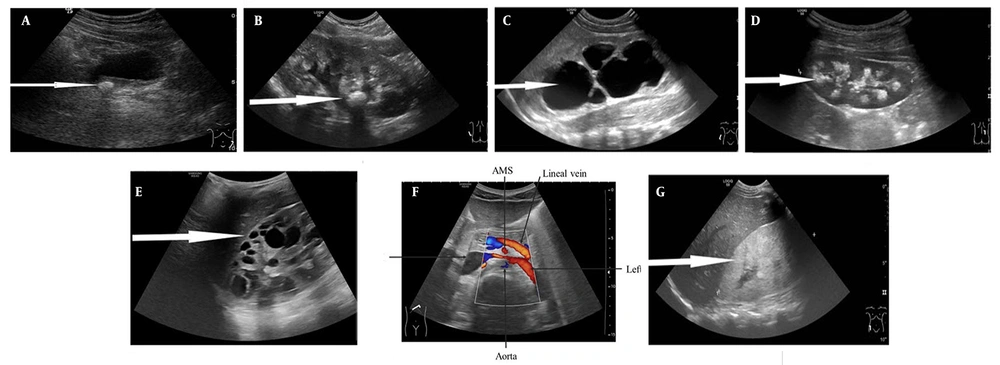
Figure 1.
Typical ultrasound images in the setting of hematuria in childhood (adapted from Horváth et al., Pediatric Nephrology, 2023, with permission). A, Juxtavesical ureteral stone with acoustic shadowing (arrow). B, Nephrolithiasis (arrow: kidney stone). C, Hydronephrosis due to pyeloureteral stenosis (arrow: enlarged pyelon). D, Nephrocalcinosis (arrow: deposition of calcium salts in the papillae of the kidney). E, Autosomal dominant polycystic kidney disease (ADPKD) (arrow: typical cysts in ADPKD). F, Nutcracker syndrome, defined as extrinsic compression of the left renal vein by the superior mesenteric artery and aorta (arrows: AMS, superior mesenteric artery; VCI, inferior vena cava). G, Increased kidney size and inhomogeneous parenchymal hyperechogenicity, including areas of the cortex and medulla, in nephrotic syndrome (arrow: hyperechogenic kidney) (13).
Ultrasound has an important role in children and pregnant women with hematuria, in whom ionizing radiation should be avoided. MRI urography is currently considered an alternative imaging modality for children, pregnant women, and patients with contraindications to iodinated contrast agents. However, MRI urography is not widely accepted in clinical practice, is expensive, and has not been sufficiently evaluated for effectiveness; therefore, it cannot be recommended as an initial examination (11). The first step in the evaluation of kidney stones is stone detection. The sensitivity of plain abdominal radiography for stone detection is approximately 45% to 58%. Although many stones are radiopaque, radiography alone is not sufficient for evaluating a patient suspected of having a urinary stone. Ultrasonography can detect 90% of stones confined to the kidney (19). However, its sensitivity for detecting ureteral stones and smaller stones (< 5 mm) is poor. Non-contrast CT remains the gold standard and is indicated in children with persistent symptoms of kidney stones and non-diagnostic ultrasound findings. IVP may be considered in patients with hypercalciuria when medullary sponge kidney is suspected (20).
2. Objectives
This study aimed to evaluate the frequency and patterns of ultrasonographic findings in children with confirmed microscopic hematuria who were referred to pediatric nephrology clinics in Zahedan during 2022 - 2023 and to describe the associated clinical symptoms in this population.
3. Methods
Microscopic hematuria was defined as the presence of more than 5 red blood cells per high-power field at 400x magnification in at least two of three freshly voided, non-centrifuged, midstream urine specimens, confirmed by both dipstick testing (≥ 1+ blood) and microscopic examination.
This descriptive cross-sectional study was conducted in 300 children older than two months who were consecutively enrolled from pediatric nephrology clinics in Zahedan between 2022 and 2023. Microscopic hematuria was confirmed by urinalysis using dipstick testing and cytology. The participants or their legal guardians provided informed consent. Demographic information, including age, sex, and place of residence, and clinical symptoms, including pain, fever, dysuria, and frequency, were recorded. The children underwent renal and bladder ultrasound examinations at a radiology center using a Samsung WS80 ultrasound machine. Ultrasound findings, including kidney stones, bladder debris, hydronephrosis, nephrocalcinosis, and other conditions, were recorded and analyzed.
3.1. Inclusion Criteria
Children were included if they had confirmed microscopic hematuria as defined above.
3.2. Exclusion Criteria
Children were excluded if they had known coagulopathies or hematologic disorders, an indwelling urinary catheter or recent urinary tract manipulation, incomplete ultrasound data, or transient hematuria due to fever, exercise, or acute infection. Children with transient hematuria were re-evaluated after 48 hours.
3.3. Ultrasound Definitions
All ultrasound examinations were performed by a single radiologist blinded to clinical symptoms, using a Samsung WS80 machine. Standardized definitions were applied. Kidney stones were defined as hyperechoic foci with posterior acoustic shadowing. Hydronephrosis and hydroureteronephrosis were graded according to the Society for Fetal Urology classification. Bladder debris was defined as mobile, non-shadowing hyperechoic material within the bladder lumen. Increased bladder wall thickness was defined as > 3 mm in a well-distended bladder or > 5 mm in a moderately distended bladder. Post-void residual urine was defined as > 10% of the pre-void volume. Nephrocalcinosis was defined as hyperechogenicity of the renal pyramids. A simple cyst was defined as an anechoic, thin-walled, round structure with posterior enhancement.
3.4. Statistical Analysis
Descriptive analyses were performed using IBM SPSS version 26.0. Quantitative data are reported as the mean ± standard deviation, and qualitative data are reported as frequencies and percentages. Missing data, as specified in the Results section, were excluded from the denominator for that variable. Sampling was consecutive; all eligible patients who met the inclusion criteria during the study period were enrolled.
3.5. Inclusion Criteria
Confirmed microscopic hematuria (defined below).
3.6. Exclusion Criteria
Known coagulopathies or hematologic disorders; an indwelling urinary catheter or recent urinary tract manipulation; incomplete ultrasound data; and transient hematuria due to fever, exercise, or acute infection (re-evaluated after 48 hours).
3.7. Ultrasound Definitions
All ultrasound examinations were performed by a single radiologist blinded to clinical symptoms, using a Samsung WS80 machine. Standardized definitions were applied: Kidney stone: hyperechoic focus with posterior acoustic shadowing. Hydronephrosis/Hydroureteronephrosis: graded according to the Society for Fetal Urology (SFU) classification. Bladder debris: mobile, non-shadowing hyperechoic material within the bladder lumen. Increased bladder wall thickness: >3 mm in a well-distended bladder or > 5 mm in a moderately distended bladder. Post-void residual: >10% of the pre-void volume. Nephrocalcinosis: hyperechogenicity of the renal pyramids. Simple cyst: anechoic, thin-walled, round structure with posterior enhancement.
4. Results
The study included 300 children, of whom 165 (55%) were female and 135 (45%) were male (Table 1). The mean participant age was 6 years (range, 1 - 18 years).
Table 1.
Demographic Data
| Variables | No (%) |
|---|---|
| Female | 165 (55) |
| Male | 135 (45) |
| Total | 300 (100) |
Kidney stones were identified in 92 children (30.7%), with the highest frequency in the 1- to 5-year age group. Hydroureteronephrosis was observed in 56 children (18.7%); it was predominantly mild and occurred mainly in the 1- to 5-year age group. Hydronephrosis was observed in 43 children (14.4%); it was mostly mild and occurred primarily in the 1- to 5-year age group. Nephrocalcinosis was observed in 2 children (0.7%), with one case in the 1- to 5-year age group and one case in the 5- to 10-year age group. Post-void residual urine was observed in 24 children (8%), most commonly in the 5- to 10-year age group. Increased bladder wall thickness was observed in 42 children (14%), most commonly in the 5- to 10-year age group. Floating echoes and bladder debris were observed in 92 children (30.7%), with the highest frequency in the 1- to 5-year age group. Cysts were observed in 6 children (2%) and ranged from 5 to 11 mm in size. Regarding clinical symptoms, 107 children (35.7%) reported pain, 38 (12.7%) had fever, 43 (14.3%) had urinary frequency, and 103 (34.3%) had dysuria (Table 2).
Table 2.
Ultrasonographic Findings
| Finding | No (%) |
|---|---|
| Stone | 92 (30.7) |
| Hydroureteronephrosis | 56 (18.7) |
| Hydronephrosis | 43 (14.3) |
| Nephrocalcinosis | 2 (0.7) |
| Mass | 2 (0.7) |
| Residue | 24 (8) |
| Wall thickness | 42 (14) |
| Echo | 92 (30.7) |
| Cyst | 5 (1.7) |
5. Discussion
In this cross-sectional descriptive study, we examined the frequency of sonographic findings in children with microscopic hematuria. A total of 300 participants were included, comprising 165 girls (55%) and 135 boys (45%).
The sonographer’s experience and skill in pediatric imaging are important. As the sonographer’s confidence increases, the need for other imaging modalities decreases, particularly in children. The sonographer must understand both the similarities and the differences between adult and pediatric urinary tract ultrasonography. A systematic and sensitive approach is required, and the sonographer must always consider each child’s specific needs (21).
In the present study, 92 (30.7%) of the 300 evaluated participants had kidney stones, and most were in the 1- to 5-year age group. In the study by Sternberg et al., 123 patients (46 boys and 77 girls) with 158 stones were evaluated. Among them, 94 (76%) had back pain, 10 (8%) had a urinary tract infection, 13 (11%) had a history of urinary tract infection, 18 (15%) had severe hematuria, 14 (11%) had urological structural abnormalities, and 7 (6%) had neurogenic bladder (22). The association between stones and hematuria is noteworthy. The finding of abdominal pain is also consistent with the results of the present study.
In the present study, 56 children (18.7%) had hydroureteronephrosis and 43 (14.4%) had hydronephrosis, most of which were reported as mild. Nephrocalcinosis was observed in 2 children (0.7%), one in the 1- to 5-year age group and one in the 5- to 10-year age group. Bladder masses were observed in 2 patients (0.7%), one in the 5- to 10-year age group and one in the > 10-year age group. In the study by Eisenhardt et al., 65 patients had lower urinary tract urothelial carcinoma, and the frequency of bladder masses was higher than that in our study (23). In the study by Speelman et al., the aim was to compare the diagnostic value of IVP, ultrasonography, and their combination in diagnosing upper urinary tract malignancies. In the final sample of 297 patients, 9 patients (3%) had upper urinary tract malignancies. The sensitivity and specificity for upper urinary tract pathology were 67% and 91% for IVP and 56% and 94% for ultrasonography, respectively. For the combined techniques, these values were 79% and 88%, respectively. This study showed acceptable sensitivity for ultrasonography in diagnosing upper urinary tract malignancies (24).
Post-void residual urine was observed in 24 patients (8%), and increased bladder wall thickness was observed in 42 patients (14%), most of whom were in the 5- to 10-year age group. Among the 300 evaluated patients, 92 (30.7%) had floating echoes and bladder debris, most commonly in the 1- to 5-year age group.
Urinary tract infection is a common and often recurrent disease in children with STEC. Renal parenchymal scarring, hypertension, and renal failure are well-established complications of infection in children. To reduce the risk of renal damage, diagnosis and treatment must be prompt. Diagnosis requires radiological evaluation of the urinary tract in all boys, all children younger than 5 years, all patients with urinary incontinence, and school-aged girls with recurrent infections to identify patients with vesicoureteral reflux, obstruction, or other urinary tract abnormalities. Both cystourethrography and renal ultrasound are initial investigations used to determine the appropriate follow-up study. Children with vesicoureteral reflux or recurrent urinary tract infections should receive prophylactic antibiotic therapy and be closely monitored to prevent renal scarring (25). The results of this study are consistent with those of the present study regarding the association between hematuria and urinary tract infection.
Among the 300 evaluated samples, 6 patients (2%) had cysts ranging from 5 to 11 mm in size. Cysts are classified as asymptomatic or symptomatic, with symptoms including abdominal pain and hematuria. Most asymptomatic cysts tend to grow slowly, although complications can occur due to bleeding, infection, or rupture (26).
Of the 300 children with microscopic hematuria, 53 (17.7%) had a positive family history and 33 (11%) had a medical history. The finding of a positive family history of hematuria is consistent with the study by Bodian et al. (27).
Among the evaluated clinical symptoms, 107 children (35.7%) reported pain, 38 (12.7%) had fever, 43 (14.3%) had urinary frequency, and 103 (34.3%) had dysuria. According to a retrospective multicenter study of 341 children with hematuria, 47.8% were asymptomatic, and the association with proteinuria gradually increased over time. Kidney biopsy was performed for symptoms of glomerular disease in 47 cases at a median of 12 months after the onset of proteinuria. Fourteen patients with concomitant proteinuria and hematuria had Alport nephropathy. Most patients who developed severe azotemia initially had persistent microscopic hematuria. The prevalence of hypertension was only 1.2%. The time of onset was more than 5 years in 2 cases and less than 5 years in 2 cases. All of these patients had chronic glomerulonephritis. Hematuria was associated with hypercalciuria in 19.9% of cases. In 14.3% of the total patient group, kidney stones developed 2 to 15 years after onset. All of these patients had hypercalciuria (28).
5.1. Limitations
This study has several limitations. First, the cross-sectional design precludes causal inference and assessment of long-term outcomes. Second, because no gold standard, such as low-dose CT, was used, the sensitivity of ultrasound for small stones could not be calculated. Third, the single-center, referred-sample setting limits the generalizability of the findings to the general pediatric population. Fourth, inter-observer variability was not evaluated. Therefore, the findings should be interpreted as descriptive frequencies rather than measures of diagnostic accuracy.
5.2. Conclusions
Identifying children with microscopic hematuria and detecting potential causes using ultrasound while avoiding ionizing radiation remain clinically important. This study showed that floating echoes, bladder debris, and stones were the most common findings in children with microscopic hematuria. Dilatation of the pyelocaliceal system, including hydroureteronephrosis and mild hydronephrosis, was also common. Most children were asymptomatic, and only about one-third reported pain and dysuria. Compared with previous studies, identifying children with microscopic hematuria and determining the causes using ultrasound are important for imaging, treatment planning, and prevention of long-term complications and irreversible sequelae. Ultrasound can effectively identify common urinary tract abnormalities in children with microscopic hematuria. Further research is needed to link these findings to long-term clinical outcomes.