1. Background
Educational systems are key pillars of social transformation and are recognized as important tools for promoting human capital (1). In this regard, higher education systems, particularly in the medical and paramedical sciences, bear substantial responsibility for training committed, efficient, and responsive human resources. Clinical internships, as a link between theoretical knowledge and practical skills, play a vital role in students’ transition from the educational environment to the professional environment (2, 3). Internships and apprenticeships are processes in which students are placed in real-world working conditions and learn to develop professional goals.
Published documents and research in the medical sciences emphasize that internships and training courses are essential components of medical education. The ultimate goal of training during internships and practical education is to prepare students to assume future responsibilities and to help improve and maintain the health status of society (4, 5).
Previous studies indicate that internships are often conducted in settings with structural and environmental problems, including insufficient experience and motivation among some professors and instructors, students’ psychological problems, a lack of appropriate facilities and educational space, poor interaction and participation among some clinical staff, a lack of transparency in internship training programs, and patients’ distrust of students (4-8).
Internship programs strongly foster reflection and critical thinking; in other words, they are considered a model of thinking in action (9).
2. Objectives
In light of the above, clinical internships play a key role in fulfilling the mission of paramedical education as outlined in official documents and educational goals. However, at the implementation level, they face challenges that may hinder the full achievement of this mission. This discrepancy between theoretical importance and practical quality underscores the need for research to describe and explain the current status of the clinical internship curriculum from the perspective of the main stakeholders, identify the dimensions and components influencing it, and ultimately propose a theoretical model for its improvement. Accordingly, the present study aimed to identify the current status of the clinical internship curriculum in the educational programs of paramedical students.
3. Methods
The research was conducted using a qualitative approach and the grounded theory method. In this study, the systematic approach of Strauss and Corbin to grounded theory was applied. The study population comprised all clinical professors at the University of Medical Sciences and Health Services in the nursing, anesthesia, midwifery, and operating room departments, as well as paramedical students in these departments who had completed at least 6 academic semesters and were undertaking internship courses. In total, 27 professors and students from teaching hospitals affiliated with the Ministry of Health and Medical Education were selected to participate in the study using purposive and criterion-based sampling.
Data were collected using semi-structured interviews. Given the importance of data analysis in the grounded theory approach, interview transcripts were analyzed concurrently with data collection in 3 stages: open coding, axial coding, and selective coding. To ensure validity and reliability, the method of Guba and Lincoln (1980) was used. They proposed 4 criteria for evaluating scientific rigor in research: credibility, transferability, dependability, and confirmability.
4. Results
According to the research methodology and the Strauss and Corbin analysis method, the findings are presented below.
The central category represents the main theme of the research. Although it emerges from within the research, it is an abstract concept (Strauss and Corbin, 2008). In the present study, after analyzing the participants' statements throughout the article, the center of gravity regarding the current status of the clinical internship curriculum in the training courses of paramedical students was identified as "the island structure of the curriculum process." The results are shown in Table 1.
Table 1.
Core Conditions of the Clinical Internship Curriculum Model in the Training Courses of Paramedical Students
| Selected Codes and Axial Codes | Sample Statements from Participants (Open Source) |
|---|---|
| The island structure of the clinical internship curriculum process | |
| Lack of standard internship curriculum structure | Different medical universities and faculties have different procedures for implementing student internships (Participants 13 and 17). |
| Currently, no two medical universities have a common checklist and curriculum for implementing students' internship curricula (Participant 8). | |
| There is no single standard for evaluating students in clinical internships or training courses, and instructors conduct evaluations based on their own personal opinions (Participants 3 and 11). | |
| I think the Ministry of Health should establish a standard and unified procedure for designing, implementing, and evaluating internships in various universities of medical sciences and affiliated faculties (Participant 15). | |
| The island structure of the clinical internship curriculum process | |
| Custom implementation of the curriculum | Internship instructors manage students' internships according to their own personal taste, and in most cases, personal opinions prevail (Participants 6 and 20). |
| Internship instructors eliminate parts of the program that they are not interested in or consider unnecessary and replace them with service work (Participants 4, 19, and 21). | |
| Due to the perception of environmental limitations, such as lack of facilities or pressure from medical staff, training instructors arbitrarily "localize" the program, which often reduces the quality of learning (Participants 5 and 12). | |
| Students' theoretical-clinical gap | There is a huge gap between what is taught in the classroom and what is required of students in the clinical setting, and this causes inefficiency in the implementation of clinical internship curricula (Participants 2, 9, and 23). |
| Theoretical training is given in a vacuum and lacks clinical context. The student cannot retrieve abstract knowledge in the complex and unpredictable hospital situation (Participants 10 and 16). | |
| Academic and educational standards conflict with field realities in the context of clinical reality (Participants 7 and 12). |
4.1. Causal Conditions
Causal conditions are events and occurrences that necessitate and influence the central phenomenon (1). In other words, causal conditions are events and occurrences that lead to the emergence of, or the necessity for, the central phenomenon. The results of this section are reported in Table 2.
Table 2.
Causal Conditions of the Clinical Internship Curriculum Model in the Training Courses of Paramedical Students
| Selected Codes and Axial Codes | Sample Statements from Participants (Open Source) |
|---|---|
| Causal conditions | |
| Linear programming of internship lessons | One of the main reasons for the state of clinical internship programs in universities affiliated with the Ministry of Health is the lack of attention to the views of curriculum implementers (Participants 3 and 22). |
| Internship lesson planning is based on a long list of skills that the student must acquire in a linear fashion (Participant 1). | |
| The internship curriculum is designed without considering the views of curriculum administrators and students or the conditions of teaching hospitals (Participants 9, 14, and 20). | |
| In the internship curriculum for paramedical students, attention is paid to the number of hours the student attends, such as 300 hours of internship in the emergency department, rather than the skills they acquire (Participants 4, 11, and 23). | |
| Weakness of the clinical instructor training system | There is not enough training in the field of supervision, and there is no specialization in this field (Participants 6 and 18). |
| Limited skills in clinical teaching and providing feedback are among the challenges of these courses (Participants 7 and 19). | |
| In some cases, personnel who have not received the necessary training in clinical education are used, and specialized training should be provided to instructors (Participants 5, 9, and 16). | |
| Weak description of students' duties | The description of students' duties in clinical internships is unclear and is based on personal preference (Participant 1). |
| Students are confused about their professional roles at university (Participants 8 and 13). | |
| The job description of students in internships should be precise and clear (Participant 11). |
4.2. Suggested Strategies
Strategies are implemented with a specific purpose to manage and control the phenomenon in question (1). In the present study, analysis of the interviews identified 4 suggested strategies to improve the curriculum planning process for paramedical students' internships in teaching hospitals. The results of this part of the study are reported in Table 3.
Table 3.
Suggested Strategies to Improve the Current Situation of Holding Internships
| Selected Codes and Axial Codes | Sample Statements from Participants (Open Source) |
|---|---|
| Suggested strategies | |
| Changing the approach to clinical training | Using active learning instead of an observational learning approach in existing clinical training (Participant 10). |
| There should be an environment where students engage in real skills rather than superficial imitation (Participant 2). | |
| Using graduate students to improve educational practices and use participatory learning approaches (Participant 10). | |
| Using the mentoring approach in the clinical education of paramedical students (Participants 4 and 19). | |
| Modern educational approaches, such as the spiral approach, should be used to review educational concepts in specific clinical periods (Participant 12). | |
| Central task in clinical education | Assigning educational tasks to students and paying attention to effective educational processes in this field (Participant 7). |
| Paying attention to students' clinical tasks and clinical training instead of miscellaneous tasks (Participants 4 and 13). | |
| Setting precise training hours for students and tailoring them to students' job duties (Participants 8 and 23). | |
| Application of artificial intelligence simulators | Tools such as artificial intelligence for simulation should be used in training courses, especially for some fields (Participants 8 and 15). |
| Currently, most countries in the world use simulations that apply artificial intelligence in clinical practice (Participant 13). | |
| Corrective assessment strategy | Replacing tick-off checklists with new standardized assessment tools based on interns' competency (Participant 2). |
| The assessment should focus on measuring students' competence rather than ticking a specific form (Participants 5 and 18). | |
| Supervision of paramedical students' internships should be continuous and accompanied by appropriate feedback in order to have an educational impact (Participant 20). |
4.3. Contextual Factors
Contextual factors represent a set of specific characteristics that define a phenomenon and constitute the setting for events or occurrences related to the phenomenon along a dimension in which the phenomenon lies (1). The results of this part of the research are reported in Table 4.
Table 4.
Background Factors of the Clinical Internship Curriculum Model in the Training Courses of Paramedical Students
| Selected Codes and Axial Codes | Sample Statements from Participants (Open Source) |
|---|---|
| Fields | |
| Busy and exhausting clinical environment | Teaching hospitals used for interns have a high volume of patient visits, which should be standardized (Participants 7 and 18). |
| There is no space for training in teaching hospitals (Participant 3). | |
| The workload of educators in hospitals is high, and the main priority is patient care rather than education (Participant 22). | |
| Weakness of resources | We currently do not have the necessary facilities to practice the skills needed by trainees in teaching hospitals (Participant 3). |
| Teaching hospitals do not have the necessary facilities and equipment to complete internships (Participant 8). | |
| In most educational departments in hospitals, we do not have the necessary simulators (Participant 11). | |
| Weak educational culture | There is a focus on clinical power over education in teaching hospitals (Participants 8 and 15). |
| The existing educational culture, in which students are afraid to ask questions of the instructor, is one of the challenges in existing internship environments (Participants 7 and 19). | |
| Teaching in clinical courses is teacher-centered and should be participatory (Participant 5). | |
| Active participation of all elements of teaching hospitals should be considered when holding internship courses (Participant 11). |
The clinical internship curriculum for paramedical students in teaching hospitals is not formed in a vacuum; rather, it is shaped within a context that affects it. Therefore, explaining the clinical internship curriculum model in paramedical students' training courses requires an understanding of the contextual factors that influence it.
4.4. Intervening Factors
Intervening conditions include structural conditions that facilitate or restrict the phenomenon and the strategies. In Table 5, according to the interviewees' perspectives, intervening factors for using artificial intelligence in the writing and optimization of university textbooks are presented.
Table 5.
Intervening Factors in the Clinical Internship Curriculum Model in the Training Courses of Paramedical Students
| Selected Codes and Axial Codes | Sample Statements from Participants (Open Source) |
|---|---|
| Intervening factors | |
| Monitoring and evaluation | The Ministry of Health should create conditions for continuous monitoring of students' clinical activities in medical universities (Participant 6). |
| Now, the main focus is on student attendance, and most assessment checklists are completed formally (Participant 14). | |
| The grading that occurs during internships is mostly a matter of taste, and there is no supervision in this regard (Participants 20 and 9). | |
| Paying attention to the quality of students' skills in internships instead of the number of hours of attendance and quantitative orientation (Participant 9). | |
| Interprofessional communication | One of the main weaknesses, in my opinion, is the incoherence between disciplines in teaching hospitals, which makes internships difficult (Participant 1). |
| Interprofessional roles in clinical internships should be properly defined (Participant 16). | |
| Conflict management between students and medical staff in teaching hospitals should be done properly (Participant 1). | |
| Communication between medical professions can have a major impact on the quality of student internships (Participant 3). | |
| Motivation | Currently, the management of teaching hospitals does not pay much attention to clinical education, and this reduces the motivation of students and clinical instructors (Participant 2). |
| Teaching hospitals should allocate a specific budget for student internship training to motivate internship personnel and hospital management staff (Participant 7). | |
| Teaching hospitals should allocate a specific budget for student internship training to motivate internship personnel and hospital management staff (Participant 7). | |
| Students' motivation to participate in internships should be considered (Participants 5, 9, 11, and 13). |
According to the study participants, the consequences of the current state of internships and training courses for paramedical students in medical universities include decreased professional competence, strengthening of the theory-practice gap, and educational attrition. These consequences underscore the need to improve internships.
4.5. Paradigmatic Model Derived from the Data
Based on open, axial, and selective coding, the paradigmatic model for examining the current status of the clinical internship curriculum in the training courses of paramedical students in teaching hospitals is presented in Figure 1.
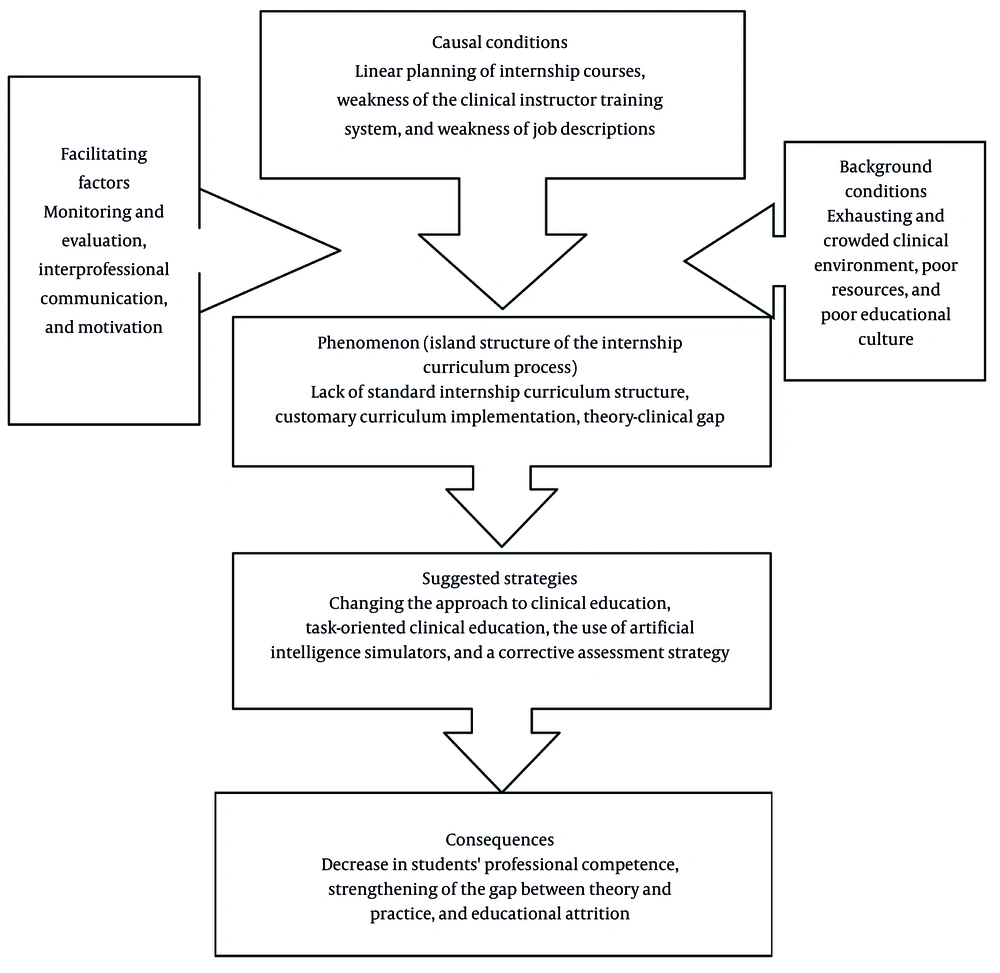
Figure 1.
Current status of internships and training courses for paramedical students in medical universities
5. Discussion
The internship curriculum for medical and paramedical students is the most critical link between theoretical education and clinical practice in real-world work environments. Neglecting it can cause substantial harm to educational programs in these fields. Accordingly, the present study aimed to investigate the current status of the clinical internship curriculum in paramedical educational programs and was conducted using a grounded theory approach. Analysis of data from in-depth interviews led to the identification of a set of concepts and categories, which were developed into a paradigmatic model. In this section, the research findings are discussed and analyzed based on the main components of the model.
The study findings indicated that the causal factors affecting the phenomenon were centered on 3 main axes: linear planning of internship courses and insufficient attention to the views of key stakeholders in designing curricula based on existing realities and localizing them according to the conditions of teaching hospitals; insufficient attention to training clinical instructors in modern educational approaches; and inadequate student job descriptions within the professional and work context in clinical settings (9, 10).
Contextual conditions represent a set of environmental characteristics that affect the clinical internship process of students in teaching hospitals. In this regard, 3 categories were identified: crowded and exhausting clinical environments in teaching hospitals due to the high volume of general referrals; lack of facilities and equipment necessary for students' clinical training in relation to the number of students, as well as the availability and up-to-dateness of facilities and equipment accessible to instructors; and weakness of the existing educational culture in conducting internship training courses (8, 11, 12).
To address the pivotal phenomenon and improve the current situation, participants emphasized specific strategies. The main axes of these strategies included changing the educational approach by adopting modern approaches, such as competency-based and mentoring approaches in clinical education; task-centered clinical education for students; the use of artificial intelligence simulators in education; and attention to corrective assessment strategies. In this context, emphasis was placed on establishing joint working groups between the university and clinical departments to review educational syllabi and on using continuous feedback as a strategy to link education and assessment. The results showed that current assessments are strongly influenced by memorization and personal relationships and require objectification based on actual performance. The findings of this part of the study are consistent with those of some studies.
Finally, the outcomes of the above interactions can be analyzed along 2 spectra. If the current situation continues, the consequences will include student academic burnout and decreased quality of health services. However, if the proposed strategies are implemented and the curriculum structure is modified, outcomes such as improved professional competencies, increased clinical self-efficacy, and consolidation of the professional identity of paramedical students are expected.
5.1. Conclusions
The model derived in this study showed that improving the status of clinical internships in paramedical disciplines is not merely an educational measure; rather, it requires a paradigm shift from centralized planning to context-based and participatory planning. The findings confirm that, to reduce the educational gap, alignment must be established among the intended, implemented, and acquired programs. This alignment will be achievable only through revising the design, strengthening organizational supports, and reforming clinical evaluation systems. In fact, the center of gravity of any transformation in paramedical education must be grounded in lived experience and real clinical needs to train competent graduates who are committed to society.