
1. Background
Gastro-esophageal reflux disease (GERD) is a common syndrome. This complication is due to contact of the esophageal mucosa with refluxed acidic gastric substances (1). Several factors including bile salts, and esophagitis are known with GERD, which lead to improvement in reactive oxygen species (ROS) and reduction in the level of endogens and exogenesis antioxidants system, such as GSH and vitamin C, and also increase in expression of ROS inducible genes (2).
Reflux esophagitis can lead to ulceration of the esophagus and also Barrett’s esophagus (BE). Barrett’s esophagus is a severe complication of GERD, which lasts in gastroesophageal reflux disease. In chronic symptoms of GERD BE usually occurs, thus the esophagus is exposed to gastroesophageal refluxate (2). People with GERD may experience symptoms such as heartburn, sores, and burning feeling in the back of the throat. Reactive oxygen species (ROS) are known to be mediators of acute gastric mucosal injury caused by ischemia (3, 4). Ethanol causes mucosal damage and anti-inflammatory response (5, 6).
In an experimental study, it was shown that injection of sodium dismutase (SOD) decreases esophagitis in rat reflux model, suggesting that esophageal adenocarcinoma (EA) progress is facilitated by inflammation and oxidative stress (7). Super oxide (O2-) is the key oxidant for production of reflux esophagitis in stomach obstruction and BE syndrome (8). Besides, other oxidant factors, such as H2O2, HO-, ONOO-, NADPH oxidase, and NOS in inflammatory cells are related to reflux esophagitis and BE (9). Lipid peroxidation is improved in BE and in addition to reactive lipid-derivatives, NO and HOCl are also increased in BE (10, 11). Free radicals affect in the etiology of many diseases. On the other hand, living organisms have antioxidant defense systems, which protect the damaging effects of excessive endogenously and exogenously produced free radicals (12). It has been reported that ROS scavengers can reduce esophageal mucosal damage. For example, SOD prevents progress to BE and EA in rats (13). In an experimental study, it was shown that supplementation of vitamin E declines EA development in rats (14). Oxidative stress reflects an imbalance between the systemic manifestation of ROS and a biological system’s capacity, which detoxify oxidant agents or repair organism damage (15). Free radicals are unpaired electrons, such as hydroxyl radical, nitric oxide, and superoxide, which can damage structural of proteins, lipids, and DNA (16).
Several factors, such as inflammatory cytokines, leukocytes, and oxidative stress, have been established to be complicated in the progress of GERD syndrome, including non-erosive reflux disease (NERD) (17). Free radicals have been associated in the pathogenesis of different gastrointestinal (GI) diseases, including GERD, gastritis, enteritis, colitis, and cancers (18).
Numerous methods, separately measure the total antioxidant capacity and pro-oxidant, which is a complex and costly method (19).
According to laboratory tests, the evaluation of the pro-oxidant-antioxidant balance (PAB), in patients with GERD through the PAB method is a routine clinical laboratory method. In this study, the oxidant and antioxidant capacity was measured. The main objective in this study was to determine PAB status between GERD patients and healthy subjects in order to determine oxidative stress using a modified PAB assay. The current researchers also investigated the correlation between PAB and anthropometric parameters and food groups intake in the population study.
2. Methods
2.1. Subjects and Study Design
In this cross-sectional case-control study, 38 patients (mean age of 31.3 ± 10.1 years, range 18 to 55 years) that had referred to the gastrointestinal clinic section of Imam Ali hospital in Zahedan, Iran, who were patients undergoing treatment and control, were studied. The GERD syndrome in patients was medically confirmed by a gastroenterologist. Diagnosis of GERD was symptom based, i.e. documented symptoms of gastroesophageal reflux disease (GERD) for longer than six months (regurgitation and heartburn, which is defined as burning epigastric or substernal pain, and responds to acid neutralization or suppression), which requires daily use of proton pump inhibitors (PPIs) or other anti-reflux drug therapy. They were refereed on a monthly basis to a gastrointestinal treatment center for health care. Sixty healthy subjects (mean age of 30.2 ± 14.8 years, range 19 to 76 years) free from any disease, who were matched with the case group in terms of age, gender, and body mass index (BMI), were selected as the control group.
The convenience sampling method was used to select patients. The control group was chosen from healthy referrers for check-up. Sample size was determined (n= 35 at least in each group) based on comparison of means between groups formula (following equation). The researchers did not find previous articles that were similar to the current study, hence the closest article (20) was used for calculation. Based on this article, mean and SD of PAB in hemodialysis patients (case) was 88 ± 33 and control group was 68 ± 23. Power of the study was chosen as 85% (1 - β = 0.85) and α = 0.05. N of 34 was the least for each group.

Equation 1.

Equation 1.
The inclusion criterion included age of 18 to 55 years old. There was no evidence of vitamin E and C supplements during the last two months. The patients had not received any special diet since two months ago.
All of these patients were enrolled in the current study, except for those, who had previous surgery on upper abdomen, illicit drug (including alcohol) or opium abuse, pregnant females, and all patients with chronic pulmonary, kidney or heart diseases, and uncontrolled hypothyroidism. In addition, patients with major psychiatrics problem or consumers of drugs for any causes were excluded from the project. Healthy subjects were selected as the control group in order to be compared with the case group for the pro-oxidant-antioxidant balance.
The study protocol was approved by the ethical committee of the research council of Zahedan University of Medical Sciences (ZAUMS) (Code number; No: 7728; 24, May 2016). Therefore, all of the aims of the protocol were clearly elucidated to the subjects.
2.2. Anthropometric Assessment
After recording the demographic characteristics of the patients, including age, gender, occupation and educational level, and medical history, their anthropometric parameters were determined. Body weight and height were measured by the Seca scale to the nearest 200 g and 0.5 cm, respectively. Body mass index (BMI) was evaluated based on the calculation body weight (kg)/ height (m2) (21).
The waist circumference (WC) was determined between the lower border of the rib and the iliac crest by a non-stretchable tape. Hip measurement was done as standing with placing feet directly beneath hips. The tape was placed around the widest part of hips and buttocks. All measurements were done based on centimeters. Waist to hip ratio was calculated by dividing waist size to hip size. According to standards, waist-to-hip ratio of greater than 1.0 is indicative of a higher than normal risk of developing heart disease. A healthy WHpR for females is under 0.8 and a healthy WHpR for males is 0.9 or less.
The circumference of hand wrist was measured by a non-elastic metering device. Their body type was determined through dividing the height by wrist circumference to small, average, and large size, and the waist to hip ratio was reported to be less than one (22).
2.3. Nutritional Assessment
The participants answered to the nutritional questionnaire, according to the pyramid food guidance system. The food frequency questionnaire was used for data about food consumption. In order to avoid eventual differences between working and not-working days, the mean values of dietary intakes were measured on one work day and one weekend day. The questionnaire was completed in a personal interview that was conducted by a nutritionist.
Standard reference was used to convert household portions to scale food.
The food guide pyramid is a quality method for determination of daily food group consumption. According to daily food guide pyramid, five major food groups are recommended to be consumed, including; bread and cereals groups, six to eleven exchanges; fruits group, two to four exchanges; vegetables group, three to five exchanges; milk and dairy products group, two to three exchanges; meat, egg, dried beans, nuts, and substitutes, two to three exchanges; and small amounts of fats, oils, and sweets (21).
During interviews, participants were invited to describe their food and beverage intake during the two days. Each of the foods listed was characterized by a full description of the usual serving size. For each case, food intake was determined according to the number of servings reported in each food group. These amounts were then compared to the rec-ommended allowance based on the food guide pyramid. It has been reported that nutritional assessment was performed in more than half of the studied groups.
Information on food habits was recorded including tobacco smoking, consumption of different foods, soft drink, tea and coffee drinking, food additives, special diet based on culture of the population studied, recorded by a trained interviewer.
2.4. Pro-Oxidant and Antioxidant Balance (PAB) Assay
The blood samples were obtained from GERD patients and healthy subjects, respectively. The serum aliquots were separated and frozen at -70°C until analysis. This method was done according to two different oxidation-reduction reactions. The PAB was measured by a modified method by Hamidi Alamdari et al. (19, 23). The PAB values were assessed by the photometric method, using 3,3’,5,5’-tetramethylbenzidine (TMB) in an enzyme linked immunosorbent assay (ELISA) reader between 570 nm or 620 nm wavelength. This method was performed based on reactions; in the enzymatic method, so the chromogen TMB is oxidized to a color cation by peroxides, and in the chemical reaction the TMB cation is reduced to a colorless compound by antioxidants. The PAB is also calibrated using a mixture of hydrogen peroxide and uric acid. The PAB value is determined based on arbitrary HK unit, which is as hydrogen peroxide in the standard solution (19, 24).
It has been reported that PAB assessment was done for all of patients and healthy subjects. However, nutritional assessment was performed in more than half of the control group.
2.5. Statistical Analysis
The results are expressed as mean ± standard deviation. Comparisons between the two groups were analyzed by t-test or Mann-Whitney U-test and chi-square. Pearson and Spearman correlation coefficients were used for assessment of parametric and non-parametric correlations. All statistical analysis were performed using the SPSS software (version 18 for windows, Chicago, USA). Data were considered significant at a level of P < 0.05.
3. Results
There was not significant difference according to age, body weight, height, BMI, and waist circumference between the two groups (P > 0.05) (Table 1).
Table 1.
The General Characteristics of the Studied Groupsa
| Groups | Case, N = 38 (38.8%) | Control, N = 60 (61.2%) | P Valueb |
|---|---|---|---|
| Age, y | 31.3 ±10.1 | 30.2 ± 14.8 | 0.6 |
| B.W, kg | 65.2 ± 13.1 | 65.8 ± 14.8 | 0.8 |
| H.t, cm | 165 ± 10.5 | 171.2±9.0 | 0.09 |
| BMI, kg/m2 | 24.02 ± 4.1 | 22.3 ± 4.0 | 0.07 |
| Waist circumference, cm | 85.7 ± 13.4 | 84.0 ± 12.6 | 0.2 |
| WHpR | 0.84 ± 0.07 | 0.83 ± 0.07 | 0.4 |
aValues are expressed as mean ± SD.
bN.S (Not significant).
According to demographic characteristics of the studied population, 43.5% were male and 56.5% female, and 31.6% and 35.5% of subjects in case and control groups were smokers, respectively. There was not significant difference according to smoking, job, and education levels between the two groups. The results showed that 31.6% and 16.1% of subjects had a history of ulcer peptic in the case and control groups, respectively.
It was observed that 31.6% and 13.3% of the participants had enteral obesity in the case and controls, respectively. According to body size, the results showed that 13.2% and 21.4% of the subjects were small, 36.8% and 53% medium, and 50% and 25% of subjects large in the case and control groups, respectively.
There was not significant difference between the two groups regarding food habits including consumption of frying food, fast food, soft drink, and food spicy between the two groups (P > 0.05) (Table 2). According to food habits of the study population, the results showed that 21.1% and 19.4% of subjects had a special diet, 47.4% and 93.5% had foods in restaurants, 86.8% and 93.5% drank coffee, 39% and 61% ate salty foods, and 71.1% and 64.5% ate salad with their meals daily in the case and control groups, respectively. It was observed that 18.4% and 29% of subjects consumed supplements of vitamin A, E, and C in case and control groups, respectively.
Table 2.
| Different Kind of Foods and Beverages | Consumption Status | ||||||
|---|---|---|---|---|---|---|---|
| Case Groups | Control Groups | P Value | |||||
| Low | Medium | High | Low | Medium | High | ||
| Frying food | 12 (32.4) | 15 (40.5) | 10 (27) | 4 (12.9) | 18 (58.1) | 9 (29) | 0.1 |
| Fast food | 25 (75.8) | 4 (12.1) | 4 (12.1) | 10 (33.3) | 14 (46.7) | 16 (20) | 0.002 |
| Soft drink | 18 (66.7) | 5 (18.5) | 4 (14.8) | 16 (51.6) | 9 (29) | 9 (19.4) | 0.5 |
| Food spicy | 9 (30.6) | 19 (50.8) | 8 (22.5) | 9 (27.3 | 14 (45.2) | 9 (27.4) | 0.7 |
aValues are expressed as No. (%).
bChi-square test was shown, exception of fast foods intake (P = 0.002) there was not significant difference according to consumption of other foods and beverages between two groups.
The results (Man-Whitney U-test) showed that there was not significant difference based on the mean levels of PAB between the two groups (P = 0.5) (Figure 1).
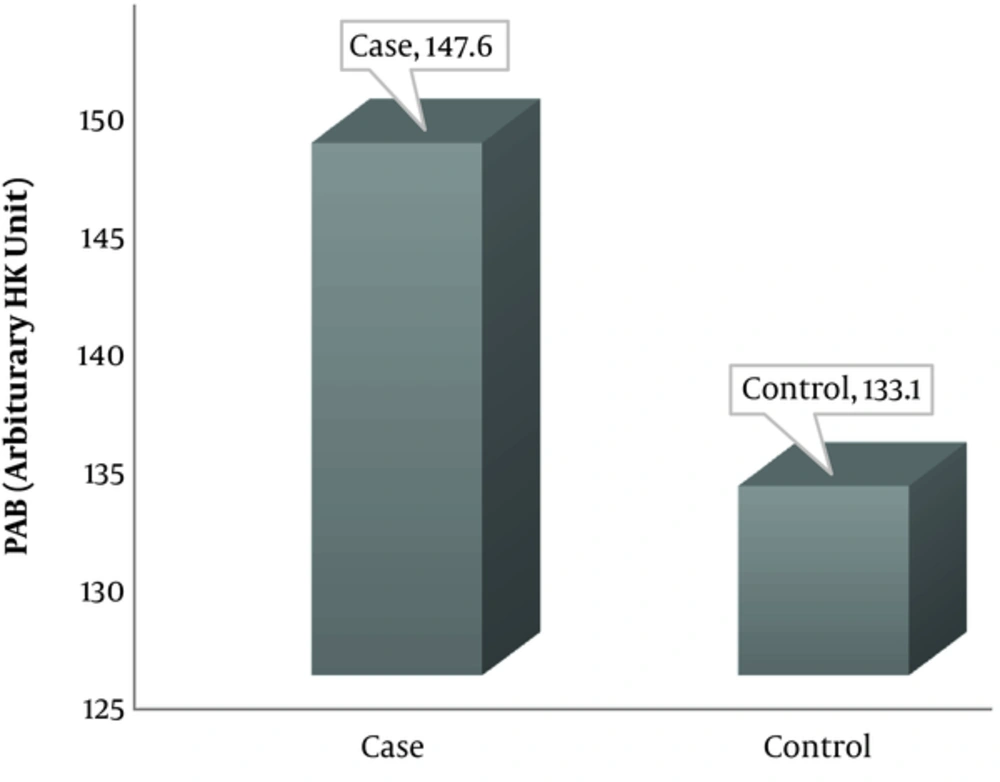
Figure 1.
Pro-oxidant and antioxidant balance levels of serum in studied groups
The results of food frequency questionnaire showed that there was no significant difference according to food groups intake between the two groups as daily and weekly, respectively (Figure 2). There was no significant difference based on food habits including consumption of fraying foods, spicy foods, salty foods, salad and drinking tea and coffee between the two groups (P > 0.05). However, there was a significant difference based on consumption of fast foods between the two groups (X2 = 12.3, P = 0.002).
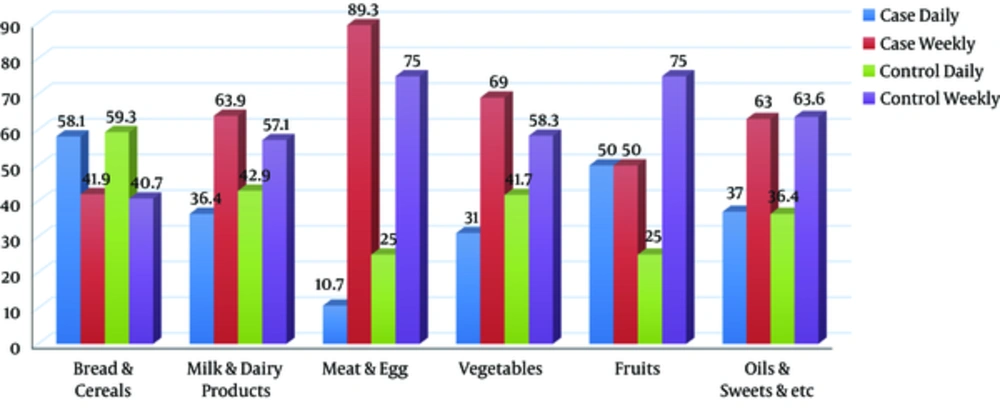
Figure 2.
Percentage of frequency of food groups consumption in the studied groups
It was also observed that there was a positive and significant relationship between PAB and BMI (r = 0.41, P = 0.0001) and waist circumference (r = 0.24, P = 0.04) (Figure 3).
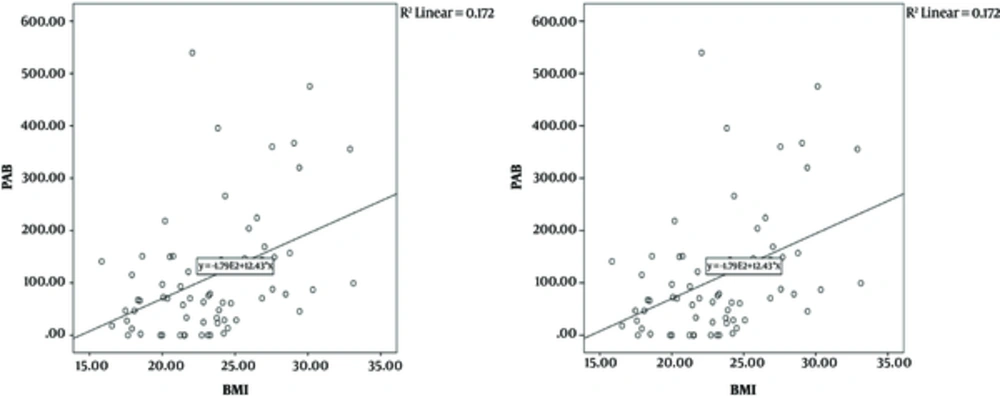
Figure 3.
Correlation of pro-oxidant and antioxidant balance levels (HK/UN) with waist circumference and body mass index
4. Discussion
The findings of the present study showed that there was no significant difference according to PAB, food groups, and food habits between the two groups. However, there was a significant correlation between PAB and BMI, and WC. A significant difference was also observed based on consumption of fast foods between the two groups. There are several methods for determination of oxidative stress as an important factor in the pathogenesis of digestive diseases. However, there is no specific laboratory method for evaluation of oxidative stress in the population. There are several factors, which affect this assessment, including the principal of the methods, which determine the total pro-oxidant and antioxidant abilities alone, difficulty, time limitation, cost, reliability, and validity of the method.
Determination of PAB by TMB reagent is simple, rapid, and cheap and can measure the pro-oxidant burden and the antioxidant capacity in the evaluation, giving a redox index (25).
The results revealed no significant increase in the PAB value in patients compared with the healthy subjects. The gastrointestinal (GI) system is the main source of ROS. Numerous factors can cause inflammation by stimulating the epithelium and macrophages and produce inflammatory cytokines and other mediators that influence oxidative stress. Several GI pathological conditions, such as gastroduodenal ulcers, GI malignancies, and Inflammatory Bowel Disease (IBD) take part in oxidative stress (1). Although, a significant difference was not observed based on PAB levels between the two groups, yet, it was confirmed that ROS mainly contributes to esophageal mucosal injuries in rats caused by reflux esophagitis or hyper-proliferation of esophageal mucosa (26).
The results showed the level of waist circumference and BMI were in the normal range and there was no significant difference between cases and controls. On the other hand, it was observed that a significant relationship exists between PAB with waist circumference and BMI. It has been reported that BMI is related to GERD symptoms in individual, which are normal and overweight. It is also suggested that relatively low weight gain or normal weight in subjects can impair to reflux function (27). With increasing of WC, abdominal obesity could be developed. It has been suggested that WC is increasing more than BMI or body weight. Prevention of obesity is the main aim for reducing the incidence of obesity-induced chronic diseases. It seems that an increase in WC acts more than it would be expected from increases in weight (28). It has been reported that WC represents central obesity. There is a modest relationship between BMI, mainly in the obese range, and GERD symptoms. Overweightness or obesity develops the risk of GERD symptoms. On the other hand, weight loss is associated with a diminished risk of symptoms (29).
A significant positive correlation was observed between the PAB value and WC in type 2 diabetes patients (T2DM). It was revealed that waist circumference (WC) in T2DM was significantly more than controls (30). The results showed that there was no significant difference based on food habits between the two groups. However, there have been variation in this trend, for example the consumption of frying food, fast food, soft drink, and food spicy at a low level in GERD patients was less than controls. It seems that on the basis of nutritional incompatibility, or nutritional and medical recommendations, patients were paid attention to food prescriptions. It is clear that modification of life style and performance of healthy dietary behaviors can improve health condition and self-expectancy.
Frying is a usual process and widely applied based on the tastes of individuals. There are a variety of fried foods according to organoleptic, flavor, quality, and appearance. Peroxide value is used as a simple test for the quality of oil, yet peroxides are unstable in the frying process and decrease the biological value of foods. Peroxide value shows oxidative reactions after frying and can represent oil quality during the process (31). It has been reported that consumption of fast foods had a positively significant correlation with BMI and obesity (P = 0.02) (32). In another study, it was reported that there was a significant correlation between fast food intake and BMI as well as WC in the Iranian population (32). On the other hand, consumption of sugar, fat, salt (SFS) palate is related to knowledge of food brands, experience with goods, and advertisements and marketing (33).
Overall, salty foods, snack, and soft drinks have little or no nutritional adequacy yet do have a lot of calories, which can influence health when they make up a large amount of what an individual eats. These foods and drinks have deficiency based on nutrient. Besides, additional calories intake from these foods could lead to weight gain and obesity. In the present study, there was consumption of fast foods in the case groups less than the control, which needs further studies. It seems that other factors should be analyzed in relation to this finding.
The results showed that there was no significant difference according to food groups intake between the two groups. The two groups were matched according to different factors. According to food guide pyramid, consumption of three to five servings per day of fruits and vegetables provides enough amounts of vitamins to the organism and dietary fiber (34).
The benefit of fruits and vegetables on health are dependent on natural antioxidant, such as vitamins A, C, and E, since oxidative stress is an underlying mechanism for numerous chronic diseases (35). Diet has an effect on body antioxidant status. It can be strengthened by providing exogenous antioxidants and precursors of endogenous antioxidants in the organism (36). There is an inverse correlation between oxidative stress and inflammation biomarkers with intake of fruits and vegetables, and natural antioxidant vitamins. Consumption of natural antioxidant vitamins can reduce oxidative stress and can motivate at risk patients for changing dietary habits. It has been emphasized that international guidelines of ≥ 5 servings per day of fruits and vegetables can reduce underlying mechanisms of chronic diseases (34).
Antioxidants can decrease the damaging effects of ROS and delay many complication of the disease. The antioxidant-pro-oxidant balance in various parts of the intestine depend on the level of antioxidants and pro-oxidants provided with the food and released by cells themselves as well as on the level of absorption of both antioxidants and pro-oxidants (37). The balance between pro-oxidant and antioxidant defense systems is important on the body’s capability of pro-oxidant damage. It has been shown that different nutrient and non-nutrient dietary components, including natural antioxidant vitamins and phytochemicals, effect the pro-oxidant/antioxidant balance of the body (38).
4.1. Conclusion
Conclusively, the findings of this study showed that PAB values in GERD patients are not significantly increased in comparison with controls. In conclusion PAB can be considered as a good predictor for evaluation of oxidative stress in these patients. Thus, determination of PAB along with other risk factors of reflux esophagitis can be used in diagnosis and reduction of complications of disease.
The present study had limitations and strengths. It was cross-sectional and, thus missing data was present in the analysis. There was limitation in the number of GERD patients, which referred to the clinic. The research compared demographic differences between individuals with and without GERD. The did not consider all aspects of oxidative stress in these patients. The results showed that there was oxidative stress in the patients and suggests that the PAB value is the easy, rapid method of PAB assay for oxidative stress. Although, a relationship was not observed between PAB and food groups consumption. Other studies have shown that intake of fruits and vegetables or selected vitamins may be useful for identifying the oxidative stress and modification of dietary habits. The strength of the current study was the assessment of food intake according to food groups consumption. Participants provided reliable information by FFQ and food habits questionnaire in two groups. It is also noteworthy to mention that data on marker of PAB status are available, economical, and need more time.