
1. Background
Kawasaki disease (KD) is a systemic syndrome of inflammatory with unknown cause and usually occurs in children less than 5 years of age. The main symptoms of the disease are fever, bilateral non-purulent inflammation of the conjunctiva, redness of the lips and oral mucosa, changes in extremities, rash and involvement of lymph nodes [1]. KD is the most common cause of acquired heart disease in children who live in industrialized countries. Its prevalence is more than 138 - 200 cases per 100,000 in children less than 5 years of age in Japan and 17.1/100000 in the United State, 8.1/100000 in UK and in Taiwan reported from 66.9 to 164.9 in 100,000 population [2-4]. High incidence in winter and the first mount of spring due to climate and rises in summer in many countries in Asia and about 75% of cases occurring in children under 5 years of age. An increasing incidence has been observed around the world by times because of recognizing disease [5]. The most important complication of KD is coronary artery involvement and is seen about 15% - 25% of affection [6-8].
Risk factors such as poor coronary artery outcomes have been studied in several populations. Demographic factors, such as young age, particularly younger than 6 months and older than 9 years, male gender, more days of fever, Asian and Pacific Islander race, and Hispanic ethnicity have been associated with poor clinical outcomes. Laboratory parameters, such as more white blood cell count, thrombocytopenia, hyponatremia, low hematocrit and low serum albumin, elevated C-reactive protein (CRP) and transaminitis, have all been associated with poor response to intravenous immunoglobulin (IVIG) and the development of coronary artery lesion (CAL) [9-11]. Eladawy et al. [12] assessed the children with KD in 2011; more than one tests of liver function were performed on admission for them and observed that 45.4% of these patients have one impaired liver function test at least. In a study conducted by Taddio et al. [13] it was observed that hepatic involvement in KD may observe.
According to a study carried out in the United State, approximately 85% - 95% of patients who have been treated with intravenous immunoglobulin and aspirin, their inflammatory syndrome had been declined within 48 hours after injection of immunoglobulin [14]. In the United State, 70% - 80% of patients who did not respond to the first dose of immunoglobulin, the second dose of 2 g/kg of body weight was significantly effective [15]. The ideal treatment should be provided within 10 days after the onset of symptoms to reduce the risk of coronary artery disease when standard treatment is intravenous immunoglobulin with aspirin. Time length of treatment, platelet count and sedimentation rate (ESR), IVIG dose are risk factors for coronary artery lesions. Having fever more than 10 days also is a risk factor for coronary artery aneurysm. In review study by Kuo et al. [16] reported that in patients with Kawasaki a single dose of IVIG had 9.4% - 23% resistance.
A study conducted by Deane Yim et al. [1] shows, a single dose of intravenous immunoglobulin with combination of aspirin in the first ten days after onset of fever has decreased the incidence of aneurysm from 20% - 25% to 2% - 4%.
2. Objectives
Given that KD is the most common cause of acquired heart disease and 25% of cases lead to coronary artery involvement and they are at risk of myocardial infarction and sudden death and because has not been reported any studies on the cardiovascular involvement in patients with KD in Zahedan so far, we aimed to determine the effect of intravenous immunoglobulin on reducing the incidence of coronary artery aneurysm.
3. Patients and Methods
This retrospective study was carried out on all children who admitted in Ali Ibne Abi Talib hospital in one decade from 2004 to 2013 years with a diagnosis of KD receiving intravenous immunoglobulin and aspirin therapy. In this study after getting permission from the hospital authorities to use of stored patient’s files in the medical records section, required information extracted and entered to the specific form. Needed information was included of demographic factor such as age and sex, clinical information such as duration of fever, conjunctivitis, cervical lymphadenopathy, mucocutanous lesion, tongue strawberry, skin rush, mucosal ulcer, scaling and fissure and laboratory finding as, erythrocyte sedimentation rate (ESR), C-reactive protein (CRP), white blood cell (WBC), platlet count (PLT), aspartate aminotransferase (AST), alanine aminotransferase (ALT), hemoglobin (Hb), alkaline phosphatase (ALP) and albomin (Alb), echocardiographic findings such as, left coronary artery (LCA), right coronary artery (RCA) and left ventricular ejection fraction (LVEF) before and after treatment. Treatment information were aspirin and intravenous immunoglobulin meanwhile, incomplete files were excluded. Patients were grouped based on principal clinical criteria into complete and incomplete (< 4 criteria) KD. Analyses of data were done by the SPSS-16 software (SPSS Inc, Chicago, Ill, USA), using ANOVA and independent sample t-test.
The level of significant was considered 0.05 according to 95% confidence interval. With the respect to the relevant ethical codes the administrative constraints were incomplete records and lack of medical records office staffs cooperation.
4. Results
In this retrospective study all 63 patients with KD who had been admitted to the Ali Ibne Abi Talib hospital from the year of 2004 for 10 years were assessed. Due to defective, 10 files were excluded. Therefore a total of 53 patients were entered to the study that 60% were male. Clinical characteristics of patients were included of conjunctivitis in 72%, lymphadenopathy in 64%, involvement of the tongue in 48%, rash in 40%, fisher’s 36%, ulcer 5% and scale was 17%. The period of febrile time for patients ranged from 5 days to 18 days. According to the clinical manifestations, Kawasaki patients grouped in complete and incomplete in the frequency of 34 (64.3%) and 19 (35.7%) respectively. For the first step, considered the treatment with single dose of IVIG resulted that out of 53 patients, 48 people (90.5%) responded to IVIG treatment and 5 patients (9.5%) did not respond when one person had recurrence state (1.9%).
To identify patients distribution regarding some laboratory parameters in two normal and abnormal states used cut-off-points of 3.5, 11, 450,000, 10,500, 40,40, 15 for Alb, hemoglobin, platelets, WBC, AST, ALT and ESR parameters respectively. To follow, the results of frequency (%) comes in the order given of 38 (71.4%), 16 (31%), 27 (50%), 14 (26%), 16 (31%), 29 (54%) and 1 (1%) for normal state.
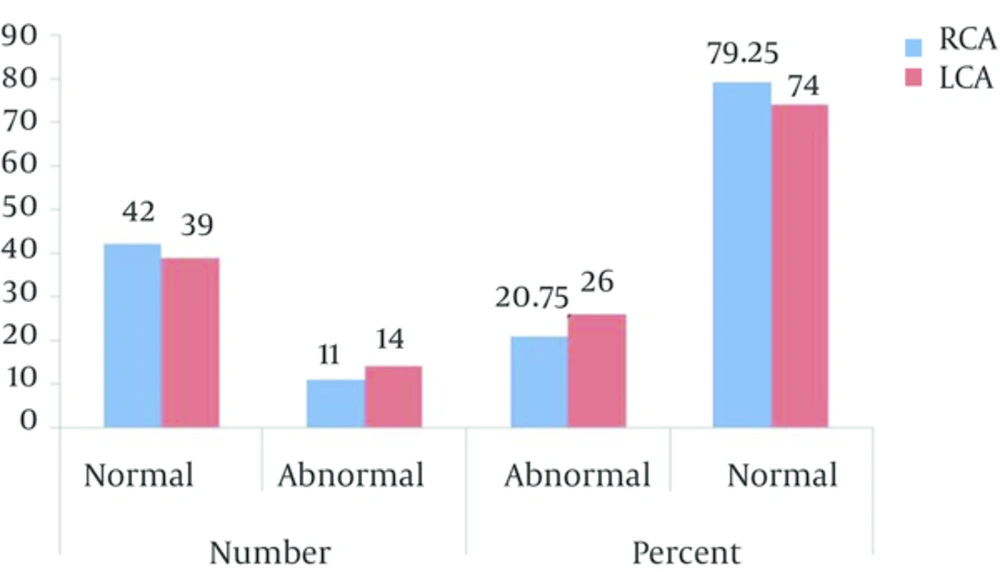
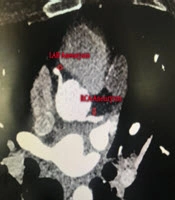
Figure 1.
Left coronary artery, LCA; right coronary artery, RCA.
Echocardiography was done in the acute phase (before treatment) for the patients. Primary coronary involvement in RCA and LCA were 20.75% (11 patients) and 26% (14 patients) respectively (Figure 1) and the frequency of aneurysm in coronary artery involvement was 5%. The mean of LCA and RCA diameters in before and after treatment were 2.39 ± 0.84, 1.95 ± 0.72 mm and 2.12 ± 0.54, 1.81 ± 0.31 mm respectively (Table 1).
Clinical manifestations were compared for patients with and without coronary artery involvement. The findings revealed that for patients with and without left coronary artery involvement, conjunctivitis (72.7% and 71%), cervical lymphadenopathy (63.6% and 41.9%), tongue strawberry (63.6% and 41.9), skin rush (45.5% and 38.7%), mucosal lesion (9.1% and 3.2%), scaling (18.2% and 16.1%) and fissure (36.4% and 35.5%) were respectively. The results also showed that conjunctivitis (66.7% and 72.7%), cervical lymphadenopathy (77.8% and 60.6%), tongue strawberry (55.6% and 45.5), skin rush (55.6% and 36.4%), mucosal lesion (10% and 6.1%), scaling (22.2% and 15.2%) and fissure (44.4% and 33.3%) were for patients with and without right coronary artery involvement respectively.
In patients with KD with and without LCA involvement, the means of age, duration of fever and the onset day of IVIG were 47.5 ± 18 and 28.6 ± 16 months, 10.7 ± 3.6 and 8.2 ± 1.9 days and 9.8 ± 3.1, 8.2 ± 1.9 days respectively and showed a significant difference. In these patients with and without RCA involvement the means of age were 46.5 ± 17 and 31.5 ± 18 in months and for the duration of fever were 10.5 ± 3.6 and 8.2 ± 2.5 days showed a significant difference (Table 2).
In these patients with and without coronary aneurysm some of factors showed significant differences. These factors were duration of fever with 13±4.2 and 8.8±2.8 days, ESR with 121.5 ± 21 and 73.9 ± 29.8 mm/h and ALP with 808 ± 101 and 476 ± 148 (Iu/L) for with and without coronary aneurysm respectively (Table 3).
Table 1.
Assessment of Left or Right Coronary Artery Before and After Kawasaki Treatment
| Parameters | Mean ± SD, mm | P Value |
|---|---|---|
| LCA (ASA + IVIg) | 0.001 | |
| Before | 2.39 ± 0.84 | |
| After | 1.95 ± 0.72 | |
| RCA (ASA + IVIg) | 0.001 | |
| Before | 2.12 ± 0.54 | |
| After | 1.81 ± 0.31 |
Abbreviations: LCA, left coronary artery; ASA + IVIg, asprin + intravenous immunoglobulin; RCA, right coronary artery.
Table 2.
The Impact of Some Factors in Kawasaki Patients in Right and Left Coronary Artery
| Factors Under Deliberation | Mean ± SD of Left Coronary | P Value | Mean ± SD of Right Coronary | P Value | ||
|---|---|---|---|---|---|---|
| Abnormal = 14 | Normal = 39 | Abnormal = 11 | Normal = 42 | |||
| Age, months | 47.5 ± 18 | 28.6 ± 16 | 0.001 | 46.5 ± 17 | 31.5 ± 18 | 0.01 |
| Days of fever | 10.7 ± 3.6 | 8.2 ± 1.9 | 0.01 | 10.5 ± 3.6 | 8.5 ± 2.5 | 0.03 |
| Days of IVIG | 9.8 ± 3.1 | 8.2 ± 1.9 | 0.046 | 9.4 ± 2.6 | 8.5 ± 2.4 | 0.25 |
| WBC, mm3 | 15,463 ± 7,097 | 12,564 ± 4,696 | 0.13 | 15,689 ± 7,805 | 12,678 ± 4,617 | 0.14 |
| Hemoglobin, g/dL | 8.8 ± 0.93 | 9.6 ± 1.8 | 0.1 | 9.04 ± 1.7 | 9.5 ± 1.6 | 0.45 |
| Platelet, mm3 | 464,091 ± 177,557 | 477,000 ± 235,926 | 0.87 | 458444 ± 211,417 | 477,758 ± 225,432 | 0.81 |
| Neutrophil, (%) | 64.6 ± 18.16 | 57.4 ± 17.4 | 0.2 | 68 ± 16 | 56.8 ± 18 | 0.09 |
| Albumin, g/dL | 3.13 ± 0.42 | 3.21 ± 0.4 | 0.24 | 3.23 ± 0.4 | 3.27 ±0.43 | 0.79 |
| ESR, mm/h | 78.2 ± 34.7 | 74.5 ± 28.7 | 0.68 | 65.3 ± 33 | 79 ± 29.3 | 0.16 |
| CRP | 1.5 ± 1.09 | 1.6 ± 1.2 | 0.82 | 1.6 ± 1.4 | 1.5 ± 1.1 | 0.75 |
| AST, Iu/L | 65.8 ± 57 | 45.3 ± 33 | 0.1 | 60.7 ± 34 | 49.5 ± 64 | 0.42 |
| ALT, Iu/L | 54 ± 74 | 54 ± 65 | 0.9 | 43.4 ± 29.3 | 57.7 ± 76 | 0.51 |
| ALP, Iu/L | 501 ± 178 | 483 ± 151 | 0.69 | 470 ± 161 | 495 ± 160 | 0.63 |
Abbreviations: IVIG, intravenous immunoglobulin; WBC, white blood cell; ESR: erythrocyte sedimentation rate; CRP: C-reactive protein; AST, aspartate aminotransferase; ALT, alanine aminotransferase; ALP, alkaline phosphatase.
Table 3.
The Impact of Some Factors in Kawasaki Patients With and Without Coronary Aneurysm
| Factors | Mean ± SD With Coronary Aneurysm, n = 3 | Mean ± SD Without Coronary Aneurysm, n = 50 | P Value |
|---|---|---|---|
| Age, months | 48 ± 17 | 34 ± 19 | 0.3 |
| Days of fever | 13 ± 4.2 | 8.8 ± 2.2 | 0.04 |
| Days of IVIG | 11 ± 1.4 | 8.6 ± 2.5 | 0.2 |
| WBC, mm3 | 22,350 ± 14,490 | 12870 ± 4670 | 0.52 |
| Hemoglobin, g/dL | 8.5 ± 1.9 | 9.4 ± 1.6 | 0.42 |
| Platelet, mm3 | 540,000 ± 3.09 | 470,000 ± 2.1 | 0.6 |
| Neutrophil, (%) | 56 ± 5.6 | 59.4 ± 18 | 0.7 |
| Albumin, g/dL | 3.35 ± 0.49 | 3.26 ± 0.43 | 0.78 |
| ESR, mm/h | 121.5 ± 21 | 73.9 ± 29.8 | 0.03 |
| CRP, mg/dL | 2.5 ± 0.7 | 1.5 ± 1.1 | 0.27 |
| AST, Iu/L | 88.5 ± 18 | 51 ± 44 | 0.15 |
| ALT, Iu/L | 78 ± 11 | 53 ± 69 | 0.61 |
| ALP, Iu/L | 808 ± 101 | 476 ± 148 | 0.003 |
Abbreviations: IVIG, intravenous immunoglobulin; WBC, white blood cell; ESR, erythrocyte sedimentation rate; CRP, C-reactive protein; AST, aspartate aminotransferase; ALT, alanine aminotransferase; ALP, alkaline phosphatase.
5. Discussion
In this study the majority of patients were male. KD was more common in boys than girls. Early involvement of the right coronary heart disease was minor in compare to the left. The mean of LCA and RCA diameters before and after treatment were significantly different. The means of duration of fever for with and without coronary aneurysm were different; ESR and alkaline phosphatase in patients with KD had significant difference.
KD is a febrile acute vascular inflammatory disease that can affect various organs and occurs mainly in infants and children. KD occurs in every racial and is increasing around the world. KD is a leading cause of acquired heart disease in children [1, 4, 17]. Several studies show that for these patients there is a wide range of coronary involvement (15% - 55%). In this study the primary cardiac involvement in RCA, LCA and aneurysm were 20.75%, 26% and 5% respectively which was similar to other studies [5, 16-18]. In the study of recovery rate of coronary artery involvement with echocardiography’s measurements a positive correlation was observed so that the correlation was significant before and after treatment in the left and right coronary artery (P = 0.001 and P = 0.001) respectively. Among the factors that were evaluated to determine their effects on the remission of coronary artery therapy, treatments (IVIG, ASA) and CRP had strong and significant effective. From all the parameters in comparison between groups with and without coronary artery disease, in the left coronary febrile period (P = 0.01), age (P = 0.001) and the onset time of IVIG (P = 0.04) showed a significant difference when for the right coronary, febrile period (P = 0.03), age (P = 0.01) showed a significant difference. Among the patients with and without aneurysm, duration of fever (P = 0.04), ESR (P = 0.03) and ALP (P = 0.003) showed significant differences and recurrence observed only in one patient (1.8%) in which is similar with the study conducted [17]. In a study conducted on 203 patients with KD by Ghelani et al. [19] 65% were male. Out of them 33 patients (16.3%) had coronary artery disease. High ESR, high platelet count, low serum albumin levels and recurrent KD were associated with coronary artery disease. Kawasaki recurrent and high ESR was identified as independent predictors for coronary artery disease. A study by Akhtar et al. [20] examined 56 patients for 14 years, aged from 2 months to 9 years with KD. Abnormality in LCA and RCA were 30% and 36% respectively. Risk factors for cardiovascular disease involvement for males were fever > 10 days during the initial offering period and the percentage of neutrophils was more than 75% in the number of white blood cells. The average of time for follow-up was 2.5 years and 8% of patients had abnormal coronary yet. Our results in the specific circumstances of coronary aneurysm are similar with the late study. Ahn et al. [18] considered two groups of children, with Kawasaki and without Kawasaki but with congenital heart disease (CHD). Clinical characteristics such as sex, mean age, WBC, neutrophil, hemoglobin, platelet, CRP, ESR, AST, ALT, protein, albumin, total duration of fever and coronary artery lesion were examined in these groups. WBC count (neutrophil), platelet count, ALT, AST, and total protein were significantly higher in Kawasaki group and hemoglobin and albumin levels were significantly lower in the Kawasaki group compared with the control group (P < 0.05). The same results concluded from the present study. Liu et al. did a study on patients with KD based on age groups of, less than 6 months, 7 - 12 months and greater than one year. Clinical manifestations, laboratory results and echocardiography assessed in differential and correlations. In the case of echocardiography findings they received to conclusion that, both study more or less have same results. In the clinical symptoms, just cervical lymphadenopathy was statistical different in age groups in both studies. Laboratory findings such as white blood cell count and hemoglobin were different in age groups in the Liu et al. study in which was dissimilar with our results. In the present study ALT, AST and albumin, received statistical difference between the age groups of patients with Kawasaki when in the late study observed differences in various paired groups [21]. Yellen et al. [22] conducted a study on patients with KDs and concluded that, 70.3% of patients had complete Kawasaki when this percent in our study was 64.36%. They also analyzed laboratory findings for complete and in complete Kawasaki for comparison. Same result received for ALT according our study. Eladawy et al. [12] carried out a study on liver in acute KD and concluded in the majority of laboratory parameters such as Alb, hemoglobin, platelets, WBC, AST, ALT and ESR observed statistical relationship in the frequency and the normality. The results of the study are comparable similar with our results.
Among the patients those who had LCA coronary artery involvement were higher compared to RCA. From the evaluated factors onset age and sex had not significant impact but overall time fever in both groups had significant difference.