
1. Background
Leukemia inhibitory factor (LIF) is a glycoprotein, classified as a sub-class of interleukin 6 cytokines with a wide biological function range and multiple effects on cells, human physiology and disease [1]. It was first characterized as an inducer of macrophage differentiation while it inhibits the growth of murine myeloid leukemia M1 cells. Also it regulates the survival of neurons, hematopoiesis, differentiation in embryonic stem cells, motility and survival rate of sperm, platelet numbers by effecting bone marrow function, improves survival of both sensory and motor neurons acute phase proteins embryo development [2-12]. HLIF is absolutely required for maintaining the stemness of embryonic stem cell (ESC) lines [13-16]. LIF-deficient mice demonstrate difficulties in blastocyst implantation [17], which suggests that administration of hLIF may aid the implantation rate of women displaying some forms of infertility [18]. The tyrosine kinase [Janus kinas (JAK)] binds constitutively to the intercellular domain of the LIF receptor complex in its inactive form. Upon LIF binding, JAK kinase activates transcription of signal transducers and activators of transcription (STAT) 1 and STAT 3 through SH2 domains. STAT proteins are then activated and translocated in to the nucleus, where they function as transcription factors [19, 20]. CISH gene encodes a protein which contains a SH2 domain and a SOCS box domain. These proteins belong to cytokine-induced STAT inhibitor (CIS) that are suppressor of cytokine signaling (SOCS) or STAT-induced STAT inhibitor (SSI), protein family. CIS family members are known to be cytokine-inducible negative regulators of cytokine signaling. According to CISH Inducibility by LIF pathway, we choose it for treatment with homemade his 6-LIF to evaluate LIF bioactivity. Low expression of LIF in eukaryotic cells has been reported [3, 21]. Escherichia coli (E. coli) has higher expression, however the protein mis-folds and aggregates to form inclusion bodies (IBs) in prokaryotic hosts is common [22]. In general, the solubilization of IBs requires high concentrations of denaturants, such as urea or guanidine hydrochloride and subsequent refolding via the removal of the denaturants. In many cases the overall yield of biologically active protein from IBs is low [23].
2. Objectives
In present study, we tried to clone and codon optimizes the human LIF gene effectively and produces the recombinant protein easily by simple IPTG induction and is able to purify it by single step. We observed that low temperature significantly improves the solubility of hLIF as a fusion protein in E. coli. Also we established a single step protocol for purifying bioactive hLIF relying on His-tag tail by immobilized metal affinity chromatography. The bioactivity of fused hLIF was tested by MTT assay and CISH gene stimulation assay by real time PCR that confirmed its bioactivity.
3. Materials and Methods
This is an experimental study, materials and methods divides to:
3.1. Gene Expression Assay
3.1.1. Construction of Expression Vector
The hLIF gene includes 181 amino acid codons for polypeptide synthesis (NCBI reference sequence: MN002309.3) was synthesized for fully expression in E. coli (Gen Fanavaran Ldt, Tehran, Iran). The codons were optimized for E. coli in order to improve the expression of hLIF. Each amino acid includes several codes in DNA sequence; the most frequent codes were choosed instead of human common codes. Then optimized sequence inserted into the expression vector pET-28a (+) with BamHI and XbaI restriction sites (Generay Biotech Co, Ltd). pET-28a (+) introduces kanamycin resistance in drug sensitive host with the T7lac promoter for stable transcription. Also adds 6x His-tag sequence in the N-terminal of heterogen protein to facilitate the purification step of the protein and also adds a thrombin site for removing the His-Tag sequence from recombinant hLIF after purification [24].
3.1.2. Expression and Purification of rLIF
The modified pET28a (+) vector vectors were transformed into competent E. coli BL21 (DE3) host cells treated by Mgcl2 and transformation approved by bacteria culture in kanamycin added medium and plasmid extraction. The transformants were cultured at 37°C in LB medium containing 30 μg/mL kanamycin or 50 μg/mL ampicillin (as appropriate), and the target protein expression was induced using 0.5 mM isopropyl-β-D-thiogalactoside (IPTG) when the optical density at 600 nm (OD600) reached 0.7 - 0.8 au (approximately 3 hours). After the addition of 0.4 mM IPTG, the culture was maintained at 37°C for alternative 3 - 7 hours in order to increase protein solubility. All expression levels were analyzed using sodium dodecyl sulfate-polyacrylamide gel electrophoresis (SDS-PAGE) with 12% Tris-glycine gel.
3.1.3. Purification of rhLIF
Cells were harvested by centrifugation at 4000 x g for 15 minutes at 4°C, and the cell pellets were resuspended in 5 - 10 mL binding buffer (20 mM sodium phosphate, 500 mM NaCl, 20 mM imidazole, pH = 7.4) for remove non-specifically bound proteins, applied 3 mL elution buffer (20 mM sodium phosphate each gram of cell paste. Enzymatic digestion (0.2 mg/mL lysozyme, 1 mM MgCl2, 1 mM PMSF) starts for 30 minutes at room temperature. Then lysate was sonicated 6 - 10 times on ice for 30 seconds with 1 min interruptions. Then the supernatant was clarified by centrifugation at 20,000 x g for 10 minutes at 4°C and filtered through a 0.45 μm syringe filter (biochrom, England). The overexpressed hLIF fusion protein was initially purified using immobilized metal ion affinity chromatography (IMAC). At first column was equilibrated with 10 mL of binding buffer then the collected supernatant in previous step were added and ran. Then column washed with 10 mL binding buffer to, 500 mM NaCl, 500 mM imidazole, pH = 7.4) and collected the eluate and purified His6-hLIF and sterilized the production (0.2 µ filter) and stored at -20°C until further study.
3.1.4. Electrophoresis, Silver Staining and Western Blot Analysis
All purified proteins were analyzed using SDS-PAGE [25]. Protein samples were denatured in 5 x sample buffer [0.2 M Tris-HCl, pH = 6.8, 20% glycerol (v/v), 10% SDS (w/v), 0.05% bromophenol blue (w/v)] containing 10% β-mercaptoethanol (v/v) for 5 minutes at 95°C. Samples were loaded into 12% polyacrylamide gels. Fractionated proteins were developed using Coomassie Brilliant Blue R-250 stain and silver stain (Merck). The silver staining was stopped using 5% acetic acid (v/v) for 15 minutes once the bands were clearly visible. Gels were washed with water, incubated overnight and preserved in an aqueous solution containing 5% glycerol (v/v) and 0.02% sodium azide (w/v). After assuring of protein band existing by Ponceau S staining of SDS-PAGE gels, protein fractions transferred to polyvinylidene fluoride (PVDF) membrane (Millipore) by electro elution at 60 V for 3 hours. The PVDF membrane was incubated overnight in blocking buffer [5% w/v skim milk (Merck) in 0.05% v/v Phosphate-buffered saline (PBS)-Tween-20 solution] at 4°C, followed by washing 3 times with PBS-Tween-20 and shaking in 50 rpm for an hour in 1: 200 dilution of mouse monoclonal LIF antibody (Santa Cruz biotechnology, Inc.), with repeating washing step 3 times with PBS-Tween 20. The membrane was then incubated with 1/2000 dilution of a goat anti-mouse IgG peroxidase conjugate (Sigma) and the signal was detected by 4-chloro-1-naphthol (Biogen, Iran) substrate solution.
3.1.5. Biological Activity
3.1.5.1. MTT Cell Proliferation Assay
Bioactivity of His6-LIF was measured by ability to promote proliferation of human erythroleukemia cells (TF-1). TF-1 cells were grown in Dulbecco’s Modified Eagle’s Medium (DMEM) medium (GIBCO ®) containing 10% fetal calf serum. The TF-1 cell line is unique because of its responsiveness to multiple lymphokines and cytokines of such as interleukin 1 (IL-1), interleukin 4 (IL-4), interleukin 6 (IL-6), interleukin 9 (IL-9), interleukin 11 (IL-11), interleukin 13 (IL-13), stem cell factor (SCF), leukemia inhibitory factor (LIF) and nerve growth factor (NGF). Before the assay, TF-1 cells were cultured without GM-CSF for 24 hours prior to treatment with His6-LIF (0.05 - 50 ng/mL) and seeded into a 96-well plate at a density of 5 × 10³ cells/well. After 72 hours incubation at 37°C, 5% CO2 in air, 3-(4, 5-dimethylthiazol-2-yl)-2, 5diphenyltetrazolium bromide (MTT, Invitrogen) was added and incubated for an additional 4 hours. After the formation of formazan crystals, 10% SDS in 10 mM HCl was added and incubated at 37°C, 5% CO2 in air overnight, to dissolve the crystals. After overnight incubation, the absorbance was measured at 570 nm.
3.1.5.2. Quantitative Real-Time PCR
Two types of cell lines were used for this propose, monocytes and TF-1 cells. Monocytes were extracted by Ficoll from whole blood. Heparinized blood smoothly added on Ficoll in 1:1 ratio, then centrifuged in 200 g for 10 minutes and supernatant were discarded and sediment cells were gently mixed with rich medium and transferred into the culture flasks, incubated in 37°C, 95% humidity and 5% Co2 for 1 hour then medium was discarded (monocytes attached to flask surface) and fresh rich medium were added. For treatment of each cell lines with homemade rLIF two groups were chosen, treated and untreated cells. Cells harvested 48 and 72 hours. CISH induction has main effect on cell and causes fate determination such as growth, proliferation, development and immunity. Total RNA was extracted using the RNeasy Mini Kit (Qiagen, Germany). RNA was extracted from cells and cDNA was obtained from total RNA using BIONEER kit [AccuPower CycleScript RT PreMix (Dn6)]. The resulting cDNA was used to perform quantitative real-time polymerase chain reaction (qRT-PCR) using fast start SYBR green master (Roche Applied Science, Germany) in an S1000 thermal cycler (Bio-Rad Laboratories). β-actin was used as the endogenous control to normalize the expression levels. cDNA was amplified using the following primer sets: CISH- F 5’-GTAGAGGGGAAGCTGAGGCT-3’, R 5’-CGAGGTCTAGAAGGCAGTGG-3’ (Accession NO: NG-023194.1) and glyceraldehyde-3-phosphate dehydrogenase (GAPDH) F: 5’-GCTCTTTTCCAGCCTTCCTT-3’, R: 5’-CTTCTGCATCCTGTCAGCAA-3’ used as reference gene. The thermo cycling protocol included pre-incubation at 95ºC for 2 minutes and 30 cycles at 95°C for 30 s, 62°C for 30 s, 72°C for 45 s and finally at 72°C for 2 minutes (www.genescript.com). For statical analysis we used SPSS. P value indicated less that 0.05 that means our work is significant.
4. Results
4.1. Expression and Purification of Recombinant Optimized LIF Fusion Protein
For the highest output of soluble recombinant fusion protein, different concentrations of IPTG (0.2, 0.5, 1.0 mM), and induction temperatures (25, 30 and 37°C) were used to optimize. For this propose, transformed E. coli were cultured at 37°C and when the culture OD600 reached 0.7 - 0.8, the temperature was decreased to 25, 30 or 37°C and IPTG was added and incubated for 3 - 7 hours. The longer the incubation time caused the more formation of inclusion body (IBs) and the less soluble recombinant protein. Chromatography column used to purification of recombinant protein that binds to his 6-tag of expressed hLIF. The amount and purity of rLIF from different inducer concentration and induction time were analyzed by SDS-PAGE and spectrophotometer (Figure 1). Induction by 0.4 mM of IPTG for 3 hours resulted in most soluble recombinant protein. In all inducer concentrations and all the induction times, recombinant protein was expressed and SDS-PAGE approved it. The purification of the recombinant LIF was done by single step immobilized metal affinity chromatography (IMAC) with elution containing 500 mM imidazole. For washing nonspecific binding proteins the column was washed by binding buffer. The diagram of rLIF purification by chromatography is indicated in Figure 1.
SDS-PAGE gel staining results approved purification of rhLIF, gel staining was done by Coomasie Brilliant Blue R-250 and silver staining (Figure 2). Western blotting proved accuracy of chromatography purification (Figure 3).
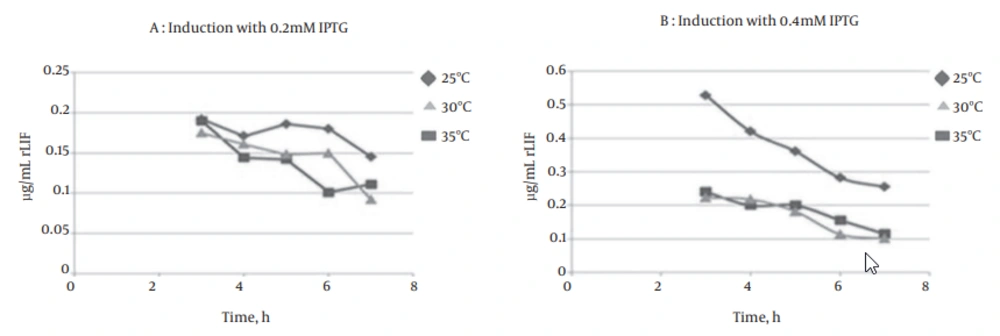
Figure 1.
A and B indicate induction by two different IPTG concentrations. Induction by 0.4 mM of IPTG for 3 hours in 25°C has the most output of purification.
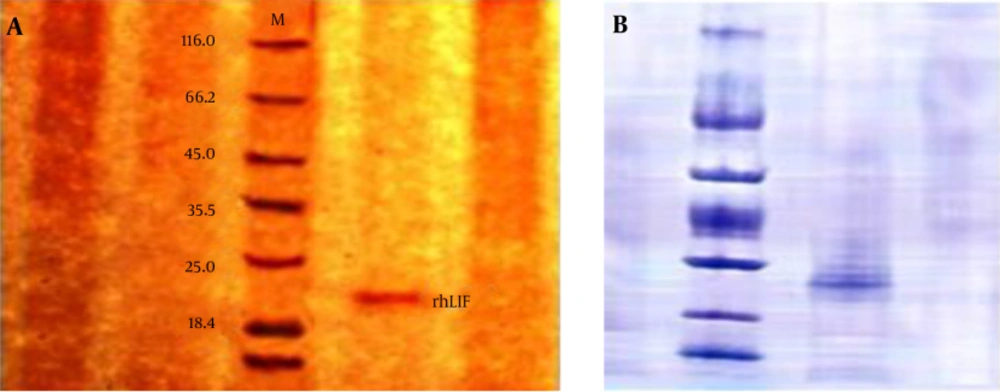
Figure 2.
A, SDS PAGE silver nitrate staining; B, Coomasie brilliant blue R-250.
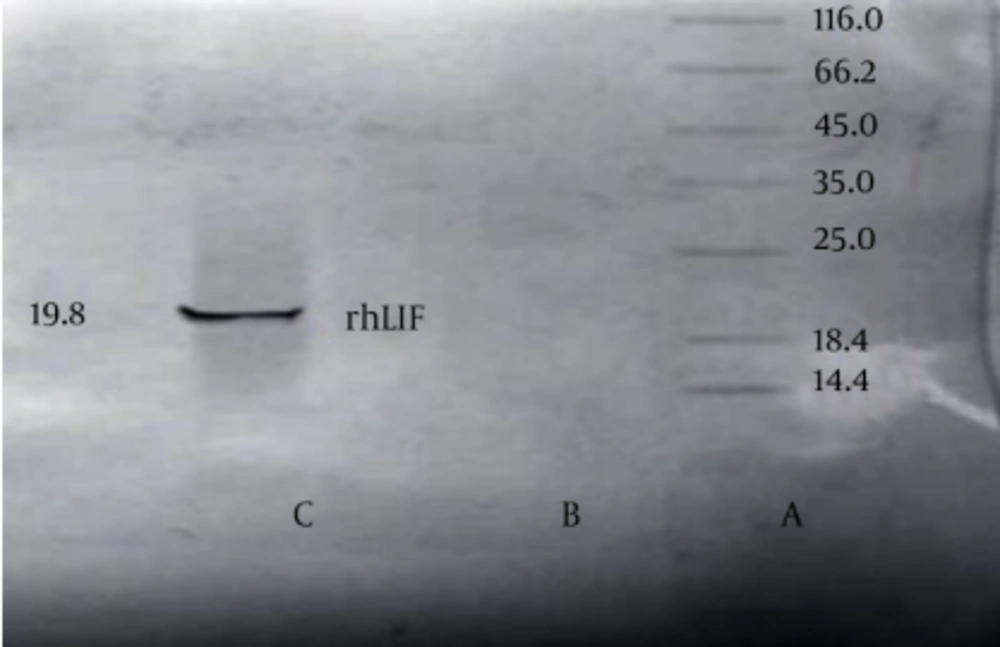
Figure 3.
A, protein molecular weight Marker; B, Transformed E. coli expressing hLIF protein, C: negative control. Desired protein band indicated by arrow.
4.2. Bioactivity of LIF
4.2.1 MTT Assay
To assess the biological activities of the rLIF expressed in E. coli, their ability in induction of TF-1 cell proliferation with MTT assay used. LIF biactivity can be characterized on the basis of its ability to stimulate the proliferation of human erythroleukemia (TF-1) cells. The results indicated that His 6-proteins obviously promote the proliferation of TF-1 cells (Figure 4). This study indicated that the His 6-hLIF protein was an effective factor in inducing TF-1 cells proliferation, so added His-tag at the N-terminal of the rLIF protein do not interfere with bioactivity (Figure 4).
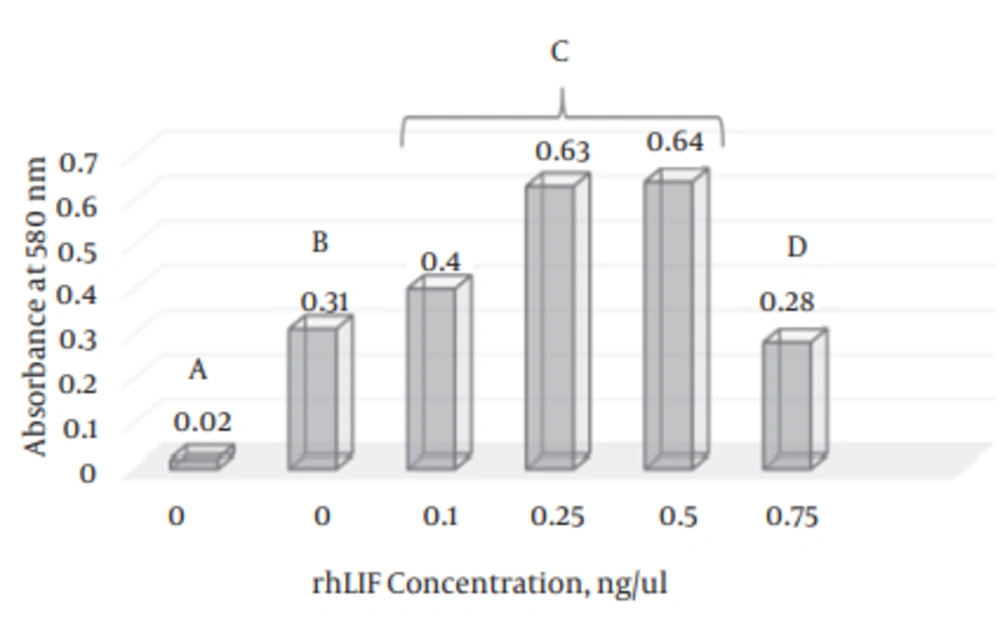
Figure 4.
A, media without cell; B, untreated cells; C, treated cells with different concentration of rhLIF; D, Dead cells because of high rhLIF concentration.
4.2.2. Real Time PCR
In addition, purified His 6-hLIF fusion protein was tested for its ability to induce cytokine inducible SH2-containing protein (CISH) which is a key gene in LIF receptor pathway which is inducable by IL2, IL3, IL6, and IL10(interleukin 2,3,6,10) family, Gamma interferon factor (INF), granulocyte-macrophage colony-stimulating factor) (GM-CSF) and epidermal calcium binding protein (EPO) that results in proliferation, growth, development and immunity. CISH (cytokine inducible SH2-containing protein) induction were tested by real time PCR, two cell lines were used for this propose human monocytes that was extracted from whole blood and TF-1. LIF effects CISH expression in monocytes according to immune response and in TF-1, CISH makes cells to proliferate. After real time PCR reactions, result analyzing indicated an over expression of the CISH after treatment with LIF in contrast to control samples. Over expression of CISH is a reason for rhLIF bioactivity.
5. Discussion
In present study, we approached cloning and optimized expression by codon optimization of the human LIF gene. We effectively produced the recombinant protein easily by simple 0.4 mM of IPTG induction for 3 hours was able to purify it by single affinity chromatography step. We observed that low temperature significantly improves the solubility of hLIF as a fusion protein in E. coli. Also we established a single step protocol for purifying bioactive hLIF relying on His-tag tail by immobilized metal affinity chromatography. The bioactivity of fused hLIF was tested by MTT assay and CISH gene stimulation assay by real time PCR that confirmed its bioactivity.
Degeneracy of the genetic codes can interfere with protein producing in hosts manipulated with external genomic DNA from different species that is result of wobble codons are used differently in prokaryotic common hosts. To solve this we optimized LIF codons for bacteria to gain the recombinant protein easily [23]. The other effective factor in producing recombinant protein in bacteria is temperature that can handles forming of inclusion bodies made of recombinant protein because of over expression, to solve this we cultured and inducted cells in different temperatures as other studies but we tried to combine this tempreture alternation with inducer concentration [24, 25]. To validate the functionality of hLIF, we applied MTT assay as previously reported [26]. The other specifies of our work is single step of purification just by simple affinity chromatography that do not need any subsequent modifying for activating rhLIFT we attached his-tag to the end of the recombinant protein to be able to extract rhLIF easily but in others studies they fuse insoluble agents like s-glutathione transferase to recombinant LIF to make it soluble in cytoplasm for easy extrction. In contrast to other similar works that further modifications is needed to break insoluble agent to obtain bioactive recombinant protein, like separating signal peptide we did not need such extra works [27]. In different studies adding signal peptide made soluble recombinant protein that inhibits inclusion body formation but we reduced this by temperature factor. For measuring LIF bioactivity for the first time we used a key gene that lies in LIF pathway. A method which is sensitive and rapid against embryonic stem cell cultivating and treatment by LIF that costs high. But other studies used stem cell culturing that is high cost and is not easily accessible. In other studies they use stem cell cultivation for indicating rhLIF activity to preserve polypotency but we used a key house-keeping gene that is responsible for LIF effect on different cells and tissues, we examined this gene by Real Time PCR against using highly cost stem cell cultivation [6].