1. Background
Curcuma longa is a herbaceous plant that the rhizome is widely used to flavor and color in foods [1]. It is a dietary source of curcuminoid compounds included curcumin (75 - 95%), dimethoxycurcumin and bisdimethoxy-curcumin. Several chemical compounds, as volatile oil, zynjybrn alpha and beta, turmeric and as well as glucose, arabinose, fructose, glucose and starch in the rhizome of turmeric [2]. Previouslyconciderable studies have been designed to evaluate therapeutic significance of the crude extracts in cancer cell lines of breast, ovarian, colon, liver, leukemia, pancreatic and prostate [3]. Moreover several studies have shown that curcumin prevents from the formation of tumor cells and reduces the speed of many cancers development. In addition several research have shown that the use of turmeric as a spice prevent the growth of cancers of the stomach and colon [4].
Cancer stem cells capable of self-renewal as cancer cells, matched and non-matched cell divisions, resulting in the creation of tumor is known [5]. Recent cells cancer stem cells (CSCs) isolated from the tumor of the breast [6], brain [7], melanoma [8], prostate [9], Osteosarcoma [4] and many other tumors. This observation led to the theory of cancer stem cells. According to this theory within a tumor, a small number of these cells have unlimited proliferative capacity, cause tumor growth. In theory, by the finding that most tumors consist of a heterogeneous population of cells with varying degrees of differentiation match. Perhaps also because the current treatment that target dividing cells in the tumor mass and reduces but not prevents tumor regrowth is that this treatment does not destroy cancer stem cells [10]. The genes that control stem cell self-renewal are a new class of cancer molecular markers that uncontrolled expression of cancer is very important in the process [11]. The genes included OCT4, Nanog, SOX2, KLF4 and Nucleostemin [12, 13]. OCT4 a pronounced pow (POU) domain transcription factor has been that all pluripotent cells during mouse embryogenesis and widely expressed by undifferentiated mouse embryonic stem cells and embryonic cancer cell lines also expressed. However, to date, tests have shown that OCT4 expression in stem cells generally weaker sex as well as OCT4 marker used for human Gennady tumors is poor [14]. These gene produce differential three variants (OCT4A, OCT4B, OCT4B1) with alternative splicing that the protein structure and function are different [15].
Nanog a transcription factor that has homeodomain those stem cells are capable of self-renewal. This gene is one of several factors that can be expressed in pluripotent cells and reduced expression of will in the beginning of differentiation [16]. Nucleostemin gene belongs to the family of binding proteins and protein Guanosine triphosphate (Gtp) single subunit synthesis of this gene, there are mainly low in the nucleolus and nuclear sap. This gene plays an important role in the regulation of P53 protein and the regulation of the cell cycle [17].
2. Objectives
According to the available evidence on the role of curcumin in the treatment and prevention of cancer, this study investigated the effects of curcumin on genes as genes that control the way in gastric cancer cell immortality as representative cell lines.
3. Materials and Methods
3.1. AGS Cancer Cell Line
In this experimental study, gastric cancer cell line (AGS) was purchased from Pasteur institute of Iran. The cells were cultured in RPMI-1640 containing 10% fetal calf serum, penicillin and streptomycin antibiotics and incubated at 37°C with 5% Co2 and 90% humidity.
3.2. Preparation of Curcumin Concentrations
Root of curcumin were obtained from the herbarium of medicinal plants and was extracted with Soxhlet apparatus, similar to previous studies [18], concentrations of 20, 40 and 100 µg/mL of extract (curcumin) was prepared.
3.3. Cell Culture
To investigate the effect of curcumin on studied cell lines, the cells were cultured and passaged several times to ensure the accuracy of the cells and the proliferation finally 2 × 10⁵ cells/mL as adequate levels of cells in primary culture was selected. Cells in the test and control groups with three repetitions for each concentration were cultured. To each well of the six plates for 200 µL cells (40,000 cells), culture medium containing cells was added. Plates incubated and after 24 hours the concentration of the desired three blank cells in plates dedicated to groups the test were added. The control group received sterile distilled water (as a buffer).
RNA extraction and cDNA synthesis: After three times of 24, 48 and 72 hours, cells in test groups (three different levels) and control, harvesting and washing with phosphate-buffered saline (PBS) buffer, total cell RNA (RNA purification kit) was isolated. For cDNA synthesis, RNA obtained from the previous step, were used (conversion kit cDNA synthesis), synthesized cDNAs incubated in -20°C condition.
3.4. Primer Design
Forward and reverse primers of studied genes, OCT4 (variants A, B, B1), Nanog, Nucleostemin and β-actin (as internal housekeeping control gene) were designed with software version 3 design primer and then control at NCBI BLAST software (Table 1).
Table 1.
Sequence of OCT4 Variants, Nanog, Nucleostemin and β-Actin Gens Primers
| Target genes | Designed Oligo | Relative Sequence | Fragment Length |
|---|---|---|---|
| OCT4A | 111 | ||
| F | CGCAAGCCCTCATTTCAC | ||
| R | CATCACCTCCACCACCTG | ||
| OCT4B | 177 | ||
| F | AGAACCGAGTGAGAGGCAAC | ||
| R | TGAGAAAGGAGACCCAGCA | ||
| OCT4B1 | 128 | ||
| F | GCACTTCTACAGACTATTCCTTGG | ||
| R | TGATCCTCTTCTGCTTCAGG | ||
| NANOG | 165 | ||
| F | CCTATGCCTGTGATTTGTGG | ||
| R | AGTGGGTTGTTTGCCTTTG | ||
| Nucleostemin | 174 | ||
| F | CAGAGATCCTCTTGGTTGCAG | ||
| R | AATGAGGCACCTGTCCACTC | ||
| β-actin | 160 | ||
| F | CACACCTTCTACAATGAGC | ||
| R | ATAGCACAGCCTGGATAG |
3.5. Amplification of the Desired Genes
Followed, the cDNA synthesized and preparation of primers of target genes, the real-time PCR was used for detection of interested genes expression. Briefly, 4 µL of specific primers (forward and reverse), 3 µL of DNA, 10 µL mastermix (SYBR Green, Iran) and 3 µL DNase free water (final volume of 20 µL) was added to each well of the PCR plate and covered with special tape to prevent evaporation. The real-time reaction was reproduced with the company’s proposed synthesis of primers (one cycle of 95°C for 30 seconds and 45 cycles with the conditions of 95°C for 10 seconds, 58 - 62°C for 15 seconds, 72°C for 20 seconds). Charts and data devices (numbers ct) were analyzed and evaluated and β-actin gene was used as an internal control.
4. Results
4.1. Expression Pattern of OCT4 Variations
OCT4 expression patterns showed variations in the concentrations studied turmeric extract and after periods of 24, 48 and 72 hours, the expression of both variants OCT4A and OCT4B reduced, while OCT4B1 variants show increased expression (Figure 1).
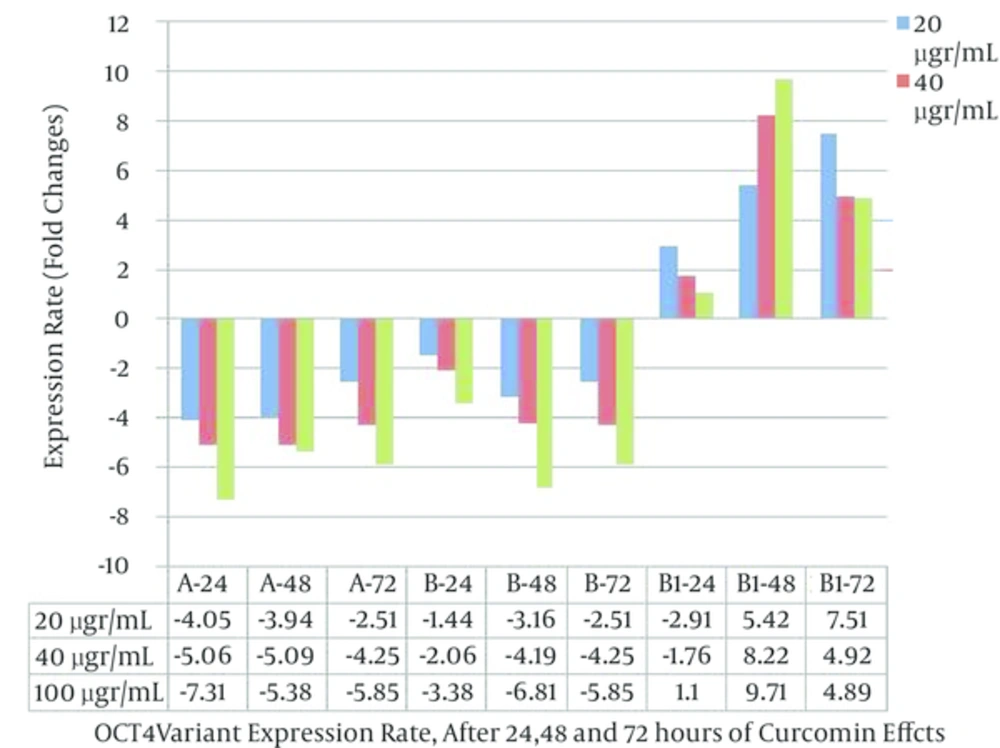
Figure 1.
Expressional Profile of OCT4 Variants (A, B and B1), After Curcumin Concentrations (20, 40 and 100 µg/mL) Effects for 24, 48 and 72 hours in AGS cancer cell line
The results showed the highest rate of decrease in OCT4A and OCT4B variants expression in concentration of 20 µg/mL after 24 hours. Unlike the two other variants (A and B), OCTB1 variants showed increased expression, the highest concentration of 100 µg and 48 hours.
4.2. Expression Pattern of Nanog
As shown in Figure 2 Nanog gene expression were decreased by the concentration of turmeric extract, the maximum reduction occurs in the concentration of 100 µg/mL for 48 hours.
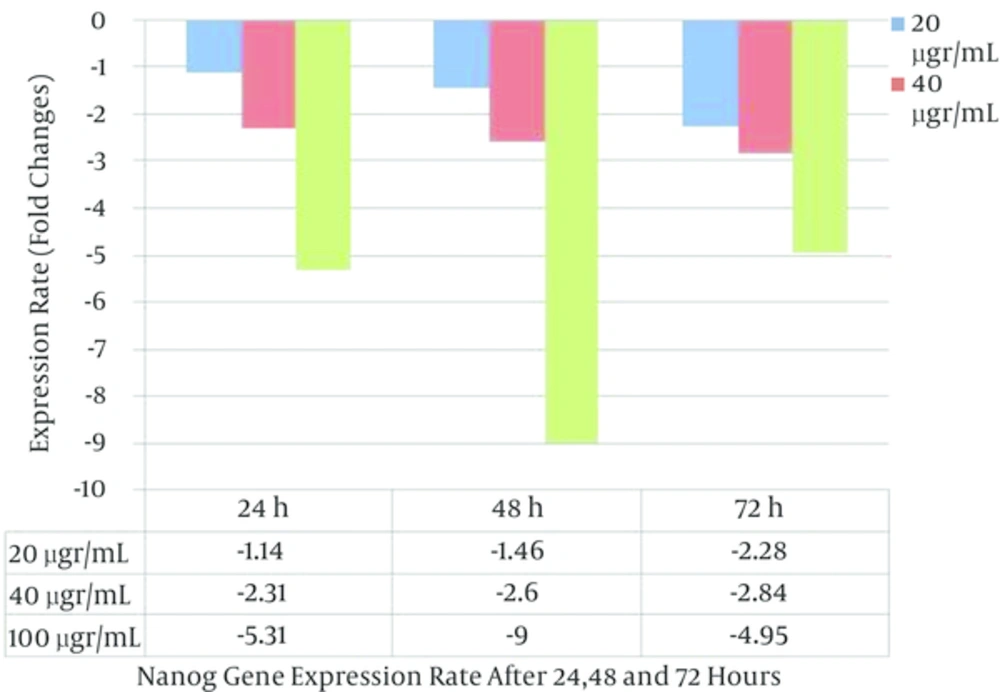
Figure 2.
Expressional Profile of Nanog Gene, After Curcumin Concentrations (20, 40 and 100 µg/mL) Effects for 24, 48 and 72 Hours in AGS Cancer Cell Line
4.3. Expression Pattern of Nucleostemin
Nucleostemin gene expression pattern in studied cell line suggested, turmeric extract concentration were decreased this gene expression after impact with the increase and decrease over time also increased gene expression (Figure 3). The highest reduced expression of this gene was observed in concentration of 100 µg/mL and 72 hours.
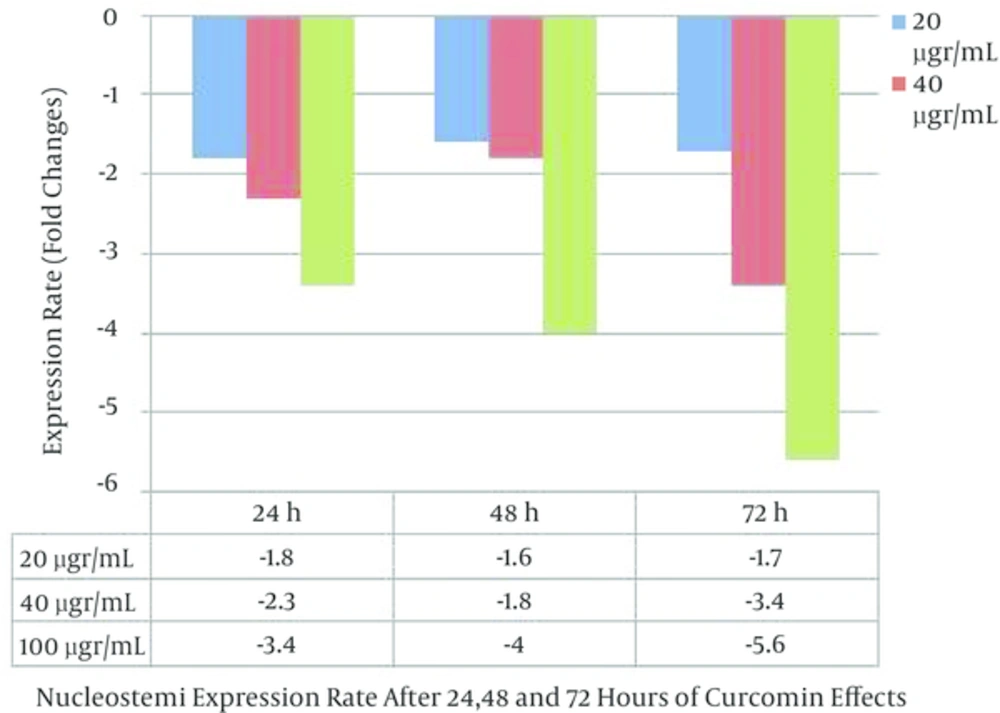
Figure 3.
Expressional Profile of Nucleostemin Gene, After Curcumin Concentrations (20, 40 and 100 µg/mL) Effects For 24, 48 and 72 Hours in AGS Cancer Cell Line
5. Discussion
In this study, the effects of turmeric extract (curcumin) on the expressional profile of genes that control immortality pathway in AGS cancer cell lines were studied. The results showed that turmeric extract have decreased expression variant, OCT4 variants except OCT4B1, Nanog and Nucleostemin genes, a dose-dependent decrease, also change of genes expression was time dependent and may be a mechanism of cell death in response to extract. About all of diseases, including cancers, resulting in dysfunction and changes in the expression of various genes [19].
There are two main hypotheses about cancer, based first, all of tissue cells can converted to cancer cell and established a cancer colon on tissues. According to the second theory, the cells called adult stem cells (ASCs), presented in nearly all tissues, and are origin of cancer. According to “cancer stem cell” hypothesis, many tumors originate from differentiated tissues stem cells [20]. This theory is based on the factors that control the differentiation of stem cells or uncontrolled proliferation of tissue may be the most important factors involved in the approval process are considered carcinogenic [21]. Other evidence supporting this theory resembles a small population of cancer stem cells are tissue cells, the small population of cells capable of escaping of apoptosis and resistance to chemotherapy, so, cancer coming back after the destruction of tumors [13].
OCT4, Nanog, Nucleostemin gene expression capable to create self-renewal state in cells [22]. OCT4 gene includes three variants (A, B, B1), the OCT4B1 variant recently been detected and up-regulated in cancer cells [20]. The increase will vary according to grade that can be useful in cancer diagnosis and determine the degree of malignancy [12, 23]. OCT4 gene includes three variants (A, B, B1), the variant OCT4B1 recently been detected in cancer cells express high. The increase will vary according to grade that can detect cancer and determine its grade. Variant OCT4B1 addition to the cell lines and cancer stem cells expressed similar behavior OCT4A. The zygote to blastocyst stage continues to express the start and after differentiation, cancer stem cells express both reduced but only expressed OCT4B1 seen again. In a previous study related to cancer and cancer genes on tissues belonging to different cancers or cancer cell lines, interesting results have been obtained [15, 24]. In this study, Atlasi et al. showed cytoplasmic expression OCT4B1 directly related to nuclear expression in stem cells is OCT4A. But in cancer cells, while expression of speech stops OCT4A but OCT4B1 will continue. In other words, aberrant expression of epithelial activates genes OCT4 reproductive cells to reproduce and turn these cells into cancer cells, the variant is expressed in these cells OCT4B1 [15].
Conventional cancer treatments have serious side effects and, at best, only a few years, the life expectancy of the patient increases. Complementary medicine therapies can be beneficial in cancer control and anti-tumor compounds suitable for further studies in various countries have done.
Several studies have shown that consumption of certain foods and herbs can inhibit the growth of cancer cells. Dixon et al. effects of curcumin in anti-metastatic breast cancer were investigated. [25]. Wong et al. demonstrated that curcumin may induce apoptosis in specific doses in many cancer cells. Curcumin is the release of cytochrome c and stability of P53 [23]. Curcumin inhibits the transcriptional network in stages and thus prevents the cell proliferation [26]. In another study of cell cycle arrest and growth of curcumin on gastric cancer cells was observed [27]. In this study, the time of differentiated cells gradually stopped path are programmed cell death after treatment with curcumin formulation dendrosome, Bax gene expression levels increased by 50% indicated that the mitochondrial death pathway gradual activation of the indicator programmed cell. To increase the stability and solubility of curcumin, Konecks et al., after examining the antitumor activity of liposomal curcumin on pancreatic cancer cells found that curcumin inhibits the growth of cells in the pancreas [28].
According to emphasize the use of herbal medicines in the treatment of cancer, in this study the effect of different concentrations of curcumin on the expression of genes OCT4 (OCT4A, OCT4B, OCT4B1), Nanog and Nucleostemin in gastric cancer cell was tested and the summery our datas showed that turmeric extract (curcumin) the effect of genes that control immortality pathway and decreased expression help them to reduce the rate of cell division, and this loss leads to the development of cancerous tissue. The results can be used as an example of the use of herbal medicines in the study of the molecular mechanisms of cancer pathways, is used.