
1. Background
Exercise training and curcumin are well-confirmed anti-ageing approaches to protect against age-related diseases. Recently, sirtuin family, the most promising targets for anti-ageing approaches, have attracted many attentions (1). SIRT1, the human homolog of Sir2 protein, is responsible for delayed ageing in animal models (2). It plays a role in many physiological functions, such as gene expression control, cell cycle regulation, apoptosis, DNA repair, metabolism, oxidative stress response, and aging (2). Although there is not enough data about direct role of sirtuins in the improvement of human lifespan, it was shown that healthy lifestyle (regular physical activity and healthy diet) can improve health status through an increase in sirtuins (3). The study of sirtunis activators is one of the most extensive and robust research topics. Some hopes are put on regular exercise (4) and curcumin (2).
Exercise training is one of the interventions reported to reduce the risk of all-cause and cardiovascular mortality by 30% and prevent loss of muscle mass and strength, increase the oxidative capacity of skeletal muscles, exert anti-inflammatory effects, and thereby, postpone age-related muscle deteriorations (5). In the early 20th century, Joseph Pilates suggested a physical fitness system, called Pilates, that is well established to elicit numerous health-beneficial effects and has the potential to counteract age-related diseases, such as metabolic syndrome and diabetes (6, 7).
Recently, curcumin, a natural polyphenol derived from Curcuma longa, is identified as a highly efficient anti-aging factor. As reported by researches, curcumin can extend the lifespan of Caenorhabditis elegans and drosophila (8), and its potential antioxidant, anti-inflammatory, anticancer, neuroprotective, and antidiabetic effects are also confirmed in many studies (9). Based on the results of studies, curcumin can increase mitochondrial biogenesis, exercise endurance, and skeletal muscle oxidative capacity, improve insulin resistance, and inhibit adipogenesis in mice (9).
Effect of turmeric supplementation and exercise training on SIRT1 serum level is examined in animals and human (10-12); however, data about its interactive effects are limited and inconsistent; in addition, studies are largely focused on aerobic exercises (1, 3), with scarce data on the influence of Pilates exercises; a combination of endurance and strength exercises. Moreover, the exact molecular mechanism of curcumin is debated. It is mainly believed that curcumin exerts its metabolic effects via an adenosine monophosphate-activated protein kinase (AMPK) and/or SIRT1-mediated activation of transcriptional coactivator peroxisome proliferator-activated receptor-γ coactivator-1α (PGC-1α) (1).
2. Objectives
The current study aimed at determining the effects of a 12-week daily turmeric intake, alone or along with Pilates training on SIRT1 serum level and body fat percentage in postmenopausal females.
3. Methods
3.1. Study Design
The present randomized, double-blind, placebo-controlled, clinical trial with pre- and post-test design and control group was carried out in accordance with the Declaration of Helsinki: the ethical principles for medical research; all experimental procedures were approved by the Research Ethics Committee of Tabriz University of Medical Sciences (IR.TBZMED.REC.1396.699). The study was also registered at the Iranian Registry of Clinical Trials (IRCT code: IRCT20180218038785N1). Written informed consent was obtained from subjects before the study onset.
3.2. Participants
Forty-eight middle-aged postmenopausal females with sedentary lifestyle were randomly selected from 100 volunteers with a computer-generated random number list to participate in the study (Figure 1).
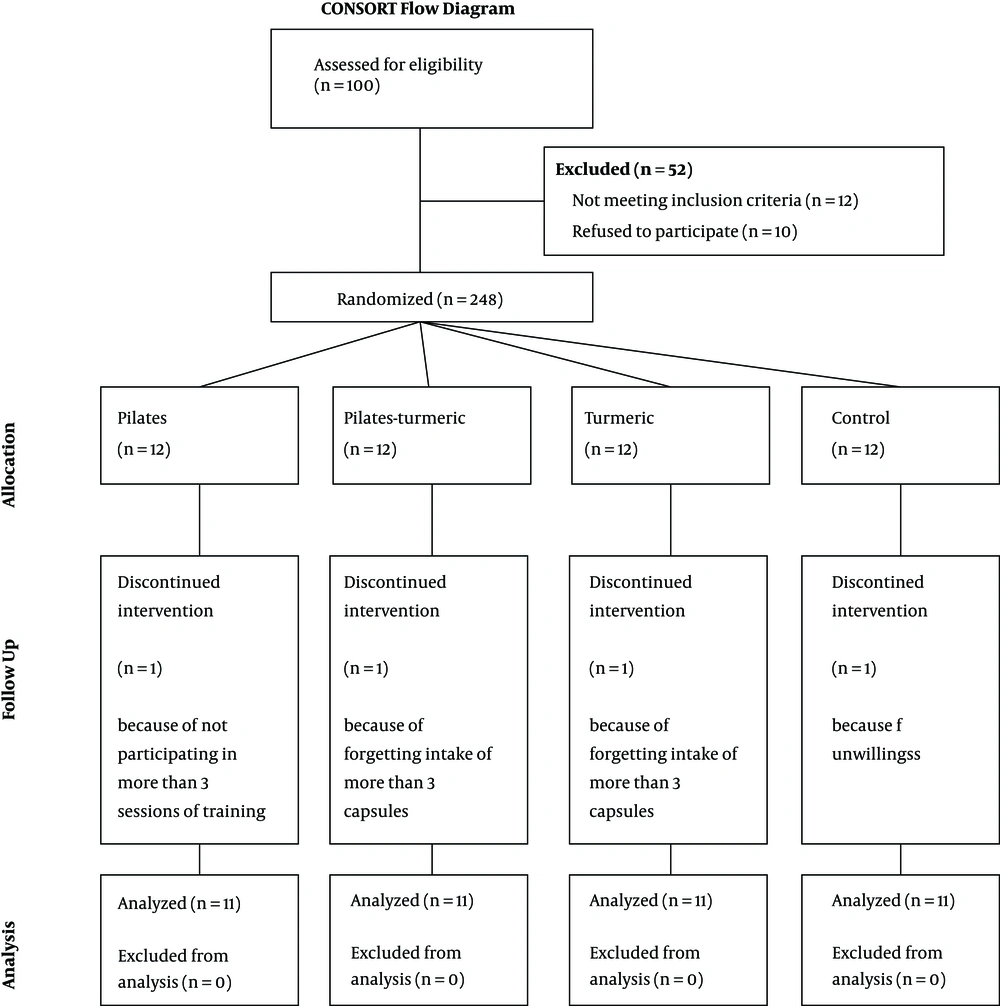
Figure 1.
Consort flow diagram shows the allocation of the study groups
The inclusion criteria of the study were: being overweight, having sedentary lifestyle, and not consuming any drugs and supplements. Subjects were excluded if they had any illnesses or allergies to spices, if they forget to intake capsules more than three times, and if could not participate in more than 20% of Pilates training sessions. Sample size for each group with regard to the study design and prevalence of overweight (~27% with a 95% confidence interval and a margin of error of 0.05) was estimated as 12.
Participants were randomly divided into four homogenous groups as the Pilates training, turmeric supplement, Pilates training plus turmeric supplement, and control. All participants were instructed to take three capsules of 1.5 mg/kg of turmeric/flour daily 30 minutes after each meal. The training group received 60 minutes of Pilates exercises three days a week for 12 weeks (7, 13). The participants in the control group did not participate in any physical exercises and consumed three placebos per day. All subjects were asked to refuse consuming turmeric and other spices containing turmeric. Four subjects could not complete the whole program and were excluded from the study. Subjects’ diet was controlled weekly by food record questionnaire (7, 14). Subjects were blinded to distribution of capsules with the same color and shape, with third person.
Pilates training protocol. The intensity of exercises was 40% - 70% of maximal heart rate. Exercise repetitions were 8 - 20 and Pilates equipment such as weights, balls, and bands were used to increase exercise intensity.
3.3. Measurements
Skin fold thicknesses of participants were measured from the suprailiac, triceps, and thigh points in mm (with Holtain brand Skinfold Caliper). The body fat percentage (BF%) of the participants was computed by Jackson Polack formula (7). Venous blood samples (2 mL) were obtained in two phases, before and 24 hours after protocol, in vaccutainers under strict aseptic conditions. Blood samples were centrifuged at 3000 rpm for 20 minutes to isolate serum. SIRT1 levels were measured by commercial ELISA kit number E: 2557Hu (Shanghai crystal Day, China).
3.4. Statistical Analysis
All values were reported as mean and standard deviation (SD). The Shapiro-Wilk test was used to verify normal statistical distributions. Pairwise t-test and one-way ANOVA were used to determine the significance level (P < 0.05). Bonferroni post-hoc test was used to compare the mean of the groups. SPSS V. 22 was used to do the statistical procedures.
4. Results
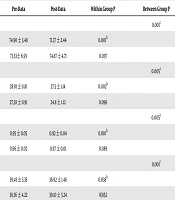
The mean and standard deviation of individual characteristics of the participants at baseline are shown in Table 1. The study results showed that combined Pilates training and turmeric supplementation reduced weight by ~ 8% (Figure 2) and body fat percentage by ~ 6% (Figure 3) and increased serum SIRT1 content by ~ 2.9 fold (P < 0.01) in the trained groups compared with the control group (Figure 4). There were significant differences between the training groups in comparison with the control or turmeric groups in all dependent variables. With regards to almost similar effect sizes, there was no significant difference between Pilates and Pilates-turmeric groups (Table 2). Moreover, turmeric supplementation alone, did not show any significant difference in dependent variables in comparison with the baseline or control group (P ≥ 0.05), (Table 2).
Table 1.
Characteristics of the Patients in All Groups at Baseline Values as Means ± SD
| Variable | Pi (N = 23) | C (N = 23) | P-C (N = 23) | P (N = 23) | P Value |
|---|---|---|---|---|---|
| Age, y | 50.00 ± 3.20 | 51.12 ± 2.90 | 50.96 ± 3.86 | 50.09 ± 5.65 | 0.700 |
| Height, cm | 160.80 ± 1.70 | 160.70 ± 1.60 | 161.20± 1.80 | 161.30 ± 1.30 | 0.884 |
| Weight, kg | 71.82 ± 2.68 | 70.89 ± 3.87 | 71.71 ± 3.11 | 70.81 ± 2.77 | 0.814 |
| BMI | 28.05 ± 1.62 | 27.69 ± 2.83 | 27.66 ± 2.43 | 27.31 ± 2.29 | 0.826 |
| Body Fat, % | 36.52 ± 2.02 | 37.12 ± 2.05 | 37.90 ± 2.08 | 37.63 ± 1.78 | 0.361 |
Table 2.
Comparison of the Changes in Variables Within and Between Four Groups at Baseline and After 12 Weeks of Pilates Training and Turmeric Supplementationa
| Variables | Pre-Test | Post-Test | P Value Within Groups | F | P Value Between Groups |
|---|---|---|---|---|---|
| SIRT1, pg/mL | 37.819 | 0.001b | |||
| Pilates | 10.41 ± 0.9 | 31.12 ± 0.6 | 0.000c | ||
| Pilates- Turmeric | 11.64 ± 2.90 | 33.80 ± 2.31 | 0.000c | ||
| Turmeric | 11.51 ± 0.90 | 15.13 ± 1.31 | 0.732 | ||
| Control | 12.01 ± 3.7 | 11.90 ± 2.8 | 0.865 | ||
| Weight, kg | 18.75 | 0.001b | |||
| Pilates | 71.81 ± 9.43 | 65.92 ± 8.65 | 0.000c | ||
| Pilates- Turmeric | 71.73 ± 3.11 | 65.71 ± 2.52 | 0.000c | ||
| Turmeric | 70.90 ± 2.94 | 70.61 ± 3.46 | 0.345 | ||
| Control | 70.82 ± 2.31 | 71.04 ± 2.50 | 0.468 | ||
| BF, % | 24.65 | 0.001b | |||
| Pilates | 36.54 ± 3.11 | 30.51 ± 2.60 | 0.001c | ||
| Pilates- Turmeric | 37.93 ± 1.50 | 32.01 ± 1.22 | 0,001c | ||
| Turmeric | 37.14 ± 4.3 | 36.98 ± 2.8 | 0.078 | ||
| Control | 37.60 ± 2.01 | 38.01 ± 3.00 | 0.094 |
aValues are presented as mean ± SD.
bSignificant difference between group (one-way ANOVA).
cSignificant difference within group (pairwise t-test).
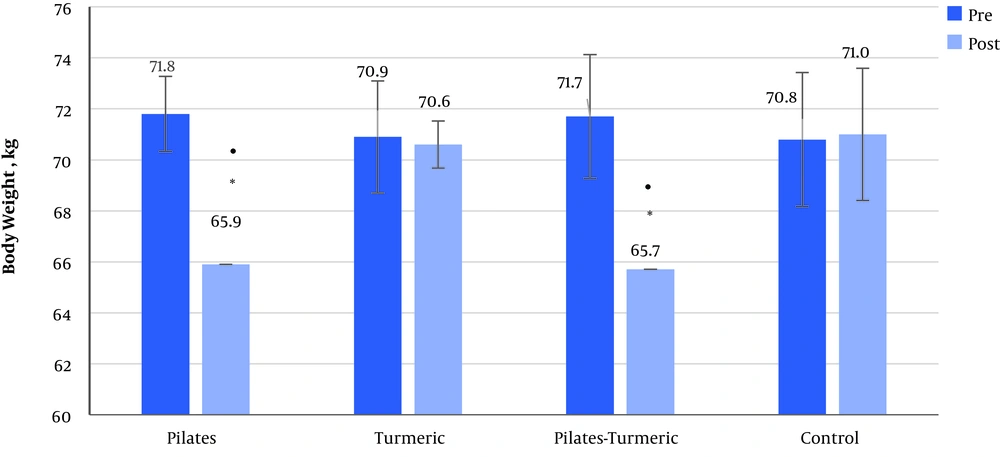
Figure 2.
Body weight in the different experimental groups at the beginning and end of the study. Values are presented as means ± SD. *P = 0.01 vs. pretest in the same group. ●P = 0.02 vs. turmeric and control groups.
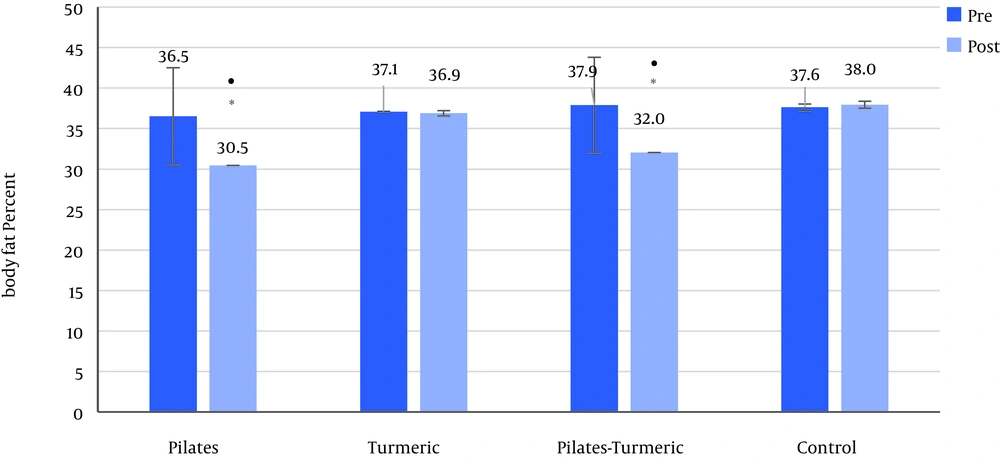
Figure 3.
Body fat percent in the different experimental groups at the beginning and end of the study. Values are presented as means ± SD. *P = 0.02 vs. pretest in the same group. ●P = 0.01 vs. turmeric and control groups.
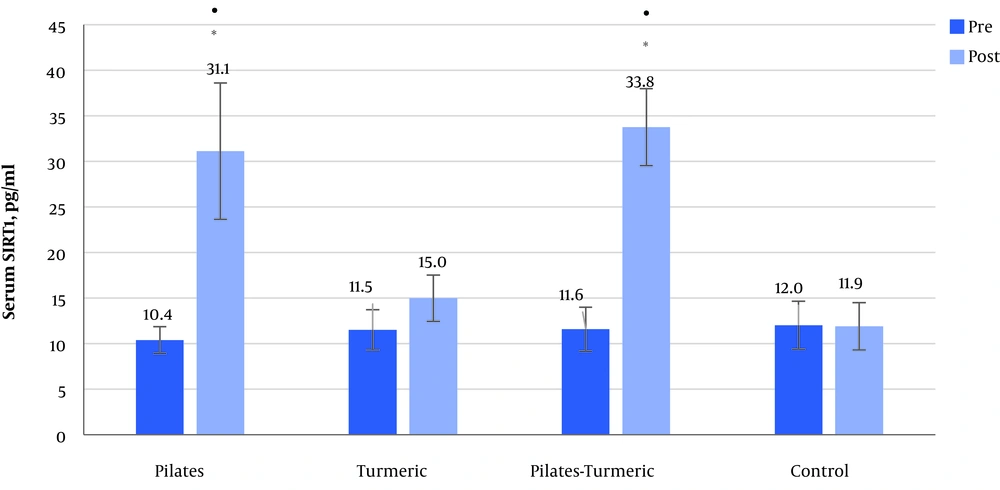
Figure 4.
Serum Sirtuin1 in the different experimental groups at the beginning and end of the study. Values are presented as means ± SD. *P = 0.01 vs pre-test in the same group. ●P = 0.01 vs. turmeric and control groups.
5. Discussion
According to the findings, although Pilates training with and without turmeric supplementation significantly increased serum SIRT1 concentration and decreased weight and body fat percent, turmeric supplementation alone did not affect these parameters. These findings challenge the current study hypotheses and previous turmeric studies. There was no similar study in the literature to compare results and most of curcumin studies were performed on other organisms such as nematode, animals or human cell cultures (8, 10, 12).
The observation that Pilates training increased SIRT1 was in accordance with previous reports in rodents (1, 3, 10) and a study on human subjects (15) but in contrast to a previous report on human subjects did not declare any effects of exercise on SIRT1 (16). It seems that using subjects in different ages with different physical fitness levels and different types of exercises with different intensities can be the cause of inconsistency of different findings of studies. Ma et al. observed no changes in SIRT1 content following four weeks of low volume high intensity exercise in young males (16). Usually, the change in the variables depends on their basal level, and the major changes are observed after an intervention in subjects with lower base and fewer levels (15). Participants in the current study were overweight non-athlete females, and since the level of SIRT1 was lower in overweight and obese subjects, their SIRT1 levels reached a significant level. Also, it seems that duration of intervention in the study by Ma et al. was shorter than that of the present study, which can be the cause of inconsistency.
Pilates training method was used as an exercise program in the current study since this method helps to increase energy consumption of exercise through using respiratory and core muscles more than other exercise methods (7).
Potential mechanisms to explain the exercise-induced increase of the SIRT1 are caloric restriction (CR), nitric oxide synthase (NOS) and AMPK (2). CR induced with exercise training can act as a Sirtuin activator. As suggested, CR and exercise training have similar effects (2, 17) and weight and body fat percent reduction is the fact that supports this suggestion. Endurance exercise increases skeletal muscle NOS and AMPK expression and activity and induces SIRT1 expression (17).
SIRT1 antiaging effects are through deacetylation and activation of PGC-1α, which can coactivate various transcriptional factors including NRF-1 and NRF-2 and peroxisome proliferator-activated receptors α, γ, and δ. Since such transcriptional factors regulate the genes involved in mitochondrial fatty acid oxidation, in the TCA cycle and in the respiratory chain, such functions of SIRT1 and PGC-1α may at least partially lead to the association between these protein expressions and mitochondrial biogenesis. Human aging is generally linked to a progressive mitochondrial dysfunction (17). Part of this deterioration is caused by decrease in NAD+ availability and consequent functional impairment of the deacetylase SIRT1 (18). Indeed, low SIRT1 activity results in the acetylation-dependent inactivation of PGC1α, MYC, and HIF1A, which limits the PGC1 α -dependent expression of nuclear genes encoding mitochondrial proteins, as well as the MYC- and HIF1A-dependent expression of mitochondrial transcription factor TFAM (2). SIRT1 is an inhibitor of NF-kB and decreases the inflammaging process via NF-kB and also deacetylates FOXO3 and increases FOXO3’s ability to induce cell cycle arrest. It also inhibits the ability of FOXO3 to induce cell death. This example illustrates how alterations in the intracellular levels of one single metabolite can contribute to mitochondrial aging by impairing mitonuclear communication (2).
There are contradictory reports about turmeric and its effective compound, curcumin, on SIRT1 levels and expression (12, 19, 20). It seems that using different forms of curcumin instructions such as injection or oral supplementation, and different forms of curcumin compounds such as turmeric powder, extract or soluble curcumin, on different type of subjects such as human or rat can be the cause of inconsistency. Grabowska et al. observed that curcumin elevates SIRT1 levels in human vascular cells (12), Sahin et al. reported the elevation of SIRT1 and prevention of muscle damage by supplementation of novel water-soluble CW formulation in rats (20), and Ray Hamidie et al. showed that Curcumin injection in combination with exercise training increased cytosol NAD+/NADH ratio and SIRT1 protein in Wistar rats muscles (19). But Nishimora et al. reported the down regulation of SIRT1 expression with ethanol extract of turmeric in human cells (21).
The current study results showed that 12 weeks of Pilates training with or without turmeric supplementation significantly decreased weight and body fat percent in overweight females. It was in agreement with studies that showed Pilates training could improve body composition (6, 7).
The results showed that turmeric supplementation did not have significant effects on body composition. There are contradictory reports about the effects of curcumin on body weight and body fat percent (22-25). Di Pierro et al. showed that 30 days of supplementation with bioavailable form of curcumin can enhance weight management protocols and approaches (24). They reported that administration of curcumin with weight loss diet in metabolic syndrome affected subjects, besides, its local effects on liver and adipose tissue can decrease cortisol and reduce appetite. It seems that the difference in subjects’ health condition can be the cause of disagreement, since subjects of the present study were healthy overweight females and did not show any effect on body composition.
According to the reports, curcumin down-regulates expression of genes responsible for energy metabolism and lipid accumulation and decreases the level of intracellular lipids. Moreover, curcumin suppresses angiogenesis essential for tissue growth, and down regulates the expression of several key genes responsible for adipogenesis and lipogenesis such as PPARγ and C/EBPα (26).
Most of researches used curcumin, but the current study employed natural turmeric powder. Orally administered turmeric has low systemic bioavailability. According to studies, oral administration of curcumin indicates the trace levels of parent compound and its metabolites in the liver and portal circulation (9). The factors that constrain curcumin bioavailability include chemical instability at intestinal pH, very poor water solubility, high rate of urine elimination as glucuronide or sulfate, poor absorption, rapid metabolism, and rapid systemic elimination (9). Curcumin delivery method as well as the duration of treatments may be the result of inconsistency of reports. Cooking or dissolution in oil may increase bioavailability of the curcumin existing in foods (27). It is also reported that Piperine increases the bioavailability of curcumin (28). However, using turmeric or curcumin extract or more novel delivery approaches such as nanoparticles may be more effective and provide certain health benefits (29). WHO recommends 0 - 3 mg/kg body weight as an acceptable daily intake of curcumin as an additive. Safe dose of turmeric powder was used in the current study and no discomfort and side effects were reported (9).
Accordingly, curcumin had beneficial effects on the improvement of plasma SIRT1, lipid profile, glucose tolerance, insulin sensitivity or lifespan in “metabolically disordered” models (29-31). Since these observations indicate, a certain degree of metabolic dysfunction is required to obtain favorable effects of curcumin. It seems that the subjects in the present study were “metabolically healthy” to experience any improvements with turmeric. However, future human studies are needed to verify this and elucidate the apparent species-related discrepancies.
The current study had some limitations such as shortage of funds and financial support to check SIRT1 gene expression, other chemical parameters such as PGC1-α, AMPK, FOXO3 and NOS mRNA and content to determine mechanisms, furthermore, there was no follow-up; personal and genetic differences, stress, and sleep of the subjects could not be controlled. Finally, it is suggested that further studies incorporating laboratory data changes such as SIRT1 gene expression, PGC1-α, AMPK, FOXO3 and NOS mRNA and content should be undertaken for a more in-depth assessment of the effects of Pilates training and turmeric supplementation on aging process. In addition, as the duration of the present study was approximately short (12 weeks), it seems advisable that the long-term effects of turmeric supplementation be investigated in larger groups of participants.
5.1. Conclusions
In conclusion, the present study findings indicated that moderate to high intensity Pilates training with and without turmeric supplementation can have beneficial metabolic effects but turmeric supplementation alone did not elicit significant improvements in SIRT1 and body composition in healthy middle-aged females. It is suggested that more bioavailable forms of curcumin or bioavailability enhancers such as piperine to get better results.