Fulltext
The full text is available in PDF.
International Cardiovascular Research Journal
An annual journal in scientific affiliation with the Cardiovascular Research Center, Shiraz University of Medical Sciences
Image Credit:Int Cardiovasc Res J
Authors
Background: Increased right atrial pressure due to pulmonary hypertension may impair venous drainage with resultant coronary sinus dilatation. The aim of this study was to search for correlations between coronary sinus diameter and estimated pulmonary artery pressure in children.
Methods: In a prospective study, 100 children who were referred consecutively for transthoracic echocardiography were included in this study. Ratios of coronary sinus diameter to weight, body surface area and aortic annulus were calculated for in each patient. Correlation between coronary sinus diameter and estimated pulmonary artery pressure was studied by person correlation. A tricuspid regurgitation peak gradient more than 36 mmHg or pulmonary regurgitation peak gradient more than 25 mmHg were considered as pulmonary hypertension.
Results: Sixty-eight of our participants had no pulmonary hypertension and 32 did. Mean age was 7.6 years in the patients without pulmonary hypertension and 8.0 years in the patients with pulmonary hypertension (P=0.11). Mean coronary sinus diameter to aortic annulus diameter ratio was 0.49 ± 0.13 in the patient with pulmonary hypertension versus 0.38 ± 0.12 in the patient without pulmonary hypertension (P<0.001). The coronary sinus diameter to body surface area ratio was 1.3 ± 0.59 versus 0.7 ± 0.28 (P<0.001), and coronary sinus diameter to weight ratio was 0.06 ± 0.03 versus 0.02 ± 0.01 (P<0.001).
Conclusion: coronary sinus dilation was documented in pediatric patients with pulmonary hypertension. The ratios of coronary sinus diameter to aortic annulus diameter, body surface area and weight correlated significantly with pulmonary hypertension.
© 2017, Author(s). This open-access article is available under the Creative Commons Attribution 4.0 (CC BY 4.0) International License (https://creativecommons.org/licenses/by/4.0/), which allows for unrestricted use, distribution, and reproduction in any medium, provided that the original work is properly cited.
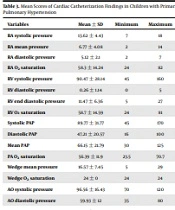
Mottaghi H, Ghofrani M, Alizadeh B, Abbasi Shaye Z, Heidari E. The Predictability of Echocardiography in Children with Primary Pulmonary Hypertension and Its Comparison with Cardiac Catheterization Parameters. Zahedan J Res Med Sci. 2022;24(4):e115130. doi: https://doi.org/10.5812/zjrms-115130
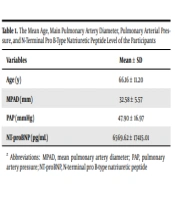
Gharibi S, Ghavami M, Khederlou H, Ghorashi SM, Dabiran S, et al. Evaluation of the Correlation of Pulmonary Arterial Hypertension (PAH) with the Pulmonary Artery Trunk Diameter and Serum Level of N-Terminal Pro B-Type Natriuretic Peptide (NT-proBNP) in Patients with PAH. I J Radiol. 2023;20(2):e133022. doi: https://doi.org/10.5812/iranjradiol-133022
Noori N, Meraji M. Comparison between echocardiography finding and cardiac catheterization data in diagnosis of pulmonary hypertension. Zahedan J Res Med Sci. 2005;7(4):e94923. doi:
Parsaee M, Saedi S, Salehi N, Saedi T. Altered Pulmonary Venous Flow Pattern in Young Adults with Atrial Septal Defect. Int J Cardiovasc Pract. 2016;1(2):e130036. doi: https://doi.org/10.20286/ijcp-010206
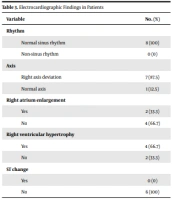
Mottaghi Moghaddam Shahri H, Ghofrani M, Alizadeh B, Seyedi J, Heidari E. Clinical and Paraclinical Findings of Primary Pulmonary Hypertension in Children. Multidiscip Cardio Annal. 2023;14(1):e114419. doi: https://doi.org/10.5812/mca-114419
Last Update: 2 weeks ago
Last Update: 2 weeks ago
Last Update: 2 weeks ago
Last Update: 3 hours ago
Last Update: 7 hours ago
Last Update: 5 days ago
