
1. Background
Pulmonary arterial hypertension (PAH) is a devastating and progressive pulmonary vascular disease, leading to right-sided heart failure and death (1, 2). Diagnostic delay in PAH leads to irreversible changes in patients (3). Many factors are associated with PAH, which has different manifestations (4, 5). Commonly, it is defined as a resting mean pulmonary arterial pressure (mPAP) > 25 mmHg or mPAP > 30 mmHg during exercise (5). Echocardiography is considered a non-invasive tool for evaluating the extent, cause, and prognosis of PAH and management approaches (6). However, the diagnostic sensitivity of echocardiography is lower than that of right heart catheterization (RHC) (7).
Although RHC remains the gold standard diagnostic tool for PAH, it is an invasive strategy (8, 9). Computed tomography (CT) scan is also used to assess the lung parenchyma and pulmonary vasculature. CT findings, such as the main pulmonary artery diameter (MPAD) and MPAD/ascending aorta diameter (AAD) ratio, are the predictors of PAH (10, 11). It should be noted that the absence of CT findings does not exclude the diagnosis of PAH (12). Evidence suggests that a combination of CT and echocardiographic markers of PAH has a significantly higher diagnostic accuracy than either test used in isolation and may identify other potential causes of respiratory discomfort (13, 14). Overall, the presence of MPAD > 28 mm and MPAD/ADD ratio > 1 on CT scan represent a very high probability of PAH (11, 12). Additionally, N-terminal pro B-type natriuretic peptide (NT-proBNP) and prohormone B-type natriuretic peptide (proBNP) can be regarded as prognostic predictors in patients with PAH (15).
2. Objectives
The current study aimed to assess the correlation of CT-based MPAD with both PAH severity on echocardiography and NT-proBNP level in patients with PAH due to chronic obstructive pulmonary disease (COPD).
3. Patients and Methods
3.1. Study Description
This cross-sectional study was performed on patients with a diagnosis of COPD exacerbation, who were admitted to Imam Khomeini Hospital Complex (IKHC), a general university-affiliated center in Tehran, Iran, from March 2019 to March 2020. Patients with MPAD > 29 mm on CT scan were considered eligible for the study. The patients underwent additional paraclinical evaluations, such as echocardiography and laboratory tests. Their demographic and clinical characteristics, laboratory findings, echocardiographic parameters, and CT findings were retrieved from the hospital/medical records.
All the patients underwent imaging in the supine position, with inspiration breath holding. In this study, CT scanning, including pulmonary CT angiography and spiral chest CT scan with or without contrast with 3D reconstruction, was performed using a single multi-detector CT scanner (a 16-slice CT scanner, SOMATOM Sensation 16, Siemens, Forchheim, Germany) and reported by an experienced radiologist. The MPAD on CT scan was measured using true axial and 3D reconstruction models.
Echocardiography was performed using an echocardiographic device (Vivid S60, GE Healthcare, Chicago, IL, USA) by an experienced cardiologist. Multiple views were used for the optimal Doppler estimation of tricuspid regurgitation velocity (TRV). The tricuspid regurgitation gradient (TRG) was then calculated based on the modified Bernoulli equation (TRG = 4V2). Moreover, blood samples were drawn from the peripheral vein for NT-proBNP measurements. The plasma levels of NT-proBNP were analyzed using the enzyme-linked immunosorbent assay (ELISA).
The exclusion criteria were as follows: (1) artifacts on CT scans; (2) lack of NT-proBNP measurements and/or accurate mPAP measurements via echocardiography; and (3) conditions leading to either elevated NT-proBNP levels or increased MPAD, including heart failure with preserved or reduced ejection fraction, myocarditis, takotsubo cardiomyopathy, acute myocardial infarction/coronary artery disease, cerebrovascular accidents, subarachnoid hemorrhage, septic shock, acute respiratory distress syndrome, hepatic cirrhosis, hyperthyroidism, atrial fibrillation, history of congenital heart disease, acute and chronic thromboembolic pulmonary hypertension, chronic kidney disease, connective tissue disorders, and vasculitis. Finally, 63 patients who met the inclusion criteria were enrolled in the final analysis.
3.2. Definitions of Variables
In this study, COPD was defined as a chronic condition, associated with abnormal pulmonary function (post-bronchodilator forced expiratory volume in 1 second [FEV1]/forced vital capacity [FVC] ratio < 0.70 and FEV1 < 80% with frequent exacerbation, necessitating recurrent hospitalization and long-term use of bronchodilators) (16). Also, PAH was defined as resting mPAP > 25 mmHg or mPAP with exercise > 30 mmHg on echocardiography (5).
3.3. Ethical Statement
All the participants provided written informed consent before inclusion in the study. The investigations conformed to the principles outlined in the Declaration of Helsinki. The study protocol was approved by the institutional ethics committee of IKHC (ethical code: IR.TUMS.IKHC.REC.1398.284).
3.4. Statistical Analysis
Continuous data were described by measuring mean and standard deviation (SD) or median with 25th and 75th percentiles for variables with normal and skewed distributions, respectively. The normal distribution of variables was examined using histogram charts, as well as descriptive indices. Number and frequency (%) were measured for describing categorical variables. Chi-square test was also used to compare discrete variables, and student’s t-test was employed to compare the mean values of two quantitative variables. Additionally, bivariate correlations between two normally distributed variables were measured by Pearson’s correlation coefficient test. Also, to compare categorical groups, one-way analysis of variance (ANOVA) test was performed. Differences were considered significant at a P-value < 0.05. All statistical analyses were conducted in IBM SPSS Statistics for Windows Version 23.0 (IBM Corp. Released 2015. IBM SPSS Statistics for Windows, Version 23.0. Armonk, NY: IBM Corp.).
4. Results
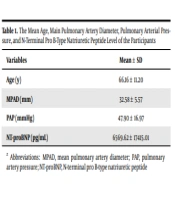
In this study, 63 patients were examined, including 44 male and 19 female patients. The mean age of the patients was 66.16 ± 11.20 years (Table 1).
Table 1.
The Mean Age, Main Pulmonary Artery Diameter, Pulmonary Arterial Pressure, and N-Terminal Pro B-Type Natriuretic Peptide Level of the Participants
| Variables | Mean ± SD |
|---|---|
| Age (y) | 66.16 ± 11.20 |
| MPAD (mm) | 32.58 ± 5.57 |
| PAP (mmHg) | 47.90 ± 16.97 |
| NT-proBNP (pg/mL) | 6569.62 ± 17415.01 |
Abbreviations: MPAD, mean pulmonary artery diameter; PAP, pulmonary artery pressure; NT-proBNP, N-terminal pro B-type natriuretic peptide.
The mean, minimum, and maximum values of MPAD were 32.58, 21, and 55 mm, respectively. The mean PAP was 47.90 mmHg, ranging from 21 to 97 mmHg. The NT-proBNP level ranged from 2 pg/mL to 122,971 pg/mL, with an average value of 6569.62 pg/mL. Overall, 86% of the patients had serum NT-proBNP levels < 10,000 pg/mL, and only two patients had a serum NT-proBNP level of about 120,000 pg/mL. The MPAD mainly ranged from 30 mm to 40 mm, and only two patients showed MPAD > 50 mm.
Based on the results, PAP was in the range of 20 - 70 mmHg in the majority of the patients. PAP < 20 mmHg was not detected in any of the patients. Age was not significantly correlated with MPAD, PAP, or NT-proBNP level. On the other hand, MPAD showed a significant positive correlation with the level of NT-proBNP (r = 0.444, P < 0.001). Overall, PAP had a significant positive correlation with MPAD (r = 0.306, P = 0.015). A similar relationship was also observed between PAP and NT-proBNP level (r = 0.353, P = 0.005) (Table 2).
Table 2.
Correlations of N-Terminal Pro B-Type Natriuretic Peptide Level with Age, Main Pulmonary Artery Diameter, and Pulmonary Arterial Pressure (Section A) and Correlation of Pulmonary Arterial Pressure with Main Pulmonary Artery Diameter (Section B)
| Variables | NT-proBNP | PAP | ||
|---|---|---|---|---|
| Pearson’s correlation coefficient (r) | P-value | Pearson’s correlation coefficient (r) | P-value | |
| Section A | ||||
| Age | 0.008 | 0.937 | - | - |
| MPAD | 0.444 | < 0.001 | - | - |
| PAP | 0.353 | 0.005 | - | - |
| Section B | ||||
| MPAD | - | - | 0.306 | 0.015 |
Abbreviations: MPAD, mean pulmonary artery diameter; PAP, Pulmonary artery pressure; NT-proBNP, N-terminal pro B-type natriuretic peptide.
In the majority of the patients (74.7%), MPAD was > 30 mm. Based on the results, half of the patients (50.7%) had a PAP of 40 - 60 mmHg, 17 (27%) patients had a PAP < 40 mmHg, and 14 (22.3%) patients had a PAP > 60 mmHg. The mean PAP was 41.06 mmHg in patients with MPAD < 30 mm and 54.45 mmHg in patients with MPAD > 30 mm; however, the difference was not significant (P = 0.221). Regarding the NT-proBNP level, the difference was greater, with significantly higher NT-proBNP levels detected in patients with MPAD > 30 mm (P = 0.009). Only the NT-proBNP level was significantly different between three levels of PAP (20 - 40, 41 - 60 and > 60 mmHg) (P = 0.042), and regarding MPAD, the difference was not significant (P = 0.221) (Table 3).
Table 3.
Relationship of Pulmonary Arterial Pressure, Main Pulmonary Artery Diameter, and N-Terminal Pro B-Type Natriuretic Peptide Level in Patients with Pulmonary Arterial Hypertension a
| Variables | MPAD (mm) | PAP (mmHg) | ||||
|---|---|---|---|---|---|---|
| No. (%) | Mean ± SD | P-value | No. (%) | Mean ± SD | P-value | |
| Section A | ||||||
| PAP (mmHg) | 0.221 | - | ||||
| < 30 | 16 (25.3) | 41.06 ± 12.40 | - | - | ||
| ≥ 30 | 47 (74.7) | 54.45 ± 16.59 | - | - | ||
| NT-proBNP (pg/mL) | 0.009 | - | ||||
| < 30 | 16 (25.3) | 1533.75 ± 2024.12 | - | - | ||
| ≥ 30 | 47 (74.7) | 4150.81 ± 2762.91 | - | - | ||
| Section B | ||||||
| MPAD (mm) | - | 0.126 | ||||
| 20 - 40 | - | - | 17 (27) | 30.94 ± 6.86 | ||
| 41 - 60 | - | - | 32 (50.7) | 33.31 ± 4.70 | ||
| > 60 | - | - | 14 (22.3) | 34.79 ± 4.26 | ||
| NT-proBNP (pg/mL) | - | 0.042 | ||||
| 20 - 40 | - | - | 17 (27) | 2294.71 ± 2352.38 | ||
| 41 - 60 | - | - | 32 (50.7) | 3528.91 ± 2838.03 | ||
| > 60 | 14 (22.3) | 4835.21 ± 2860.13 | ||||
Abbreviations: MPAD, mean pulmonary artery diameter; PAP, pulmonary artery pressure; NT-proBNP, N-terminal pro B-type natriuretic peptide; PAH, Pulmonary arterial hypertension.
aSection A: Comparison of pulmonary arterial pressure and N-terminal pro B-type natriuretic peptide in different subgroups based on main pulmonary artery diameter; Section B: Comparison of main pulmonary artery diameter and N-terminal pro B-type natriuretic peptide in different subgroups based on pulmonary arterial pressure.
5. Discussion
In this study, relationships between CT-based MPAD, PAH severity based on echocardiography, and NT-proBNP level were evaluated in patients with PAH. Expectedly, PAP was positively correlated with the NT-proBNP level, and MPAD had significant positive correlations with the NT-proBNP level and PAP. In this regard, according to a study by Corson et al., the sensitivity and specificity of MPAD > 29 mm for PAH identification were 0.89 and 0.83, respectively (17). According to the present results, the sensitivity of vascular criteria for PAH identification was high; however, specificity did not appear to be acceptable for routine clinical use in a patient population (17).
In another similar study by Sabri et al. in 2013, patients with MPAD > 29 mm were divided into three groups: < 35 mm, 35 - 40 mm, and > 40 mm. In this study, a significant strong relationship was found between MPAD and PAP (18). Moreover, Caravita et al. (19) concluded that in patients with connective tissue disorders and PAH, PAP is positively correlated with the NT-proBNP level. Additionally, Mohammedi et al. reported a significant association between the MPAD and PAP (11). The sensitivity of MPAD > 29.5 mm and > 31.5 mm for PAH detection was estimated at 70.8% and 52.0%, respectively, and the specificity of MPAD > 29.5 mm and MPAD > 31.5 mm was 79.4 % and 90.2%, respectively (11). Also, according to a study by Fakharian et al. (20), CT-based MPAD > 29 mm was of diagnostic value for PAH, with 63% sensitivity and 41.5% specificity. Overall, the results of these studies are consistent with the present research.
Additionally, Greig et al. (21) detected a positive relationship between the BNP level and pulmonary vascular resistance, whereas no significant relationship was found between PAP and the BNP level. Meanwhile, another study by Bernus et al. (22) on 78 pediatric patients showed no significant correlation between a single BNP measurement and echocardiographic or hemodynamic parameters. However, changes in the BNP level over time were strongly related to echocardiographic and hemodynamic data; the results of this study highlighted the importance of BNP monitoring.
To the best of our knowledge, no study has yet found a significant correlation between MPAD and NT-proBNP. The present study showed a significant positive correlation between the serum NT-proBNP level and the pulmonary artery diameter. However, since a small sample size may indicate a non-significant relationship between variables in some subgroups, further prospective research with a larger sample size may be more helpful. Also, this study only included patients with MPAD > 29 mm; therefore, specificity and sensitivity could not be assessed, which is another limitation of this study. Finally, since this study had a retrospective design and only evaluated patients undergoing CT scan without contrast, measurement biases due to non-contrast imaging studies and CT angiography with different slice thicknesses may be its other limitations.
In conclusion, the results of the present study showed that PAP was positively correlated with the MPAD. The serum NT-proBNP level also had a significant positive correlation with both MPAD and PAH. In the subgroup comparisons (two subgroups of PAP and three subgroups of MPAD), the patients’ NT-proBNP levels also differed. Therefore, if the MPAD is abnormal on CT scan, additional echocardiographic assessments and measurement of serum NT-proBNP level can be helpful. However, future prospective studies with a larger sample size are needed to evaluate the accuracy of CT-based MPAD as a prognostic factor for PAH.