
Generative AI now touches peer review in two different ways: what a reviewer may and may not use it for, and how it can legitimately help polish a review that the reviewer wrote themselves. The policy comes first, the practical guidance second.
Policy: AI use by peer reviewers
Peer reviewers are essential to the integrity of scientific publishing. Their expert evaluations and recommendations ensure that research is valid, rigorous, and credible, guiding editors in their decisions. Reviewers are chosen for their specialized knowledge of the subject matter or methods under evaluation, and this expertise is both invaluable and irreplaceable. Peer reviewers are accountable for the accuracy and opinions expressed in their reports, with the entire process operating on mutual trust among authors, reviewers, and editors.
While generative AI tools are advancing rapidly, they still have significant limitations. These tools may:
Lack of up-to-date knowledge, potentially leading to outdated or irrelevant feedback.
Generate biased or false information, compromising the quality of the review.
Produce nonsensical or inaccurate content.
Risk of exposing sensitive or proprietary information included in manuscripts.
For these reasons, Brieflands requests that reviewers:
1. Refrain from uploading manuscripts into generative AI tools to maintain confidentiality.
2. Transparently declare any use of AI tools in the evaluation process in their peer review report.
Brieflands is actively exploring safe AI tools to enhance reviewer support while maintaining the highest ethical standards. Your adherence to these guidelines ensures the integrity and trustworthiness of the peer review process.
In practice: editing your own review comments with an AI assistant
This guide outlines the process for crafting high-quality, structured peer reviews to ensure consistent and constructive feedback across all manuscripts. By adhering to the structure outlined below, editors can maintain the journal's high standards of rigor and fairness.
Purpose of Peer Review
Peer review ensures the integrity, quality, and relevance of published research. As an editor, you facilitate a transparent and constructive process, ensuring feedback is clear, actionable, and aligned with the journal's objectives.
Key Components of a Peer Review
1. Summary
Provide a concise overview of the manuscript.
Include the objectives, methods, and key findings.
Highlight the manuscript's relevance to the journal's scope.
Example:
This manuscript examines the effects of [topic] using [methodology]. The study aims to address [research question] and provides key insights into [specific findings].
2. Strengths
Identify the manuscript's strong points.
Highlight aspects such as originality, clarity, robustness of methodology, and relevance.
Example:
The research question is novel and aligns with the journal's focus. The methodology is well-designed, and the data are presented clearly, supported by comprehensive visualizations.
3. Major Concerns
Focus on critical issues that must be resolved before the manuscript can proceed.
Be specific, constructive, and solution-oriented.
Example:
The sample size appears insufficient to support the statistical analysis. Expanding the dataset or providing justification for the sample size is necessary.
4. Minor Concerns
Suggest minor improvements that enhance clarity or presentation without altering the core findings.
Example:
The figure legends are not detailed enough to stand alone. Adding more descriptive captions would improve accessibility for readers.
5. Recommendation
Choose one of the following based on your assessment:
Accept as is: Ready for publication with no changes.
Accept with minor revisions: Requires small edits, typically editorial or cosmetic.
Major revisions required: Requires substantial changes or additional data.
Reject: Does not meet the journal's standards or is outside its scope.
Provide a brief rationale for your recommendation.
Example:
I recommend major revisions. While the study is innovative, the lack of robust data analysis undermines its conclusions.
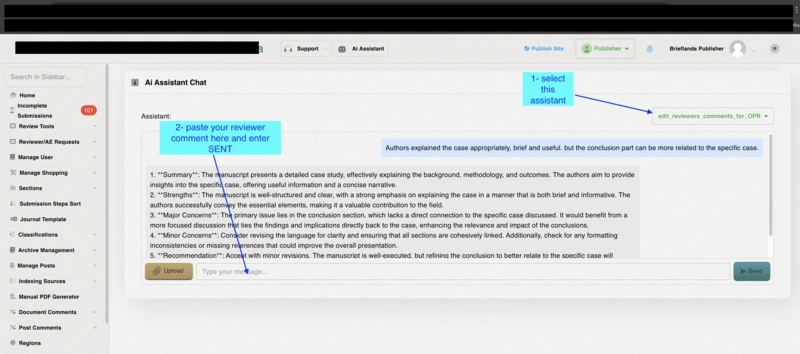
Steps to Use the Peer Review Tool
1. Paste the Reviewer's Comment:
Enter the reviewer comment text into the tool.
2. Generate Structured Feedback:
3. Review and Finalize:
Ensure the output aligns with the journal's standards and accurately reflects the manuscript's quality and contribution.
Best Practices for Editors
Be Objective: Focus on the manuscript, not the author(s).
Be Constructive: Offer actionable feedback to improve the manuscript.
Be Professional: Maintain a neutral and respectful tone.
Be Transparent: Clearly justify your recommendations.
Integrating the Tool into Editorial Workflows
Training: Ensure all editors are familiar with the peer review structure and tool.
Monitoring: Periodically review feedback quality to maintain consistency.
Recognition: Acknowledge reviewers and editors for constructive and timely feedback.
FAQs
What if the tool's output requires further refinement?
Editors should manually adjust the output to ensure clarity and accuracy.
Can I use the tool for different peer review models?
Yes, the structured format is adaptable for single-blind, double-blind, and open peer reviews.
How should I handle unclear or incomplete reviewer comments?
Request additional context, such as the abstract, or seek clarification directly from the reviewer.
The distinction that matters: an AI assistant may help with the language of a review, but the assessment itself must be the reviewer’s own work, and the confidentiality of the manuscript must not be broken by pasting it into an external tool. See also the AI Authorship Policy for authors.