1. Background
Infertility is a growing health and social problem, which affects about 15% of couples (1). The male factor infertility accounts for 50% of infertile couples. The causes of male factor infertility are gene mutations, aneuploidy, varicocele, infectious diseases, infection of male sex glands, immunity disorders, radiation, chemotherapy, systemic and iatrogenic disorders, life style (2) and intense exercise (3). Despite the beneficial effects of exercise, some studies have shown that intense exercise has adverse effects on the male and female reproductive system (4). Although the exact mechanism involved in exercise-induced reproductive disruption is not well defined (5). Abnormality in the reproductive system following exercise can be due to disruption of the pulsatile secretion of gonadotropin-releasing hormone (GnRH) probably due to the stress of exercise and sustained low energy availability (6). Reproductive dysfunction following exercise or physical activity is dependent on the kind of exercise (7). Forced swimming stress has been used to examine the physiological changes of laboratory animals in response to stress (8). Swimming elevates serum adrenocorticotropic hormone (ACTH) and cortisol level. Long term increase of the cortisol hormone has adverse effects on the body (9). Cortisol suppresses the hypothalamic-pituitary-gonadal axis and leads to reproduction abnormality (10). However, the response intensity and biological responses during stress vary according to the type and duration of stress (11). Evidence shows that swimming leads to decreased number and motility of sperm and fertilization capacity and reduction in serum testosterone level in rats and humans (11, 12). Hyperthermia without swimming inhibits reproductive functions or spermatogenesis in males (13). Previous studies have shown the adverse effects of local scrotal hyperthermia on normal adult testis in several species, including mice, rats, cows, pigs, sheep and humans (14, 15). The reported effects include a temporary reduction in relative testis weight accompanied by a temporary period of partial or complete infertility (14, 15). On the other hand seminiferous epithelium are also sensitive to cooling (16). Mild hypothermia and local cooling of testis in rats induces apoptosis of germ cells through affecting microtubule polymerization leading to change in cell cycle (16). Cold shock can induce expression of heat shock proteins and may result in cell death (17).
2. Objectives
Previous studies have shown the effect of swimming or local exposure of testis to hypothermia and hyperthermia on spermatogenesis. Additionally water temperature is an important factor in the forced swimming test. Yet, the question that remains to be answered is whether swimming or water temperature is effective on spermatogenesis. Therefore, the aim of this study was to investigate the effect of chronic swimming and standing in cold, warm and lukewarm water on the spermatogenesis process in a mouse model.
3. Materials and Methods
Adult male Balb/c mice (weighting 35 to 45 g and aged: six to eight weeks) were housed under standard laboratory conditions (on a 12-hour light-dark cycle) with free access to tap water and chow. Forced swimming of all groups was performed during the light phase. Animals were maintained and handled according to the protocols approved by the Guilan University of Medical Sciences Animal Care and Use Committee. Animals were purchased from the Razi Institute. Forty-nine male mice (N = 49) were randomly divided into seven groups: C, control; SwC, swimming in cold water (10°C); StC, standing in cold water (10°C); SwL, swimming in lukewarm water (23°C); StL, standing in lukewarm water (23°C); SwW, swimming in warm water (36°C); StW, standing in warm water (36°C). Controls were not placed in water to swim or stand. They were in their cages with free access to water and food.
Animals in swimming groups were submitted to daily forced swimming in a pool (length 10 cm, width 40 cm, depth 60 cm) for five minutes, five days/week during five weeks. However, groups StC, StL and StW were left standing on a raised platform inside the waterpool without swimming for the same time and duration. After each exam, animals were dried with a towel paper and were allowed to return to their cages with free access to water and food.
Animals were anaesthetized with 0.4 mL of ketamine and 0.2 mL of xylazine, intraperitoneally, and killed on day 36. They were dissected and their testes were fixed in 10% neutral buffered formalin for five days and processed routinely for histological studies. Sections with thickness of 5 µm were prepared and either stained with hematoxylin and eosin (H & E) for histological studies or with immunohistochemical protocols for study of DNA fragmentation (apoptosis) in spermatogenic cells.
Blood samples were collected through the inferior vena cava immediately after killing the mice. The serum was separated and stored at -80°C. Serum testosterone and luteinizing hormone (LH) levels were measured using an enzyme linked immunosorbent assay (ELISA) kit according to the manufacturer’s instructions (Monobind, USA).
The quality and condition of spermatogenesis in each seminiferous tubule was scored according to Johnsen scoring method (18). This method applies a grade from 1 to 10 to each tubule cross section according to the following criteria: 10, complete spermatogenesis; 9, many spermatozoa present but disorganized spermatogenesis; 8, only a few spermatozoa present; 7, no spermatozoa but many spermatids present; 6, only a few spermatids present; 5, no spermatozoa or spermatids present but many spermatocytes present; 4, only a few spermatocytes present; 3, only spermatogonia present; 2, no germ cells present; and 1, no germ cells or Sertoli cells present. For each animal, ten seminiferous tubule cross sections were observed and a mean score count was calculated. To achieve this, for each animal, 100 seminiferous tubules in transverse sections were scored (18). In situ detection of cells with DNA strand breaks was performed for formalin-fixed, paraffin-embedded tissue sections by terminal deoxynucleotidyl transferase dUTP nick-end labeling (TUNEL) according to the manufacturer’s instructions (Roche, Germany). Cells with dark brown nucleus were considered as apoptotic. In each animal, three slides and in each slide, 8-10 fields with area of 1 × 1 mm2 were studied. In each field, number of positive apoptotic cells was counted and then divided by numbers of both positive and negative cells and the result was expressed as a percentage. Data analysis was performed using the SPSS software version 13.0 for Windows Microsoft 2010. The normality distribution of samples was tested using Kolmogorov-Smirnov Test. The data was analyzed by the analysis of variance (ANOVA) and Tukey’s Post Hoc Test. A P < 0.05 was considered statistically significant.
4. Results
The hormonal level findings are presented in Figure 1. Serum level of testosterone and LH in controls was 4.2 ± 0.4 ng/mL and 1.64 ± 0.04 IU/L, respectively. Serum level of LH and testosterone were reduced significantly in all swimming and standing groups when compared with the control group, the only exception being group 5 (standing in lukewarm water) (Figure 1). The microscopic appearance of histopathological samples of testis is shown in Figure 2. In the control group, the testis contained many seminiferous tubules. In each tubule the germinal epithelium were arranged in layers; those at the earlier stages of maturation being at the tubular basis and those at the most advanced stages located at the lumen. The cell types from the periphery towards the lumen were spermatogonia, primary spermatocytes, secondary spermatocytes, round and elongated spermatids respectively. The Sertoli cell’s nuclei with their irregular shape were located on the basement membrane. Among the seminiferous tubules there were interstitial tissue containing the endocrine Leydig cells, various connective tissue cells and interstitial vasculature (Figure 2). The organization of seminiferous tubules in groups SwC, StC, SwL and StL were similar to the controls. However their quality of spermatogenesis was reduced (Table 1 and Figure 2). Organization of seminiferous tubules in groups SwW and StW changed and some vacuoles were observed inside the germinal epithelium both in standing and swimming in warm water groups (Figure 2). When the Johnsen scores were compared for each group, the best values were observed for the controls and standing in lukewarm water without swimming group. No difference was found in Johnsen score or testosterone level between group SwC and SwL (swimming in cold and lukewarm water). Swimming and standing in warm water severely reduced the above-mentioned parameters when compared with the controls (P < 0.05); group SwC, P < 0.02 and group SwL, P < 0.05. Both testosterone level and Johnsen score in group SwL (swimming in lukewarm water) were lower than its control group i.e. standing in lukewarm water, yet this difference was not significant. Swimming or standing in warm water significantly increased apoptosis in spermatogenic cells (P < 0.001). However swimming or standing in other water temperatures resulted no statistical differences between groups (Table 1 and Figure 3).
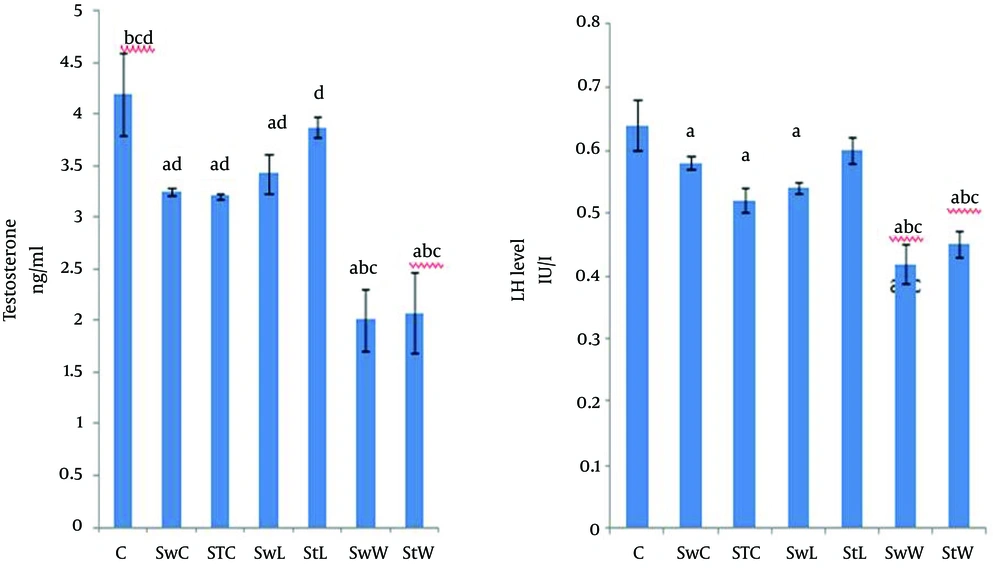
Figure 1.
Data are expressed as mean ± SD. Controls (C), swimming in cold water (10°C) (SwC), standing in cold water (10°C) (StC), swimming in lukewarm water (23°C) (SwL), standing in lukewarm water (23°C) (StL), swimming in warm water (36°C) (SwW), and standing in warm water (36°C) (StW). A) Significant in compare with the control (P < 0.05). B) Significant in compare with swimming in cold water (P < 0.02). C) Significant compare with swimming in lukewarm water (P < 0.05). D) Significant in compare with swimming in warm water (P < 0.001).
Table 1.
| Groups | Johnsen Score | Apoptosis, % |
|---|---|---|
| C | 9.2 ± 0.03c,d,e | 4.2 ± 0.42e |
| SwC | 8.8 ± 0.01e,f | 5.10 ± 1.62e |
| StC | 8.6 ± 0.02e,f | 3.91 ± 0.20e |
| SwL | 8.5 ± 0.01e,f | 4.48 ± 1.0e |
| StL | 9.0 ± 0.02, e | 4.04 ± 0.50e |
| SwW | 7.9 ± 0.02c,d,f | 16.3 ± 1.80c,d,e |
| StW | 8.1 ± 0.01c,d,f | 14.22 ± 1.21c,d,e |
aData are expressed as mean ± standard deviation.
bControls (C), swimming in cold water (10°C) (SwC), standing in cold water (10°C) (StC), swimming in lukewarm water (23°C) (SwL), standing in lukewarm water (23°C) (StL), swimming in warm water (36°C) (SwW), standing in warm water (36°C) (StW).
cSignificant in compare with swimming in cold water (P < 0.02).
dSignificant in compare with swimming in lukewarm water (P < 0.05).
eSignificant in compare with swimming in warm water (P < 0.001).
fSignificant in compare with control (P < 0.05).
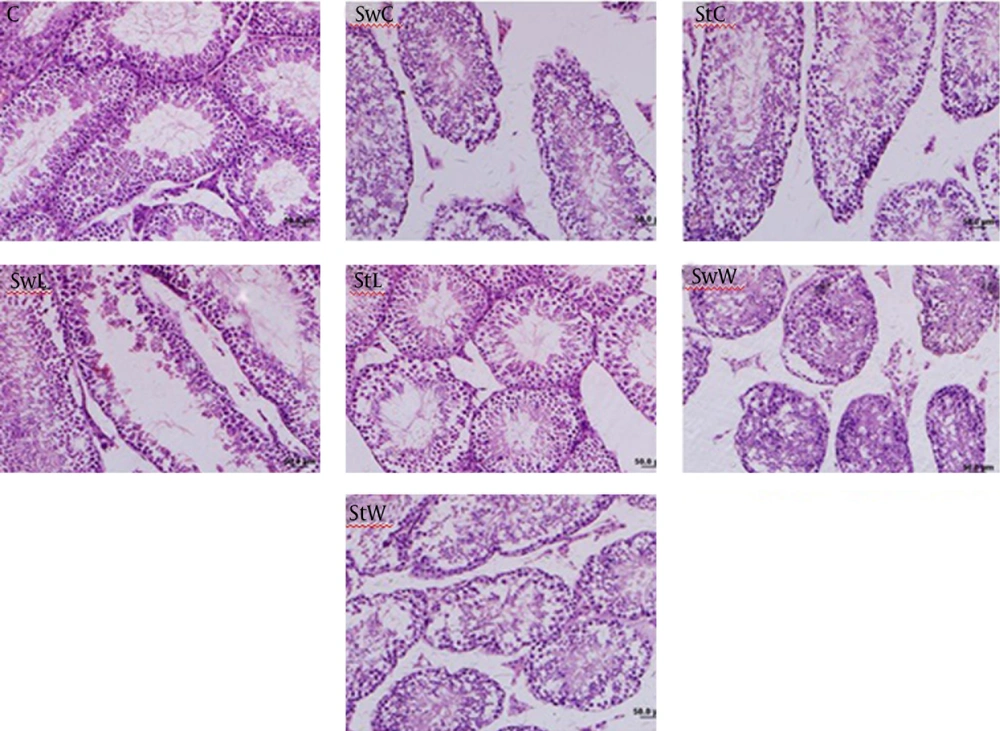
Figure 2.
Controls (C), swimming in cold water (10°C) (SwC), standing in cold water (10°C) (StC), swimming in lukewarm water (23°C) (SwL), standing in lukewarm water (23°C) (StL), swimming in warm water (36°C) (SwW), standing in warm water (36°C) (StW). H&E staining. Magnification: × 200.
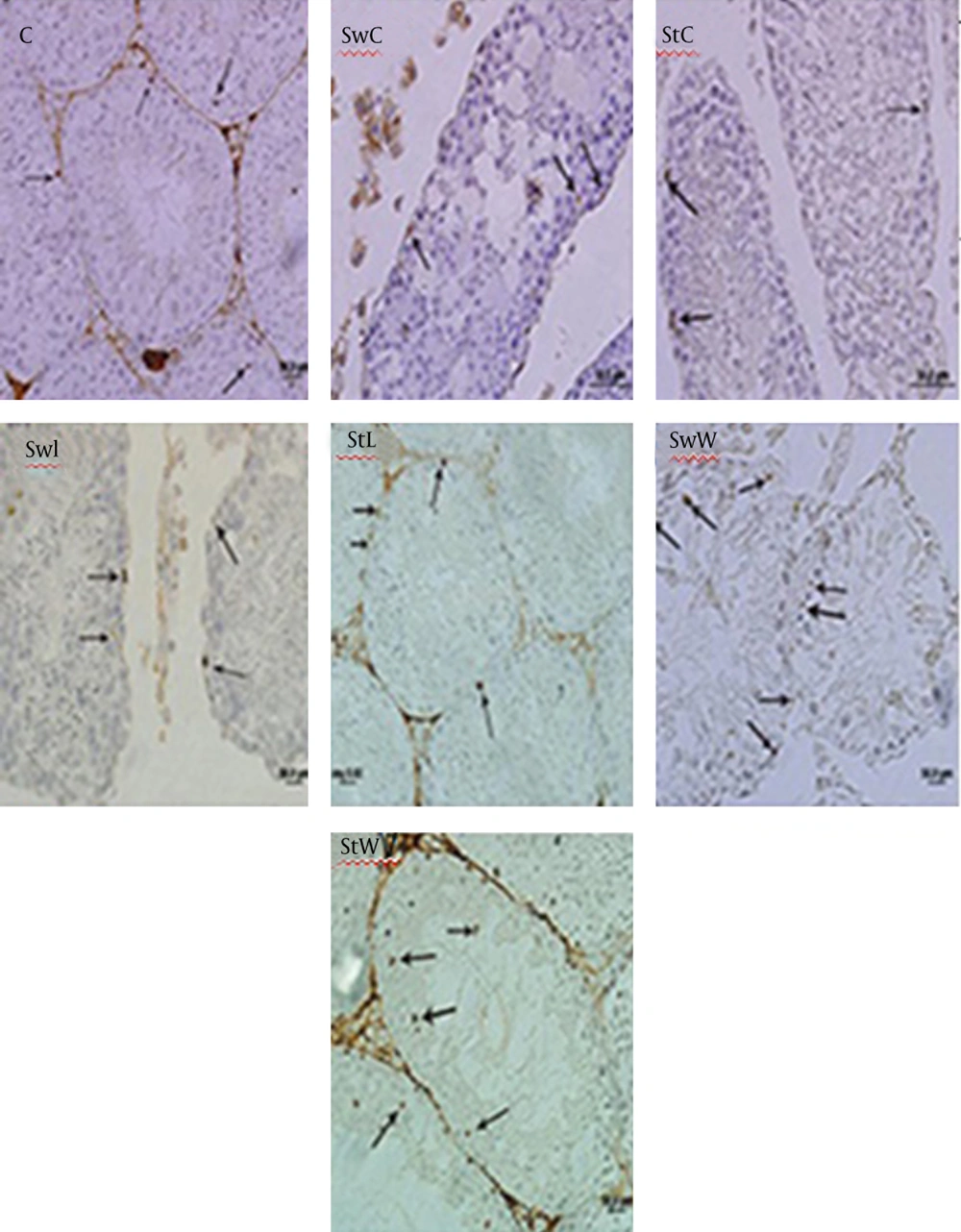
Figure 3.
Arrows show brown apoptotic cells. Controls (C), swimming in cold water (10°C) (SwC), standing in cold water (10°C) (StC), swimming in lukewarm water (23°C) (SwL), standing in lukewarm water (23°C) (StL), swimming in warm water (36°C) (SwW), standing in warm water (36°C) (StW). TUNEL and Hematoxylin staining. Magnification: × 400.
5. Discussion
Our study demonstrated that swimming for five weeks in male mice reduces fertility parameters including serum LH and testosterone levels as well as maturity of spermatogenesis and Johnsen score at all water temperatures. Therefore, swimming may reduce fertility in male mice. However standing in lukewarm water was safe. Warm water increased testicular apoptosis in both swimming and standing groups. This result suggests that a high temperature is itself more effective than low temperatures on male mice fertility. Spermatogenesis in mice takes about five weeks therefore our study was designed with a 35-day duration (19). In this study we chose swimming because it has a number of advantages in comparison with other types of exercise such as running on a treadmill (13). The amount of work done during swimming is higher than that during treadmill running for the same duration of time (13). Swimming decreases serum testosterone levels both in males and females (12). Similarly exercise decreases pulsatile secretion of LH and FSH and shuts down stimulation of ovaries in females (7). It is well known that stress exerts an inhibitory effect on pituitary-gonadal axis (20, 21). Exercise is a stressor that can affect serum FSH, progesterone and estradiol levels and also testosterone and LH levels (22). We found that swimming reduced serum LH and testosterone levels compared to the control group. Testosterone is released from Leydig cells under the influence of LH. Testosterone is critical for differentiation of round spermatids to elongated spermatids (13). Therefore, one of the probable mechanisms that reduce spermatogenesis maturity in swimmers is decreased serum testosterone and LH levels, as observed in our study. The other probable mechanisms may be increased free radical production or adrenocorticotropin hormone (13). Our study also showed that both swimming and standing in warm water significantly increased apoptosis in male germ cells. Apoptosis is a programmed cell death process that takes places in different cells during both embryonic and adult life (23). Exercise can either cause (24), inhibit (25) or have no effect on apoptosis of different cell types (26). The probable mechanisms responsible for exercise –induced apoptosis include: increased glucocorticoid hormone, intracellular calcium concentration and reactive oxygen species (27). We only found an increase in apoptosis rate of germ cells in mice swimmingin warm water. Perhaps one reason for this outcome was the reduced level of testosterone or LH, as observed by our study. However, this cannot be the only reason, because in addition to the group that swam in warm water, groups that were forced to swim in cold and lukewarm water, also had reduced hormone levels without any effect on rate of apoptosis; this probably indicates that other possible mechanisms could also be involved. Faraone-Mennella et al. in 2010 showed that physical exercise (treadmill running) increases apoptosis in rat testis both in the short and long term (24). Similarly, exposure to local temperature (43ºC) in male rodents increases the rate of apoptosis in germ cells through increasing heat shock protein (HSP) expression in testis as well as increasing spermatocyte’s DNA fragmentation (15, 28). A three-minute swim in water at a temperature of 32ºC produces mixed opioid/nonopioid analgesia when animals were submitted to the hot-plate test (12, 29). Opiates have a role in decreased gonadotropin secretion during both acute and chronic stress and therefore have a major impact on the regulation of the pulsatile pattern of LH secretion (30). However, the mechanisms by which heat stress changes reproductive hormones are not well understood. Molecular and genetic studies for determination of the causes of apoptosis associated with exercise or standing in warm water are recommended. In this study swimming or standing in cold water could not induce apoptosis in germ cells however it induced a decrease intestosterone and LH. In contrast to our study, Blanco-Rodriguez et al. in 1997 indicated an increase in spermatogonial apoptosis during stages XII and XIV following testicular local hypothermia at 10ºC (16). In vitro studies on hamster fibroblast cells (31) and human synovial cells have also shown a relationship between cold shock-induced apoptosis and the cell cycle (32). These contraries may be due to the nature (in vivo or in vitro) and design of the study, for instance we forced our mice to swim in water while in Blanco’s study the animal’s bodies were out of water. Daily swimming in water of different temperatures (cold, lukewarm and warm) or standing in warm water for five minutes for five consecutive days/week during five weeks in male mice changes serum testosterone and LH levels and reduces maturity of spermatogenesis. Standing in lukewarm water without swimming has no side effects on spermatogenesis or male sex hormones. Regardless of swimming, warm water itself is associated with increased level of apoptosis in testis. In other words swimming itself has side effects on spermatogenesis and warm water also influences the testis and disturbs the male reproductive system and may be associated with sub fertility. Further studies on the adrenal gland function and stress system following swimming or standing in cold, lukewarm and warm water that affect the hypothalamic-pituitary-gonadal axis are recommended.