


1. Background
Wastes are generated by healthcare activities, which usually include general waste sharps, human tissues, body parts, pharmaceutical, pathological, radioactive, and chemical materials, clothes, textiles, and other infectious materials (1-6). There are two major groups of medical waste, i.e., infectious and noninfectious. Nearly 75% to 90% of wastes due to healthcare activities are noninfectious, which is comparable with domestic solid waste (7-10). The remaining 10% to 25% is different from other types of waste and may be hazardous to humans and/or the environment (10, 11).
The pathogens in wastes may be released in the environment and contaminate water resources. Moreover, water pollution may result from hazardous substances (e.g. heavy metals) found in biomedical wastes (12). In the past, hospital wastes were majorly biodegradable. Nevertheless, since the production of plastic materials, wastes have become non-biodegradable (13).
Hospital wastes expose a variety of health threats to the healthcare staff and patients, as well as people outside hospital settings (10). According to a survey by the World Health Organization (WHO) in 22 developing countries, about 18% to 64% of healthcare facilities use inappropriate waste disposal methods (14). Consequently, waste management and contamination problems associated with waste production have drawn researchers’ attention (15, 16).
Production of medical waste has increased rapidly in Iran in the past decades due to population growth, number of healthcare facilities, and use of disposable medical products. However, inadequate attention has been paid to this phenomenon in the past decades (17). Although this problem is common in the majority of developing countries, there are insufficient data regarding medical waste management. Even though medical wastes account for a small proportion of total solid wastes in Iran, they should not be neglected, given the possible presence of hazardous substances in these wastes.
There are no suitable solid waste removal organizations in many hospitals of Iran, and there is a scarcity of policies for solid waste disposal and management (18). Accordingly, the current research aimed at characterizing medical wastes and the current situation of waste management in five selected hospitals of Tehran, Iran and identifying attainable improvement strategies.
2. Methods
In this study, five hospitals were analyzed over three months (July to September 2016) in Tehran, Iran. The researchers attempted to examine the amount of hospital waste production, waste segregation conditions, type of containers, temporary site of storage, waste accumulation, waste treatment, onsite transfer, offsite transfer, and waste disposal processes.
In this study, a data form and a questionnaire were designed in accordance with the WHO guidelines for hospital waste monitoring in developing countries (19). The questionnaire consisted of four sections, including:
1) Hospital general information containing 15 questions, 2) treatment and disposal containing 15 questions, 3) the sterilizer’s general information containing 26 questions, and 4) the sterilizer’s information containing 17 questions (19).
In every hospital, hospital authorities, waste managers, and other involved staff were interviewed, and waste collection and removal processes were examined; next, the waste materials were weighed over 60 days. This research also studied low - heat thermal facilities, which were used in the hospitals for the treatment of infectious wastes. The temperature range of the low - heat thermal process was 93 to 177°C. The essential types of low - heat thermal processes consisted of dry heat (hot air) and wet heat (steam) disinfection (20). Two objectives were addressed in these investigations: 1) evaluation of low - heat facilities to treat infectious wastes; and 2) amount of reduction in infectious wastes after treatment. The information form and questionnaire were filled out and collected. Microsoft Excel software was used to code and analyze the results.
3. Results
With respect to the bed - occupancy rate at the selected hospitals, 2.54 to 7.5 Kg/bed/day of solid waste was produced. The average solid waste production was 4.72 Kg/bed/day (infectious waste, 2.3 Kg/bed/day). It should be noted that bed occupancy refers to a bed used by a patient during one day (Table 1).
Table 1.The General Information of the Selected Hospitals
| Code Number | Waste Generation Rate, (Kg bed-1 day-1) | Bed Capacity | Average Solid Waste Production, (Kg bed-1 day-1) | ||
|---|---|---|---|---|---|
| Total | Active | Total | Infectious | ||
| 1 | 5.1 | 617 | 477 | 4.72 | 2.3 |
| 2 | 3.9 | 1000 | 870 | ||
| 3 | 7.5 | 100 | 100 | ||
| 4 | 4.57 | 50 | 35 | ||
| 5 | 2.54 | 120 | 110 | ||
Overall, two types of solid waste, including general (non - infectious) and medical waste were produced in the hospitals; a significant part of the waste was infectious and included sharp wastes. Based on the findings, general and medical waste accounted for 26% to 71% (average, 56%) and 29.4% (average, 42%) of solid wastes produced in the hospitals, respectively. Moreover, the quantity of different produced wastes is presented in Figure 1.
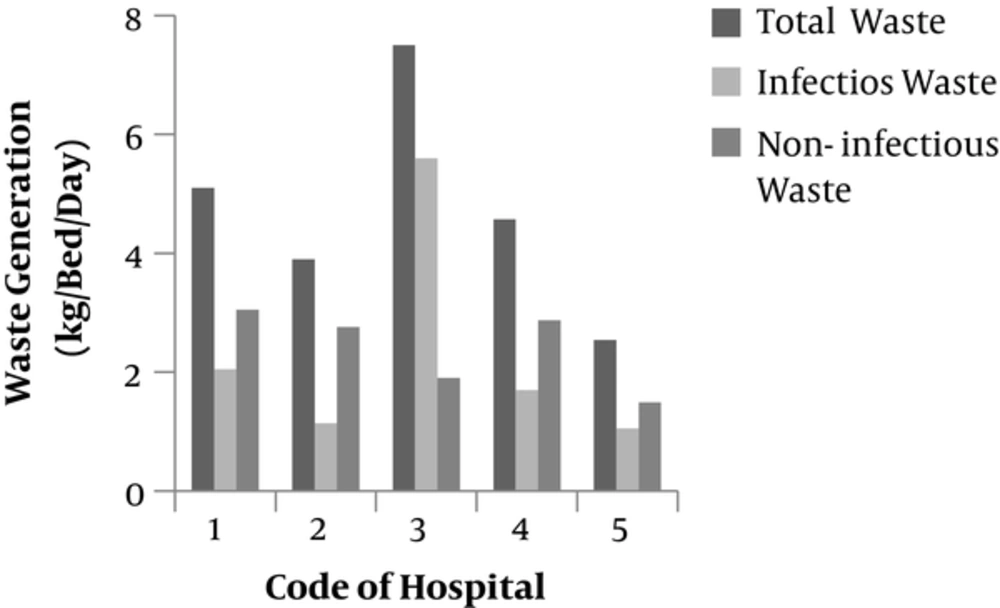
Figure 1.
The Amount of Different Types of Waste Produced at the Hospitals
The observations showed that segregation of general and medical wastes was not routinely implemented. Two strategies were employed for solid waste storage at the hospitals: 1) local storage (temporary) using rigid containers lined with tie - off plastic bags; and 2) use of a central storage site close to the entrance on the floor. Nearly 43% of waste containers were disinfected.
Figure 2 presents the hygienic status of storage, collection, and segregation systems at hospitals. According to this figure, the sanitary level of storage systems was good, average, and poor in 20%, 60%, and 20% of hospitals, respectively.
Collection and transfer of solid waste materials was carried out at two stages in the evaluated hospitals. Onsite transfer was first carried out by moving the waste from the primary site of storage to the central area. Then, waste was moved by offsite transfer via vehicles, which transferred the waste from the central to disposal or treatment site. Figure 2 presents the sanitary status of these systems at the hospitals. The hygienic status of the systems was poor, moderate, and good in 20%, 40%, and 40% of hospitals, respectively.
The segregation of wastes was also analyzed in this study. The hygienic status of medical segregation organizations is presented in Figure 2. This figure demonstrated that the hygienic status of medical segregation systems was good in 40%, average in 20%, and poor in 20% of hospitals.
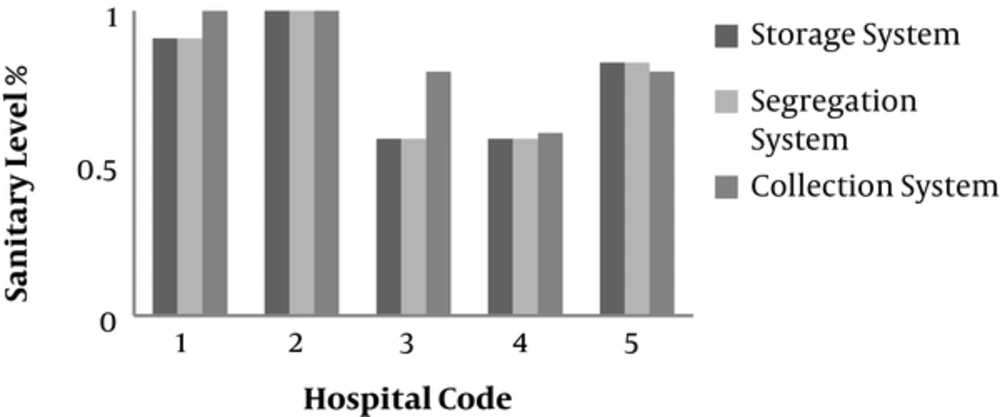
Figure 2.
The Sanitary Status of Storage, Collection and Segregation Systems at the Hospitals
According to the findings, the evaluated hospitals included some waste treatment facilities for pollution management. These hospitals had low - heat facilities to treat infectious wastes, and they were monitored by a biological indicator. The biological indicator in the trial was placed in a horizontal position in various locations inside the chamber, as recommended by the manufacturer. The observations showed that some of these facilities could not treat infectious wastes and changed them to non - infectious wastes. Table 2 shows the type of facilities and biological indicators for disinfecting infectious wastes.
Table 2.The Efficiency of Treatment Facilities for Disinfection of Infectious Wastes
| Code of Hospital | Type of Treatment Facility | Biological Indicator Result |
|---|---|---|
| 1 | Autoclave | Positive |
| 2 | Dry heat technology | Negative |
| 3 | Autoclave - shredder | Negative |
| 4 | Hydroclave | Positive |
| 5 | Dry heat technology | Negative |
Treatment facilities could also reduce the weight and volume of the wastes. The current research compared the weight and volume of infectious wastes before and after treatment. The weight of infectious waste was reduced to between 7% and 51%, and the volume was reduced to between 32% and 85% after treatment. Figures 3 and 4 show the percentage of weight and volume reduction in these facilities, respectively.
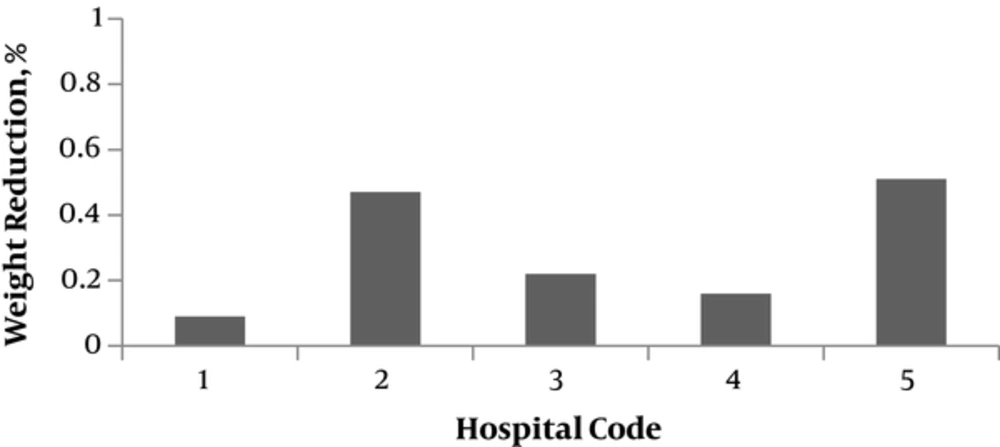
Figure 3.
The Weight Reduction of Infectious Waste After Treatment
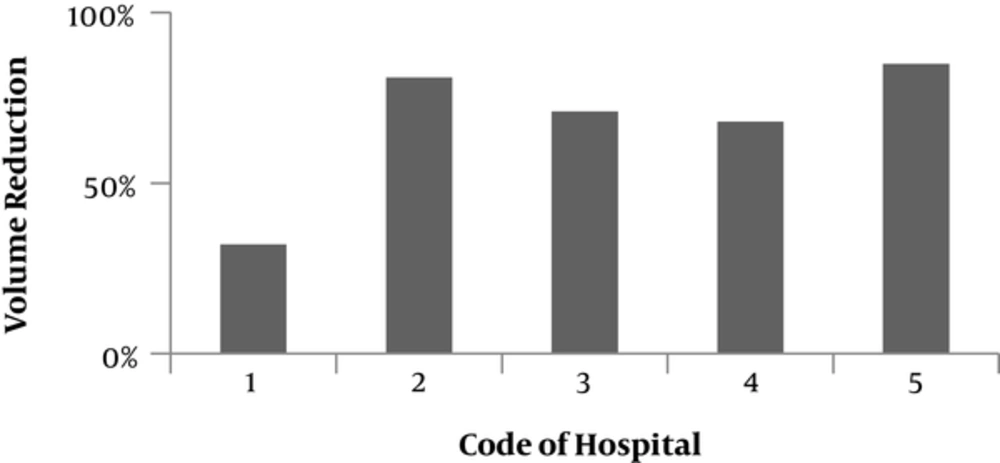
Figure 4.
The Volume Reduction of Infectious Waste After Treatment
Finally, the treated wastes were transferred by vehicles to Kahrizak landfill site, which is situated about 60 Km away from Tehran (21).
4. Discussion
Based on the results, the rate of waste production was within a range of 2.54 to 7.5 Kg/bed/day in the evaluated hospitals. This finding is in line with a study performed at a specialized hospital in Tehran (2008), reporting a moderate rate of 4.58 Kg/bed/day (22). Similarly, Askarian et al. (2002) reported a medium rate of 8.025 Kg/bed/day at private hospitals of Shiraz, Iran (1.25 to 14.8 Kg/bed/day) (23). Alimohamad et al. showed a medium rate (4.38 Kg/bed/day) at Shariati Hospital of Tehran (24), and Parandeh (2012) reported a rate of 3.8 Kg/bed/day at the hospitals of Kerman Province, Iran (25).
Comparisons were made between the reports from Iran and other studies from different countries. In this regard, in a study in Libya, the mean rate of waste production was 1.3 Kg/bed/day (general waste,72%; infectious waste, 28%). This finding is inconsistent with the current study (P = 0.05) (26). Moreover, the current findings are not in line with a study by Baghaee (2000) in Tehran hospitals (average, 2.71 Kg/bed/day) (23). The results of the current study were also different from the study by Farzadkia et al. (2009), which showed a range of 2.5 to 3.01 Kg/bed/day for eight teaching hospitals in Tehran (10). For further comparison, studies performed in some neighboring countries, including Saudi Arabia and Kuwait, were also evaluated. The results indicated a lower rate of waste production related to healthcare activities compared to the current study (0.03 to 3.78 and 3.65 to 5.4 Kg/bed/day, respectively) (27, 28).
According to a survey by Yang et al. (2010) in 15 hospitals of China, medical waste production ranged from 0.5 to 0.8 Kg/bed/day (29). Diaz et al. (2008) estimated a medical waste production range of 0.016 to 3.23 Kg/bed/day in developing countries (infectious waste, 63%; range,0.01 to 0.65) (30). As indicated, the findings of the present study are inconsistent (P < 0.05) with studies performed in Asian and Arabic countries.
The first issue in the management of hospital waste is the amount of waste produced per capita, which is influenced by the number of patients, type of hospital, welfare, cultural factors, and management status (17, 31). In accordance with the common categorization, medical wastes can be classified as infectious and noninfectious. These two types of waste should be separated at the source of production, and minimization and disinfection activities should be applied in accordance with the national regulations and guidelines.
Any mismanagement in segregation, minimization, or disinfection can lead to serious health and environmental problems. Moreover, the quantities of infectious and noninfectious wastes may increase and change at the same hospitals or hospitals located in similar geographical regions due to poor management practices. Therefore, the managerial status should be examined before any comparison. The discrepancies in daily waste production at hospitals may be attributed to differences in income and welfare of patients and clients, differences among hospital departments (e.g. surgical and pediatric units), and methods of waste management at hospitals (17).
Some researchers believe that due to healthcare advances and improved application of disposable products, there has been an increase in the quantity of produced waste at hospitals. For instance, in Germany, 8 Kg/bed/day of hospital waste is produced, while according to field investigations, below 4 Kg/bed/day of waste is produced in Tehran. Overall, in comparison with industrialized European countries or the Americas, the rates of waste production are lower in developing countries. The observed variations might be related to differences in living conditions and standards regarding accessibility to treatment facilities (14).
In the current study, wastes were not segregated adequately, which leads to an increase in the infectious waste ratio (42%) more than similar reports (10% to 15%) in a study by Farzadkia et al., 2009). This finding is inconsistent with WHO reports from developing countries (19). According to these reports, efficient waste removal is not accomplished in 64% of hospitals in 26 different countries (14). Arab et al. (2008), Sabour et al. (2007), and Bayat (47.7%; 2015) reported consistent findings (24, 32, 33). Overall, waste removal is among major problems in different hospitals of Iran. The infection waste ratio in this study is different from studies performed in the United States (26%), Brazil (17%), and Taiwan (18%) (34).
Lack of waste segregation (infectious and non - infectious) at the origin of production increases the amount of infectious waste (35). In a previous report, the amount of infectious waste increased by 15.1% due to contamination via contact with noninfectious waste (33). According to the current study, adequate containers were utilized in proper locations in most hospitals.
According to the results, the hygienic status of storage systems was poor in 20% of the evaluated hospitals. As presented in Figure 2, the hygienic status of collection systems was poor and medium in 20% and 40% of the hospitals, respectively. These findings are in contrast with a survey by Askarian et al. (2004) at teaching hospitals of Fars Province, Iran. According to this study, only 26.7% of hospitals had a good hygienic status and a secure temporary storage site; also, 53.3% of the hospitals were well - secured yet had a poor hygienic status.
It should be noted that 20% of the hospitals lacked temporary storage sites, and the waste was directly discharged in the hospital yard (23). According to Figure 2, some hospitals did not correctly segregate infectious and non - infectious wastes. Therefore, the researchers encountered irregular presence of infectious wastes at these hospitals.
The present results are in line with the segregation rate reported in another study from Egypt. This study was different from a study by Magda Magdy et al. in 2010, which indicated segregation of different medical wastes at all hospitals (28). Moreover, some treatment facilities (e.g. autoclaves and hydroclaves) were employed at these hospitals (36).
According to the principles of the Iranian Ministry of Health, treatment activities are among the prerequisites for waste management at hospitals; moreover, hospitals are required to treat waste materials before disposal (23). Infectious wastes at these hospitals were transported to the treatment site, mixed with general wastes after processing, and transported to the landfill site.
Although financial limitations are regarded as the most important cause of poor waste management, hospital directors can still improve their performance despite resource shortages. Selection of treatment strategies for infectious solid wastes should be based on safety characteristics and not economic conditions (11). Some immediate measures can be taken to promote the current status of hospital waste management. These measures only require staff commitment, without imposing any financial burdens. These actions are environmental health education for the staff, segregation of wastes (infectious and noninfectious) at hospitals, disinfection of the central storage site, and separation of infectious wastes from chemical and radioactive wastes.
