
1. Context
Supplier’s efforts to induce patients to buy health care services beyond what is medically required are known as supplier-induced demand (SID) (1). SID is an important issue in health economics with roots in knowledge and information asymmetries between health service providers and patients (1-3). The more complex the health condition of a patient is, the more extensive these asymmetries will be (2). SID has two main negative impacts. First, it hampers the efficiency and allocation of resources. Second, it imposes unnecessary expenditures on patients and wastes their time. Even if patients pay all the recommended expenditures, SID still hampers the effective allocation of national income. In addition, SID disturbs the balance between supply and demand in health care markets (2, 4, 5).
Cancer is an extremely complex and costly disease. In 2018, 18.1 million new cancer cases were identified, and 9.6 million cancer-related deaths were registered (6). Approximately 70% of cancer-related deaths occur in low- and middle-income countries. Increased life expectancy and aging are common reasons for the increasing incidence of cancer, and these factors significantly increase cancer’s economic impact. In 2010, cancer was responsible for about 1.16 trillion US dollars in overall costs through the world (7, 8).
The information and knowledge asymmetries between patients and physicians are significant when considering the complexity of cancer, as these asymmetries enable SID. Accurate diagnosis is crucial for appropriate and effective cancer management, and the diagnosis of cancer can cause severe psychosocial and economic problems. Cancer treatment costs are increasing two or three times faster than other health care costs (9).
The diagnosis and treatment of cancer can negatively impact the patient’s welfare and quality of life. A cancer patient’s family members are also likely to experience severe external shocks (10). Unnecessary and induced services intensify patients’ anxiety and expenditures. It has been reported that 30% of all health expenditures in the United States in 2012 were spent on unnecessary or ineffective services, and thousands of unexpected deaths could be attributed to these unnecessary services (11).
Practitioners are prone to overusing imaging services and high-tech equipment when making diagnoses, which results in the unnecessary use of some equipment. Although such equipment has benefits, they are not cost-beneficial. Therefore, policy-makers and researchers have attempted to understand which factors cause the overuse of services (12). Overuse is more common when diagnosing cancer than during treatment or follow-up (13). However, the diagnosis of cancer does nothing to increase the patient’s health directly (2, 3).
The current study initially aimed to review previous studies on SID related to breast cancer diagnosis because breast cancer is the most frequently diagnosed form of cancer in women globally (14). However, because no studies about SID in breast cancer diagnosis could be found, we searched for studies on SID in the diagnosis of all types of cancers. However, no studies were found in this case, either.
2. Evidence Acquisition
The current study is a systematic review of SID in cancer diagnosis. Four main databases (Scopus, Science Direct, Web of Science, and PubMed) were searched using the following keywords from January 1980 to July 2019: induced demand, cancer, diagnosis, and breast. The results are shown in (Table 1). After skimming the articles and applying inclusion criteria (articles that included the above-mentioned keywords), unrelated articles and duplicates were removed. Two independent reviewers studied topics, abstracts, and results of the articles. In 95% of cases, articles were homogeneous. In order to address heterogeneities, a consensus protocol was developed. Atlas Ti was used to analyze the searched studies, i.e., after reviewing the articles based on the inclusion criteria, related information was extracted and entered into the software (Figure 1). Moreover, references of the searched studies were also reviewed to explore other eligible studies.
Table 1.
Search Strategya
| Search | Query | |
|---|---|---|
| PubMed | #1 | Search (induced* demand [Title/Abstract]) Filters: Publication date from 1980/01/01 to 2019/07/22; Humans |
| #2 | Search ((induced*demand [Title/Abstract] AND (“1980/01/01” [Pdat]: “2019/07/22” [Pdat]) AND Humans [Mesh])) AND cancer Filters: Publication date from 1980/01/01 to 2019/07/22; Humans | |
| #3 | Search ((((induced*demand [Title/Abstract] AND (“1980/01/01” [Pdat] : “2019/07/22”[Pdat] ) AND Humans[Mesh])) AND cancer AND ( “1980/01/01”[Pdat] : “2019/07/22”[Pdat] ) AND Humans[Mesh])) AND diagnose*[Title/Abstract] Filters: Publication date from 1980/01/01 to 2019/07/22; Humans | |
| #4 | Search (((((induced*demand [Title/Abstract] AND (“1980/01/01” [Pdat]: “2019/07/22”[Pdat] ) AND Humans[Mesh])) AND cancer AND ( “1980/01/01”[Pdat] : “2019/07/22”[Pdat] ) AND Humans[Mesh])) AND breast Filters: Publication date from 1980/01/01 to 2019/07/22; Humans | |
| ScienceDirect | pub-date > 1980 and (induced demand) [All Sources (- All Sciences -)] | |
| pub-date > 1980 and (induced demand) and (cancer) [All Sources (- All Sciences -)] | ||
| pub-date > 1980 and (induced demand cancer) and (diagnosis (- All Sciences -)] | ||
| pub-date > 1980 and (induced demand cancer) and (diagnosis) and (breast) [All Sources (- All Sciences -)] | ||
| Scopus | 1 | TITLE-ABS-KEY (induced demand) AND DOCTYPE (ar OR re) AND PUBYEAR > 1979 |
| 2 | KEY (induced demand AND cancer) AND DOCTYPE (ar OR re) AND PUBYEAR > 1979 | |
| 3 | TITLE-ABS-KEY (induced demand AND cancer AND diagnosis) AND DOCTYPE (ar OR re) AND PUBYEAR > 1979 | |
| 4 | TITLE-ABS-KEY (induced demand AND breast AND cancer) AND DOCTYPE (ar OR re) AND PUBYEAR > 1979 | |
| Web of Sciences | 1# | (TS= (induced* demand*)) AND LANGUAGE: (English) AND DOCUMENT TYPES: (Article) |
| 2# | (#1 AND TS = (cancer)) AND LANGUAGE: (English) AND DOCUMENT TYPES: (Article) | |
| 3# | (#2 AND TS = (diagnosis)) AND LANGUAGE: (English) AND DOCUMENT TYPES: (Article) | |
| 4# | (#3 AND TS = (Breast)) AND LANGUAGE: (English) AND DOCUMENT TYPES: (Article) | |
aSearch engines and databases: PubMed-Science Direct-Scopus Web of Sciences. Date: 1980 up to July 2019. Limits: Language (only resources with at least an abstract in English).
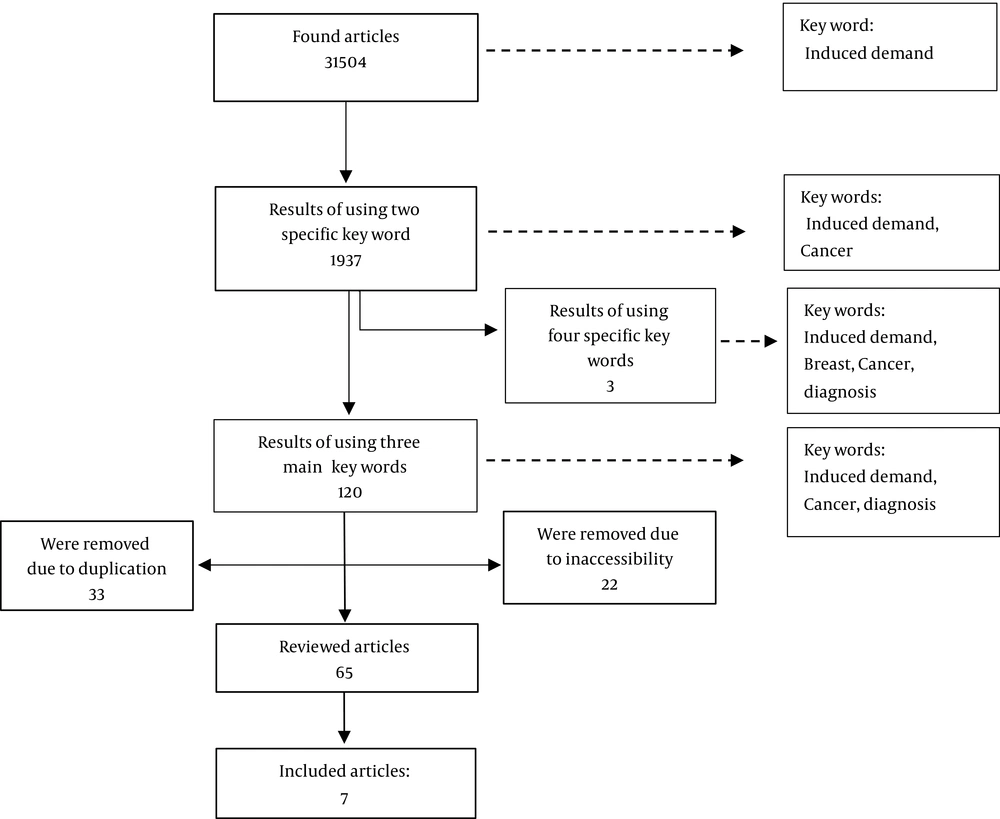
Figure 1.
The selection articles process
Searching for the ‘induced demand’ keyword showed 31504 articles, but when they were filtered with the “cancer” keyword, they were reduced to 1937. After adding the third keyword (diagnosis), 120 articles remained. However, when a combination of ‘induced demand, cancer, diagnosis, and breast’ keywords was used together, the results were not acceptable because they were not relevant to the purpose of our study. Therefore, we focused on the first three main keywords. From the 120 articles, 22 were removed because of inaccessibility, i.e., they were not available to download. Also, 33 articles were omitted because of duplication. The remaining 65 articles were thoroughly reviewed, but none of them matched the main purpose of our research, i.e., they did not match the “induced demand” keyword. We were unable to find research on induced demand in cancer diagnosis. Therefore, we searched the most relevant words to SID such as overdiagnosis, overtreatment, overuse, and unnecessary interventions, instead of “induced demand”, by manually searching in the 65 articles and their references. Doing so, we achieved seven articles that were thoroughly analyzed in the present study.
3. Results
The review revealed that physicians’ personal benefits and financial incentives are the main drivers of unnecessary imaging and the overuse in cancer diagnosis (15, 16). Other noteworthy factors are financial relationships between physicians and other health care providers (17) and physicians’ full or partial ownership of imaging equipment (18). These factors significantly increase the probability of overuse through the increased utilization of diagnostic services. Furthermore, the overuse of services for diagnosing early-stage cancer is related to a patient’s geographical location (which affects their access to such services), income (and, thus, their ability to pay for these services), and education (18, 19).
Physicians’ perspectives, fears of medical error, and concerns about missing an important diagnosis are mentioned as factors that may result in overdiagnosis (18). Some characteristics of patients can also increase the unnecessary use of imaging techniques. These characteristics include comorbidities, as well as the patient’s age (elders usually demand additional services), trust in physicians (15), and education (low education is associated with overuse). Two studies investigated the association between patients’ education and overuse and overdiagnosis in cancer-related diagnostic services (19, 20).
Utilizing defensive medicine and ignoring clinical practice guidelines (CPGs) are also mentioned as factors that increase the probability of overusing imaging techniques (15-18, 21). A lack of clear standards and adequate details about patients’ characteristics are noted in another study (13). The literature review showed that technological advancements also influence the inappropriate use of imaging (16, 20). Unusual waiting lists for appropriate diagnostic services; pressures to make in-time diagnoses (particularly in emergencies); a lack of communication between specialists, radiologists, and family physicians; and the high working load of physicians and their tendency to employ high-tech equipment to gain more information are some other factors that influence the probability of the inappropriate utilization (16).
The results indicate that the most related examples of SID in cancer diagnosis are related to overdiagnosis or attempts of early diagnosis through unnecessary screening (mentioned by 57.14% of the reviewed studies) and ignoring clinical practice guidelines (42.85% of the reviewed studies) (15, 18, 20, 21). These factors are classified into three categories: economic; socio-cultural, and structural (Table 2).
Table 2.
Factors Influencing Probability of SID in Cancer Diagnosisa
| Type | Factors | The First Author | Year |
|---|---|---|---|
| Economic factors | Financial interests | Lavery et al. (15); Morrison (16) | 2011 |
| Patients’ ability to pay | Choi et al. (19); Oakes et al. (18) | 2011; 2017 | |
| Financial relationships between physicians and other health care providers | Lavery et al. (15) | 2011 | |
| Ownership of imaging equipment by physicians | Oakes et al. (18) | 2017 | |
| Socio-cultural factors | Comorbidities | Oakes et al. (18) | 2017 |
| Concerns about losing important diagnoses | |||
| Fear of medical error | |||
| Patients’ age (the older the patient, the higher the utilization of health care services) | |||
| Lack of a comprehensive perspective among physician | |||
| Patients’ trust in physicians | |||
| Patients’ education (the lower the education, the higher the overuse) | Choi et al. (19); Klotz (20) | 2010; 2012 | |
| Physicians’ knowledge and skill | Morrison (16) | 2013 | |
| Patients’ demand to use high tech imaging services | |||
| Defensive medicineb | Morrison (16); Oakes et al. (18); Lavery et al. (15) | 2013; 2017; 2011 | |
| Ignoring CPGsb | Lavery et al. (15); Predmore et al. (21); Oakes et al. (18) | 2011; 2018; 2017 | |
| Structural factors | Technological advancement | Morrison (16); Klotz (20) | 2013; 2012 |
| Long waiting list | Morrison (16) | 2013 | |
| Pressures for in-time diagnosis in emergency situations | |||
| Lack of communication between specialists, radiologists and family physicians | |||
| The High working load of physicians and tendencies toward using high tech imaging services to gain more information | |||
| Unnecessary screenings | Klotz (20); Oakes et al. (18); Choi et al. (19); Predmore et al. (21) | 2012; 2017; 2010; 2018 | |
| Geographical access to high tech equipment | Choi et al. (19); Morrison (16) | 2010; 2013 | |
| Lack of clear standards | Grilli and Chiesa (13) | 2018 | |
| Lack of detailed information about patients |
aFactors are classified into three categories: economic, socio-cultural, and structural (Table 2).
bSome factors can fall into both socio-cultural and structural categories.
Improving the social determinants of health, income, and education will result in high overall survival and decreases the probability of overuse (21, 22). Patients’ expectation (23) which usually increases as the socio-economic status increases, is also an important factor for overusing (18). The symptoms of the patient may affect overuse in diagnosis and treatment procedures (24, 25).
3.1. Discussion About Results
It is perhaps worrying that we could not find any study that considered the impact of SID in cancer diagnoses even though SID is a central topic in the field of health economics. According to Reinhardt, the subject of physician-induced demand “goes straight to the heart of probably the major controversy in contemporary health policy” (26). Also, cancer is one of the most prominent and complex diseases in the world. Given the above, there is an urgent need for research in this area.
The findings of the current study indicate that most studies related to the concept of induced demand in cancer diagnosis included keywords such as “overuse” (or “overutilization”), “overdiagnosis”, “unnecessary interventions”, and “too much medicine”, (27) meaning inappropriate actions have been taken in response to patient’s needs (21, 23, 25, 28). Although SID is semantically related to words such as overuse, it has several differences. Unlike SID, these words are not inherently economic terms. In SID, patients’ preferences are also considered, and there is also a kind of manipulation in patients’ demand, but in overuse and similar words, such cases are not considered necessarily.
Overtreatment is more common in urban areas than in rural areas and is associated with the patient’s education level. Moreover, the patient’s geographical location determines their access to diagnosis facilities and, as such, can affect the probability of overuse (18, 21). The overdiagnosis of cancer is most commonly due to trying to diagnose cancer in its early stages or its recurrence during the follow up period. However, trying to early-stage diagnosis of cancer in non-symptomatic cases has significant negative psychological and economic impacts and increases the probability of overdiagnosis and overtreatment (20).
Predmore et al. (21) used a systematic review approach to investigate factors that influence the overuse and overdiagnosis of screening tests for colorectal cancer. They categorized these factors into three groups: patient-related factors, physician-related factors, and environmental factors. Physicians’ unawareness of CPGs, their misunderstanding of CPGs, their lack of trust in CPGs, and their geographical access to colonoscopy devices were associated with overuse (21).
Grilli and Chisa (13) systematically reviewed four types of cancers (breast, colorectal, lung, and prostate) and found that the frequency of overdiagnosis is about 24% on average. In contrast, the rates of the unnecessary use of medicine, surgical interventions, and radiotherapy were less than 10%.
The types of high-tech diagnostic equipment that tend to be overused include computed tomography (CT), magnetic resonance imaging (MRI), and positron emission tomography (PET/CT), even though these methods do not always promote the patient’s health (16). Meanwhile, in another study, Ren H et al. reported that using advanced methods and technologies reduce the unnecessary utilization of diagnostic methods. According to their study, the overall sensitivity of cystoscopy optical coherence tomography (94%) was significantly higher than that of cystoscopy (75%, P = 0.02) and voided cytology (59%, P = 0.005) (29).
Morrison (16) investigated factors that influence the inappropriate utilization of advanced imaging services. He states that the increased use of advanced technologies (CT, MRI, and X-rays) is not inappropriate in all cases, although the following factors might be related to their inappropriate utilization: technological advances, the patient’s demand for advanced imaging technologies, increased availability of technologies, the physician’s desire to obtain information when they have a heavy workload, defensive medicine, financial interests of the physician and their ownership of diagnostic equipment, a lack of effective communication between members of the medical team, insufficient knowledge of physicians, and excessive wait times for appropriate tests (16).
Chen et al. (30) found that a physician’s specialty is positively associated with the frequency of utilizing MRI and CT-SCAN services. Internal specialists, surgeons, gynecologists, neonatal specialists, emergency specialists, and family physicians were the most likely to prescribe diagnostic services.
Lavery et al. (15) showed that ignoring CPGs is an important factor for unnecessary diagnostic services for prostate cancer. Also, physicians do not spend enough time to inform low-risk patients that imaging services may not really be necessary.
Akbari et al. (31) reported that more than 50% of the diagnostic imaging in primary breast cancer diagnosis are not matched with pathologic report as the golden standard of cancer diagnosis due to lack of spending time by radiologists and quality of their equipment.
Increasing the density of physicians, as demand creators, is also positively associated with the extent of health services. A study on the health care market of Australia revealed that a one percent increase in the total number of physicians turns into a 0.46% rise in demand for health care services. Different studies found similar findings about the impact of physicians’ behavior and their beliefs on demand for health care services (32-35). Attempting to maintain their income level, physicians start to induce demand when the number of patients or their income decreases (28).
A series of solutions are proposed for early diagnosis of cancer and preventing the probability of SID, such as strategies to rationally control disease diagnosis, avoiding diagnoses that are not truly necessary, rationalizing screening examinations, identifying and categorizing high-risk groups and adjusting the threshold for recall and biopsy. Also, reviewing CPGs or developing new ones and training health staff for using them. CPGs can be developed by the latest research, that cause overdiagnosis rather than best benefit for the patient (7).
Strengthening the gatekeeping role of health insurance companies may, also, be another effective strategy to restrict unnecessary prescription of diagnostic imaging services. Furthermore, ministries of health can use regulations to control unnecessary utilization of diagnostic services. In this line, an effective strategy could be improving the quality of health information systems, particularly for imaging diagnostic tools. Health information systems, in combination with quality assurance systems, will effectively improve the quality of the health care system, while simultaneously decreasing the overdiagnosis and overutilization as a bystander effect (36).
Different studies, mentioned that screening for early diagnosis of cancer is an important source of overuse of health care services (37-39). To address such problems, which are usually more severe in low-income countries, piloting national cancer screening programs and identifying their pros and cons are highly useful (37).
4. Conclusions
The observed lack of studies focusing on “SID” and “cancer diagnosis” indicates an urgent need for research on this topic. Moreover, economic, social, and structural reforms related to equipment and service overuse and cancer overdiagnosis must be put into place. Such reforms are needed to control costs within health care systems and to provide patients with the best benefits possible through the optimal allocation of resources. Important steps (e.g., revising and institutionalizing clinical guidelines for cancer diagnosis, especially regarding cancer diagnostic imaging and screening) must be taken for medical procedures to be managed properly and for the most appropriate policies to be followed within health care systems.