
1. Background
Cancer is one of the leading causes of disease and mortality in the world, regardless of the development of countries. Of the 18.1 million new cases of cancer in the world, 48.4% belong to Asia, and 9.6 million cancer-related deaths occur worldwide, 57.3% of which also belong to Asia. The incidence rate of cancers in the latest statistics of the National Cancer Registry of Iran was 135,000 cases (169 per 100,000 Iranians), of which 52% were men and 48% were women. In Iran, cancer is the third leading cause of death (1, 2).
Today, there are many therapeutic methods for cancer management, which has led to an increase in the survival rate of the patients (3). In cancer management, adherence to treatment is as important as the correct diagnosis and treatment of the disease (4). Adherence to treatment, as one of the challenges in the management of chronic diseases, is defined as the extent to which people behave in disregard for health and treatment advice which may have serious outcomes for patients such as the recurrence and the progression of the resulting disabilities (5). Adherence to treatment is a serious concern for health care providers, and in many cases, their efforts to persuade the patient to adhere to various recommendations, such as taking medication and following treatment regimens, seem to have been ineffective (6).
Several patients fail to follow the recommended medication instructions for a variety of reasons, such as the drug side effect, dissatisfaction with the effectiveness of the medicine, and high treatment costs (7). Generally, many factors affect adherence to treatment including the quality of life, attitude toward treatment, the individual’s perception of self-efficacy, the patient’s low self-esteem, stress, depression, the relationship between the physician and the patient, and demographic characteristics such as age, economic and social conditions, and the clinical status of the individual (8). Research evidence showed that the rate of adherence to treatment varies in patients with cancer. Therefore, implementing interventions to increase treatment adherence is necessary to reduce mortality and readmission and improve the patients’ quality of life (9).
Some evidence has shown that the patient's beliefs and attitudes toward the disease are effective factors in disease management and treatment adherence, and spiritual health is one of these influential variables (10). The results of the studies conducted regarding some chronic diseases have pointed out the mediating role of spirituality in increasing adherence to treatment. According to the previous research, spirituality, through its supportive role, leads to improved self-care in patients with diabetes (11), and in adolescents with diabetes, it influences their self-confidence (12), and in adolescents with cancer, affects their ability to fight against cancer (13). In addition, in patients with cystic fibrosis, it strengthens the patient's perception of the effectiveness of the treatment, which leads to adherence to treatment. In patients with heart failure, spirituality has been an important factor in adherence to treatment (14).
Spiritual health refers to having a sense of acceptance, positive emotions, a sense of positive interaction with dominant and superior power, and trying to understand the meaning and the purpose of life (15). Also, it is an important approach to coping with stressful situations as an integral part of the lives of cancer patients, and in addition to helping them to adapt to difficult conditions, promotes their mental and physical health (16). Low levels of spiritual health are associated with severe pain and fatigue, decreased quality of life (17), unwillingness to adhere to medication and treatment, and, ultimately, the disruption of the treatment process (18).
Evidence has showed that the rate of adherence to treatment in Iranian patients is low, too, which causes irreparable problems for many of the patients with chronic diseases (19).
Although spirituality has a long history and deep roots in Iran, this concept and spiritual interventions have sometimes been ignored. However, these interventions have received more attention in the Iranian culture and society recently (20). Previous research found an implicit relationship between spirituality and adherence to treatment in Iranian patients. It seems that this approach can be used to help increase adherence to treatment (21).
2. Objectives
Considering the importance of adherence to treatment in patients with cancer and the effective position of spirituality in various aspects of life in Iranian society, identifying relevant and influential variables can help to design interventions in order to modify or strengthen these variables and improve adherence to treatment, this study was conducted to determine the relationship between some demographic and clinical variables of patients with cancer considering the mediating role of spiritual health and adherence to their treatment.
3. Methods
3.1. Study Design and Participants
This descriptive correlational study was conducted on the patients with cancer admitted to the oncology wards of 9 selected teaching hospitals in the northern, southern, eastern, and western provinces of Iran, as well as the capital, in 2021. The patients were selected through convenience sampling and inclusion criteria were: adult patients with cancer who had passed at least one year after a cancer diagnosis, lack of disability or handicap due to cancer, and were not in the final stages of the disease. Since no such study had been conducted in the country so far, in order to maximize the sample size, P-value was considered equal to 50%, d = 10 %,
3.2. Measurement
The instruments used in this study included the demographic and clinical information questionnaire, Spiritual Well-Being Scale (SWBS), and Morisky Medication Adherence Scale-8 (MMAS-8).
the demographic and clinical information questionnaire consists of 11 items including Age, sex, marital status, educational status, job, religion, source of income, being a religious person, diagnostic time, need for others to take care of, and need to receive support services.
SWBS was designed by Paloutzian and Ellison in 1982 and consists of 20 items, where 10 items evaluate religious health, and the other 10 assess existential health. The spiritual health score is the sum of these two subgroups, which is considered to be 120 - 20. Twenty items are scored on a 6-point Likert scale. Scores from 1 to 6 are given to the "strongly agree, disagree, relatively disagree, relatively agree, agree, and strongly agree" options, respectively (9 items are also scored in reverse). Ultimately the scores of items are added together and the total score of spiritual health (22) is calculated for items. This scale had good validity and reliability in various studies (23) and has also undergone psychometric evaluation in Iran (α = 0.88) (24). The alpha of the instrument in this study was 0.72.
MMAS-8, which was used to measure treatment adherence, has 8 items. The first 7 items are answered as yes or no. Each No has 1 point, where each yes has none. The eighth item is scored on a 5-point Likert scale, ranging from never (4 points), rarely (3 points), sometimes (2 points), usually (1 point), and always (no point). After summing the scores, the scores lower than 6 mean weak adherences; 6 or 7, moderate adherence; and 8, full adherence (25). The psychometric evaluation of this tool has been done and approved in the International studies (26) and in the studies (27) in Iran. In this research, the Farsi version of this tool was used. The Cronbach's alpha of the instrument in the present study was α = 0.74.
Considering the linguistic and accent differences in different parts of the country, sampling was performed by 6 trained nursing students. After explaining the objectives and the research method, the participants were asked to read and respond to the items of the tools carefully. The allocated time to complete each questionnaire was about 10 minutes. Sampling lasted from November to September 2019.
3.3. Statistical Analysis
The collected data were analyzed using SPSS20 software. Initially, the data were analyzed through descriptive statistical methods, including absolute and relative frequencies, and indices of dispersion such as mean and standard deviation. Then, to determine the factors related to the degree of adherence to the treatment of patients with cancer, considering the mediating role of spiritual health, path analysis was performed.
Before conducting path analysis, the data were checked for missing values and normality assumptions. In order to assess the normality of the distribution of each variable, the Kolmogorov Simonov test was used. Bivariate correlations among all the measures were calculated to assess the assumption of multicollinearity.
Path analysis was conducted to evaluate the direct and indirect effects of independent variables (marital status, educational status, diagnostic time, being religious) on the dependent variable (adherence to treatment), considering the mediating effect of spiritual well-being. Maximum likelihood estimation (ML) was used to evaluate the path model. To evaluate the fitness of the path model, the normed χ2, comparative fit index (CFI), root mean square error of approximation (RMSEA), Tucker–Lewis Index (TLI), and Standardized Root Mean Square Residual (SRMR) were used. The values of CFI and TLI > 0.95, RMSEA < 0.06, and SRMR < 0.10 were assumed to demonstrate a good fit to the model. Statistical analyses were conducted using SPSS software (version 22) and Mplus (version 6.8).
3.4. Ethical Approval and Consent Participate
This study is a project approved by Shahid Beheshti University of Medical Sciences, Tehran, Iran and has been approved by the Ethics Committee of Biomedical Research of the Cancer Research Center (IR.SBMU.CRC.REC.1399.036). In order to collect data, after obtaining the necessary permits, written informed consent was obtained from the participants. They were also reassured about the confidentiality of the information, and the permission to leave the study at any stage of the research.
4. Results
A total of 234 people participated in this study. The mean age of the patients with cancer participating in the study was 47.27 ± 15.36, with the age range of 15-86, of which 72.2% (169) were female, and 27.8% (65) were male. The demographic and clinical characteristics of the participants are shown in Table 1.
Table 1.
Demographic and Clinical Characteristics of the Participants in the Study (n = 230)
| Variables | No. (%) |
|---|---|
| Age (y) | |
| 15 - 30 | 37 (15.8) |
| 31 - 40 | 47 (20.1) |
| 41 - 50 | 59 (25.2) |
| 51 - 60 | 44 (18.8) |
| 61 < | 47 (20.1) |
| Sex | |
| Female | 169 (72.2) |
| Male | 65 (27.8) |
| Marital status | |
| Single | 35 (15) |
| Married | 179 (76.5) |
| Widow | 16 (6.8) |
| Divorced | 4 (1.7) |
| Educational status | |
| Elementary loses | 96 (41) |
| Diploma | 91 (38.9) |
| Academic | 43 (18.4) |
| Job | |
| Employee | 59 (25.2) |
| Unemployee | 125 (53.4) |
| Retried | 19 (8.1) |
| Out of service | 19 (8.1) |
| Other | 12 (5.1) |
| Do you consider yourself a religious person? | |
| No | 26 (11.1) |
| Yes, but not much | 60 (25.6) |
| Yes | 148 (63.2) |
| How long ago was your illness diagnosed? | |
| Month | 116 (49.6) |
| Year | 115 (49.1) |
| Do you need others to take care of you? | |
| No | 170 (72.6) |
| Yes | 64 (27.4) |
| Do you need to receive informal support services? | |
| Yes | 95 (40.6) |
| No | 139 (59.4) |
The mean score of spiritual health in the patients with cancer was 76.70 ± 13.75. Spiritual health was moderate and good in 89.7% and 10.3% of the participants, respectively. The mean scores for religious health and existential health were 39.92 ± 8.56, and 37.09 ± 6.12, respectively. In addition, the mean score of treatment adherence in patients with cancer was 6.47 ± 2.1, which was weak in 34.2% of the participants; moderate, in 29.68%; and good, in 36.8%.
Due to the fact that this study was conducted to determine the factors related to the degree of adherence to the treatment in patients with cancer, considering the mediating role of spiritual health, path analysis was performed using Mplus software. The theoretical and conceptual model of the researchers to investigate the factors affecting the adherence to treatment among patients with cancer, after reviewing the literature, are shown in Figure 1.
-preview.webp "Path analysis for the developed model")
Figure 1.
Path analysis for the developed model
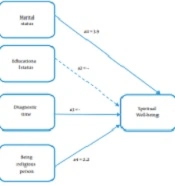
The findings from the path analysis indicating the predictors influencing adherence to treatment either directly or indirectly are reported in Tables 2, 3, and illustrated in Figure 2.
-preview.webp "The path model between adherence to treatment and independent variables (marital status, educational status, diagnostic time, being religious), mediated by spiritual well-being. Unstandardized estimates are labeled. Dash line is non-significant. *P-value < 0.05, ***P-value < 0.001.")
Figure 2.
The path model between adherence to treatment and independent variables (marital status, educational status, diagnostic time, being religious), mediated by spiritual well-being. Unstandardized estimates are labeled. Dash line is non-significant. *P-value < 0.05, ***P-value < 0.001.
Table 2.
Pairwise Correlations Between Independent Variables, Spiritual Well-being, and Adherence to Treatment a
| Variables | (1) | (2) |
|---|---|---|
| Adherence to treatment | 1 | 0.22** |
| Spiritual well-being | - | 1 |
| Age | -0.03 | 0.04 |
| Gender | -0.02 | 0.01 |
| Marital status | 0.13 | 0.13* |
| Educational status | -0.04 | -0.14* |
| Job | 0.02 | -0.08 |
| Being religious person | 0.10 | 0.10* |
| Diagnostic time | -0.12 | -0.17** |
| Need others to take care | 0.007 | -0.01 |
| Need to receive support services | 0.02 | 0.005 |
a **Correlation is significant at the 0.01 level; * Correlation is significant at the 0.05 level
Table 3.
The Path Model Analysis of Independent Variables, Spiritual Well-being, and Adherence to Treatment a
| Effect/Path | B | Standard Error | β | 95% CI for B | P-Value | |
|---|---|---|---|---|---|---|
| Lower | Upper | |||||
| Direct | ||||||
| Marital status -> spiritual well-being (a1) | 3.96 | 1.64 | 0.13 | 1.27 | 6.65 | 0.015* |
| Educational status -> spiritual well-being (a2) | -0.59 | 0.91 | -0.04 | -2.10 | 0.89 | 0.51 |
| Diagnostic time-> spiritual well-being (a3) | -4.83 | 1.66 | -0.18 | -7.56 | -2.10 | 0.004* |
| Being religious person-> spiritual well-being (a4) | 2.21 | 1.06 | 0.12 | 0.45 | 3.95 | 0.037* |
| Spiritual well-being-> adherence to treatment (b) | 0.10 | 0.03 | 0.76 | 0.03 | 0.14 | 0.008* |
| Indirect | ||||||
| Marital status -> spiritual well-being -> adherence to treatment (a1*b) | 0.35 | 0.19 | 0.10 | -0.02 | 0.72 | 0.06 |
| Educational status -> spiritual well-being -> adherence to treatment (a2*b) | -0.05 | 0.08 | -0.03 | -0.18 | 0.07 | 0.49 |
| Diagnostic time -> spiritual well-being -> adherence to treatment (a3*b) | -0.42 | 0.15 | -0.14 | -0.68 | -0.17 | 0.007* |
| Being religious person -> spiritual well-being -> adherence to treatment (a4*b) | 0.19 | 0.11 | 0.09 | -0.02 | 0.37 | 0.07 |
a B, unstandardized coefficient; β, standardized coefficient; 95%CI, 95% confidence interval;* P-value < 0.05
It was found that marital status (B = 3.96, β = 0.13, P-value < 0.05), diagnostic time (B = -4.83, β = -0.18, P-value < 0.05), and being religious (B = 2.21, β = 0.12, P-value < 0.05) have a direct effect on spiritual well-being. Spiritual well-being had direct effect on adherence to treatment (B = 0.10, β = 0.76, P-value < 0.05).
The time of diagnosis had a significant indirect impact on adherence to treatment via spiritual well-being (B = -0.42, β = -0.14, P-value < 0.05).
5. Discussion
Since cancer is known as a dangerous disease that is synonymous with death and the end of life in most cultures and among the general public, preparation and acceptance can be effective in prevention, treatment, and coping with the disease. Given that spiritual health is the central core of human health, and one of the ways of coping with the disease and coordinating the forces within the individual and the outside world, it has a renowned role in dealing with the effects of illnesses such as depression, dissatisfaction with life, and incompatibility (28). The aim of this study was to determine the relationship between some demographic and clinical variables of cancer patients with spiritual health as a mediating variable and adherence to their treatment.
Based on the findings of this study, the average score of adherence to treatment was moderate or good in more than half of the research samples. In a cohort study, Makubate et al. stated that women with breast cancer had low adherence to their entire adjuvant endocrine therapy, resulting in an increased risk of mortality (29). Sajjadi et al. found that 70.7% of the patients with cancer refuse to adhere to their treatment (30). The reason behind the patients with cancer who did not adhere to the treatment may be attributed to the uncertainty they feel. This uncertainty can be the result of the complexity of cancer treatment and its complications, confusion about cancer, the unknown future of the disease, and conflicting information (31). Another study reported a 20% adherence to treatment in these patients (32), the results of which are inconsistent with the findings of the present study. In contrast, the results of another study showed that according to the statistics obtained through patients’ self-reports, the number of drugs used, laboratory results, and the rate of adherence to the treatment regimen in patients with cancer varies between 50% to100% (33). According to the World Health Organization(WHO), patients with various diseases adhere to their treatment regimen up to 50% depending on the type of treatment and disease; this percentage is higher in the patients with some diseases such as AIDS, cancer, and digestive problems, while it is lower in the ones with other diseases such as diabetes and sleep disorders (32).
Due to the malignant nature of cancer, these patients are expected to adhere to treatment more, which is consistent with the results of this study. The differences in the results of the studies depend on many factors because adherence to medications may be assessed through either direct methods such as directly observed therapies, or indirect methods such as pill counting and so on; it is not possible to prove with certainty whether the patients have taken their medications or not. On the other hand, in different studies on patients’ adherence to treatment, various types of drugs have been examined due to their different complications (29). Moreover, very different definitions of adherence and continuity have been used in the previous studies, which affect the degree of persistence and adherence to the treatment regimen (29).
In another part of the findings of this study, the mean score for spiritual health was reported to be moderate in most (more than 80%) patients with cancer, and the mean score for the religious dimension was higher than that of the existential dimension. The results of the present study in this section are similar to the findings of other studies. In a study conducted on 1442 patients with cancer in Iran, Samiee Rad and Kalhor showed that the average spiritual health was moderate and that its level was higher in the dimension of religious health (34). In another study, Li et al. showed that 69% of the Taiwanese patients with colorectal cancer and colostomy reported moderate levels of spiritual health (35). Martins et al. found that 64% of patients with cancer in Portugal obtained desirable scores of spiritual health, and that only 10.7% of them had moderate scores (36). In the study of Rezaei and Ebrahimi, the mean score of spiritual health in patients with cancer was moderate and was higher in the religious dimension (37). Studies have shown that the malignant and chronic nature of cancer and the presence of physical and psychological stress can affect the patients’ attitudes, beliefs, and quality of life; therefore, these patients tend to take refuge in religion and spiritual inclinations in order to adapt themselves to these critical conditions (38). Confirming these findings, Kim et al. stated that spirituality plays an important role in adapting to stressful conditions caused by chronic diseases (39). Besides, another finding of this study was the positive and direct relationship between the two variables "being religious" and “spiritual health”. In other words, the more religious one’s attitudes and beliefs, the higher his/her level of spiritual health. Religious beliefs are an important factor in the psychological support of patients, and they believed that they must rely on God's power in order to feel more comfortable and regain the power to move toward greater adaptation to the illness. Probably this can be related to this issue (40) because Iranians are religious people, according to the cultural and ideological conditions, and most turn to religion in order to adapt to critical conditions. Several patients with cancer believe that religious beliefs and spiritual health provide them with an important source for coping with the disease and treatment. Many studies have pointed out that one of the most important adaptation responses in these patients is their returning to spirituality, and this return has a very important role in improving their adaptability and life (41). Therefore, it is common and significant to find that most people have religious leanings.
In addition, the results of this study showed that there is a significant positive relationship between the mean score of adherence to treatment and the mean score of spiritual health. Shahdadi et al. reported that there is no significant relationship between spiritual health and adherence to the therapeutic diet as a final outcome (42). In a study, Javanmardifard et al. showed that there is an inverse relationship between spiritual health and adherence to treatment in diabetic patients (43). Study results stated that although spirituality leads to adaptation to chronic illness conditions, it is not associated with appropriate self-care behaviors because participants believed that God's will protects them against the illness (43). In this regard, Habte et al. showed that religious beliefs and using medicinal plants can lead to the replacement of medical measures with religious activities. For example, Orthodox Christians use holy water instead of anti-diabetic drugs, which leads to short-term or long-term drug-use disorders (44). In this regard, Bodenheimer et al. stated that Muslims believe in God and, as a result, do not have proper control over their diseases (45). According to research the reason behind this was stated: patients believe that religion and spirituality are better coping mechanisms in dealing with stress and despair, and they create a sense of inner peace and satisfaction with life, emotional and social support, as well as having access to resources and counseling in times of crisis (44), and if an individual considers him/herself religious, he/she may replace his/her religious beliefs with medical measures. The results of these studies are inconsistent with the findings of the present study. In contrast, Alvarez et al. reported a significant relationship between spirituality and adherence to a therapeutic diet (46). There were very few studies that examined the relationship between these two variables in cancer patients. Finally, the differences between the findings may be attributed to cultural and religious changes as well as the differences in disease type, age, duration and the severity of the disease, and the level of spiritual well-being.
According to the results of the Path Analysis model, diagnostic time had a negative indirect effect on adherence to treatment through a mediating variable (spiritual health). The results of a study showed that the length of treatment and the duration of the disease are among the factors affecting the acceptance of the treatment regimen and adherence to it (47). In a systematic review by Goh et al., the duration of treatment, being affected by the disease, and its complexity were mentioned as the effective factors in adherence to treatment in children with cancer (48). Makubate et al. showed that the patients who had been diagnosed with cancer for 5 years had better adherence to treatment than patients who had been diagnosed for 3 years or less (29). Garay-Seilla et al. reported that adherence to a treatment regimen has a relationship with the duration of the disease or having diabetes (49). By contrast, in another study, they acknowledged an inverse relationship between the duration of diabetes and adherence to treatment (50). The most important factors behind this inconsistency between the results can be found in the differences in the studied populations, cultures, and the types of treatment.
There was also a significant negative relationship between "the duration of illness" and "spiritual health". In other words, the patients who have been suffering from cancer for several years have lower levels of spiritual health. In some studies, no relationship was reported between spiritual health and the duration of the illness (51), which is not consistent with the results of the present study. In patients with cancer, meaning in life is directly related to physical and spiritual health. For patients with cancer who are in the final stages of their disease, spiritual and religious peace may even be more important than their physical and mental health (52). Diagnosing cancer equates to increasing the patients' spiritual needs. In the early stages of the disease, a positive religious confrontation with higher resilience provides a framework for understanding, managing effectively, and better coping with the inconsistencies and the mental disorders created during the course of the disease (53). Therefore, the patients who have recently been diagnosed with the disease are expected to have higher spiritual health because it has a very significant effect on the frustrations caused by the disease.
Another result of this study was the positive and direct relationship existing between the mean score of spiritual health and marital status. The results of previous studies emphasized that the existential dimension of spiritual health in married individuals is higher than in single ones. They believe that loneliness and isolation cause apathy, especially if a person has a disease, and this can affect individuals’ spiritual health, which is consistent with the present study (54). In contrast, the results of the study by Janbabaei et al. showed that the spiritual health of married patients with cancer was higher than that of single and widowed patients, but there was no statistically significant relationship between those groups (55). Other studies reported that there is no significant relationship between marital status and spiritual health (28, 37). There are both similarities and differences between the results regarding the relationship of demographic and clinical variables with spiritual health in patients with cancer in this study and those of other studies. This may be caused by several factors, namely differences in assessment tools, the number of samples, and their types. Therefore, the factors that make a difference in the spiritual health of patients with cancer need to be further evaluated.
5.1. Limitations
One of the limitations of this study was that the participats were all Muslim, so generalizing the results to other religions would cause bias. Therefore, it is suggested that qualitative spiritual health studies, as well as studies in communities with other religions, be conducted. Moreover, few studies examined the relationship between adherence to treatment and spiritual health in patients with cancer, which made the discussion difficult.
5.2. Conclusions
Considering the direct relationship between spiritual health and adherence to treatment regimens, while strengthening spirituality, it is necessary to emphasize the need to adhere to treatment regimens in these patients. Patients must be clarified that alternative treatments, such as spiritual treatments, can lead to better adaptation to the disease process, but should not be used by patients as an alternative to the main treatment. In this study, the variable of diagnostic time affected adherence to treatment indirectly. Besides, in examining the factors affecting spiritual health, the findings indicated the effect of the variables “being religious”, “marital status”, and “the time of diagnosis”. Awareness of the factors affecting adherence to treatment, spiritual health, religious attitudes of patients, and determining the mental needs of patients with a comprehensive view, facilitate adaptation, and adherence to treatment in patients with cancer. Medical team members need to be familiar with all the physical, mental, and spiritual aspects of the disease. Therapeutic interventions should include spiritual advice on prevention, medical treatment, and complementary care. In addition, the general components of spiritual advice should be included in routine medical-nursing screenings. Therefore, it is suggested that in addition to the physical care program for patients with cancer, a program be considered to meet their spiritual needs.