


1. Background
Cancer is a highly complex disease that necessitates specialized social work interventions due to its severe consequences and widespread impact. The International Cancer Research Institute's 2018 report indicates that Iran sees 110,114 new cancer cases annually, with 55,785 cancer-related deaths reported in the same year (1). The prevalence of all types of cancer is increasing, even despite the current high statistics (2). Stress caused by treatment costs, increased death anxiety in sufferers or their families (3), stress of losing a job (4, 5), stress of losing social networks and being isolated (6), the pressure caused by not being able to continue studying, the stress of losing the peer group (7), and finally the stress caused by self-concept alterations (8) are some of the consequences of this disease. Therefore, an essential health policy is the provision of psychosocial support to patients, families, and caregivers (9). Evidence shows that psychosocial support along with medical care improves patients' psychological adjustment and social functioning, reducing suffering caused by the cancer and treatment. A meta-analysis of 45 clinical trial studies emphasizes the importance of psychosocial interventions in promoting emotional adjustment, enhancing resilience, and improving the patient's quality of life (10). According to the World Health Organization, the presence of social workers in hospitals goes back to health, which encompasses physical, mental, social, and spiritual dimensions. Among medical and paramedical professions focused on physical care, social workers hold a special role in addressing the psychosocial health aspects of diverse patient groups (11, 12). Social workers, as a part of a professional team, offer general support to patients and their families, assist in adapting to diagnoses, reduce psychological damage, and work with dying patients (13).
Association of Oncology Social Workers, Association of Children's Oncology Workers, and NASW recognize the vital role of social workers in providing psychosocial support, advocacy, empowerment, and resource management. They have published specialized standards for their activities, ensuring that social workers are equipped to effectively support their clients (14). Social workers also play a vital role in providing cancer care in Iran. They provide services in hospitals and cancer centers, but their role and practices are not clearly defined and a specialized protocol for their services has not been developed. Additionally, most social workers do not receive specialized training in this field during their studies or employment (15). To effectively care for their patients, social workers should be qualified in this field; they should know about the growing needs of patients and families, responding to cancer patients based on age and sex, and addressing the developmental needs of children. These professionals should be able to assess 261 patients’ psychosocial needs and provide comprehensive support for patients and families (16).
Currently, social workers do not have a unified and integrated approach to screen, evaluate, and provide services to cancer patients. Many of these patients do not receive the appropriate psychosocial care of the health system; the burden of care and treatment of these patients is high, and they are frequently admitted to hospitals, and caring for family caregivers is neglected, while the existence of an integrated protocol of social work interventions in the field of cancer can play an important role in the screening and proper care of patients who need to receive psychosocial support and reduce the burden of caring for their family (17). Therefore, this study was conducted to develop a protocol for oncology social work interventions in hospital and medical centers in Iran. A mixed method will be used to design the protocol to achieve a practical guide through theoretical consensus, while reviewing sources and gaining the experiences of stakeholders.
2. Objectives
The present study was performed, using a sequential mixed-method approach; the first phase was conducted by the review method, the second and third phases by the qualitative method, and finally, the evaluation was done, using the AGREE model.
3. Methods
3.1. The First Phase: Literature Review
The research objectives focused on specialized interventions for social workers in cancer. The first step involved formulating questions based on these objectives. The second step involved determining relevant keywords, using MeSH in the PubMed database. These keywords were searched in internal and external databases, including Google Scholar, Scopus, SID, PubMed, Web of Science, and ProQuest. The researchers considered inclusion and exclusion criteria for studies, including: Relevance with the subject and purpose of the study, English and Farsi language, original article availability, and period from 2000 to 2022. Studies unrelated to the research objectives and articles, whose full text was unavailable, were excluded from the study. After searching, articles were extracted in terms of specialized interventions of social workers in cancer, with criteria, barriers, and facilitators in separate categories. Then, the articles were evaluated based on the CASP checklist. This checklist examines the articles based on the accuracy, validity, and significance of the studies. There are 10 questions in the checklist, which are about the objectives, method and design of the research, sampling method and data collection method, relationship between the researcher and the respondents, ethical considerations, data analysis method, method of reporting the findings, and the value of research. Articles were rated as excellent (41 - 50), very good (31 - 40), good (21 - 30), average (11 - 20), or poor (0 - 10). Only studies rated as excellent or good were included.
In total, the initial search resulted in finding 170 studies. The repetitive articles were removed. Finally, 45 abstracts were left. Then, the number of studies reached 30 by PICO criteria for the title and abstract screening. Inclusion criteria and questions were applied concerning titles, summaries, methods, results, and discussion. Every study was reviewed several times to ensure all sections met the checklist criterion. Finally, 12 studies met inclusion criteria (Figure 1).
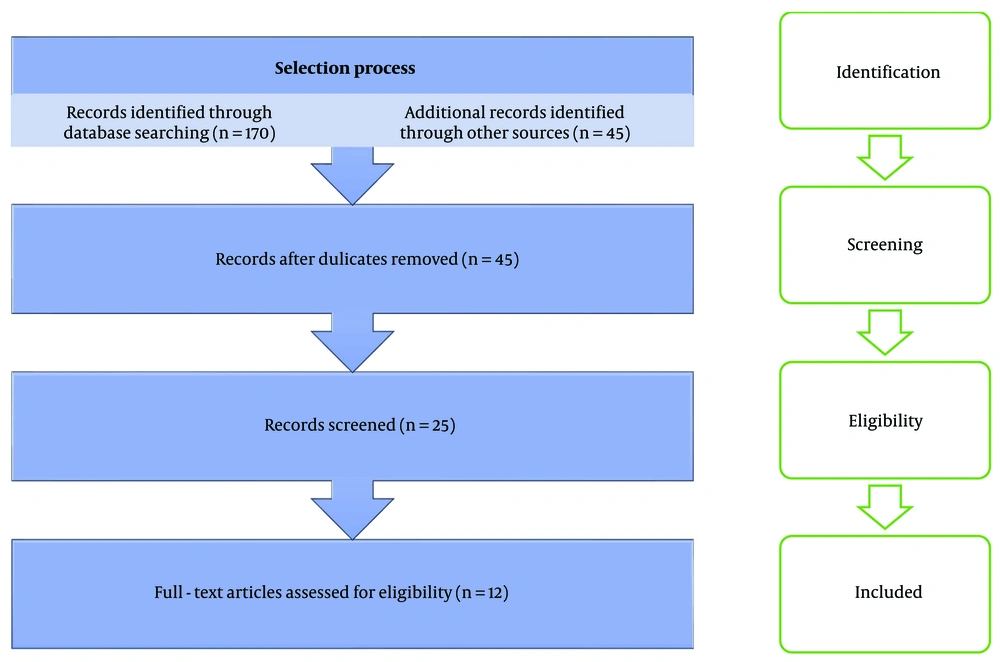
Figure 1.
The flowchart of systematic search results and selection strategy
3.2. The Second Phase: Conventional Content Analysis
At this stage, a conventional content analysis method was used and data were collected, using semi-structured interviews. Hospital social workers and social workers working in public and private institutions related to cancer, as well as cancer patients and their families participated in this study. Purposive sampling was used and continued until theoretical saturation was reached.
Inclusion criteria for social workers: Social work expert with at least 2 years of professional work experience related to cancer patients.
- Inclusion criteria for patients and their families: Receiving social work services, a patient with cancer or being diagnosed, having a family member with cancer (living or deceased), and experience in caring for a cancer patient.
- Exclusion criteria: Lack of expertise in the field of cancer and unwillingness to participate and cooperate in research. The demographic information of the participants is mentioned in Table 1.
Table 1.Demographic Characteristics of Participants
| Row | Position | Age | Gender | Job Experience |
|---|---|---|---|---|
| 1 | Patient 1 | 45 - 36 | Female | - |
| 2 | Patient 2 | 45 - 36 | Female | - |
| 3 | Patient 3 | 35 - 26 | Female | - |
| 4 | Patient 4 | 35 - 26 | Female | - |
| 5 | Social worker | 35 - 26 | Female | 7 |
| 6 | Social worker | 35 - 26 | Male | 5 |
| 7 | Social worker | 35 - 26 | Female | 6 |
| 8 | Social worker | 35 - 26 | Female | 6 |
| 9 | Social worker | 35 - 26 | Female | 9 |
| 10 | Social worker | 45 - 36 | Male | 8 |
| 11 | Patient 5 | 35 - 26 | Male | - |
| 12 | Social worker | 35 - 26 | Female | 5 |
| 13 | Patient 6 | 55 - 46 | Female | - |
| 14 | Social worker | 35 - 26 | Female | 8 |
| 15 | Patient 7 | 55 - 46 | Female | - |
| 16 | Patient 8 | 45 - 36 | Female | - |
| 17 | Patient 9 | 45 - 36 | Female | - |
| 18 | Social worker | 45 - 36 | Female | 9 |
| 19 | Social worker | 35 - 26 | Male | 12 |
The interviews were conducted according to the research goals, ethical considerations, and confidentiality, with written informed consent obtained from participants. The interview guide was prepared based on the results of a literature review. The interview began with an open question and was guided by leading and clarifying questions to meet the research objectives. The purpose of this stage is to explore the experiences of oncology social workers, their specialized interventions in the cancer field, standards of professional practice, their educational needs, and the challenges that they faced in this way.
In this study, Lindgren et al. approach was used for data analysis, including: (1) Writing down the entire interview immediately after it is done; (2) reading the entire text of the interview to gain a general understanding of its content; (3) determining the units of meaning and basic codes; (4) classifying similar primary codes into more comprehensive classes; and (5) determining the content hidden in the data. Initially, the analysis was exploratory, aimed at discovery (18). In later stages, the analysis became interpretive. The research evaluates reliability, using Dahlgren et al.'s (2007) criteria for reviewing qualitative research. These criteria include: (1) Credibility (value of correctness or validity); (2) transferability (applicability); (3) reliability (stability); (4) neutrality (influence).
3.3. The Third Phase: Focused Group Discussion and Combining the Information of the First and Second Phases
In the third phase, the result of the review study and qualitative phase was discussed, using focused group discussions. Participants described their specialized interventions and work processes, providing practical examples. Experts proposed solutions to improve service provision. In the final meeting, the proposed process and draft protocol were prepared. This guideline outlines the care process for cancer patients and their families, following a basic case management approach. It begins with patient identification and proceeds through comprehensive assessment, goal setting, intervention planning, implementation, termination, evaluation, and follow-up. Additionally, it identifies the necessary standards for social work practice with cancer patients (Table 2). These standards were specified in 5 levels (general quality, knowledge, skills, competences, and professional development). In this department, there were 10 experienced social workers in the field of cancer, in 2 groups of 5 and 4 sessions. Social workers were asked to comment on practice standards and combine the results of the first and second stages. Purposive sampling was used and continued until theoretical saturation was reached.
Table 2.Standards of Professional Practice
| Standard Title | Description |
|---|---|
| Level one standard: Qualifications and documents | Bachelor's degree in social work; Having experience working with cancer patients |
| Level two standard: Knowledge domain | Having a correct knowledge and understanding of the medical, social, and family dynamics of incurable diseases and the resulting disabilities; knowledge of specific resources available to cancer patients; knowledge of social and religious values; systems theory in relation to family functioning; mastery of effective verbal and written communication methods |
| Level three standards: The range of skills | Creating and maintaining a correct therapeutic relationship and interpersonal boundaries; promotion of patient and family rights; family empowerment; providing care interventions; negotiation and advocacy; receiving professional help from other specialists, colleagues; cooperation with social organizations; direct/indirect consultation and support |
| Level four standards: Competencies | Clinical (comprehensive assessment, comprehensive care planning, information related to treatment and care), educational, advocacy, research, professional behavior and ethical responsibilities, collaboration with interdisciplinary team |
| Standard level five: Professional growth | Collaboration with other professions, the interdisciplinary care team in planning and providing timely, efficient clinical services to cancer patients and their families |
3.4. The Fourth Phase: Using the AGREE Method for the Final Review and Evaluation of the Protocol
The protocol was presented by 8 experts (purposive sampling), who evaluated it in writing based on 6 criteria of goal and scope of interventions, stakeholders, development process, clarity of presentation, accessibility, and independence. The instrument used in this evaluation was AGREE, which evaluates the health promotion protocol, diagnostic guidelines, treatment, and intervention (19). Each criterion was scored from 1 (completely disagree) to 4 (completely agree), with the results detailed in Table 3.
Table 3.The Results of the Evaluation Using the Guide Critique Method (AGREE) a
| The Opinion of the Evaluators | The Goal and Scope of Interventions | Stakeholders | Compilation Process | Clarity of Presentation | Accessibility | Lack of Dependence in Writing | Final Assessment |
|---|---|---|---|---|---|---|---|
| Assessor number 1 | 100 | 93.7 | 84.2 | 93.7 | 83.3 | 100 | I strongly recommend |
| Assessor number 2 | 91.6 | 87.5 | 92.8 | 81.2 | 91.6 | 100 | I recommend subject to changes |
| Assessor number 3 | 58.3 | 62.5 | 71.4 | 62.5 | 58.3 | 62.5 | I recommend subject to changes |
| Assessor number 4 | 75 | 93.7 | 80.7 | 75 | 100 | 87.5 | I strongly recommend |
| Assessor number 5 | 83.3 | 100 | 71.4 | 87.5 | 91.6 | 100 | I recommend subject to changes |
| Assessor number 6 | 100 | 93.7 | 85.7 | 81.2 | 100 | 75 | I strongly recommend |
| Assessor number 7 | 63 | 67 | 75 | 62.5 | 58.3 | 73.5 | I recommend subject to changes |
| Assessor number 8 | 100 | 100 | 93.7 | 93.7 | 91.6 | 100 | I strongly recommend |
| Conclusion | 83.9 | 87.2 | 92.7 | 79.6 | 84.3 | 87.1 | - |
a Values are expressed as %.
3.5. Ethical Considerations
All ethical considerations were followed throughout the study's 4 stages, and it was approved by the Ethics Committee at the University of Rehabilitation Sciences and Social Health (IR.USWR.REC.1399.248).
4. Results
4.1. The Second Phase
The results of the second stage of the study were extracted in 5 main themes (Table 4). These themes include: Interventions and approaches used in social work practice, service delivery challenges, facilitators, principles of palliative care, standards of practice, occupational and professional self-care.
Table 4.Main Codes and Subcategories
| Main Codes | Subcategories |
|---|---|
| Social work approach for specialized interventions | Patient-centered and family-centered services, intervention in the context of case management approach, comprehensive evaluation combined with an ecological perspective, care-therapeutic-palliative support, evaluation of the effectiveness of interventions, termination |
| Challenges in service providing | Barriers: Non-cooperation of stakeholders, weak knowledge and intervention skills, workload, ambiguity of role and responsibilities, limited resources |
| Facilitators | Facilitators: Self-motivation, altruism, resilience, self-efficacy, social support networks, and public participation in cancer |
| Principle of supportive and palliative care | Respecting the patient's right to knowledge, choice and self-determination in the entire process of diagnosing and treating the disease; communicating empathically and professionally, away from pity and blame; conditional confidentiality regarding information that the patient does not wish to be disclosed; respecting all the rights of the dying patient and his family |
| Standards of practice | Qualifications, knowledge, skills, competencies (clinical, educational, research, and ethical responsibilities, advocacy, cooperation with interdisciplinary team), and professional growth |
| Professional self-care | Erosion and occupational stress factors, improving socio-occupational self-care, expanding the professional-social support network |
4.2. The Third Phase
In the third stage, experts were asked to explain the standards of social work practice in the field of cancer in addition to discussing the results of the previous two stages (Table 2).
4.3. The Fourth Phase
The purpose of this stage was to evaluate the protocol in terms of comprehensiveness and effectiveness from the point of view of experts.
The protocol targets cancer patients and their families, healthcare social workers, and cancer treatment clinics.
5. Discussion
5.1. The First Phase
The prevalence of cancer is rising due to increased life expectancy, industrial lifestyles (including processed food consumption and insufficient physical activity), environmental pollutants (such as respiratory, noise, and nutritional pollution), and high stress and conflicts in large cities (20, 21). Health and treatment centers maintain continuous contact with cancer patients and their families from diagnosis through treatment and recovery or death. Healthcare social workers should use effective strategies and interventions in providing services to cancer patients as part of the interdisciplinary care team. The specialization of oncology social work focuses on providing a variety of psychosocial services to individuals, groups, and communities involved in cancer care (22).
The results of a qualitative study by Ostadhashemi et al. (15) showed the social workers in the hospital do not have the necessary skills to work with cancer patients due to the lack of protocols, insufficient knowledge of interventions, and non-specialized training. Cwikel and Behar pointed out the fact that social workers do practice cognitive-behavioral interventions among cancer patients. However, there is a need to introduce new strategies of intervention, having considered specific needs among cancer patients (23). The results of a research conducted by Yi et al. in Korea also confirmed poor knowledge and skill among social workers in oncology (24). Jones and Zebrack et al. stated that there is a noted lack of specialized knowledge among social workers regarding end-of-life care (25, 26). Using the knowledge and experiences of interventionists, patients and other stakeholders, the present study has developed a protocol for specialized interventions of social workers in cancer, and it seems that this protocol can partially fill the knowledge gap mentioned in the studies.
5.2. The Second and Third Phase
This study identified 5 main categories for social worker interventions: Interventions and approaches in social work practice, service delivery challenges, principles of palliative care, standards of practice, occupational and professional self-care. The study identifies several key interventions and approaches: Patient-centered and family-centered services, case management-based interventions, comprehensive evaluation with an ecological perspective, supportive and palliative support, effectiveness evaluation of interventions, termination and follow-up. The findings of this part of the study align with those of Ostadheshemi (17) and Glajchen et al. (20). In a research, Glajchen et al. acknowledged that social workers can help cancer patients in pain management through assessment, empathic communication, psychosocial support, and problem solving (20).
Social workers face challenges in providing service for cancer patients, including barriers like stakeholder non-cooperation, limited knowledge, weak intervention skills, limited resources, and high workload. They also benefit from facilitators like personal interest and motivation, social support networks, and public participation in cancer care (27). Research by She et al. and Antoni found similar results, and consistent with this study (28, 29).
Undoubtedly, social work, as a helping profession rooted in ethical principles, requires adherence to practical standards. This study identified key standards: Qualifications and documents, knowledge scope, skill scope, competencies (including clinical, educational, research, ethical responsibilities, advocacy, interdisciplinary cooperation), and professional growth. Zebrack et al. stated that cancer affects the psychological, social, economic and family aspects of patients in addition to their physical health. Therefore, social workers must have the necessary professional qualifications to effectively support these patients (26). Pascal concluded that phenomenological approaches guide social workers toward humanitarian and realistic interventions (30).
Working in cancer care presents significant personal and organizational challenges for health care providers, including decreased and increased motivation, decreased body and physical activity, decreased job satisfaction, increased absenteeism, and turnover (17, 27, 31). It is expected that the findings of this study will create unity in the practice of social work, and they will be able to support as many cancer patients as possible. This guide helps to identify the different needs of patients and plan to solve them, and can be a basis for policy making in the macro field of health. Social workers can help reduce the suffering caused by the disease by using the capacity of all private and public and charity organizations and centers. Based on the findings of the fourth section, this protocol has the necessary quality for practical use and is designed to suit the culture of Iranian society; so, its implementation is easy and sufficiently feasible for hospital social workers.
It is recommended that this protocol be implemented as a team in collaboration with the medical staff and combined with palliative care programs for cancer patients.
5.3. Limitations
The research faced 2 main limitations: Challenges to access experienced workers in the field of cancer, which the researcher addressed using the purposeful and snowball technique to identify participants, and difficulty scheduling interviews with social workers due to their busy schedules. Interviews were conducted by the researcher to fit into the working hours of social workers.
5.4. Conclusions
Working in the field of cancer is inherently emotionally sensitive and requires a lot of knowledge and skills. The presence of a step-by-step guide for interventions in this field can improve the professional competency and efficacy of social workers to provide specialized services to patients and caregivers. The development of this protocol, by specifying the roles and specialized duties of social workers, will increase the quality of care for clients, provide specialized training for social workers, improve their position in the care team, and become an important factor in preventing their burnout.


