Previous studies have demonstrated that in addition to primary tumors, established cancer cell lines might be contained a subpopulation of cells possessing CSCs properties (
21,
22). In this research, we have identified and characterized CSCs in the colorectal cancer-derived cell line HT-29 through investigation of sphere formation and surface biomarkers. Studies have shown that under serum-free defined media, CSCs had ability to form floating spheroids (
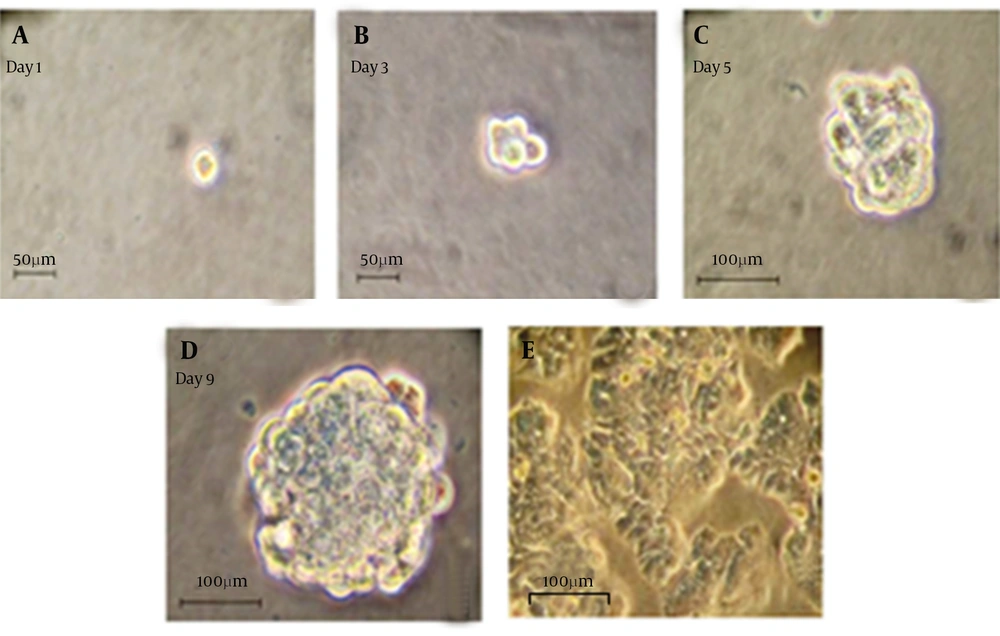
19). In consistent with previous observation, we have shown that in serum-free conditions HT-29 cell line could form spheroid colonies (colonospheres) and following exposure to 10% FBS differentiate into large and adherent cells , maintaining self-renewal capacity and differentiation potential.
Moreover, ELDA has resulted for survey functional CSCs in colonospheres has revealed that colonospheres has marked increasing frequency of cells with sphere-forming ability. Thus, it has suggested under extreme limited dilution and in serum-free conditions, spheroids could only formed from stem-like cells. Consequently, the formation of colonospheres with a very small number of HT-29 cell line has demonstrated enrichment CSCs in colonospheres (
2,
7,
20).
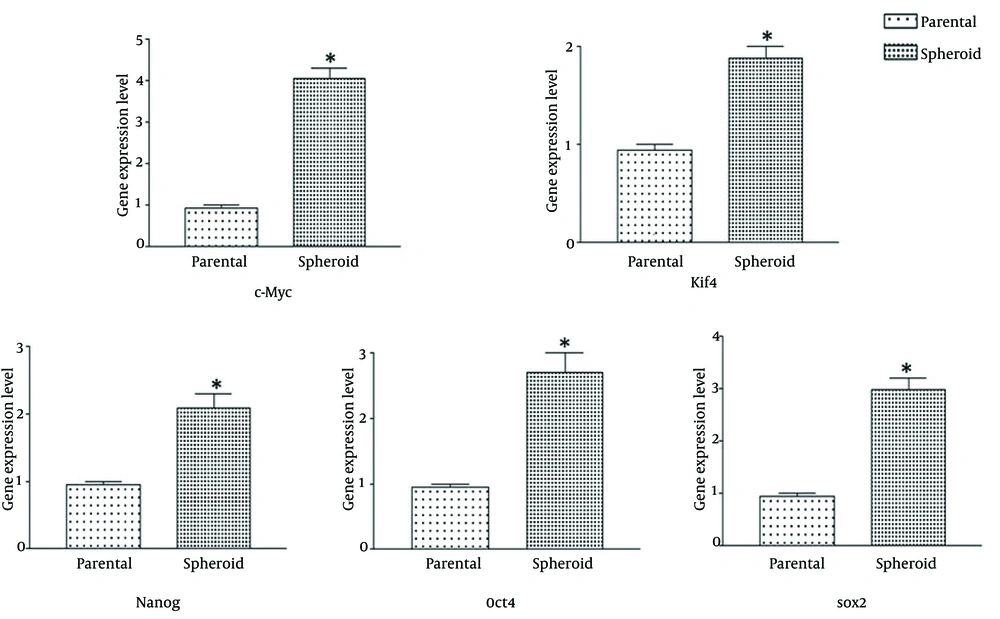
Furthermore, we have shown that colonospheres have expressed the specifics markers including Sox2, Oct4, Nanog, C-myc and KLF4 which were important for stemness properties. In several studies have reported correlations between multi potent genes expression and stemness maintenance of human CSCs (
8-
10). Saigusa et al. has reported meaningful correlations among the expression level of OCT4, SOX2 and CD133 with distant recurrence, and poor prognosis of rectal cancer patients with preoperative chemo radiotherapy (
9). Consistent with these results, Saiki et al. has also shown that lin-28 and SOX2 expression has highly associated with lymph node metastasis and Dukes stage (
10).
Currently, several molecules have identified as markers for colon cancer stem cells such as CD133, CD44, CD166 and CD24 (
2-
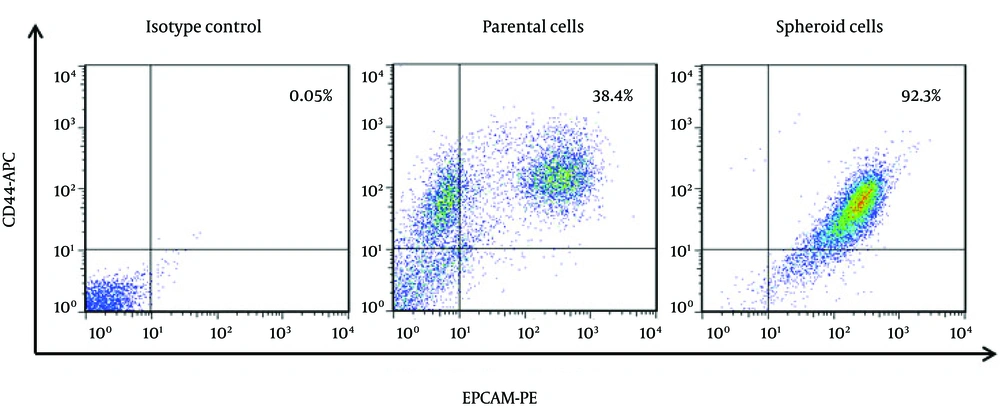
6). Previous reports via flow cytometry analysis in tumor spheres and parent cells have shown associating between CD44 and EPCAM expression with colon CSCs. The results of present study has indicated significant expression of CD44 and EPCAM in colonospheres in comparison with parent cells so that colonospheres-derived cells were over 96% CD44+and EPCAM+. In line with these results, Kanwar et al. has shown that spheroid cells derived from HT-29 and HCT116 have higher expression of CD44 and EPCAM in comparison with parental cells (
19). Thus these data strongly has indicated that colonospheres have generated under present conditions have mainly composed of CSCs.
More recently, ALDH1 has proposed as a promising new biomarker in normal and malignant human colonic SCs. Chu et al. has revealed that
in vivo implantation of CD44hi ALDH+ colon tumor cells were significantly more tumorigenic than matched CD44hi ALDH- cells. Therefore, as few as 100 CD44hi ALDH+ cells could lead to tumor formation (
5). In addition, Huang et al. (
16) has shown that implantation of only 25 ALDH+ cancer cells have tumorigenicity in NOD/SCID mice. However, further isolation of cancer cells ALDH+ using CD44 or CD133 only modestly has resulted in tumor-initiating ability (
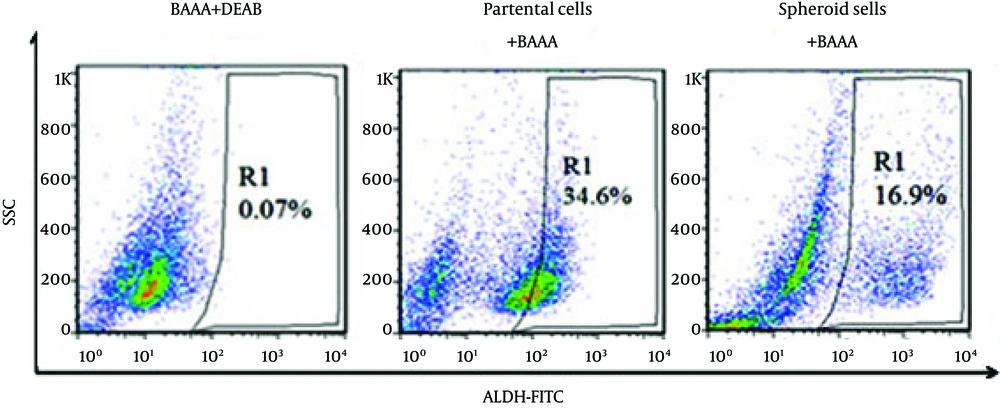
11). Thus, we have suggested that ALDH1 activity could be a valuable biomarker for identifying CSC in colonosphere population. Controversy, our findings have revealed that colonospheres exhibit have decreased levels of ALDH1 activity in comparison with the corresponding parental cells. Nevertheless, low ALDH1 activity in colonospheres had no effect on their tumorigenic potential, so this population even has shown higher ability for initiating tumor, in comparison with parental cell with high ALDH1 activity in
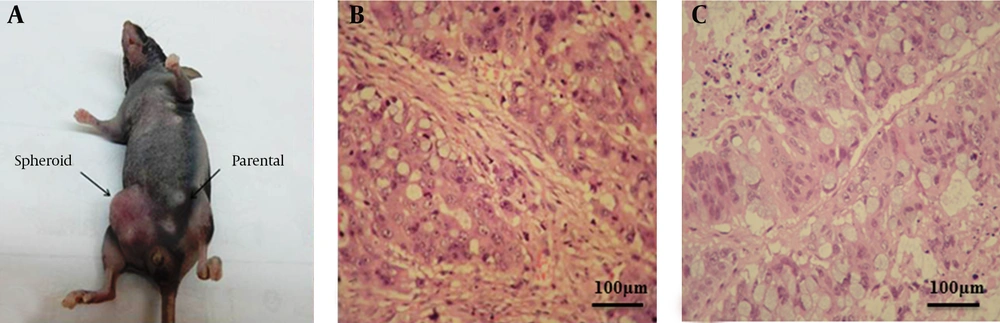
in vivo situation. Our results have shown that administration of 2500 colonospheres could be sufficient to initiate tumor growth in nude mice while 1 × 10
6 of parental cells has needed to form tumor. It would be important to point out that results of primary tumor could not generalized to colonic cell line like HT-29. The present data has indicated that there was no correlation between ALDH activity and the tumorigenic capacity, and it could not be as a universal biomarker for identifying CSCs.
Expression of ALDH1 could be different in population of tumor cell lines indicating CSCs properties. For instance, recently Yuval Shaked et al. has demonstrated that spheroid of U-87MG, MCF7, and PANC1cell lines rather than their types of parental have increased levels of ALDH1 activity. It has also shown that ALDH activity in A549 and HT-29 cells was substantially high levels in the parental in comparison with the spheroid. However, higher expression of p21 and p53 has found in spheroid of HT-29, showing more angiogenic effects and resistant to chemotherapy than parent cells (
23). A similar result has also reported by Yu et al. who have shown that high level expression of ALDH or the present of CD44 in CSCs of prostate cancer cell lines could not be relevant with tumorigenicity capacity, so that ALDHlo CD44– cells and ALDHhiCD44+cells has exhibited the same proliferative, clonogenic and metastatic capacity, indicating their potential importance for further exploration (
24).
Moreover, ALDH- melanoma cells could be equally resistant to treatment and tumorigenic with ALDH+ which indicates the functional ‘‘marker’’ ALDH has not played an exclusive role in tumor initiation and/or in low response to therapy (
25).
For the first time, our current experimental data have shown that ALDH activity has not appeared to specifically identify CSCs in HT-29 cell line. It could suggested that isolation of CSC–derived HT-29 cell line base on CD44 and EPCAM markers might be useful for characterization and further investigation of this cell line.